Every February I hear from folks who just finished a weekend project. They picked up a roll of foam weatherstripping at the hardware store, ran it around the front door frame, and the cold draft they’d been feeling since Thanksgiving finally quit.
Then the same people call me in June, frustrated, because the neighbor’s lawn crew still sounds like it’s operating in the living room and there are ants marching along the baseboard.
Those complaints all trace back to the same door, and they still need three different fixes. A residential entry door has three separate openings around it: the threshold gap under the slab, the perimeter gap where the slab meets the jamb on the hinge and latch sides, and the head gap along the top. Air will use all three. Insects mostly use the bottom one. Sound goes wherever the smallest opening lets it.
Weatherstripping, door sweeps, and acoustic seals get sold in the same aisle and get treated like grades of the same thing, cheap to expensive. They’re built to different tolerances for different jobs. A roll of adhesive foam is designed to stop moving air.
An acoustic door seal is engineered to hold continuous compression against the slab so there’s no air path left at all, which is a much tighter standard to hit. Buying the wrong one is how you end up sealing the same door twice.
Weatherstripping Handles Drafts, and That’s About It
Weatherstripping goes on the jamb, along both sides and across the top. Its job is stopping air movement, and for that it works well. On the Gulf Coast, that matters more in July than January, since we run the AC eight or nine months out of the year and every cubic foot of conditioned air escaping around a door is money leaving the house.
The material you pick determines whether you’re doing this again next spring. Adhesive foam runs about $5 to $15 a roll, and it’s the most common choice, which is unfortunate, because our humidity gets under the adhesive and the strip starts sagging off the jamb within a season. Here’s how the four common types hold up:
| Type | Price | Attachment | Lifespan in Humid Climates |
| Adhesive foam | $5 to $15 per roll | Peel-and-stick | 1 to 2 years, adhesive lets go first |
| Felt | Around $5 per roll | Adhesive or tacked | 1 year, absorbs moisture and compresses flat |
| V-strip (tension seal) | $10 to $20 | Nailed or adhered | 5+ years, tolerates a slightly warped slab |
| Silicone or rubber bulb on metal carrier | $20 to $40 per door | Screwed to the jamb | 10 years, my pick for exterior doors here |
What none of these do is block noise. Foam and felt compress under almost no pressure, so the slab closes against them without generating real contact force. Air stops. Sound keeps coming.
Door Sweeps and Automatic Bottoms
Stand inside a dark room in the middle of the day and look at the bottom of your exterior door. If you see a line of daylight, you have a threshold gap, and on most homes it measures somewhere between a half inch and three quarters of an inch. Builders leave that clearance on purpose so the door swings over flooring and carpet without dragging.
That gap is the pest highway. Palmetto bugs, ants, and the occasional gecko come through the bottom of the door far more often than anywhere else, and every pest control guy in Houston will tell you the same thing.
A surface-mounted sweep, which is a strip of vinyl or brush attached to the face of the door, costs $10 to $25 and closes it. Brush sweeps handle uneven thresholds better. Vinyl blade sweeps seal tighter and wear faster.
An automatic door bottom works differently and costs more, usually $40 to $120. It mounts into or onto the bottom edge of the slab with a plunger at the hinge side. When the door closes, the plunger hits the jamb stop and drops the seal down onto the threshold.
Open the door and it retracts. You get firm contact when the door is shut and nothing dragging on the tile when it isn’t. For a door that gets used forty times a day, that mechanism is worth the extra money.
Acoustic Seals – What Changes When Noise Is the Problem
Sound needs almost nothing to get through. A gap you can slide a credit card into carries conversation, traffic, and lawn equipment nearly as well as an open doorway does, which is why people who seal a door for drafts and expect quiet end up disappointed. Air infiltration slows down at partial contact. Sound transmission does not.
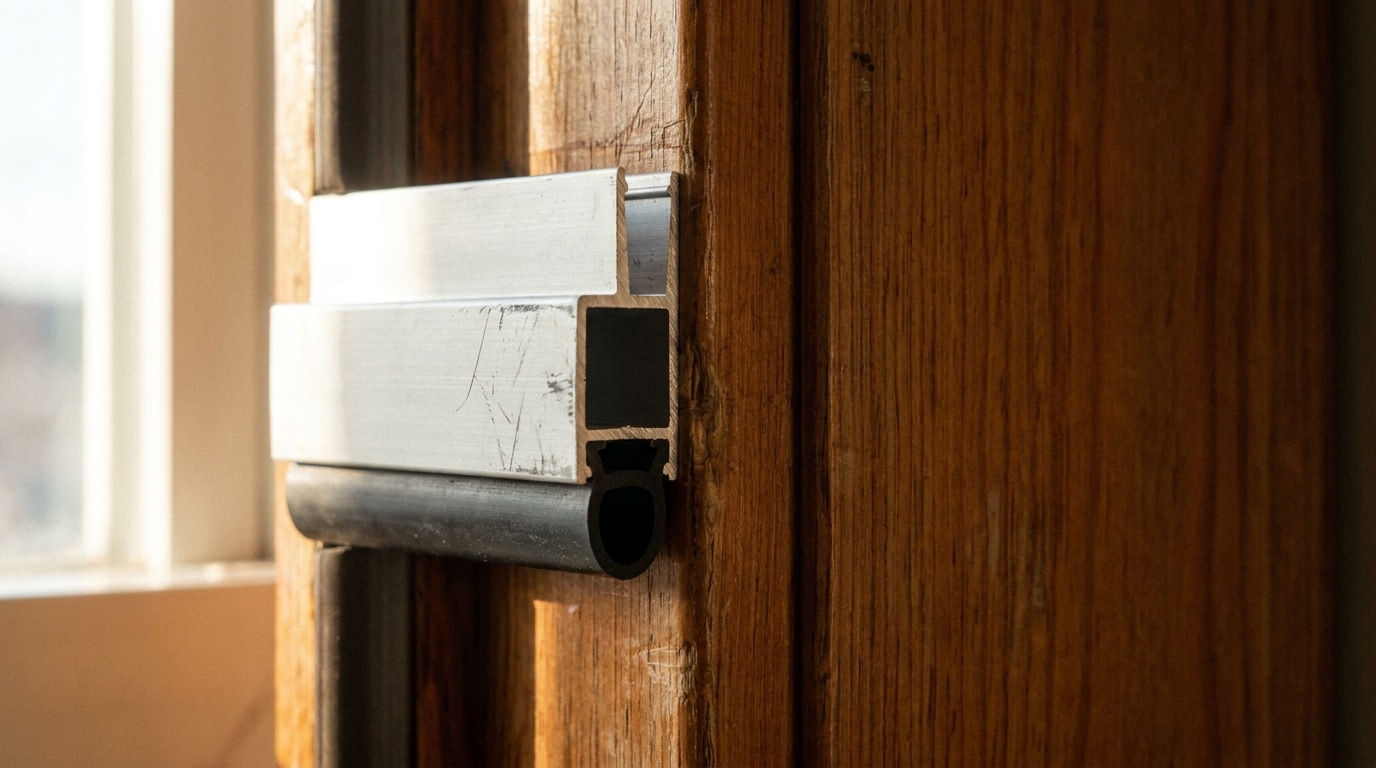
Acoustic perimeter seal systems are built around that reality. Instead of a strip pressed against the jamb face, you get an aluminum carrier screwed to the jamb holding a silicone or neoprene bulb, sized so the closing slab compresses it rather than just touching it.
The system runs continuously up one side, across the head, and down the other, with the corners meeting so there’s no break at the joints. Underneath, it pairs with an automatic door bottom sealing against the threshold.
Compression is the whole point. When you install one of these correctly, the door takes noticeably more effort to latch, and homeowners sometimes think they’ve done something wrong.
That resistance is the seal doing its job. Complete kits for a single door generally land between $150 and $400 depending on whether you’re sealing three sides or four and what the bulb is made of.
Which One You Need
| Product | Gap It Covers | Drafts | Noise | Pests | Typical Lifespan |
| Adhesive foam or felt | Jamb perimeter | Partial | No | No | 1 to 2 years |
| V-strip | Jamb perimeter | Yes | No | No | 5+ years |
| Silicone bulb weatherstrip | Jamb perimeter | Yes | Partial | No | 10 years |
| Surface door sweep | Threshold | Yes | Partial | Yes | 2 to 4 years |
| Automatic door bottom | Threshold | Yes | Yes | Yes | 7 to 10 years |
| Acoustic perimeter system | All three | Yes | Yes | Yes | 10+ years |
Work backward from the symptom instead of the product. Daylight under the door and ants in the entryway? Start with the threshold, a sweep or an automatic bottom, and you may be finished right there.
Rising summer electric bills with a system that’s been serviced and running fine? That’s a jamb perimeter problem, and a silicone bulb strip plus a sweep covers it for well under $60.
Hearing a conversation through a closed door, or hearing the highway from a bedroom at the front of the house, puts you in different territory. Partial fixes give you partial results with noise, so a perimeter system with a matched automatic bottom is the only approach that changes what you hear.
Where People Get the Install Wrong
Measure before you buy. Close the door, slide a folded piece of paper into the gap at four points along the bottom and three along each side, and mark where it goes through easily.
Older homes in the Heights and Montrose settle, and I’ve seen thresholds where the gap runs a quarter inch at one end and three quarters at the other.
Second thing: check that the door still latches. Homeowners buy the thickest bulb available, install it, and now the slab won’t seat far enough for the latch to catch, so they leave the deadbolt off, and the seal never compresses anyway. Too thick performs worse than one size down.
Two more mistakes worth avoiding. An unlevel threshold defeats any sweep with a straight blade, so shim the threshold or switch to a brush type. And when you repaint the door frame, pull the seal or mask it, since paint on a silicone bulb turns it stiff and it stops sealing within a year.
What a Seal Can’t Fix
Here’s where sealing runs out of road. A perimeter system only performs as well as the slab pressing against it, and interior doors in most tract-built homes are hollow core: two sheets of eighth-inch plywood over a cardboard honeycomb, the whole thing weighing 25 to 30 pounds.
Seal one perfectly, and you’ve closed every air path around it. Sound then goes straight through the panel, because there’s essentially nothing in the middle to stop it.
Solid core doors weigh 70 to 100 pounds and cost $150 to $400 before hanging, and that swap is what makes acoustic sealing worth doing on an interior room.
Exterior doors are a different case. Insulated steel and solid wood entry doors already have the mass, so sealing the perimeter gets you most of the available improvement without replacing anything.
Weigh the door before you spec the hardware. Perimeter systems and automatic bottoms come from acoustic suppliers like Sound Pro Solutions rather than the weatherstripping aisle, and they’re priced accordingly, so putting a $300 kit on a 28-pound hollow core door in a home office spends the money in the wrong order. Fix the slab first, then seal it.