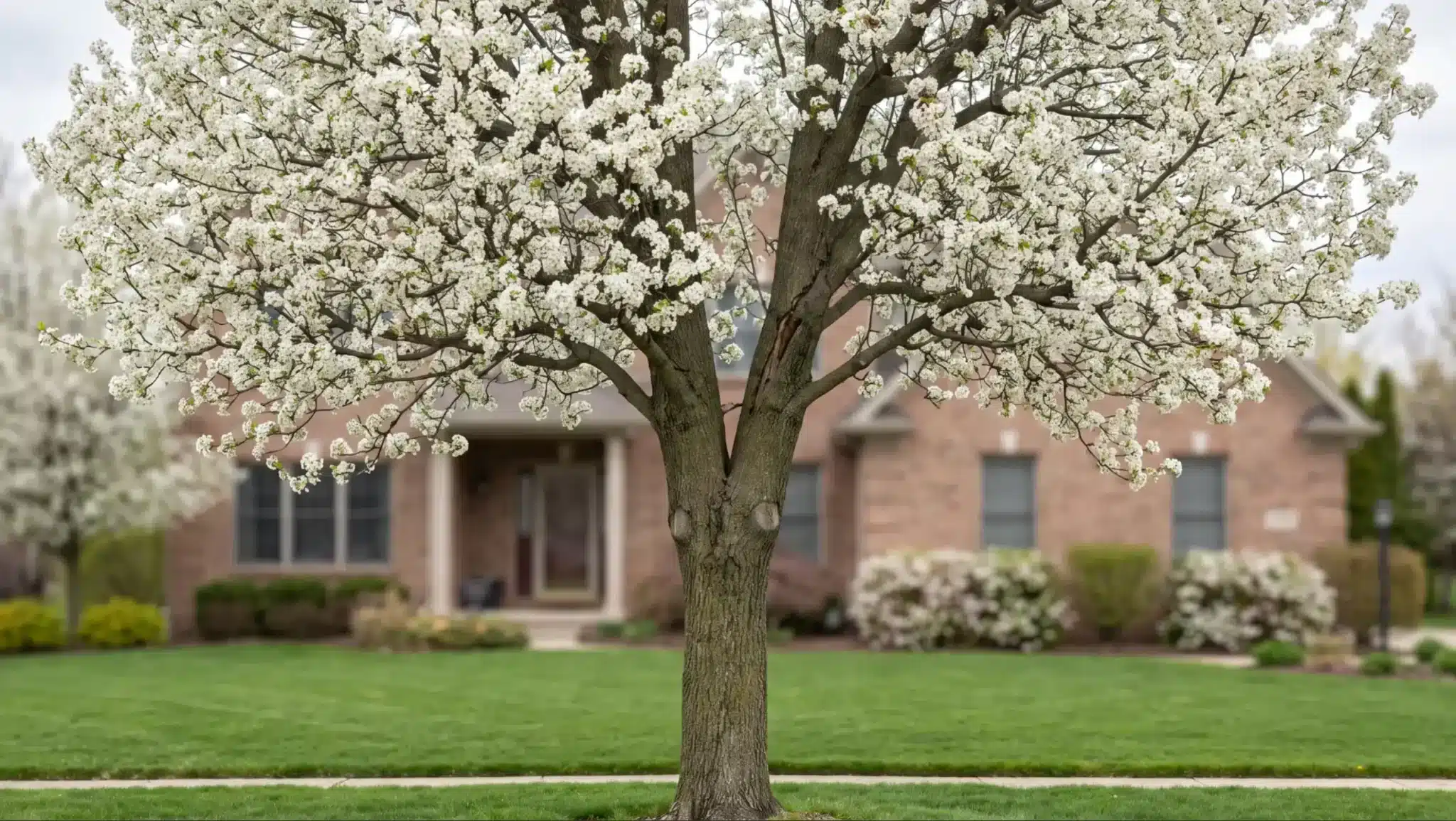
At first, Bradford pear trees may seem like a smart landscape choice. They grow quickly, have a neat shape, and produce white flowers each spring.
I have noticed that these features often hide serious problems. Bradford pear is a cultivar of Callery pear, Pyrus calleryana, and it can spread into roadsides, fields, and woodland edges. Its thorny seedlings can crowd out native plants, while its narrow branch unions make mature trees likely to split during wind, snow, or ice.
Below, you will understand why these trees are invasive, how to spot signs of structural weakness, when removal is the safest choice, and how to stop regrowth. You will also learn which native trees make stronger, safer replacements for your yard.
Bradford Pear Tree at a Glance
Bradford pear trees are often identified by their early white blooms, glossy leaves, and upright shape. Here is a quick overview of the key facts to consider when assessing one.
| Feature | Key information |
|---|---|
| Scientific name | Pyrus calleryana ‘Bradford’ |
| Plant type | Deciduous ornamental tree |
| Native range | East Asia |
| Mature size | Usually 30 to 50 feet tall |
| Flowers | White clusters in early spring |
| Flower smell | Strong and unpleasant |
| Fruit | Small, hard fruit spread by birds |
| Fall color | Red, orange, or purple |
| Lifespan | Commonly about 15 to 25 years |
| Main problems | Invasive spread, weak branches, thorns, and suckering |
| Recommendation | Do not plant; consider removing existing trees |
Callery pear is the species, while Bradford is one cultivar. This is why other callery cultivars can cross-pollinate with it and produce viable seed, which helps the tree spread.
How to Identify a Bradford Pear Tree
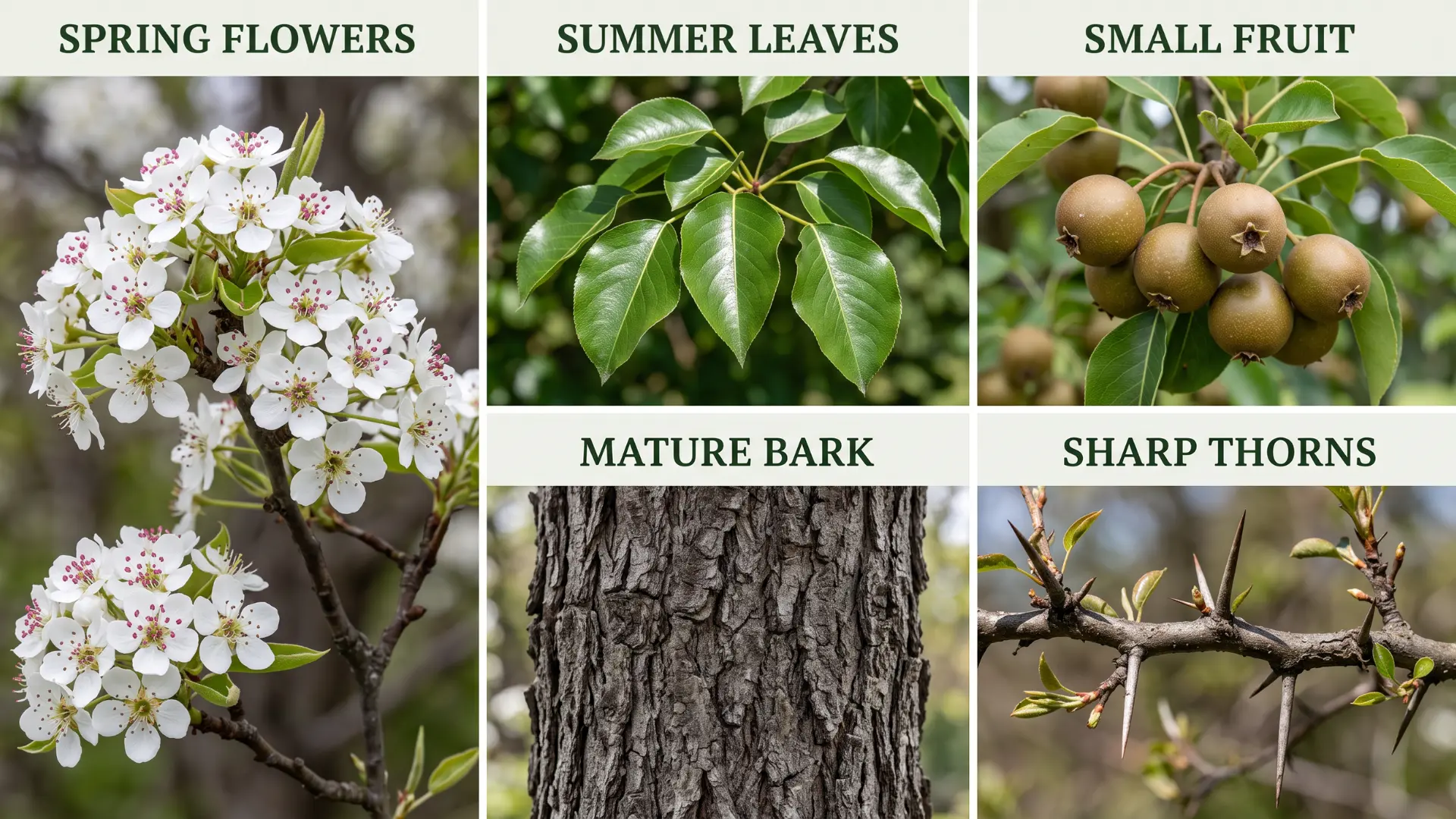
Bradford pear is easiest to spot in early spring, when its white flowers appear before many other trees have leafed out. But it is better to look for other features before confirming the tree, such as leaf shape, texture, color, bark, and fruit.
- Flowers: Five white petals arranged in rounded clusters. They often open before the leaves and have a strong smell that many people compare with rotting fish.
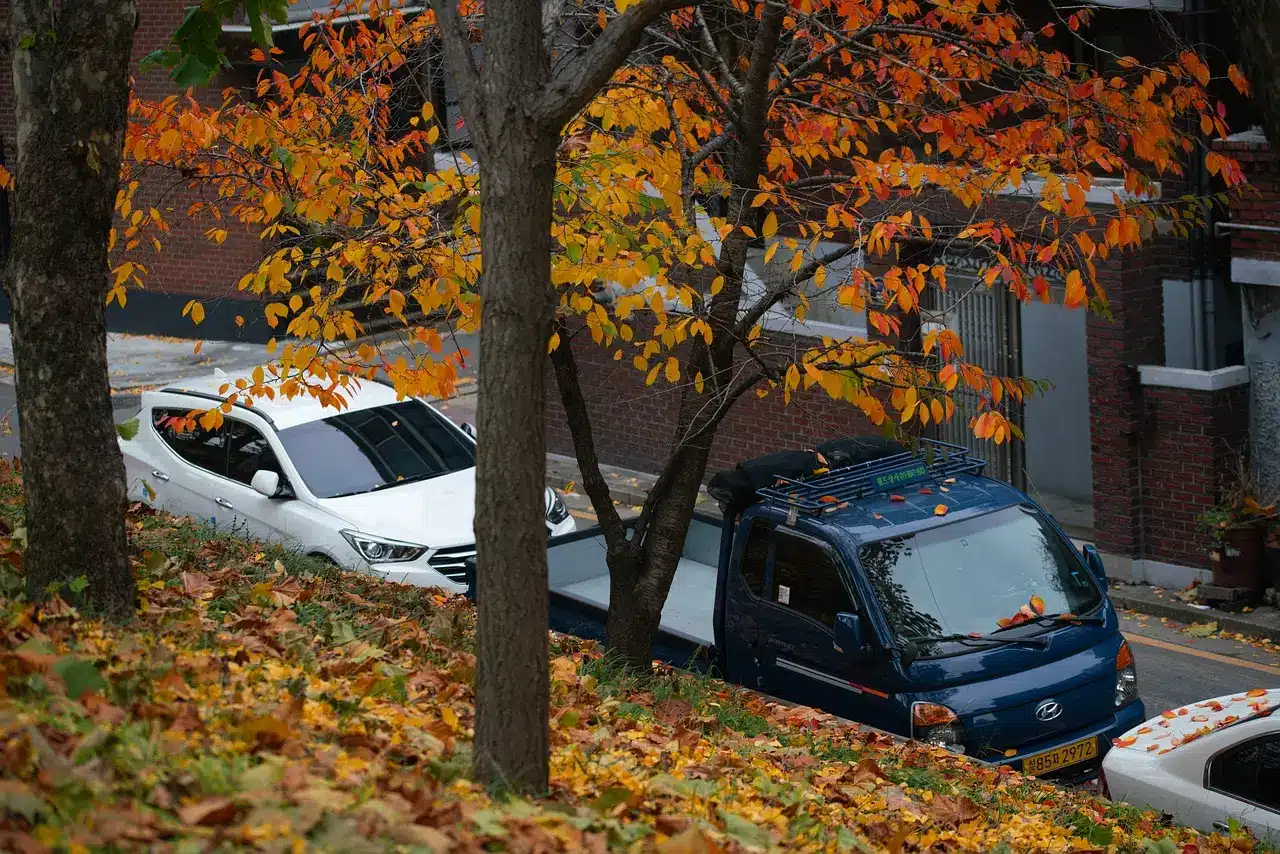
- Leaves: Thick, glossy, and dark green. They are oval, rounded, or slightly heart-shaped, with finely toothed or wavy edges. In fall, they may turn red, orange, bronze, or purple.
- Fruit: Small, round, and hard, usually greenish to brown. The fruit often grows in clusters and is eaten by birds, which helps spread the seeds.
- Bark and thorns: Young bark is smooth and gray-brown. Older bark develops shallow furrows. Wild seedlings and rootstock shoots may also grow sharp thorns.
Identify the tree in more than one season. Note the early white flowers in spring, then check for glossy leaves and clustered brown fruit later in the year. Using several features helps prevent confusion with serviceberry, dogwood, plum, cherry, or crabapple. Anyone weighing a fruiting cherry against a Bradford pear can compare bark texture, bloom timing, and fruit color through this wild cherry tree overview.
How Bradford Pear Tree Became Invasive
Bradford pear became invasive when different Callery pear cultivars cross-pollinated, produced fertile fruit, and birds carried the seeds beyond planted landscapes.
Its fast growth and ability to handle difficult conditions then helped new trees spread across fields, roadsides, and woodland edges. The Callery pear was originally brought to the United States from Asia in the early 1900s to help boost fire-blight resistance in fruiting pear trees.
Its Bradford cultivar later became a landscaping favorite thanks to fast growth, a neat rounded shape, white spring blooms, and vivid fall color.
The tree also handled clay soil, drought, and pollution well, making it a go-to choice for streets and new housing developments. Problems began once other Callery pear varieties were planted nearby, since cross-pollination allowed the trees to produce fertile fruit.
Birds then spread these seeds along roadsides, in pastures, and along forest edges, letting the species spread on its own. Cutting a Bradford pear down doesn’t solve much either, as it often sends up new shoots from its stump or roots, making long-term control difficult.
Important: States like Ohio , South Carolina, and Pennsylvania prohibit the sale or propagation of Bradford pear. Massachusetts has also listed it as prohibited , with remaining stock sales ending December 31, 2028. Check your state’s current rules before buying or planting one.
Why Are Bradford Pear Trees Considered Bad?
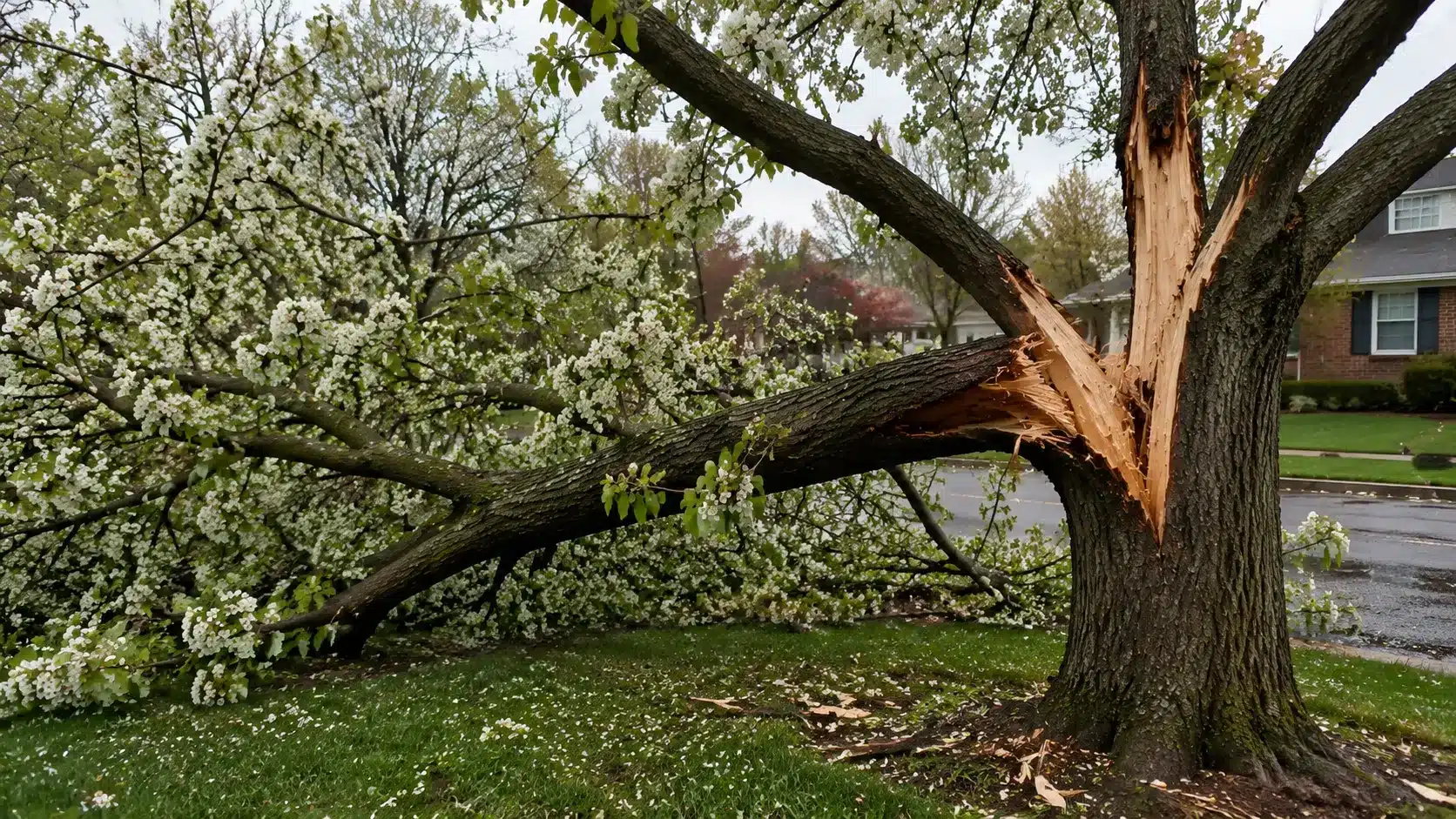
Bradford pear trees are considered bad because they spread into natural areas and develop weak branches that can fail without much warning. The USDA reports that their narrow branch angles make them highly vulnerable to storm damage, with some trees splitting under their own weight after 15 to 20 years.
1. Bradford Pear Spreads Beyond the Yard
Bradford pears were once promoted as sterile, but that claim proved incomplete. When Bradford trees grow near other Callery pear cultivars, they can cross-pollinate and produce viable seeds.
Birds eat the small fruit and carry the seeds into roadsides, fields, fence lines, and woodland edges, allowing new trees to establish far beyond the original planting site.
2. Dense Growth Crowds Out Native Plants
Escaped seedlings may develop sharp thorns and form dense colonies. This thick growth blocks sunlight and competes with native grasses, wildflowers, shrubs, and young trees for water, nutrients, and space.
Old fields, grasslands, roadsides, and woodland edges are especially vulnerable, and established stands can gradually change both plant diversity and the quality of local wildlife habitat.
Why it matters: Dense Callery pear growth can reduce native vegetation and leave wildlife with fewer useful sources of food, shelter, and nesting space.
3. Weak Branch Unions Split During Storms
Bradford pear branches often grow upright from the same point on the trunk, creating narrow V-shaped unions. These attachment points remain weak even when the tree looks healthy.
As the limbs become longer and heavier, wind, snow, ice, or heavy rain can make them split suddenly, sending large branches onto roofs, vehicles, fences, roads, or utility lines.
Expert Tip: Cracks, included bark, leaning, or past limb failure should be assessed by a qualified arborist, especially when the tree stands near people or property.
4. Many Trees Fail Within 15 to 25 Years
Bradford pears grow quickly, but that speed comes with a cost. Many begin to suffer major structural problems within 15 to 25 years. As the canopy expands, heavy limbs place increasing pressure on already weak branch unions.
A mature tree may still appear full and healthy before a storm exposes the weakness and causes a large section to break away.
Important: A healthy canopy does not guarantee a sound structure. Hidden weakness at branch joints may remain unnoticed until the tree is placed under heavy stress.
5. Homeowners Face Odor, Suckers, Fruit, and Extra Maintenance
Bradford pear creates several everyday problems for homeowners. Its spring flowers have a strong, unpleasant odor, while the small fruit can create seasonal litter.
Cutting the tree may trigger root suckers, and heavy pruning often produces upright water sprouts that are difficult to manage. These issues can lead to repeated maintenance without correcting the tree’s structural or environmental problems.
Why it matters: Compared with suitable native trees, Bradford pear offers less habitat value while creating extra upkeep, invasive growth, and a greater risk of property damage.
Should You Remove a Bradford Pear Tree?
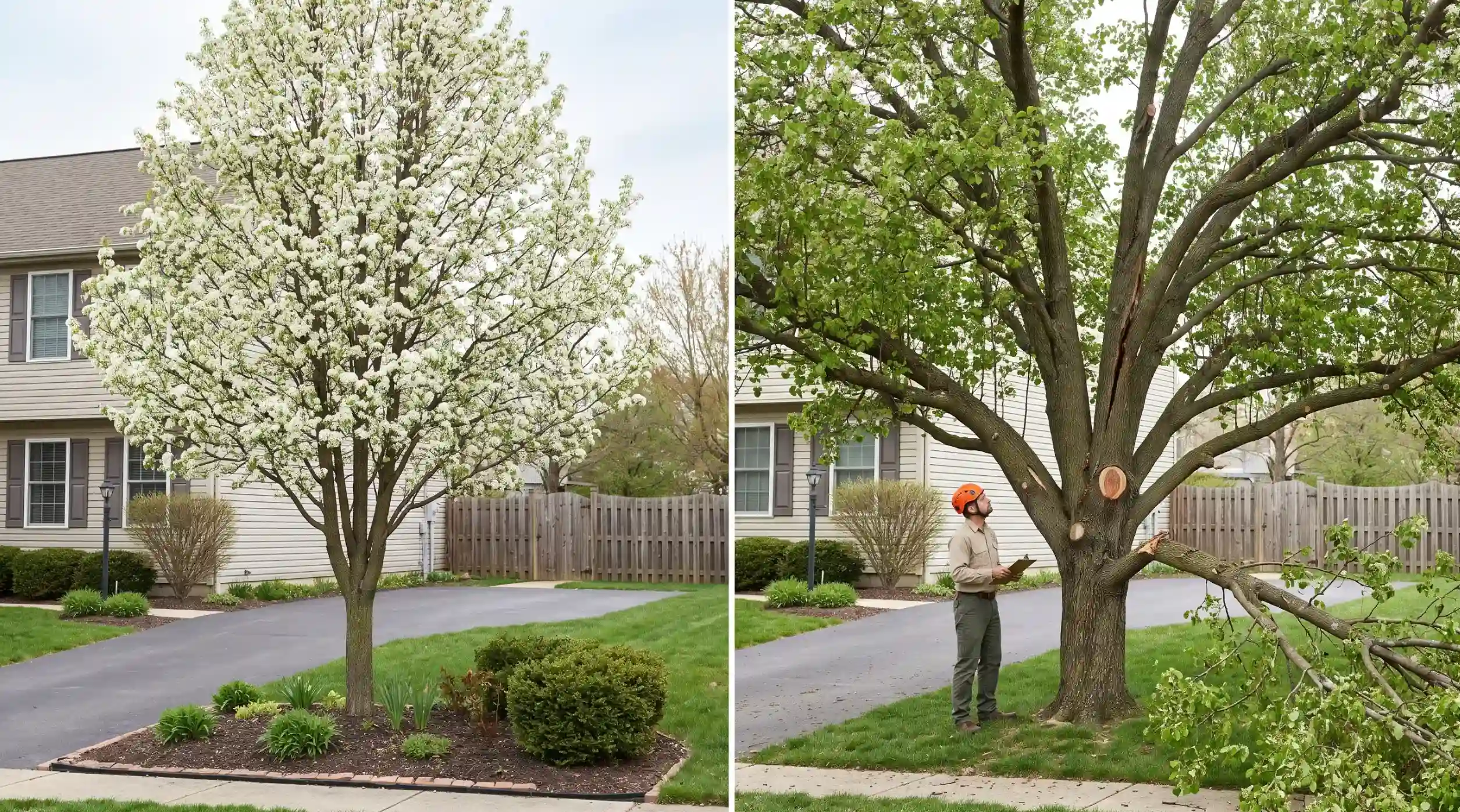
A Bradford pear that has already lost a large limb is more likely to fail again. Removal is worth considering when the tree shows structural weakness, stands close to people or property, or keeps producing suckers and seedlings.
Look for these warning signs that may mean Bradford pear tree removal or a further professional assessment:
- Deep cracks where large branches meet the trunk
- Bark trapped inside narrow branch unions
- A sudden or growing lean
- Major limbs that have already fallen
- Decay or cavities near branch attachments
- Heavy limbs over a roof, road, driveway, or power line
- Repeated root suckers or nearby seedlings
- Serious damage after wind, snow, or ice
Contact a qualified arborist when the tree is mature, close to a structure or utility line, or already splitting. Professional help is also important when removal requires climbing, rigging, or chainsaw work you are not trained to handle.
Expert tip: Remove young seedlings early. Healthy-looking Bradford pears can have undetected issues so early assessment and replacement with a suitable native tree is often safest.
How to Remove Bradford Pear Safely
Bradford pear is easier to remove while it is still young. Whatever the tree’s size, the goal is to limit seed spread, stop regrowth, and keep the work safe. When possible, remove fruiting trees before the fruit ripens. Do not wait if the tree is damaged or poses a risk to people or property.
- Step 1: Pull seedlings early. Remove young seedlings while the soil is moist, making sure the full root crown comes out. Check the area again during the next growing season.
- Step 2: Dig out small trees. Remove as much of the root system as possible. Cutting alone may cause new shoots, so gather fruiting branches carefully and avoid spreading seeds.
- Step 3: Hire an arborist for mature trees. Professional removal is safest near houses, roads, driveways, or utility lines, or when climbing and advanced chainsaw work are required.
- Step 4: Prevent stump regrowth. Treat the fresh stump with a locally approved cut-stump product when needed. Follow the product label and protect nearby plants.
- Step 5: Monitor the area. Watch for root suckers and seedlings along fence lines, roadsides, and woodland edges. Repeat control when new growth appears.
Cutting or mowing alone may not stop Bradford pear because the stump and roots can resprout. Keep checking the site through at least the next growing season.
What Are the Best Alternatives to Bradford Pear?
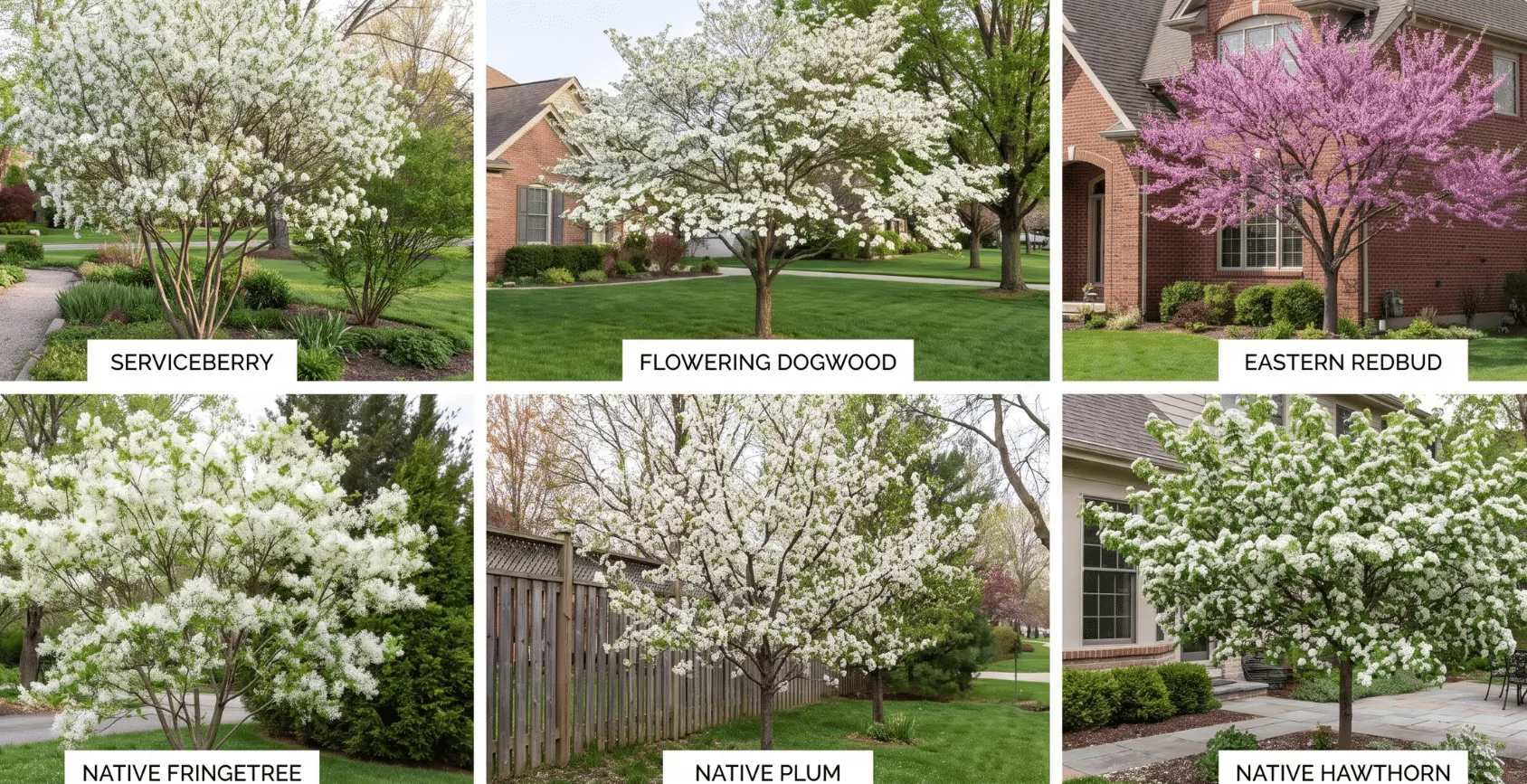
The best Bradford pear alternatives are native flowering trees such as serviceberry, flowering dogwood, eastern redbud, fringetree, native plum, and hawthorn. Avoid Chanticleer, Cleveland Select, and other Callery pear cultivars because they may still contribute to invasive spread.
When I help someone choose a replacement, I look at the available space, sunlight, soil, and how much upkeep they are comfortable with.
| Tree | Mature size | Light | Best use and key benefits | Maintenance |
|---|---|---|---|---|
| Serviceberry | 15 to 25 feet | Full sun to part shade | Small lawns, patios, and natural gardens; white spring flowers, edible berries, and fall color | Low; usually needs little pruning |
| Flowering dogwood | 15 to 30 feet | Part shade to full sun | Front yards, shaded borders, and woodland gardens; spring flowers and strong wildlife value | Moderate; prefers good drainage |
| Eastern redbud | 20 to 30 feet | Full sun to part shade | Entryways, patios, and small yards; bright pink or purple spring flowers | Low; easy to manage with little pruning |
| Native fringetree | 12 to 20 feet | Full sun to part shade | Small yards, foundation areas, and specimen planting; white spring flowers similar to Callery pear | Low |
| Native plum | 10 to 25 feet | Full sun | Wildlife gardens, open property edges, and informal landscapes; provides flowers and fruit | Moderate; may produce suckers and needs room to spread |
| Native hawthorn | 15 to 30 feet | Full sun to part shade | Screens, wildlife areas, and property boundaries; offers flowers, fruit, and shelter | Moderate; place thorny species away from paths and play areas |
Before planting, check the tree’s mature height and spread so it fits your yard without crowding buildings, sidewalks, or power lines. Eastern redbud is worth a closer look here, since its shallow, wide-spreading roots stay non-aggressive near sidewalks and foundations, as this breakdown of redbud root behavior explains.
Planting Tips for a Smooth Transition
Once you’ve picked a replacement, proper spacing and timing make the biggest difference in how well it settles into your yard.
Plant in fall or early spring, when mild temperatures and steady rainfall give roots time to establish before summer heat arrives.
Dig a hole only as deep as the root ball and twice as wide, then backfill with native soil rather than a heavily amended mix, which can trap water around the roots.
Water deeply once or twice a week during the first year, and add a two- to three-inch layer of mulch around the base to hold moisture and moderate soil temperature. Keep mulch away from the trunk to avoid rot.
Skip heavy pruning early on, since young trees direct more energy toward root growth when left mostly alone.
Frequently Asked Questions
When Is the Best Time to Remove a Bradford Pear?
Remove the tree before its fruit ripens to reduce seed spread. Spring also helps with identification because the white blooms are easy to spot. Do not wait if damaged limbs pose an immediate danger.
Can You Remove a Small Bradford Pear Yourself?
You can remove a small tree if it stands clear of buildings and utility lines and you can safely remove the root crown. Cutting it at ground level is not enough because the stump and roots may produce new shoots.
Can You Eat Bradford Pear Fruit?
Bradford pear fruit is small, hard, and unlike the pears sold for eating, it has little food value for people. Birds eat it and carry the seeds into fields, roadsides, and other natural areas.
What States Have Outlawed Bradford Pear Trees?
Ohio and South Carolina prohibit sales of Callery pear, while Pennsylvania lists it as a noxious weed. Massachusetts restricts propagation and import, with existing tree stock sales ending December 31, 2028. Check local rules before buying.
Can Pruning Make a Bradford Pear Safe?
Pruning may reduce crowded growth in a young tree, but it cannot correct weak branch structure or invasive spread. A qualified arborist should assess mature trees with cracks, trapped bark, or heavy limbs.
Final Dig
A Bradford pear may still look healthy on the surface, but weak branch joints and its tendency to spread can create bigger problems down the road.
The safest approach is to skip planting any Callery pear cultivar, keep an eye on existing trees for cracks, leaning, or broken limbs, and address issues early before they turn hazardous or produce more seed.
Once removal is complete, consider a native tree suited to your space, sunlight, and soil so it can grow strong with fewer setbacks. If you’re unsure about a tree’s condition, a certified arborist can inspect it and help you build a plan before storm season arrives.
Do you have a Bradford pear on your property? Share your experience or questions in the comments below.
Frequently Asked Questions
When Is the Best Time to Remove a Bradford Pear?
Remove the tree before its fruit ripens to reduce seed spread. Spring also helps with identification because the white blooms are easy to spot. Do not wait if damaged limbs pose an immediate danger.
Can You Remove a Small Bradford Pear Yourself?
You can remove a small tree if it stands clear of buildings and utility lines and you can safely remove the root crown. Cutting it at ground level is not enough because the stump and roots may produce new shoots.
Can You Eat Bradford Pear Fruit?
Bradford pear fruit is small, hard, and unlike the pears sold for eating, it has little food value for people. Birds eat it and carry the seeds into fields, roadsides, and other natural areas.
What States Have Outlawed Bradford Pear Trees?
Ohio and South Carolina prohibit sales of Callery pear, while Pennsylvania lists it as a noxious weed. Massachusetts restricts propagation and import, with existing tree stock sales ending December 31, 2028. Check local rules before buying.
Can Pruning Make a Bradford Pear Safe?
Pruning may reduce crowded growth in a young tree, but it cannot correct weak branch structure or invasive spread. A qualified arborist should assess mature trees with cracks, trapped bark, or heavy limbs.