Figuring out when to prune lilacs can feel a little scary, especially when you want those pretty spring blooms to come back strong. Quick answer: The best time to prune lilacs is right after the last flowers fade in late spring.
The good news is that lilacs are not fussy once you know their rhythm. You only need the right timing, clean cuts, and a little patience. Think of it like giving your shrub a fresh, floral haircut after the party is over.
I’ll walk you through the simple way to prune, shape, and care for your lilac so it stays full, healthy, and blooming beautifully.
What Does Pruning Lilac Bushes Mean?
Not every cut serves the same purpose, and understanding the difference keeps you from accidentally removing the stems that carry next season’s blooms.
Pruning lilac bushes covers four distinct actions: deadheading spent flower clusters, maintenance pruning of light and crossing growth, renewal pruning of old stems at ground level, and rejuvenation pruning for badly overgrown shrubs.
Lilacs bloom on old wood, meaning flower buds form on last year’s growth, not on new shoots produced this spring. Penn State Extension confirms that spring-flowering shrubs should be pruned after flowering, not before.
| Pruning Type | What Gets Cut | Best Time |
|---|---|---|
| Deadheading | Faded flower clusters only | Right after blooms fade |
| Maintenance pruning | Crossing, dead, and weak stems | Right after blooming |
| Renewal pruning | Oldest stems at ground level | Right after blooming |
| Rejuvenation pruning | Heavy removal of the old framework | Late winter, only when bloom loss is acceptable |
When is the Best Time to Prune Lilacs?

Pruning lilacs is mostly about timing. Cut healthy stems soon after flowering, and you protect next spring’s buds while keeping the shrub neat, open, and easier to manage each year.
The Best Time for Pruning Lilac Bushes is Right After Blooming
Prune right after the last flowers fade in late spring. Use the plant as your guide, not a fixed calendar date, because bloom time changes by region and variety.
Iowa State Extension notes that lilacs set next year’s flower buds by mid-summer, so try to finish pruning by early June at the latest.
Why Late Summer, Fall, and Winter Pruning Reduces Blooms
By late summer, next spring’s flower buds are already on the stems, even if you cannot see them. Pruning after that point removes buds that would have opened the following year.
Oregon State Extension warns that winter pruning can reduce or prevent spring flowers entirely — the shrub may still look healthy, but have little left to bloom.
Can You Prune Lilacs in Early Spring?
Early spring pruning is fine only for dead, broken, diseased, or unsafe branches. For shaping, thinning, or cutting healthy stems, wait until after flowering.
University of New Hampshire Extension recommends pruning spring-blooming shrubs after flowers fade; cutting healthy stems in early spring removes buds that were close to opening.
Pruning Lilac Bushes by Season
Doing the right cut at the wrong time of year can set the shrub back by a full bloom season. Use this table as a seasonal guide before picking up any tool:
| Season | What Is Safe to Do | What to Avoid |
|---|---|---|
| Spring (after bloom) | All pruning types: deadheading, thinning, renewal, shaping | Nothing, if done within a few weeks of bloom fading |
| Summer | Light cleanup only if the bloom window just closed | Heavy pruning once buds begin forming on stems |
| Fall | Dead, damaged, diseased, or unsafe branches only | Normal shaping or thinning of any healthy growth |
| Winter | Major renovation only, with accepted bloom loss | Any pruning aimed at protecting next spring’s flowers |
How Much Can You Cut Back a Lilac Bush?
For a healthy lilac in a normal pruning year, remove no more than one-third of the total stems. Taking more stress on the plant can trigger weak sucker growth at the base. Work through this priority order:
- Dead, diseased, or broken stems are always first, regardless of season
- Crossing or rubbing branches — remove the weaker stem at its point of origin
- The oldest and thickest canes — cut at or just above ground level
- Weak, crowded suckers — pull or cut at the root junction
- Stems growing into structures or paths — remove at the base, not partway up
Iowa State Extension recommends spreading this work over multiple seasons rather than doing it all at once.
Keep healthy young shoots since they carry future buds, and avoid flat-top trimming, which removes many buds and leaves stiff, slow-recovering growth.
Tools You Need for Pruning Lilacs
| Tool | Best For | Notes |
|---|---|---|
| Bypass hand pruners | Deadheading, small suckers, light crossing branches up to 3/4 inch | University of New Hampshire Extension explains that bypass pruners make clean cuts that heal faster than anvil types, which can crush live tissue |
| Loppers | Mid-size old canes from 3/4 to 1.5 inches in diameter | Gives leverage for thicker stems without tearing; choose a model with a ratchet mechanism for older canes |
| Pruning saw | Thick old canes at the base, over 1.5 inches | A folding saw is easy to carry; essential for base cuts in renewal pruning |
| Heavy gloves | All pruning sessions | Protects hands from woody stems and thorny undergrowth near the base of established shrubs |
| Tool sanitizer | Any session where a disease is suspected | University of Illinois Extension recommends sanitizing tools between plants and between cuts when disease is present |
Using hand pruners on a two-inch cane tears the bark and slows healing. Using loppers on a thin green shoot unnecessarily crushes tissue.
Keep all five tools clean, sharp, and accessible so the post-bloom window never gets delayed by missing equipment.
How to Prune Lilac Bushes Step by Step
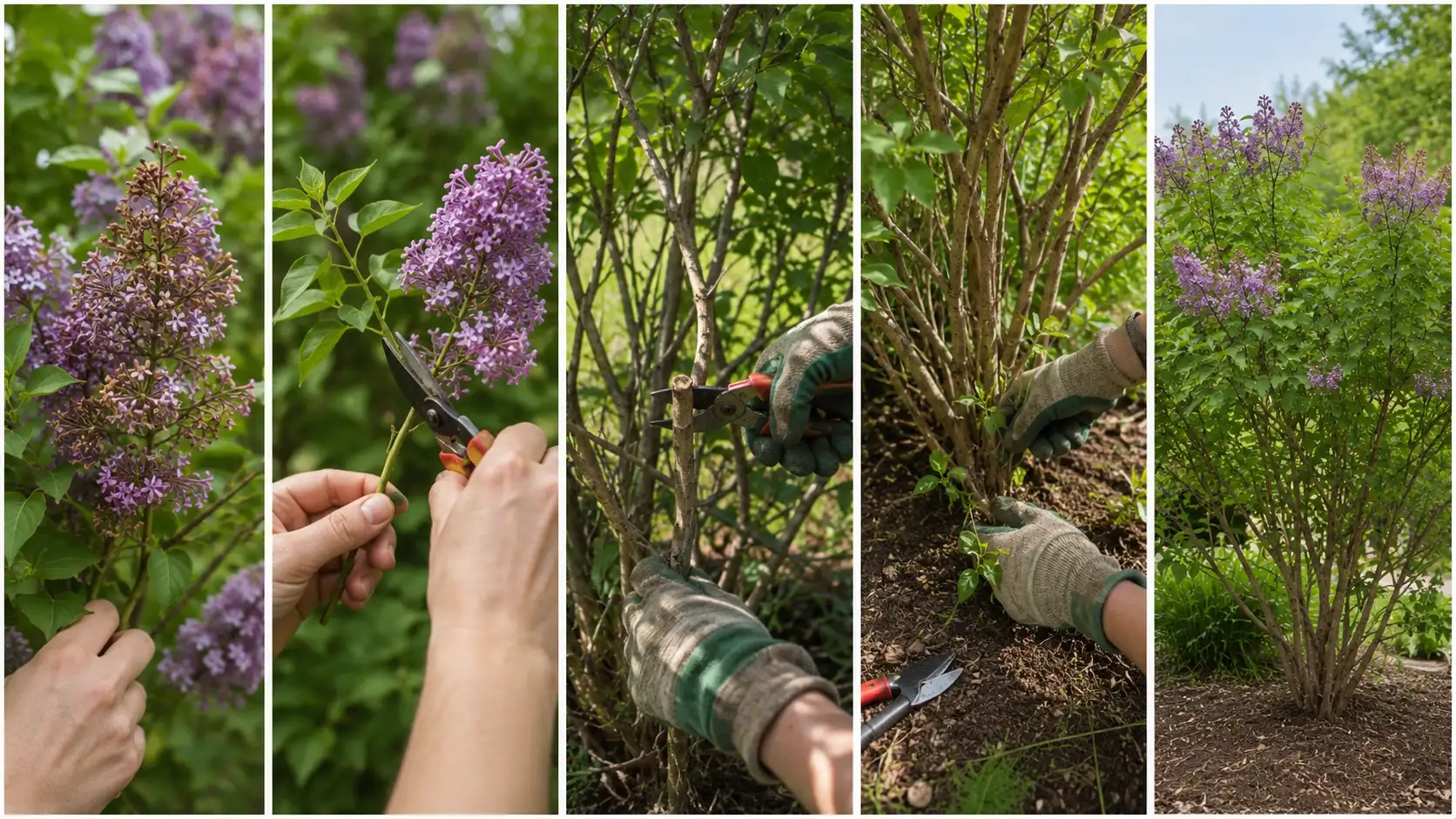
Start with faded flowers, then remove problem wood, thin old stems, and leave the shrub clean and balanced.
Step 1: Wait Until the Flowers Fade
Once the blooms turn brown at the edges and lose their color, the pruning window is open. Aim to prune within two to four weeks after bloom, before lilacs begin forming next year’s buds.
Step 2: Deadhead Spent Lilac Flowers
Cut each spent flower cluster back to the first pair of leaves or a small side shoot below the faded bloom. Use clean hand pruners and make a neat, angled cut just above the leaf node. This keeps the shrub tidy and helps limit seed production.
Step 3: Remove Dead, Damaged, Crossing, or Rubbing Branches
Look for brittle stems, cracked bark, dark spots, hollow wood, and branches that press together. Cut each problem stem back to a healthy side branch or to the base. When two stems rub, remove the weaker or inward-growing one. This opens the center so air and light move through more freely.
Step 4: Thin Older Stems and Extra Suckers
Pick a few thick, gray, woody stems that flower less or crowd the plant, then cut them at ground level instead of shortening their tops. Remove weak suckers from the base, but keep several strong, well-spaced young shoots. Those younger stems will replace the old wood over time.
Step 5: Add the Finishing Touch
Step back and check the shape from every side. The lilac should look natural and open, not flat or clipped like a hedge. Remove small trimmings from around the base, clean your tools, and water the shrub if the soil is dry.
How to Prune an Overgrown Lilac Bush
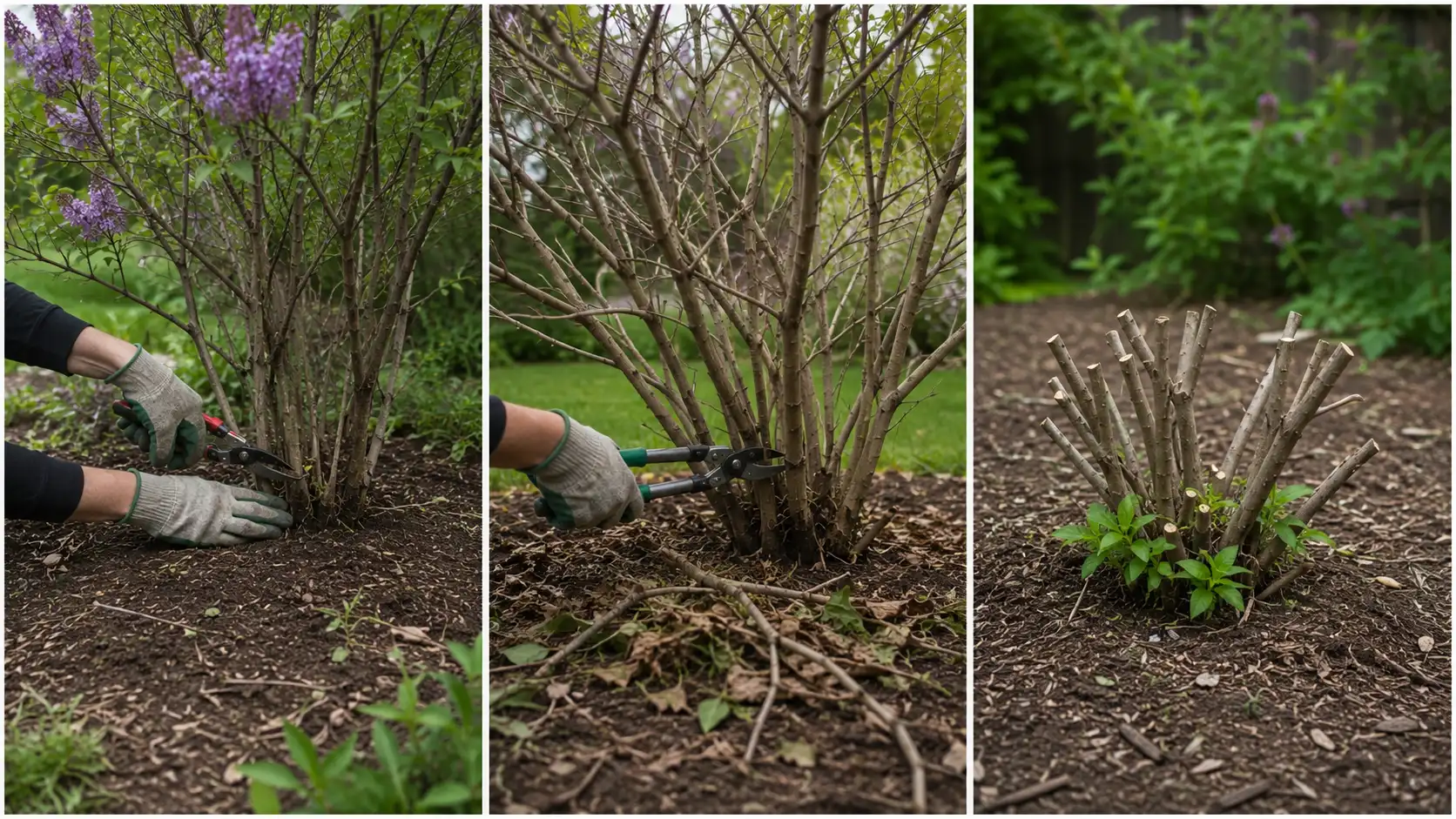
An overgrown lilac needs steady renewal, not harsh guesswork. Remove old stems in stages, protect healthy young growth, and choose hard pruning only when the shrub truly needs it.
Best Method: Gradual Renewal Pruning Over Three Years
A three-year plan is the safest approach. It slowly reduces old wood, keeps some blooms each season, and gives young stems time to grow strong.
- Year 1: Cut one-third of the oldest, thickest stems at ground level after flowering.
- Year 2: Remove another third of old stems and thin weak new shoots.
- Year 3: Cut the remaining oldest stems and keep the best young replacements.
- After year 3: Maintain yearly by removing a few old stems after bloom.
By the end, the lilac will have more young and middle-aged stems, flower better, and need only light yearly pruning to stay balanced.
When Heavy Renovation Makes Sense
Heavy renovation is useful only when a lilac is badly neglected, misshapen, or full of dead wood. It is faster, but expect fewer flowers.
- Use heavy pruning when the shrub is too crowded for gradual cuts to fix the problem.
- Prune in late winter or early spring if you need to see the bare branch structure.
- Expect little or no bloom that spring because many flower buds will be removed.
- Use the three-year plan if the shrub is healthy but simply too large.
You lose flowers for a while, but you may save a shrub that has become too weak or tangled to shape gradually.
Can You Cut a Lilac Bush to the Ground?
Yes, but treat this as a last resort. Use it only when the shrub is severely tangled, weak, or badly shaped.
New shoots will emerge from the root zone the following season, but full blooms may take one to three years to return. For most gardens, gradual renewal gives better results with less bare space.
Lilac Pruning Reference: What to Cut and What to Keep
| Lilac Part | What to Do |
| Spent flower cluster | Cut back to the nearest leaf pair or side shoot below the cluster. |
| Dead or hollow stem | Remove to healthy wood, or cut to the base if fully dead. |
| Crossing branch | Remove the weaker or inward-growing stem at its point of origin. |
| Old thick cane | Cut at or just above ground level to make room for young growth. |
| Young replacement stems | Keep the strongest, best-spaced shoots from the base. |
| Weak sucker | Cut or pull it at the root junction. |
| Strong sucker | Keep one or two well-spaced shoots on own-rooted shrubs. |
Why Your Lilac Did Not Bloom After Pruning
A lilac may skip bloom even if it looks healthy. The cause is usually timing, shade, age, fertilizer, or too much old wood:
- Pruned too late: Flower buds were already set when you cut. Move future pruning to the spring window right after blooming.
- Too much shade: Lilacs need strong sun. Thin nearby branches or consider moving the shrub if shade is heavy.
- Too young: New lilacs may take one to two years to bloom. Avoid heavy pruning while the roots settle.
- Too much nitrogen: High nitrogen feeds leaves instead of flowers. Use little fertilizer, or choose a low-nitrogen option.
- Mostly old wood: Old stems bloom less over time. Start a three-year renewal plan to replace old canes with younger stems.
If the plant looks healthy, correct the timing first, then give the shrub one full bloom cycle to recover.
Common Lilac Pruning Mistakes
- Pruning too late: Late cuts remove flower buds already formed on the stems. Prune within two to four weeks after the last blooms fade.
- Shearing like a hedge: Shearing cuts all stem tips and creates dense outer growth. Remove selected stems at the base instead.
- Topping only: Cutting only the top makes lilacs taller, woodier, and harder to manage. Remove old canes at ground level.
- Removing too much young growth: Young stems carry future bloom potential. Keep the strongest, best-spaced shoots from the base.
- Ignoring sunlight and airflow: Poor bloom may come from shade or crowding. Lilacs need full sun and good air movement.
Frequently Asked Questions
How do I know if my lilac is blooming on old wood or new wood?
Lilacs bloom on old wood. Buds form on last year’s stems, not fresh spring shoots. Prune only after flowering, so you do not remove next year’s blooms by mistake.
My lilac is next to a fence. Does that change how I prune it?
Yes. Keep the shrub open so air can move through it. Remove stems touching the fence, crowded old canes, and inward-growing stems that stay damp or block light.
Can I root the stems I cut off during pruning?
Yes, but results vary. Take softwood cuttings in late spring or early summer. Use rooting hormone, a moist mix, bright shade, and avoid cuttings below graft unions.
How long does a lilac take to recover from heavy pruning?
Most healthy lilacs need two to three seasons to bloom well again. Gradual renewal is better if you want flowers during the recovery period.
Should I fertilize my lilac after pruning?
You can feed lightly after pruning, but avoid high-nitrogen fertilizer. Too much nitrogen causes leafy growth at the expense of flowers. Many established lilacs need no fertilizer at all.
Do different lilac varieties need different pruning approaches?
Most lilacs follow the same timing rule: prune after bloom. Dwarf types need less thinning. Tree-form or grafted lilacs should not keep base suckers as replacements.
Summing Up
The most reliable rule for when to prune lilacs has not changed: prune right after the blooms fade, every single spring, and finish before midsummer.
That one habit protects next year’s flower buds, keeps old wood from crowding out productive stems, and prevents the slow decline that turns a once-flowering shrub into a tall tangle of gray canes.
For an overgrown shrub, start the three-year renewal plan this season. The tools are simple, the priority order is logical, and doing this on schedule each year produces results that no single hard renovation can match.
Drop a comment below and let me know if you have any further questions.