Good-looking houseplants that survive real life are hard to find. The white bird of paradise plant is one of them.
It has a reputation for being fussy that doesn’t quite match reality. Most people who struggle with bird of paradise plant care aren’t dealing with a difficult plant. They’re reacting to normal behavior they’ve never seen before and assuming something’s wrong.
That reaction costs plants their leaves more often than any actual problem does.
What follows sorts out what this plant genuinely needs from what looks alarming on the surface. It also pulls in real experiences from owners who’ve kept theirs alive through less-than-perfect conditions, not just textbook instructions.
By the end, telling normal from concerning should feel much simpler.
White or Orange Bird of Paradise: Why It Matters
Not every plant labeled bird of paradise is the same species. Here’s how the two compare, and why the difference changes care.
|
Feature |
White Bird of Paradise ( S. nicolai ) |
Orange Bird of Paradise ( S. reginae ) |
|---|---|---|
|
Leaf size |
Large, up to 2 feet |
Smaller, upright |
|
Mature height |
6–20 feet |
3–5 feet |
|
Flowers |
White, rare indoors |
Orange, blooms more easily |
|
Water need |
Higher |
Lower |
Note: young plants often don’t show a clear size difference yet. Check the plant tag or ask the nursery directly, since mislabeling between the two species is common.
The care below focuses on Strelitzia nicolai, commonly sold as the white bird of paradise.
Bird of Paradise Plant Care Essentials
Six habits cover the core of bird of paradise plant care. Once you know the pattern behind each one, the routine becomes second nature fairly quickly.
1. Light

Place it in the brightest spot available, ideally near a south- or west-facing window with several hours of direct sun daily. Low light causes slow growth and weak stems. If you’re keeping several plants in the same bright spot while they size up, a window plant shelf makes it easier to give each one its own spot in the light.
Move a new plant into stronger sunlight gradually over one to two weeks to avoid leaf scorch. Keep indoor temperatures between 60°F and 80°F, and keep it away from cold drafts, heating vents, and air conditioning.
Note: a plant kept in low light for months needs a longer adjustment period once moved somewhere brighter.
2. Soil

A fast-draining potting mix with chunky perlite or pumice keeps water moving instead of pooling around the roots. Heavy soil holds moisture too long and increases the risk of root rot, even with correct watering on top of it.
3. Watering

Water thoroughly until it runs from the drainage holes, then let the top two to three inches dry out before watering again. In spring and summer, that’s usually weekly. Soil takes longer to dry in cooler months, so ease off naturally rather than sticking to a fixed schedule.
Tip: check soil with a finger before watering. Conditions shift by room, season, and light.
4. Feeding

Feed once a month in spring and summer with a balanced liquid fertilizer or slow-release pellets. Skip feeding entirely in fall and winter, since a dormant plant can’t absorb it and risks a salt buildup that stresses the roots.
5. Pruning

Cut fully brown or dead leaves at the base using sterile shears, wiping the blades with rubbing alcohol between cuts to avoid spreading bacteria. Leave green leaves alone, even when they’ve split, since splitting is a normal airflow response and not a sign of damage.
6. Repotting

Move into a container one size larger every 18 to 24 months so roots can keep up with the plant’s fast leaf growth. Roots circling the drainage holes, or soil drying unusually fast, both mean it’s time sooner.
These six habits work together as one routine. Skip one, and the others end up compensating for it.
What Real Owners Say on Reddit

A long-running Reddit thread gathers owners comparing notes on their white bird of paradise, and the consensus is simpler than expected. Owners keep theirs beside south-facing or bay windows with minimal effort. One barely touches it except to water, and it keeps growing steadily. Another reports it’s doing so well that centipedes moved in.
The most striking point from the thread is how tall this plant actually gets. One commenter mentions theirs reached the second floor of their office building, a real reminder that this plant needs vertical space, not just a windowsill.
Most owners agree that inconsistent watering isn’t the problem people fear it is. Bright light, water when the soil calls for it, and room to grow. That’s the whole routine.
Growing White Bird of Paradise on the Gulf Coast
Houston sits right at the edge of where this plant can grow outdoors year-round. The University of Florida IFAS Extension notes that white bird of paradise needs cold protection once you move north of the mildest parts of the state, and a hard freeze in the mid-twenties or below can kill the top growth back to the ground.
I saw this firsthand during the February 2021 Arctic Freeze, when established specimens across the Gulf Coast lost most of their canopy in a single night.
My advice for local growers: treat this one as a large container plant first and a landscape specimen second. Keep it somewhere you can wheel it toward the house or garage before a hard freeze, and protect your tropicals from freezing the same way you would hibiscus or bougainvillea.
The upside is our humidity. Gulf Coast air is naturally close to what this plant wants indoors, so it rarely needs the humidifier a drier climate would require.
Common Problems and Their Causes
Most issues with white bird of paradise care come from changes in light, water, or the root environment. Learning what each sign means prevents unnecessary changes.
- Leaf splitting: The wide leaves split along natural seams in response to air movement. This is how the plant protects itself from tearing in wind or drafts. Remove a split leaf only if it’s also browning or dying.
- Curling leaves: Usually a sign of underwatering, low humidity, or sudden temperature changes. Check soil moisture first, then consider humidity levels before adjusting anything else.
- Root-bound stress: Fast-drying soil and roots circling the drainage holes mean the plant needs more space. Repot into one size larger container.
- Brown leaf tips: Often linked to dry air, mineral buildup from tap water, or inconsistent watering. Raise humidity or switch to filtered water.
This plant prefers higher humidity than most American living rooms naturally offer. Run a humidifier nearby if your air is dry, especially in winter.
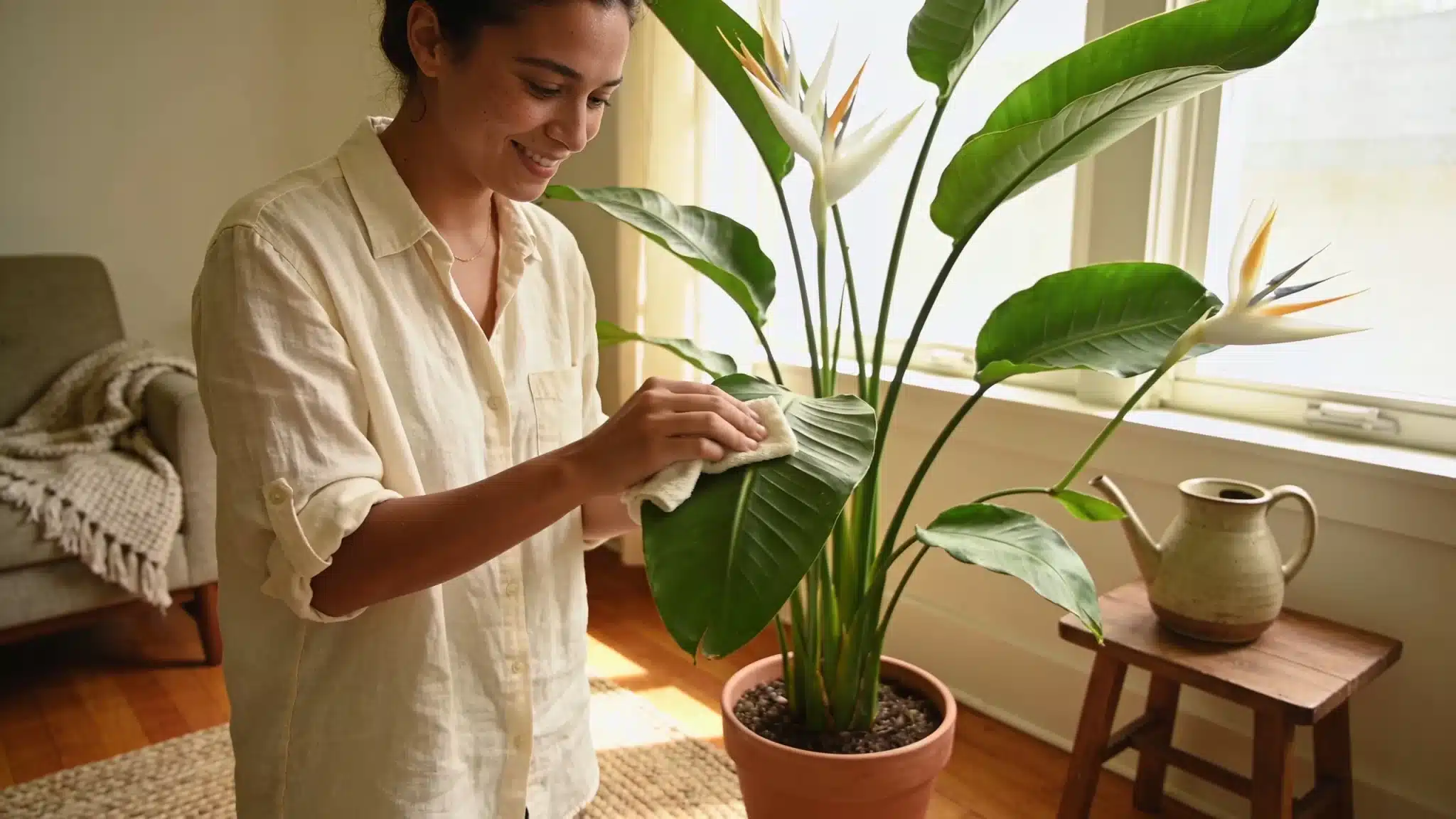
If you’re already running one for other humidity lovers like tropicals like calathea, your bird of paradise will benefit right along with them. Wipe the large leaves with a damp cloth every few weeks to clear dust and keep the leaf surface working properly. Reading these signals correctly saves unnecessary pruning and worry.
Signs of Healthy Growth
Good bird of paradise plant care shows itself in specific, visible ways through the growing season.
|
Sign |
What it means |
|---|---|
|
New leaf every few weeks |
Routine is working (spring/summer) |
|
Growth pauses in winter |
Normal rest period, not decline |
|
Deep green, glossy leaves |
Enough light and nutrients |
|
Pale or floppy new growth |
Light is likely too low |
Note: Indoor blooming is extremely rare for Strelitzia nicolai . Most growers keep this plant for its foliage. The conditions needed to produce flowers indoors are difficult to replicate consistently.
Once new growth shows up on schedule, you can keep the rest of the routine the same.
Frequently Asked Questions
How fast does a white bird of paradise grow?
Indoors, a healthy white bird of paradise puts out a new leaf every few weeks during spring and summer, then pauses through fall and winter. Growth speeds up with more light, consistent watering, and monthly feeding during the growing season. Given several years and a large enough pot, indoor plants can reach six feet or taller.
Is a white bird of paradise toxic to pets?
Yes, according to the ASPCA’s toxic plant list, white bird of paradise is mildly toxic to cats and dogs if chewed or eaten, causing nausea, drooling, or mouth irritation. Symptoms are usually mild, but keep the plant out of reach if your pets tend to chew on houseplants, and call your vet if you notice any of these signs.
Can I put my white bird of paradise outside in summer?
Yes, once you gradually adjust it to outdoor sun over one to two weeks to avoid leaf scorch, since indoor light is much weaker than direct summer sun. Bring it back inside once nighttime temperatures start dropping below 60°F, since this plant has little cold tolerance and can suffer damage even from a mild chill.
What does an overwatered white bird of paradise look like?
Overwatering shows up as yellowing lower leaves, a mushy or dark base, and soil that stays wet for days after watering instead of drying out. Root rot often follows. Let the top 2 to 3 inches of soil dry between waterings, and make sure the pot actually drains, since heavy or compacted soil is usually the real cause.
Can white bird of paradise be propagated?
Yes, through division rather than seed or cuttings, which rarely work for home growers. Separate a rooted offshoot, or pup, from the base of a mature plant, keeping some roots attached, then pot it in fresh, well-draining soil and keep it warm and slightly moist until new growth appears.
Final Takeaways
Once you know which species you have and what its normal behavior looks like, most of the guesswork in bird of paradise plant care disappears. Light and watering are the two things that actually move the needle. Everything else follows once you get those right.
What trips people up usually isn’t the plant being difficult. It’s mistaking a split leaf, a winter pause, or curling for something going wrong when the plant is simply doing what it does.
Give it space, keep the light generous, and let the soil tell you when to water.
Have a white bird of paradise of your own? Let me know in the comments how yours is doing, or drop your questions below.