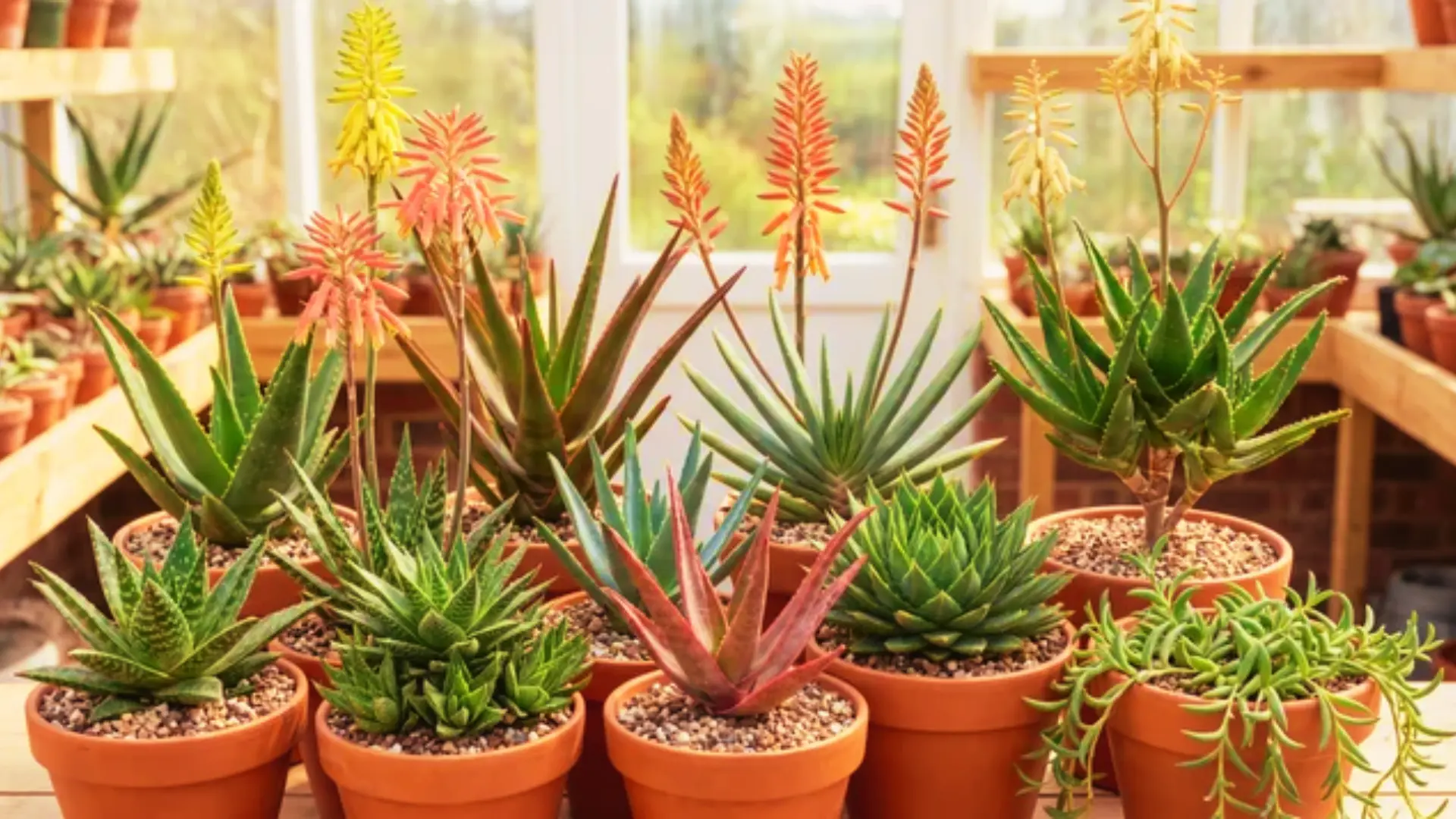
Aloe is a genus of succulent plants native mostly to Africa, Madagascar, and the Arabian Peninsula. They store water in their thick, fleshy leaves and are built to survive dry conditions with minimal care.
There are hundreds of types of aloe plants, and identification can become confusing when several species share similar features.
Aloe species identification relies on key details like leaf shape, edge teeth, markings, growth habit, and bloom color. While aloe vera is the most recognized, many others are equally captivating.
The content below is split into three growth groups: common and container-friendly varieties, colorful and ground-cover types, and shrub, climbing, and tree-like aloes. It also includes a care guide to help you grow whichever variety catches your eye.
Benefits of Aloe Plants
Aloe plants offer far more than good looks. The gel found inside the leaves has been used for centuries to soothe burns, calm irritated skin, and speed up minor wound healing. Many people keep a plant on the kitchen windowsill for exactly this reason, since a freshly cut leaf provides instant relief for smallscalds and sunburn.
Beyond skin care, aloe has a long history in traditional medicine as a digestive aid, and aloe-based drinks and supplements remain widely used today. Some varieties also carry a reputation for helping filter indoor air, one of several everyday benefits of keeping an aloe vera plant at home beyond its use on skin.
For gardeners, aloe is equally rewarding. Most varieties are drought-tolerant, low-maintenance, and well-suited to containers, making them a sensible choice for beginners and experienced growers alike. Their striking shapes and seasonal flowers also make them a strong visual anchor in both indoor and outdoor spaces.
The Basics of Aloe Species Identification
Aloes vary enough in appearance that identifying them takes more than a glance at a single leaf. Look at several features together.
Leaves offer a starting point. Shape can be broad, narrow, curved, or upright, and color ranges from green and blue-green to gray, red, or bronze. Since many species share the same thick, pointed profile, leaves alone rarely give a definitive answer.
Flowers often reveal what leaves can’t. Bloom color, stalk shape, and how tightly the flowers are packed, whether they dangle loosely or form a dense cone, are reliable ways to tell similar species apart.
Growth pattern is frequently the quickest clue. Some aloes form low compact rosettes, others spread via offsets, and some develop woody trunks or sprawling shrubs.
Common and Container-Friendly Aloe Varieties
These well-known aloe varieties are popular because they are easy to recognize and widely grown inhomes and gardens. The group includes compact potted plants, colorful rosettes, spreading clumps, and striking species with unusual leaf patterns.
Comparing their leaf shape, markings, edge teeth, growth habit, and flowers can help you tell them apart more accurately.
1. Aloe Vera
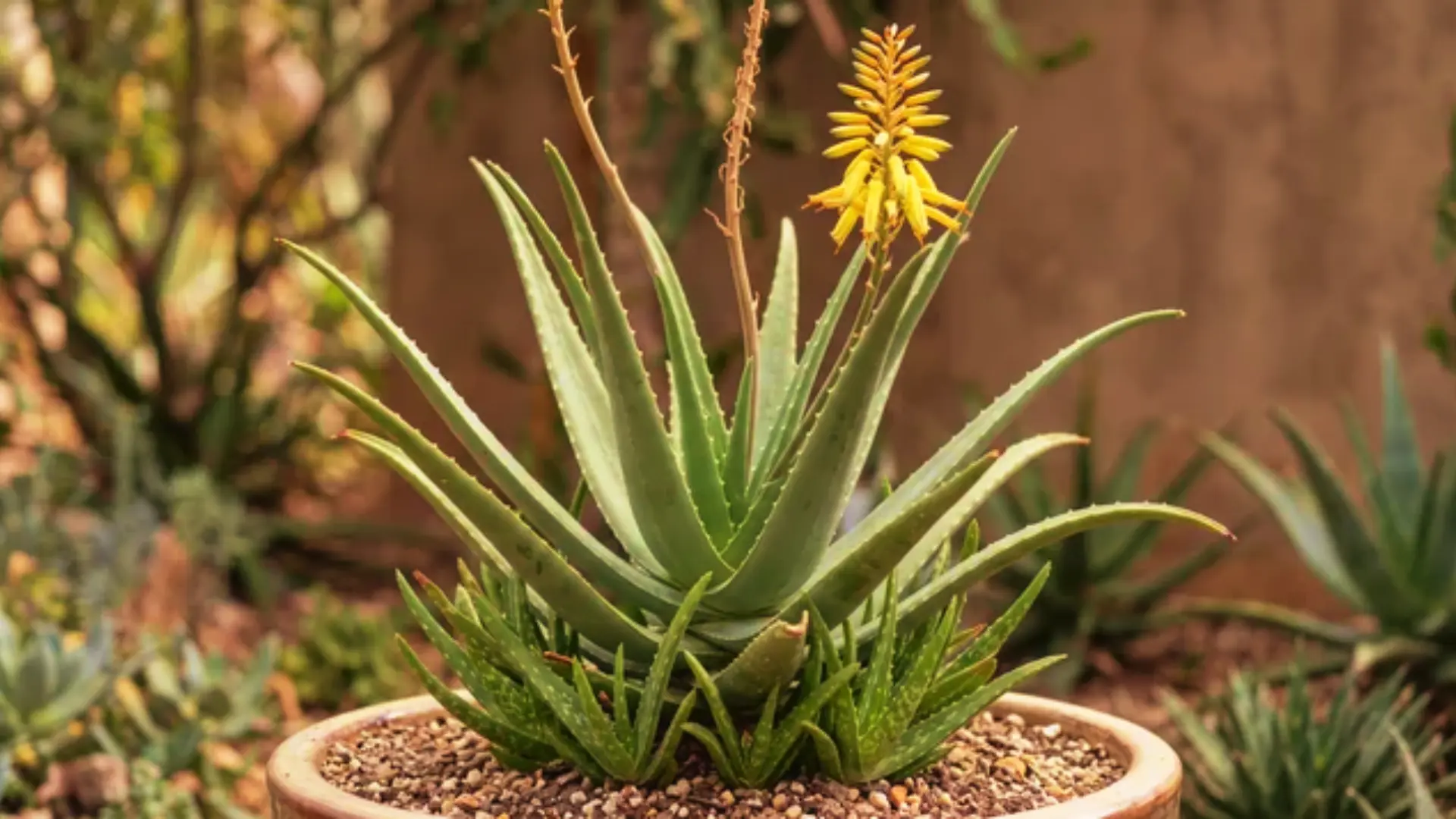
Aloe vera has thick, upright gray-green leaves with small teeth along the edges. Young plants may have pale spots that fade as the leaves mature. It forms offsets around the base, creating a clumping rosette that works well in containers and warm outdoor gardens.
- Botanical name: Aloe vera
- Sun requirements: Bright light to full sun
- Height: 1 to 2 feet
- Flower color: Yellow
- Growth form: Clumping rosette
2. Lace Aloe
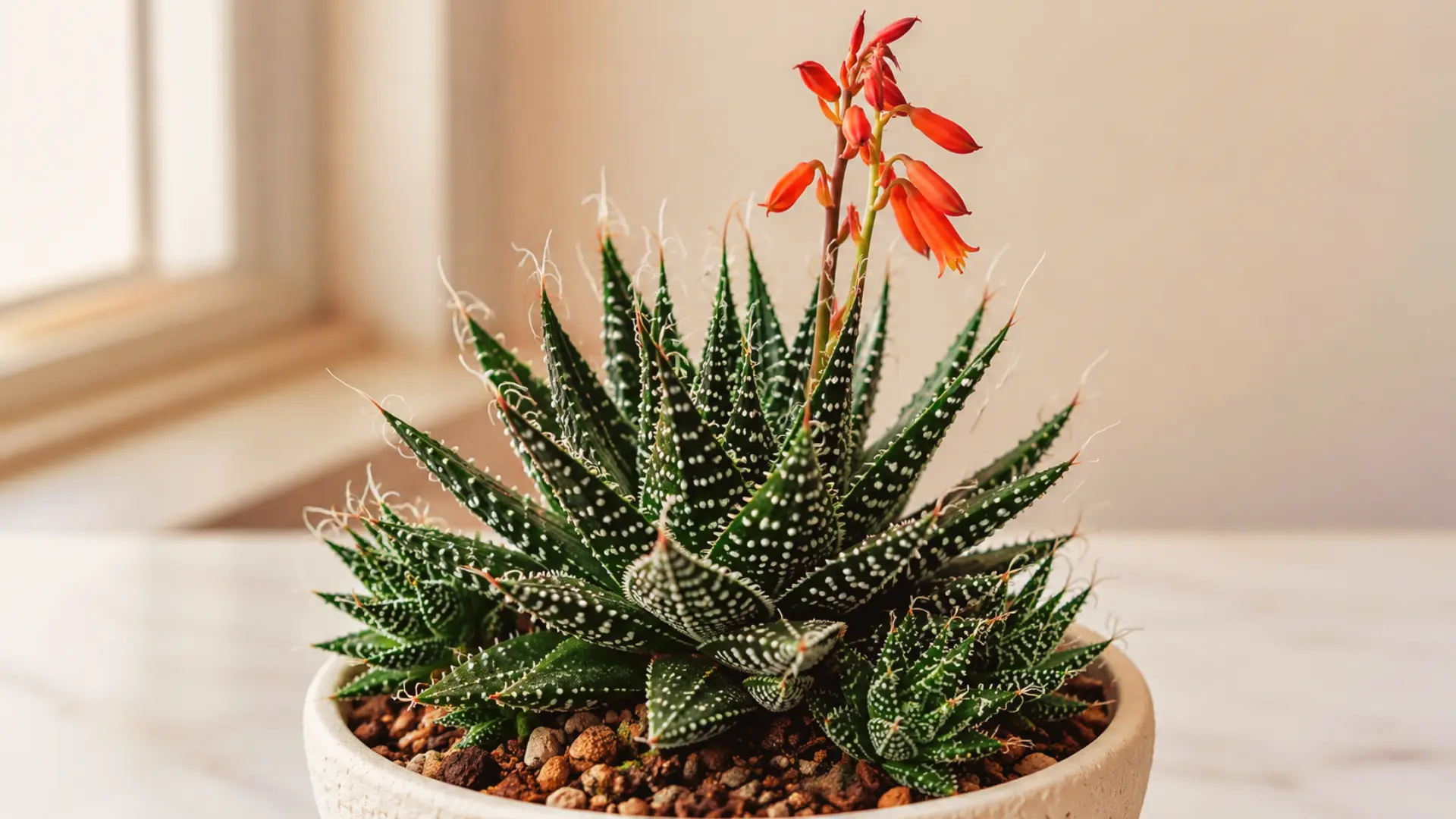
Lace aloe is a compact plant with dark green leaves covered in white raised bumps. Fine white threads may appear at the leaf tips, giving the plant its lace-like look. It produces offsets freely and is a good choice for small pots and bright indoor spaces.
- Botanical name: Aristaloe aristata
- Sun requirements: Bright indirect light to partial sun
- Height: 6 to 12 inches
- Flower color: Orange-red
- Growth form: Compact clumping rosette
3. Golden-Toothed Aloe
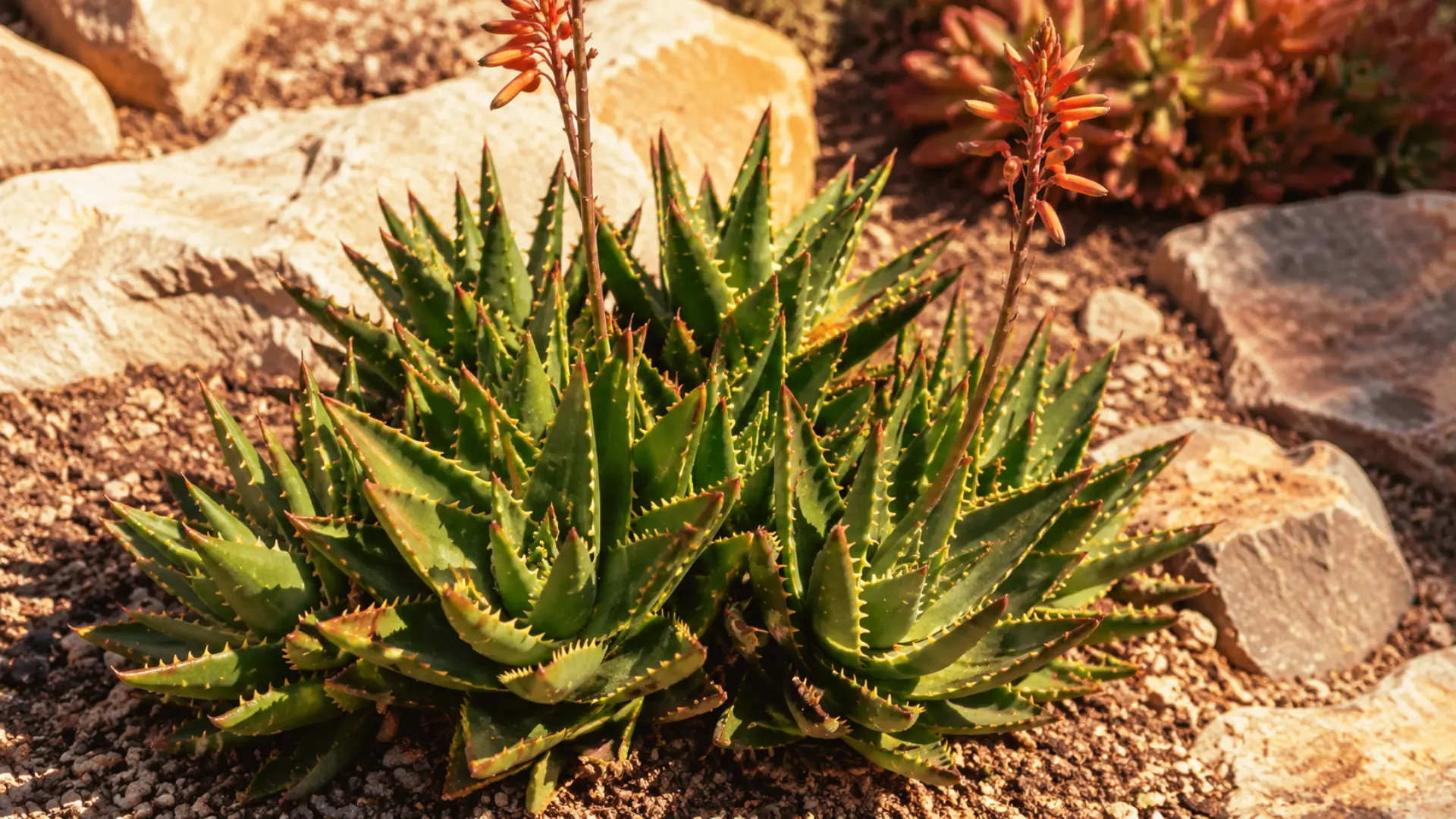
Golden-toothed aloe has short triangular leaves edged with yellow or cream teeth. Strong sunlight may give the leaf tips a rose or bronze tint. It spreads through offsets and forms a dense cluster that works well in containers or rock gardens.
- Botanical name: Aloe × nobilis
- Sun requirements: Full sun to light shade
- Height: 6 to 12 inches
- Flower color: Reddish-orange
- Growth form: Clumping rosette
4. Tiger Tooth Aloe
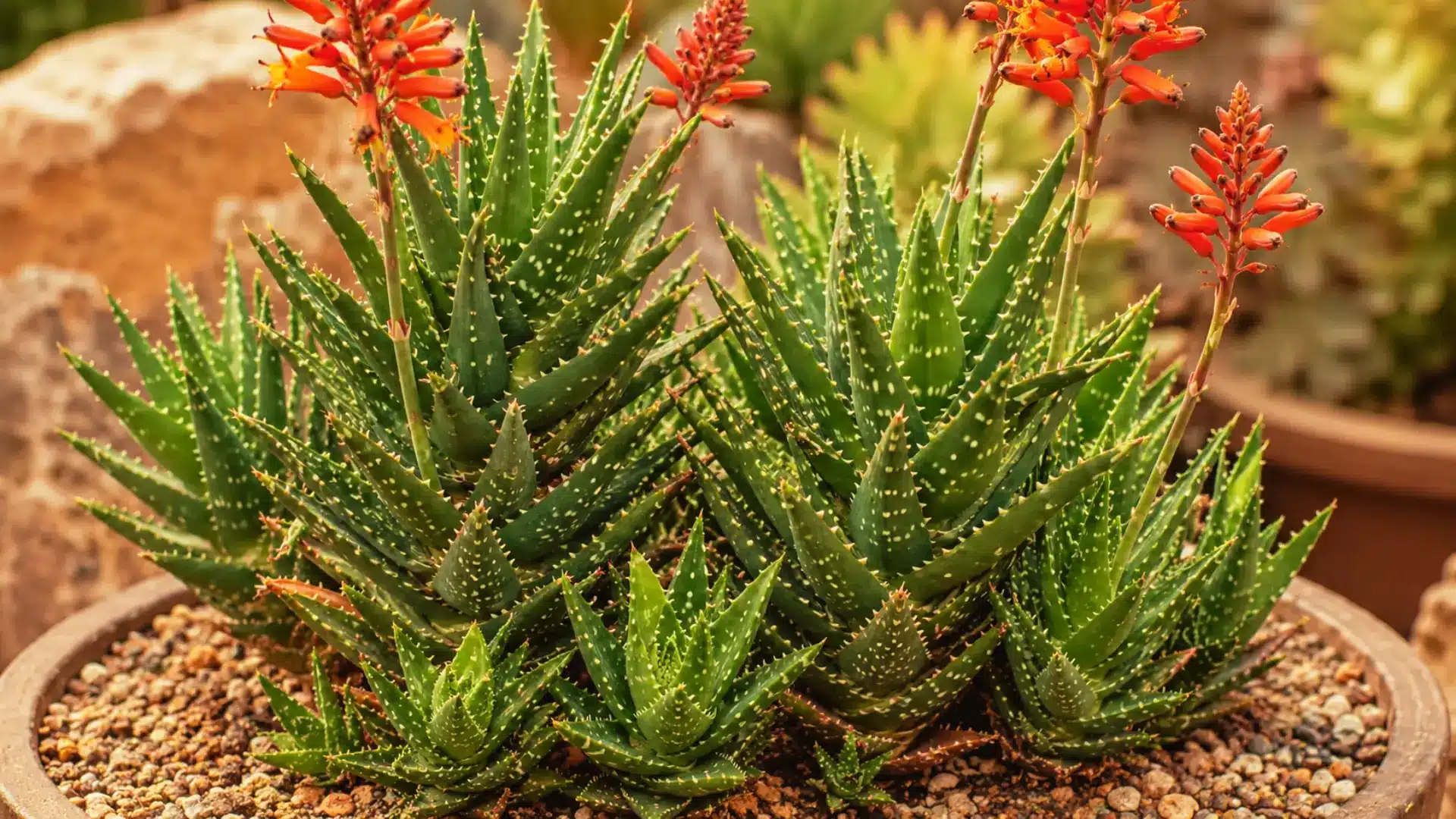
Tiger tooth aloe grows on upright stems covered with short, pointed leaves. White spots and soft-looking teeth give the plant a textured appearance. It produces many pups and gradually develops into a dense vertical clump.
- Botanical name: Aloe juvenna
- Sun requirements: Bright light to partial sun
- Height: 8 to 12 inches
- Flower color: Orange-red
- Growth form: Upright clumps
5. Tiger Aloe
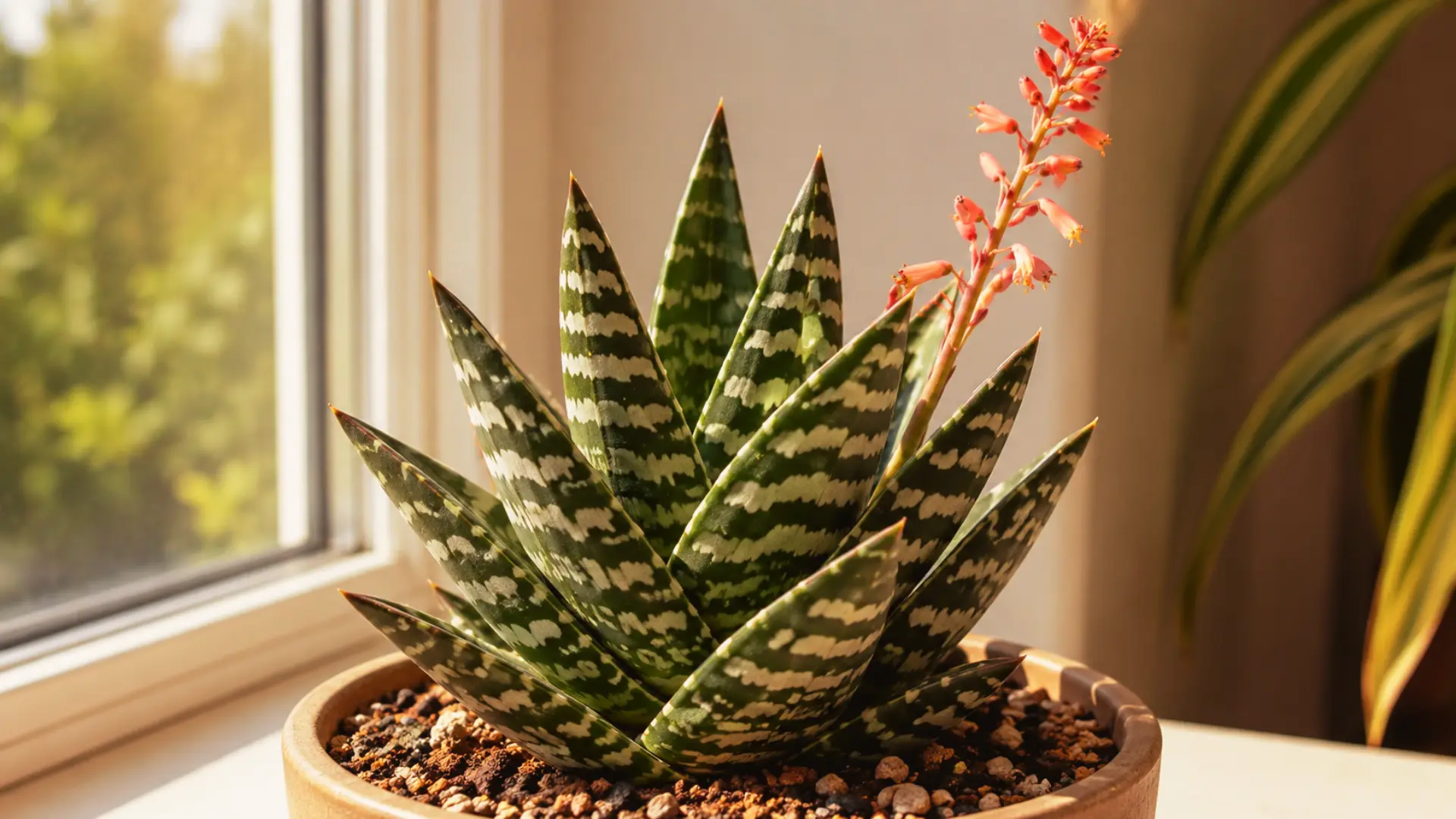
Tiger aloe has dark green triangular leaves crossed by bold white bands. The leaves grow in neat upright rows, giving the plant a tidy, stacked look. Its compact size makes it suitable for small containers and bright windows.
- Botanical name: Gonialoe variegata
- Sun requirements: Bright indirect light to partial sun
- Height: 8 to 12 inches
- Flower color: Salmon, orange, or pink-red
- Growth form: Compact rosette
6. Soap Aloe
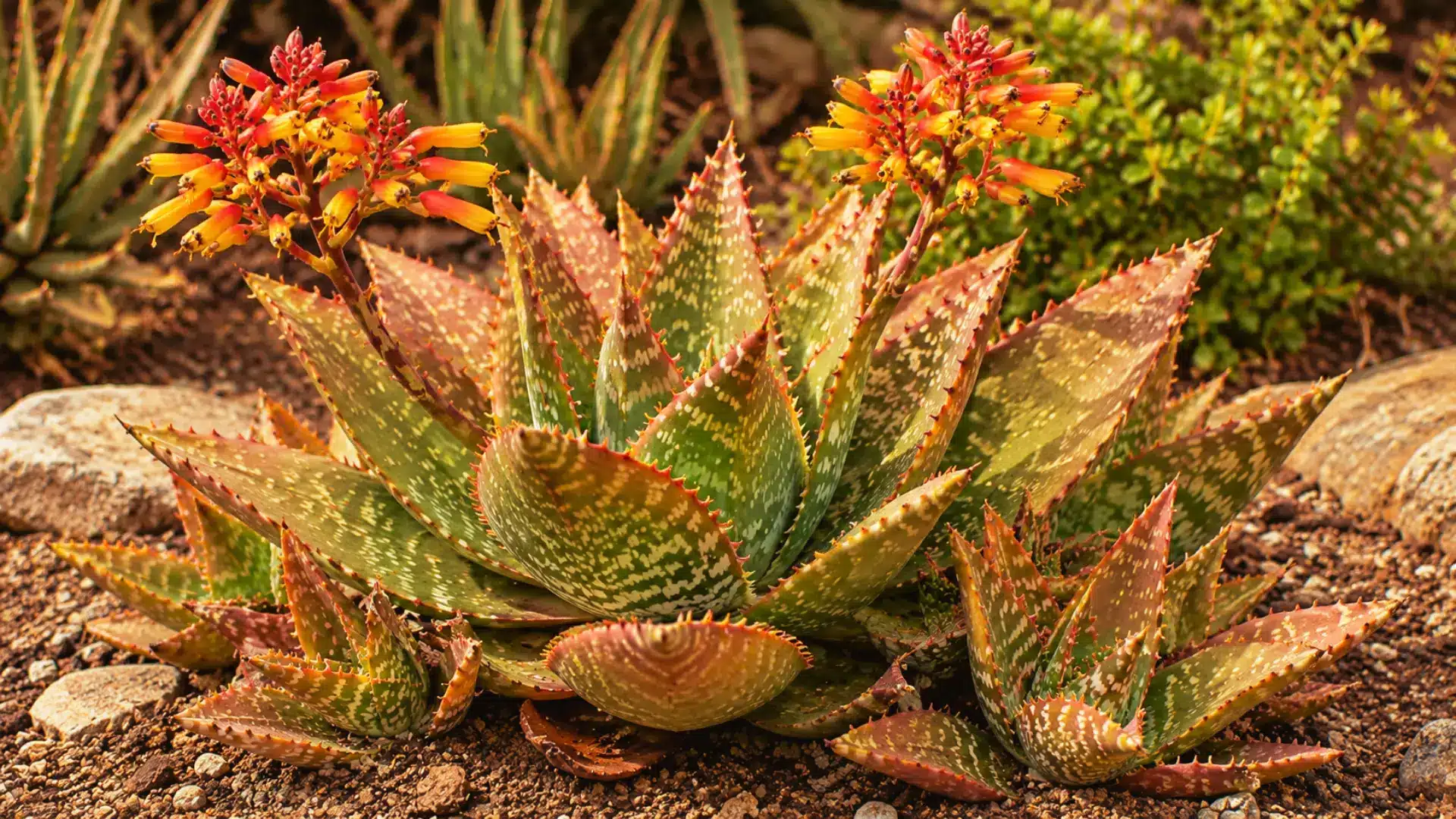
Soap aloe has broad leaves covered with pale spots and dark teeth along the edges. Its foliage may turn bronze or pink in strong sunlight. The plant spreads through offsets and produces branched flower stalks, making it useful as a colorful garden ground cover.
- Botanical name: Aloe maculata
- Sun requirements: Full sun to partial shade
- Height: 1 to 2 feet
- Flower color: Yellow, orange, or red
- Growth form: Clumping rosette
7. Coral Aloe
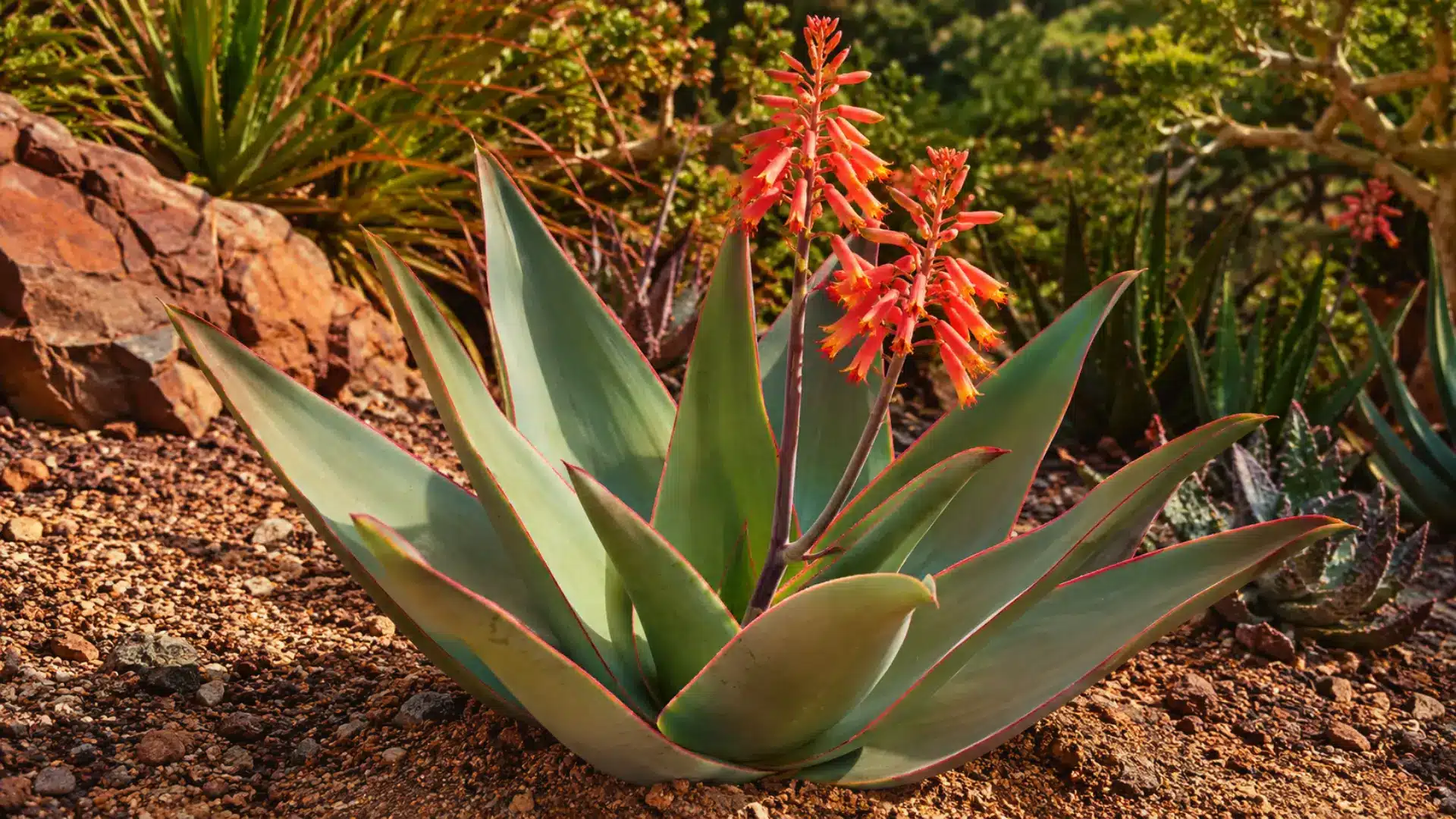
Coral aloe has broad blue-green leaves with smooth edges instead of sharp teeth. A thin pink or coral line often outlines each leaf. It usually forms one large rosette and produces bright branching flower stalks above the foliage.
- Botanical name: Aloe striata
- Sun requirements: Full sun to light shade
- Height: 1 to 2 feet
- Flower color: Coral, orange, or red
- Growth form: Solitary rosette
8. Spiral Aloe
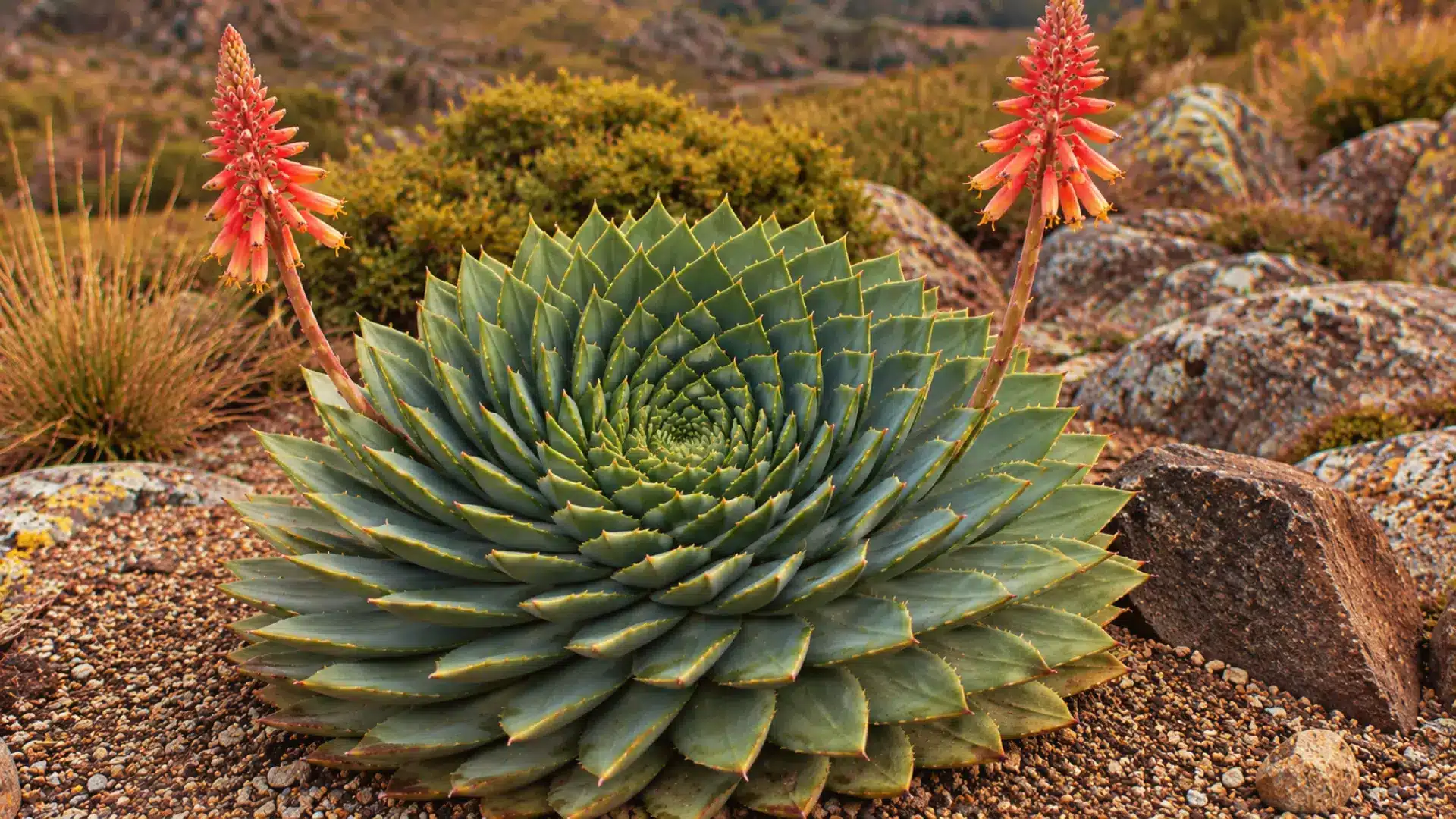
Spiral aloe is known for its leaves, which form a clear clockwise or counterclockwise spiral. The pattern becomes stronger as the plant matures. It is a striking landscape plant but needs cooler conditions and more careful watering than many common aloes.
- Botanical name: Aloe polyphylla
- Sun requirements: Full sun to light afternoon shade
- Height: 1 to 2 feet
- Flower color: Pink, salmon, red, or yellow
- Growth form: Large solitary rosette
9. Red Aloe
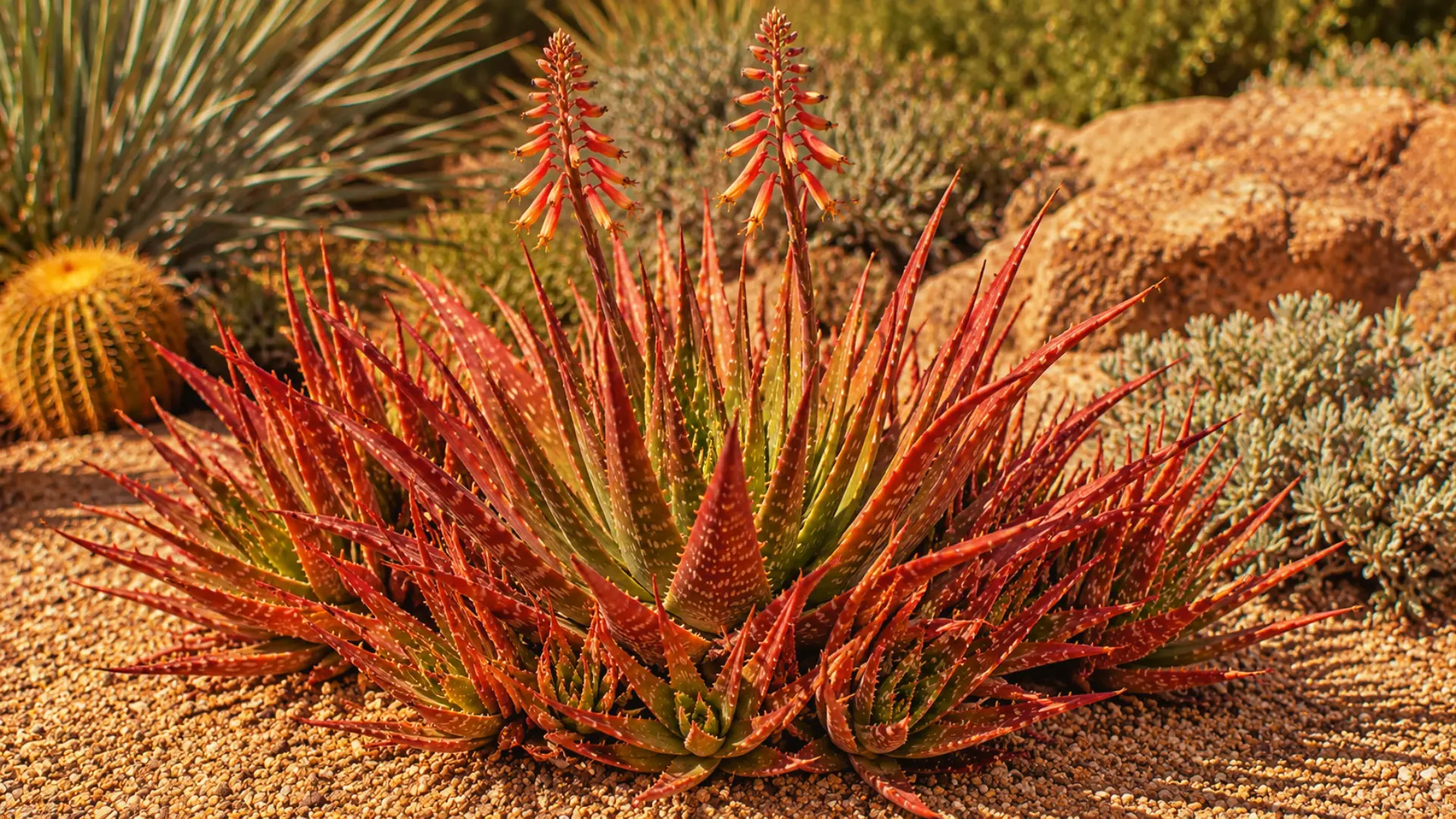
Red aloe has narrow leaves that turn copper, orange, or deep red in strong sunlight. In shade, the foliage may remain mostly green. It spreads through offsets and creates colorful clumps in dry gardens.
- Botanical name: Aloe cameronii
- Sun requirements: Full sun
- Height: 1 to 2 feet
- Flower color: Orange-red
- Growth form: Clumping rosette
Colorful, Spreading, and Ground-Cover Aloes
This group highlights aloes with bold leaf colors, unusual textures, and low-growing forms. Some stay neat and compact in containers, while others spread through offsets or creeping stems to form dense ground cover.
Their spotted leaves, raised bumps, sharp teeth, and vivid flowers make them especially useful for identification and visual interest.
10. Short-Leaf Aloe
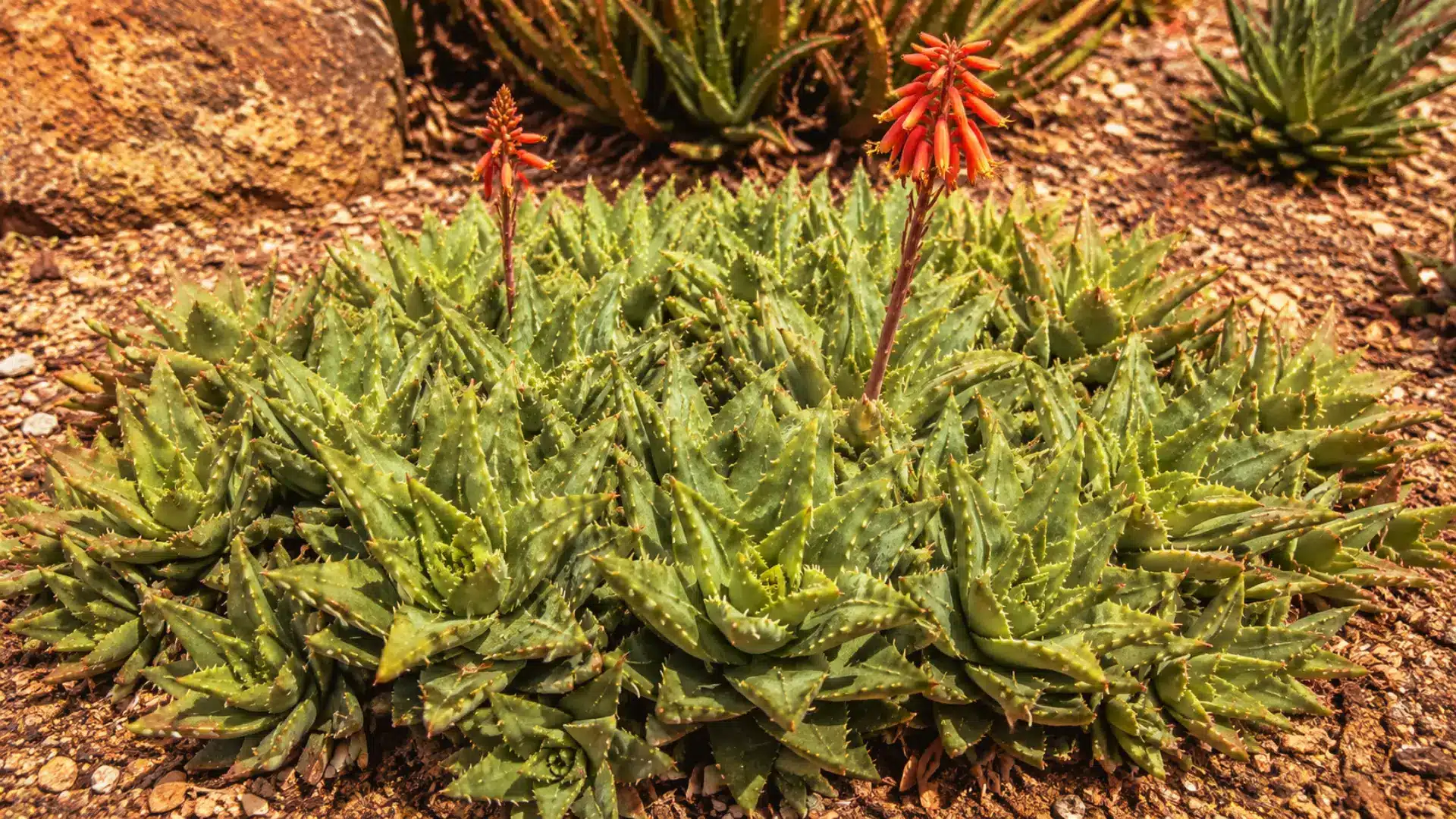
Short-leaf aloe forms small gray-green rosettes that spread across the soil. Pale teeth line the leaf edges and may also appear on the outer surfaces. This variety works well as a low ground cover in warm, dry gardens.
- Botanical name: Aloe brevifolia
- Sun requirements: Full sun to partial shade
- Height: 4 to 8 inches
- Flower color: Orange-red
- Growth form: Spreading ground cover
11. Sunset Aloe
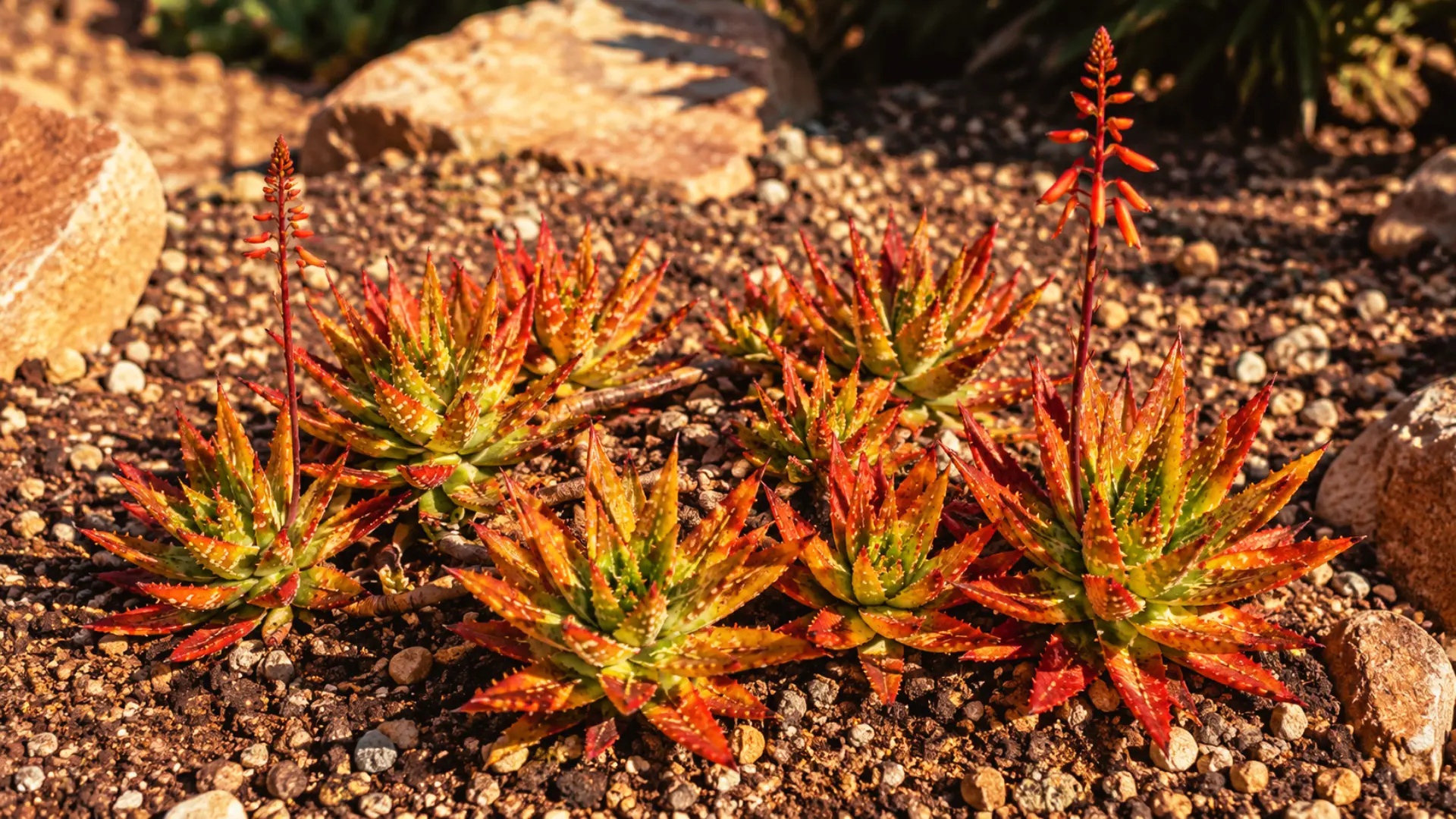
Sunset aloe displays a mix of green, yellow, orange, and red foliage. Its strongest colors develop in bright sunlight and dry conditions. The low-growing rosettes spread through offsets, creating a vivid ground-level colony.
- Botanical name: Aloe dorotheae
- Sun requirements: Full sun to partial shade
- Height: 8 to 12 inches
- Flower color: Orange-red
- Growth form: Low spreading clumps
12. Jewel Aloe
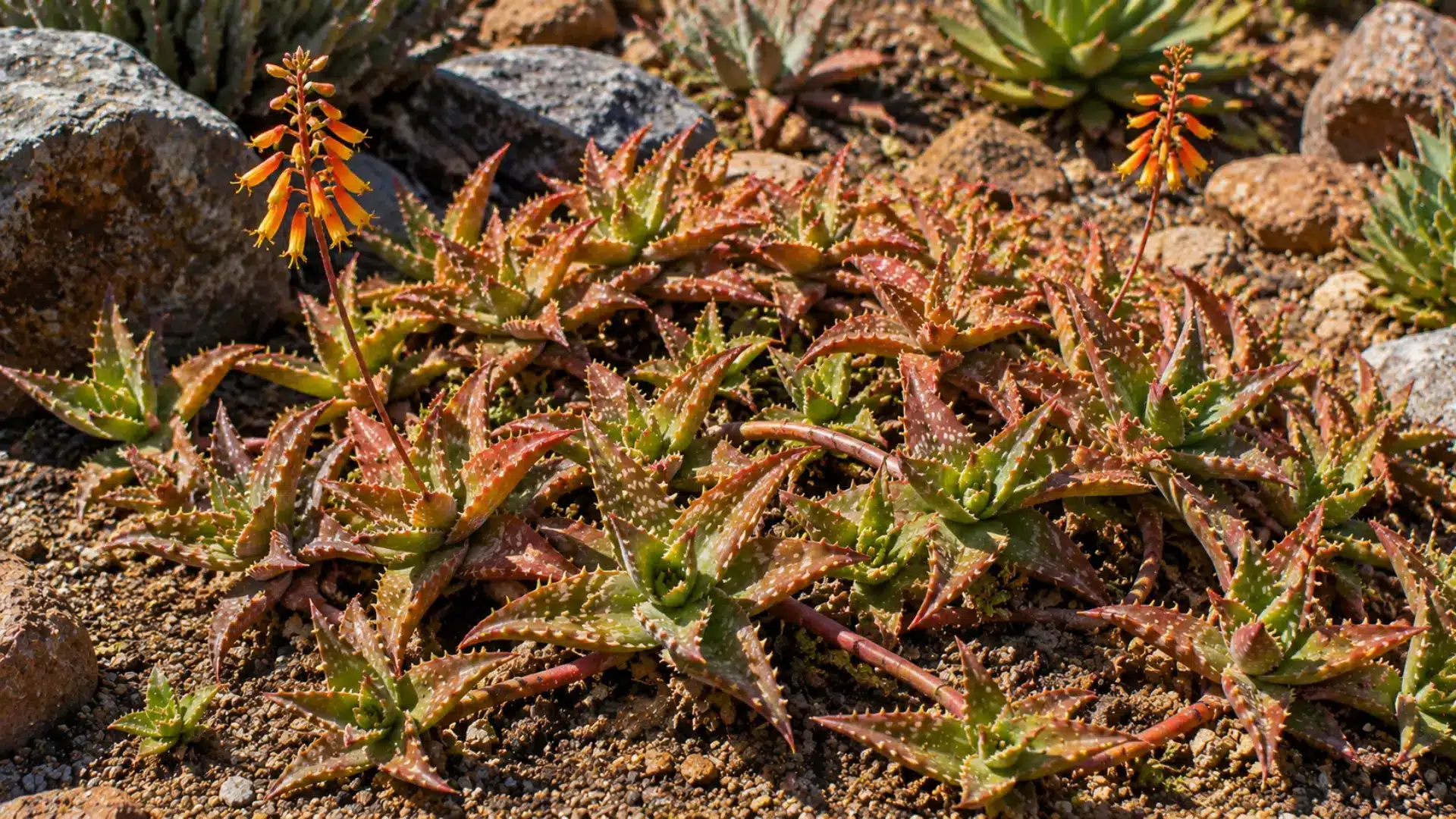
Jewel aloe has short creeping stems that spread along the ground or over rocks. Its triangular leaves have large jagged teeth and may turn bronze or red in strong sunlight. This variety works well in rock gardens, raised beds, and warm slopes.
- Botanical name: Aloe distans
- Sun requirements: Full sun to partial shade
- Height: 6 to 12 inches
- Flower color: Yellow, orange, or red
- Growth form: Spreading ground cover
13. Spider Aloe
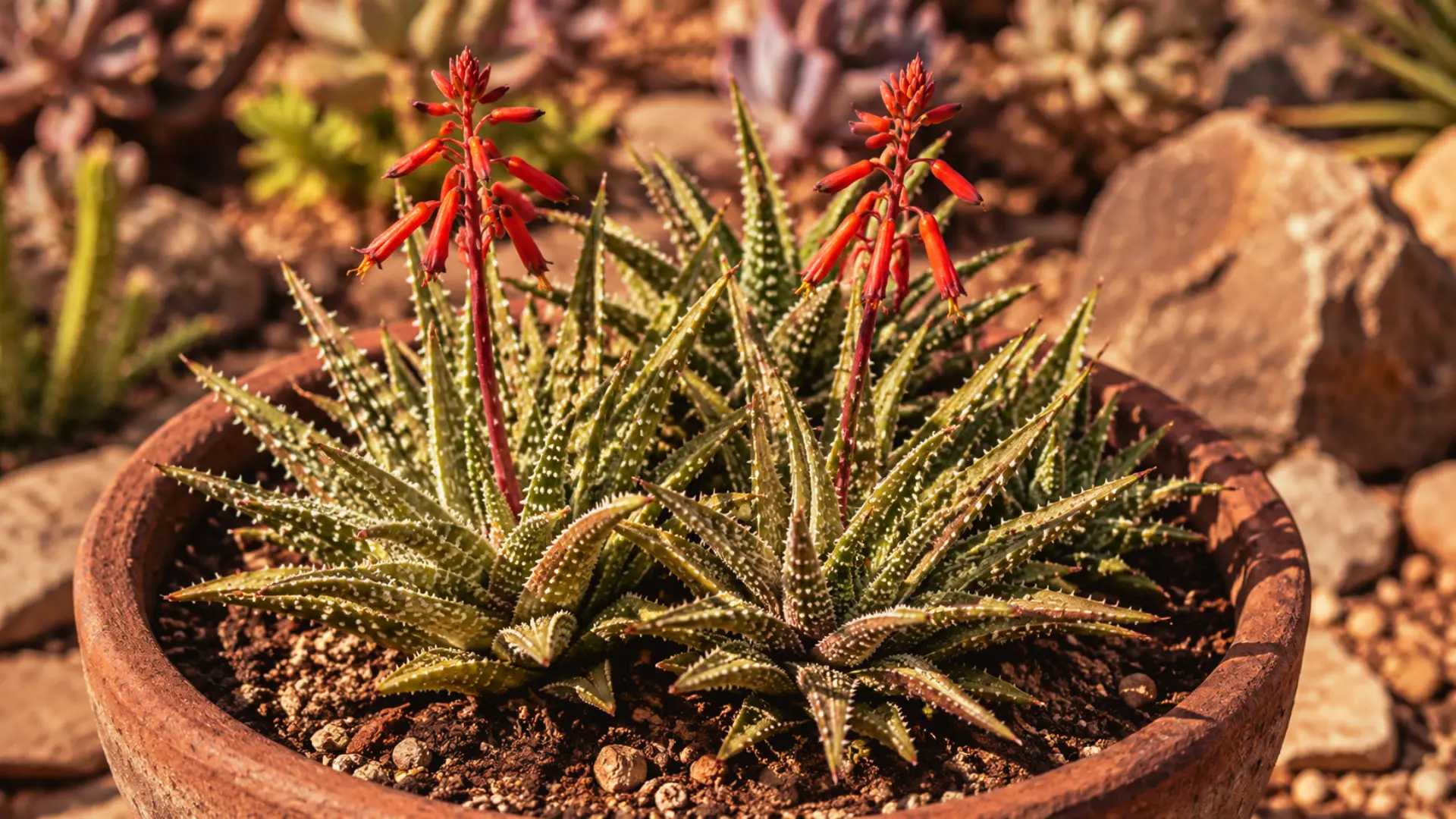
Spider aloe forms small rosettes of narrow gray-green leaves. White bumps, pale teeth, and soft prickles cover the foliage, giving it a rough texture. It stays compact and is suitable for small pots or grouped succulent displays.
- Botanical name: Aloe humilis
- Sun requirements: Bright light to partial sun
- Height: 4 to 8 inches
- Flower color: Scarlet or orange-red
- Growth form: Dwarf clumping rosette
14. Mitre Aloe
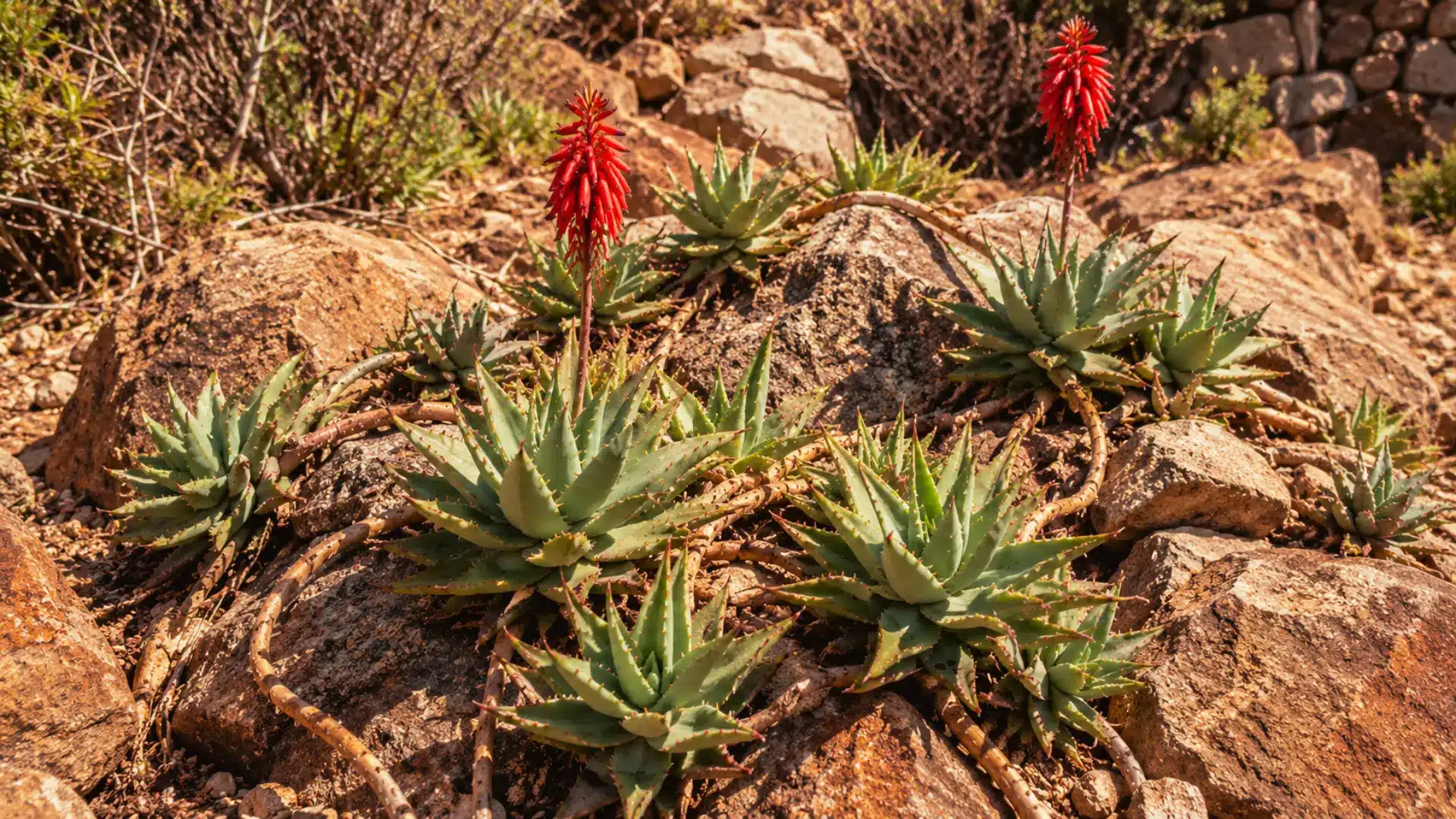
Mitre aloe grows on long stems that creep or trail across the ground. Compact rosettes form at the stem tips, with thick blue-green leaves edged by small teeth. It works well on rocky slopes or where the stems can spread naturally.
- Botanical name: Aloe mitriformis
- Sun requirements: Full sun to partial shade
- Height: 1 to 2 feet
- Flower color: Bright red
- Growth form: Trailing or creeping
15. Sand Aloe
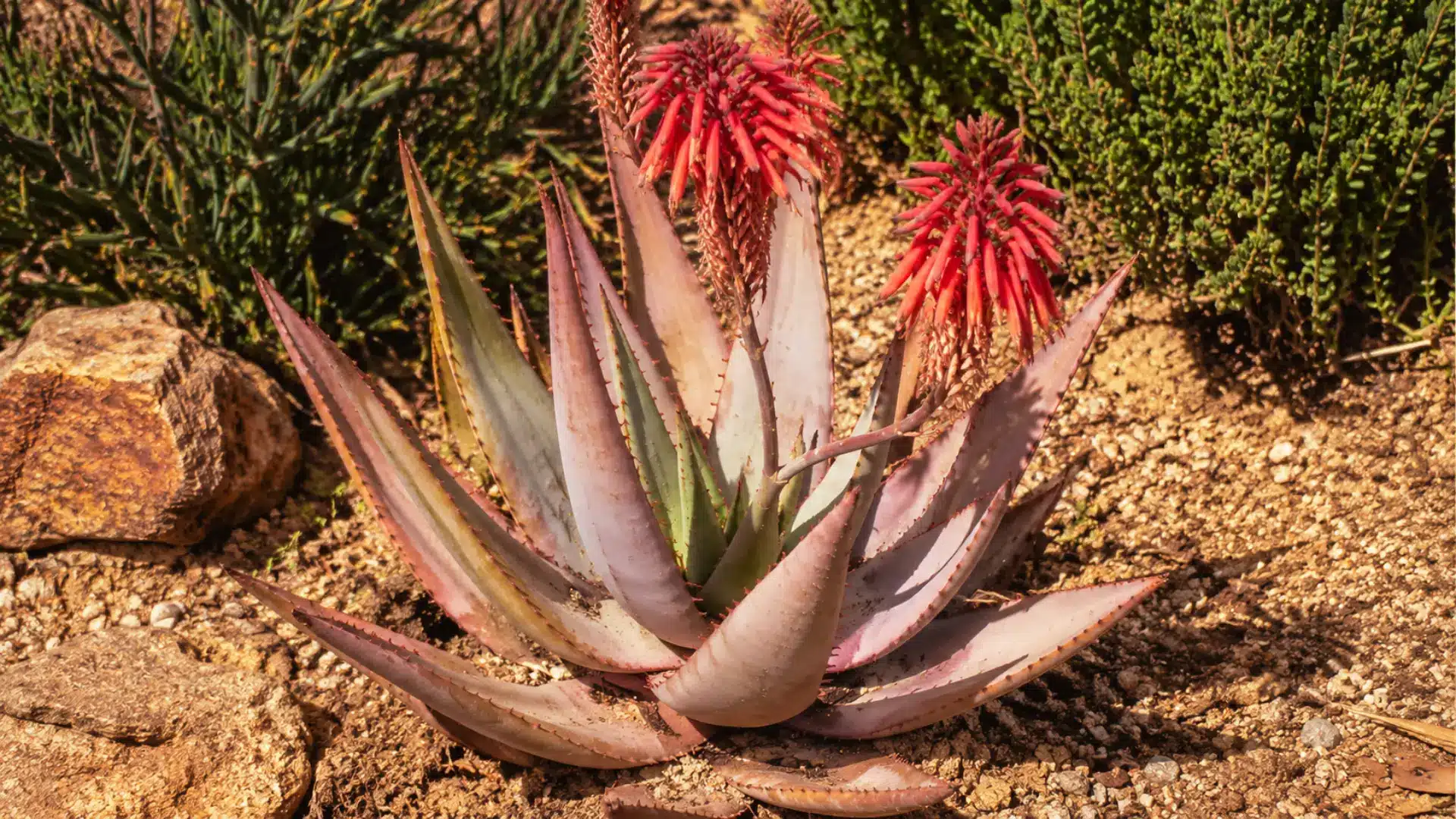
Sand aloe has broad, stiff leaves that may appear silver, gray-green, or pink. Reddish-brown teeth line the edges, giving the plant a bold, armed look. It usually forms one medium-sized rosette and works best in warm, dry outdoor spaces.
- Botanical name: Aloe hereroensis
- Sun requirements: Full sun
- Height: 1 to 2 feet
- Flower color: Red or scarlet
- Growth form: Medium solitary rosette
16. Prickly Aloe
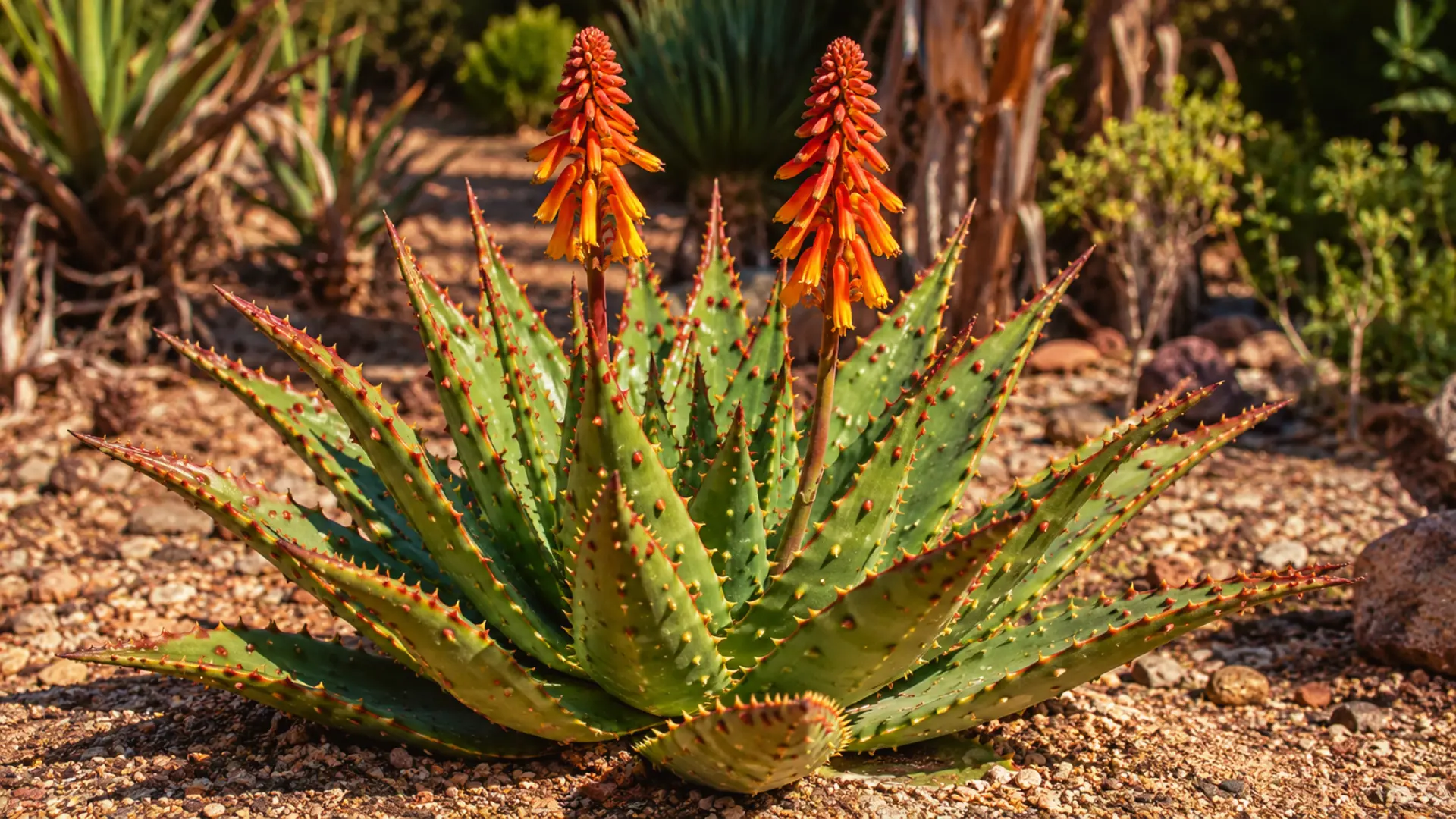
Prickly aloe is covered with reddish-brown thorns across both the leaf edges and surfaces. These thorns often rise from pale bases, making the leaves look spotted from a distance. It forms one large rosette and needs enough room to display its wide shape.
- Botanical name: Aloe aculeata
- Sun requirements: Full sun
- Height: 2 to 3 feet
- Flower color: Yellow, orange, or red
- Growth form: Large solitary rosette
17. Arabian Aloe
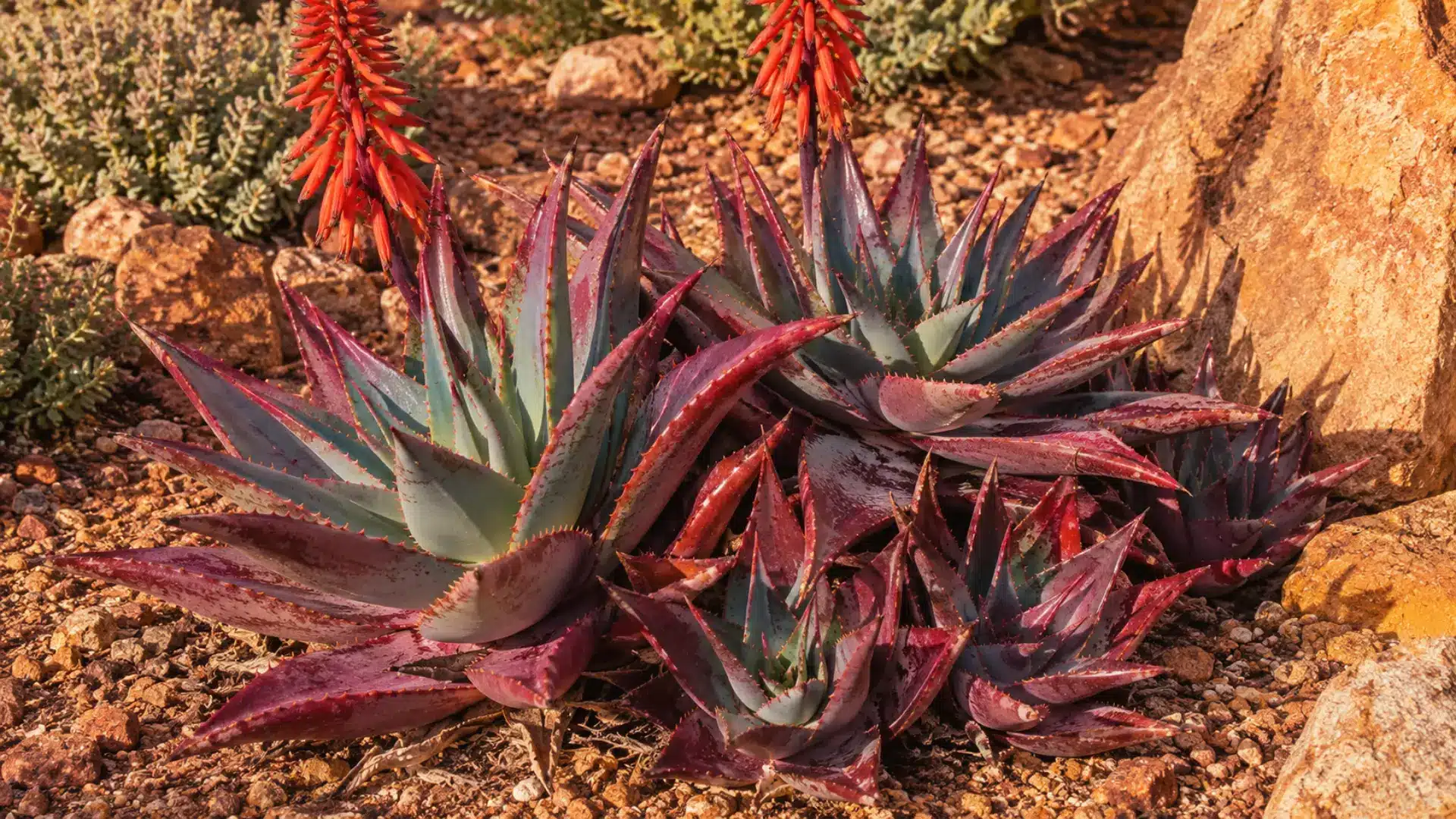
Arabian aloe has broad, arching leaves that turn red, purple, or violet in strong sun and cool weather. It forms offsets and gradually develops into a wide colony. This variety is useful where you want strong winter color and bold foliage.
- Botanical name: Aloe rubroviolacea
- Sun requirements: Full sun to light shade
- Height: 2 to 3 feet
- Flower color: Orange-red
- Growth form: Large clumping rosette
18. White-Flowered Aloe
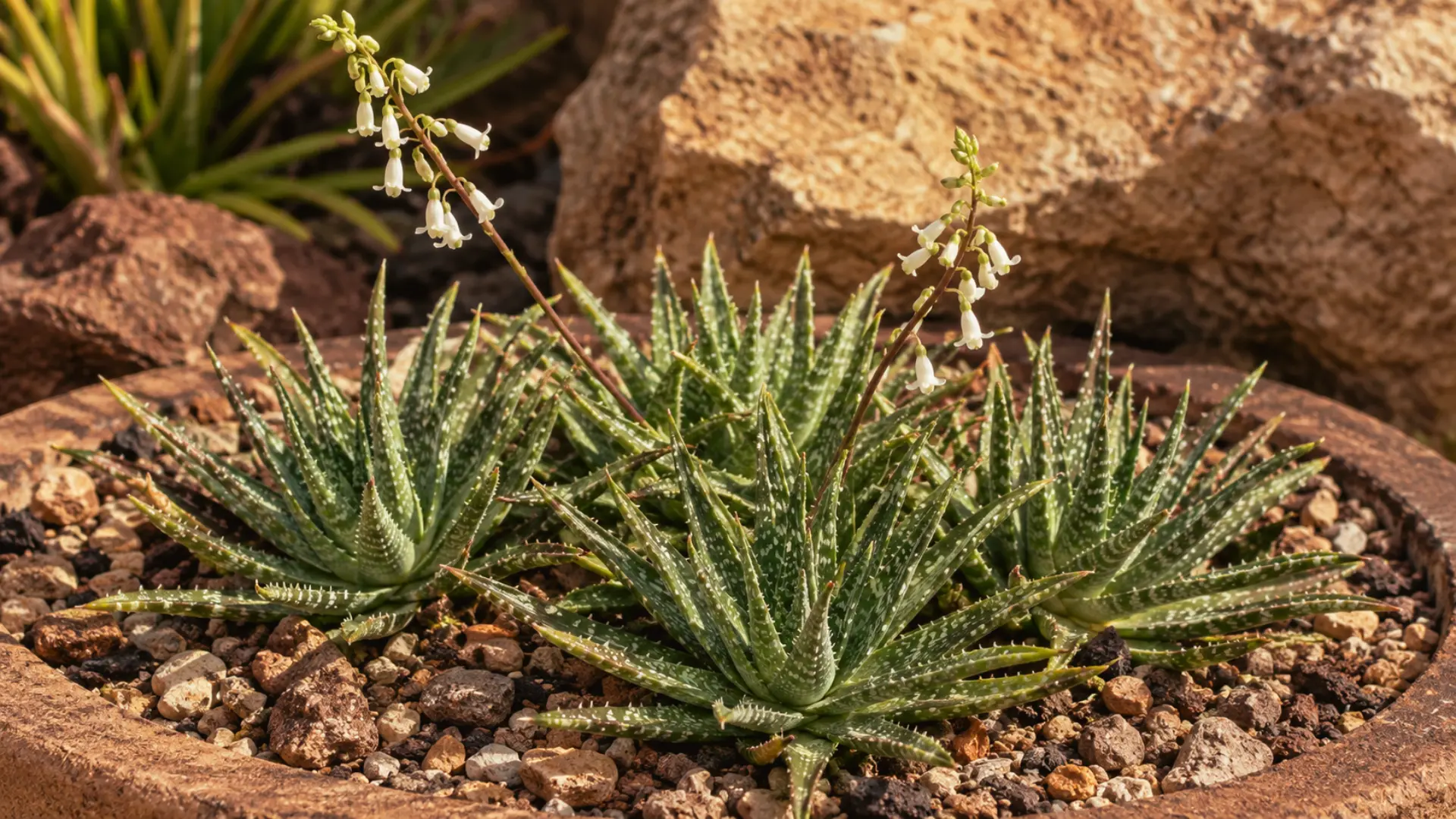
White-flowered aloe is a small species with narrow gray-green leaves covered in fine white spots. Small teeth line the leaf edges, while loose stalks carry unusual white flowers. It is a good choice for collectors who want a compact aloe with a rare bloom color.
- Botanical name: Aloe albiflora
- Sun requirements: Bright light to partial sun
- Height: 6 to 12 inches
- Flower color: White
- Growth form: Small clumps
19. Van Balen’s Aloe
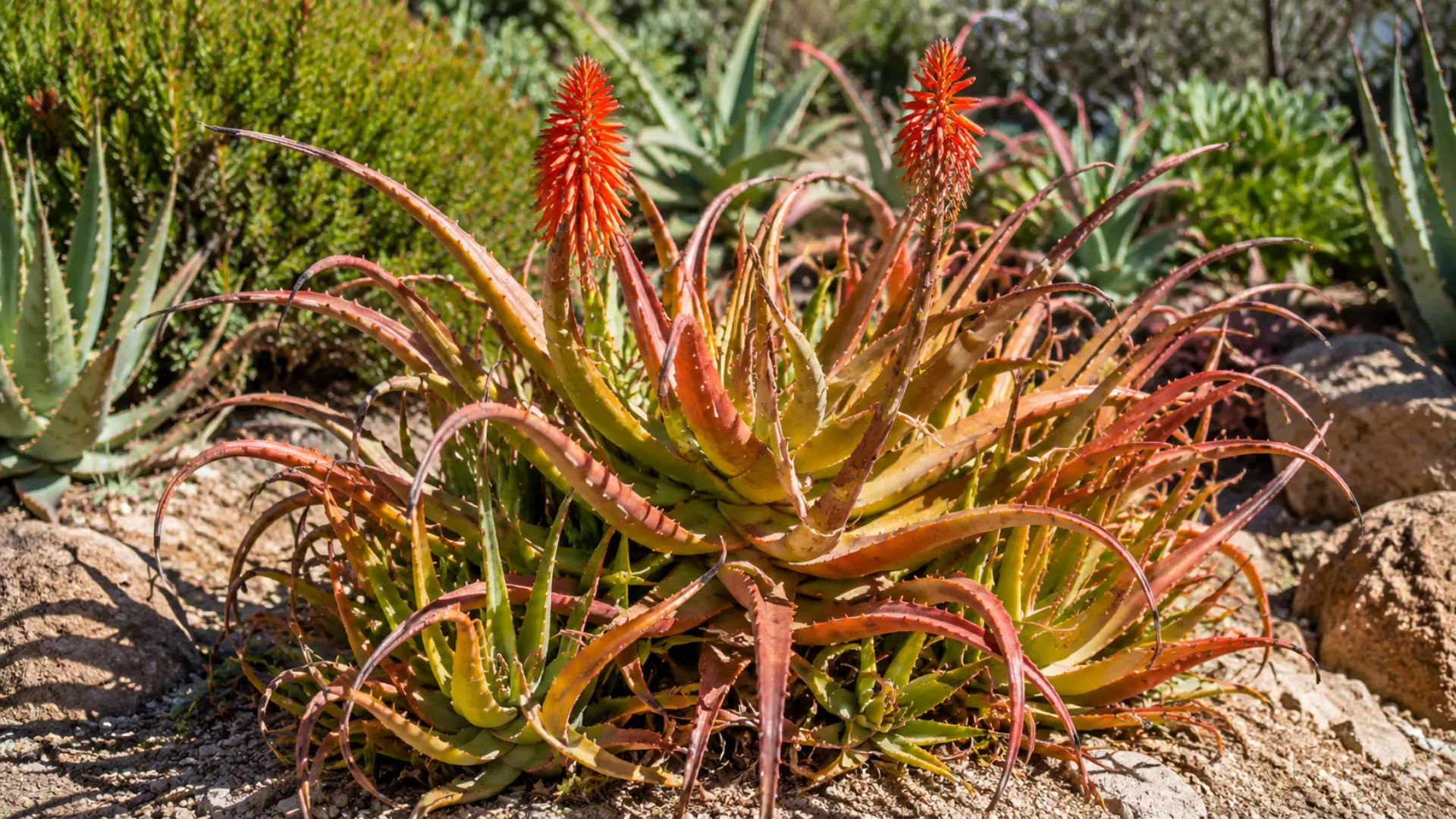
Van Balen’s aloe has long leaves that curve outward like tentacles. The foliage may change from yellow-green to bronze or red in strong sunlight. It forms offsets and can develop into a broad, dramatic clump.
- Botanical name: Aloe vanbalenii
- Sun requirements: Full sun to partial shade
- Height: 2 to 3 feet
- Flower color: Orange or red
- Growth form: Large clumping rosette
Shrub, Climbing, and Tree-Like Aloes
This group includes larger aloes with bold, structural growth habits. Some form dense shrubs with many branching stems, while others climb withlong flexible growth or develop thick woody trunks and broad crowns. Their mature shape, branching pattern, and height are often the clearest clues for identification.
20. Cat’s Tail Aloe
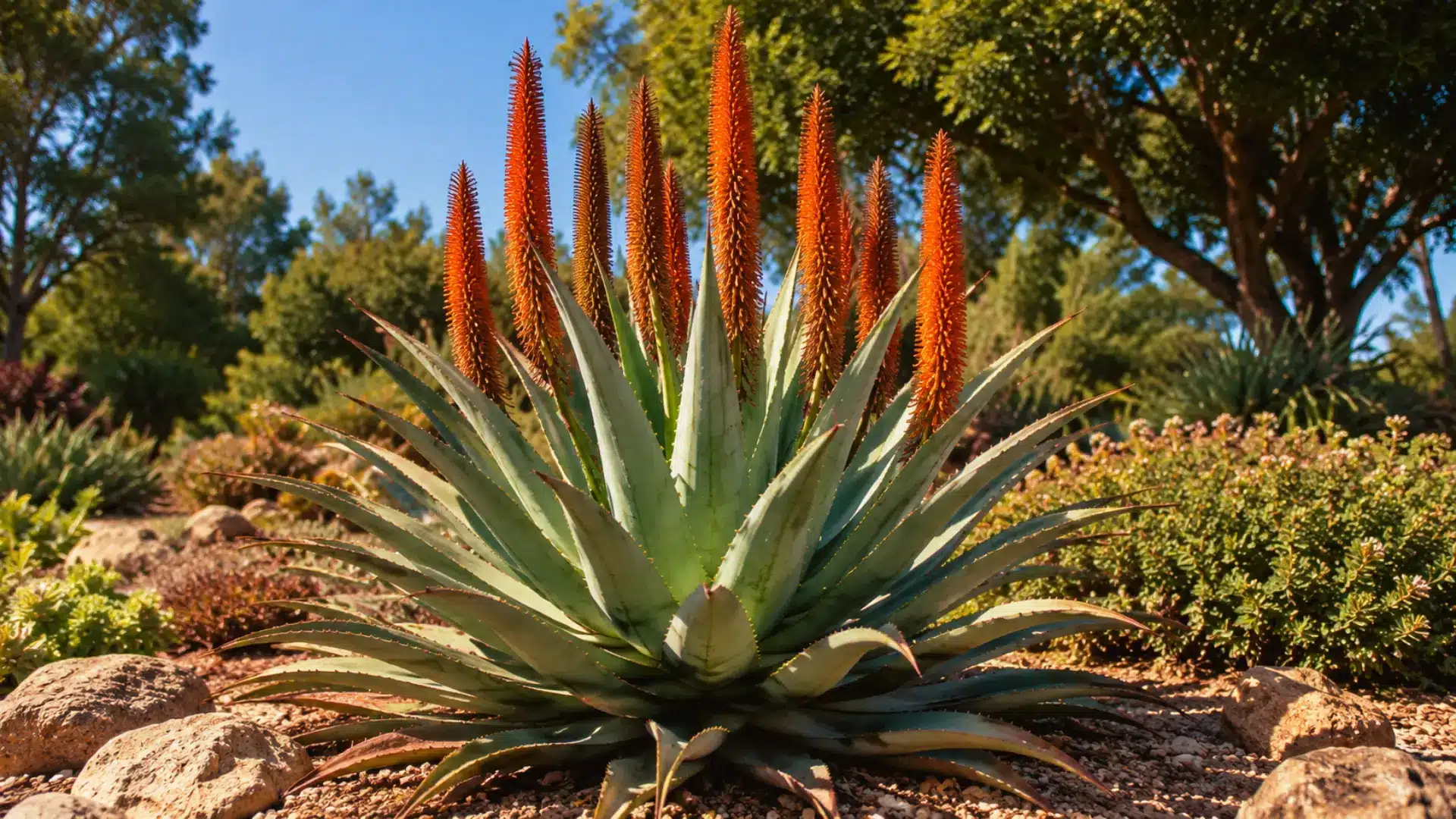
Cat’s tail aloe develops an upright trunk topped with long gray-green leaves. Its most distinct feature is the curved flower spike covered with brown-orange blooms, which creates a fuzzy tail-like shape. It is best suited to warm outdoor gardens with plenty of vertical space.
- Botanical name: Aloe castanea
- Sun requirements: Full sun
- Height: 6 to 12 feet
- Flower color: Brown-orange
- Growth form: Single-trunk tree aloe
21. African Aloe
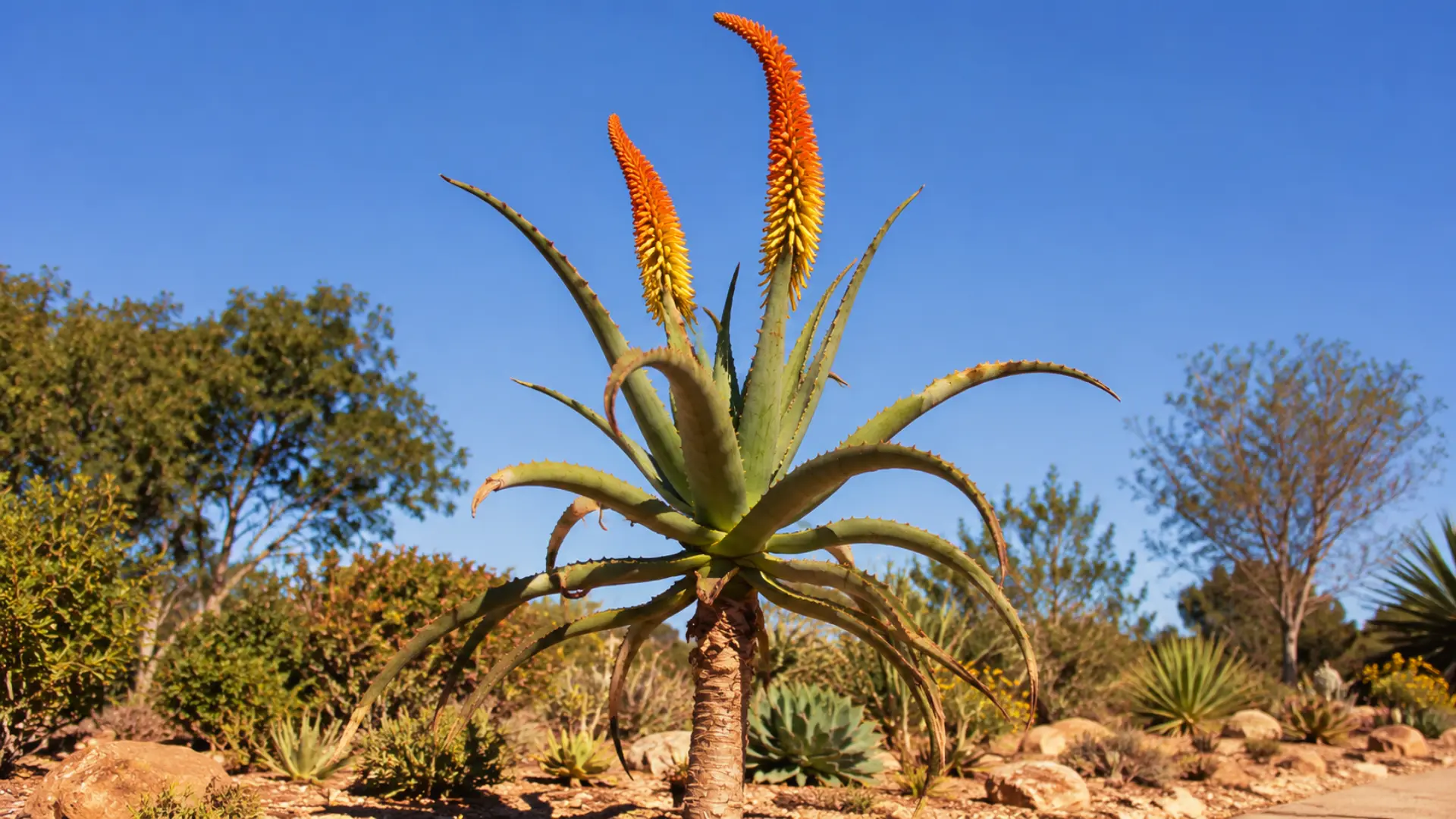
African aloe grows on a tall trunk topped by a loose rosette. Its long leaves curve in different directions, creating a less formal shape than many other tree aloes. The upward-curving orange and yellow flowers are also useful for identification.
- Botanical name: Aloe africana
- Sun requirements: Full sun
- Height: 6 to 8 feet
- Flower color: Orange and yellow
- Growth form: Tree-like aloe
22. Krantz Aloe
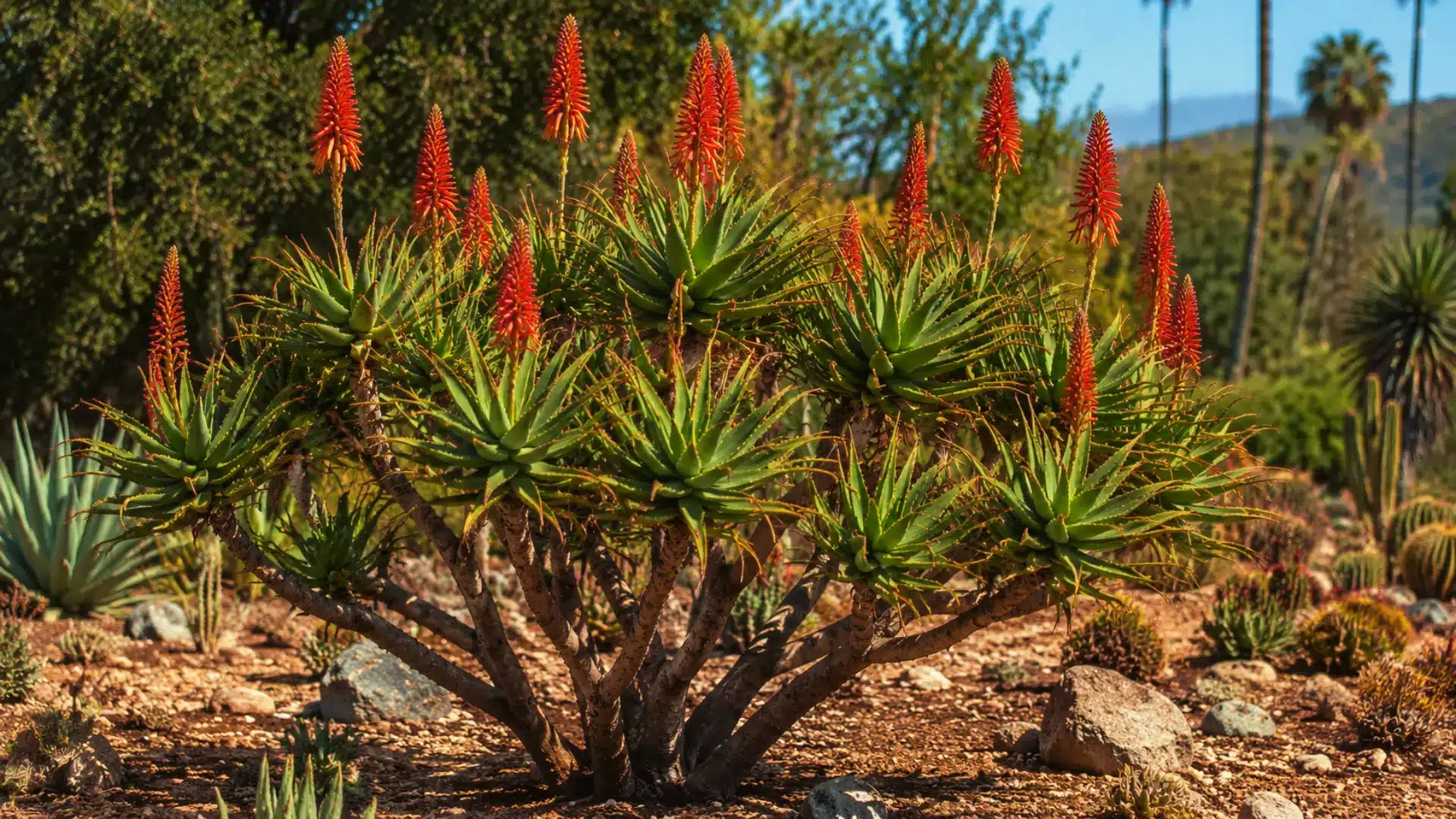
Krantz aloe forms a large shrub with several woody branches. Each branch ends in a rosette of long toothed leaves, creating a candelabra-like appearance. It works well as a flowering hedge or large landscape feature in frost-free areas.
- Botanical name: Aloe arborescens
- Sun requirements: Full sun to partial shade
- Height: 6 to 10 feet
- Flower color: Red or orange
- Growth form: Large branching shrub
23. Climbing Aloe
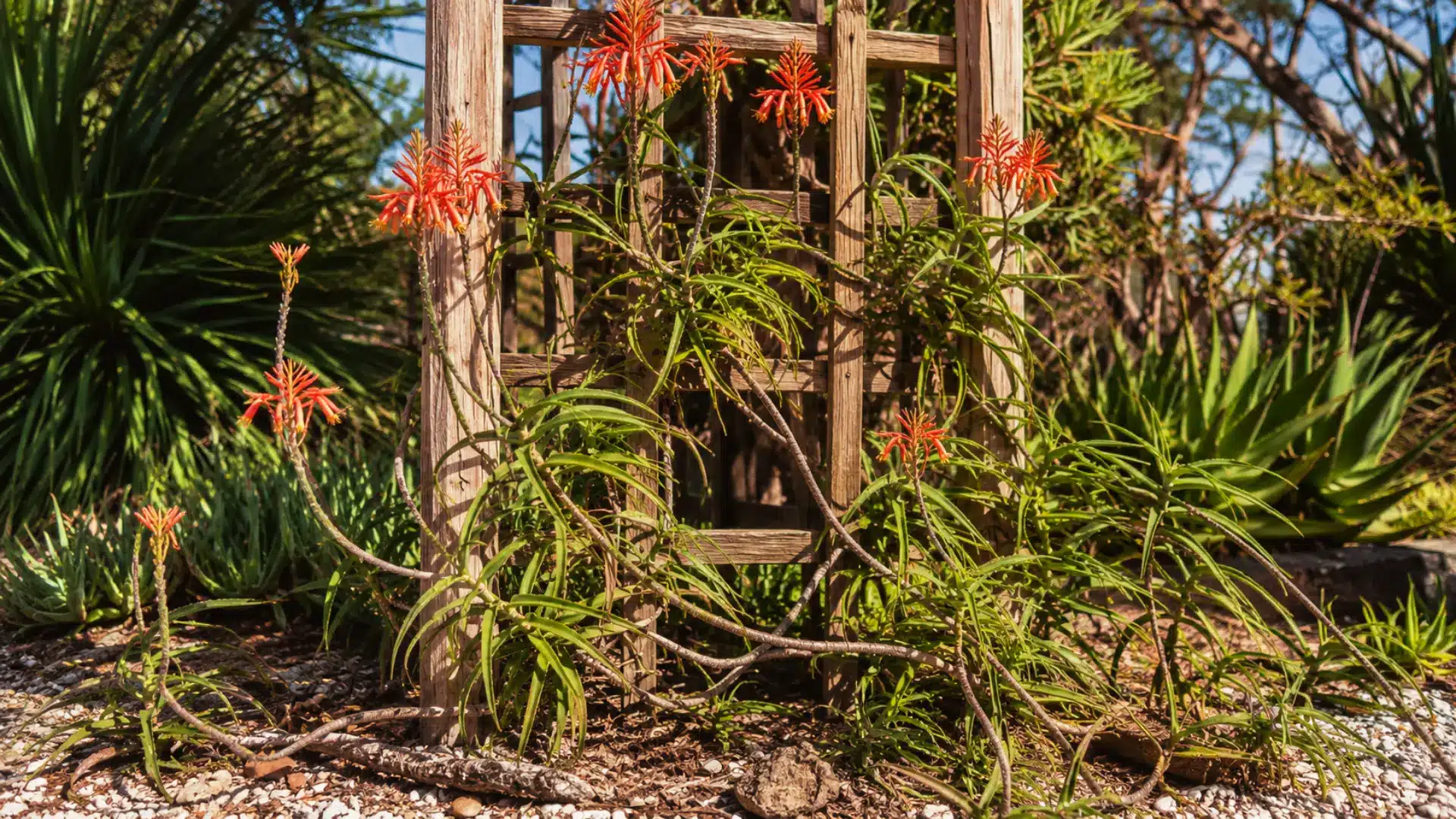
Climbing aloe produces long, flexible stems that lean against nearby plants, fences, or supports. Narrow leaves grow along the stems instead of forming one broad rosette. It grows quickly in warm climates and can be trained upward or allowed to trail.
- Botanical name: Aloiampelos ciliaris
- Sun requirements: Full sun to partial shade
- Height: 6 to 15 feet with support
- Flower color: Orange-red
- Growth form: Climber
24. Fan Aloe
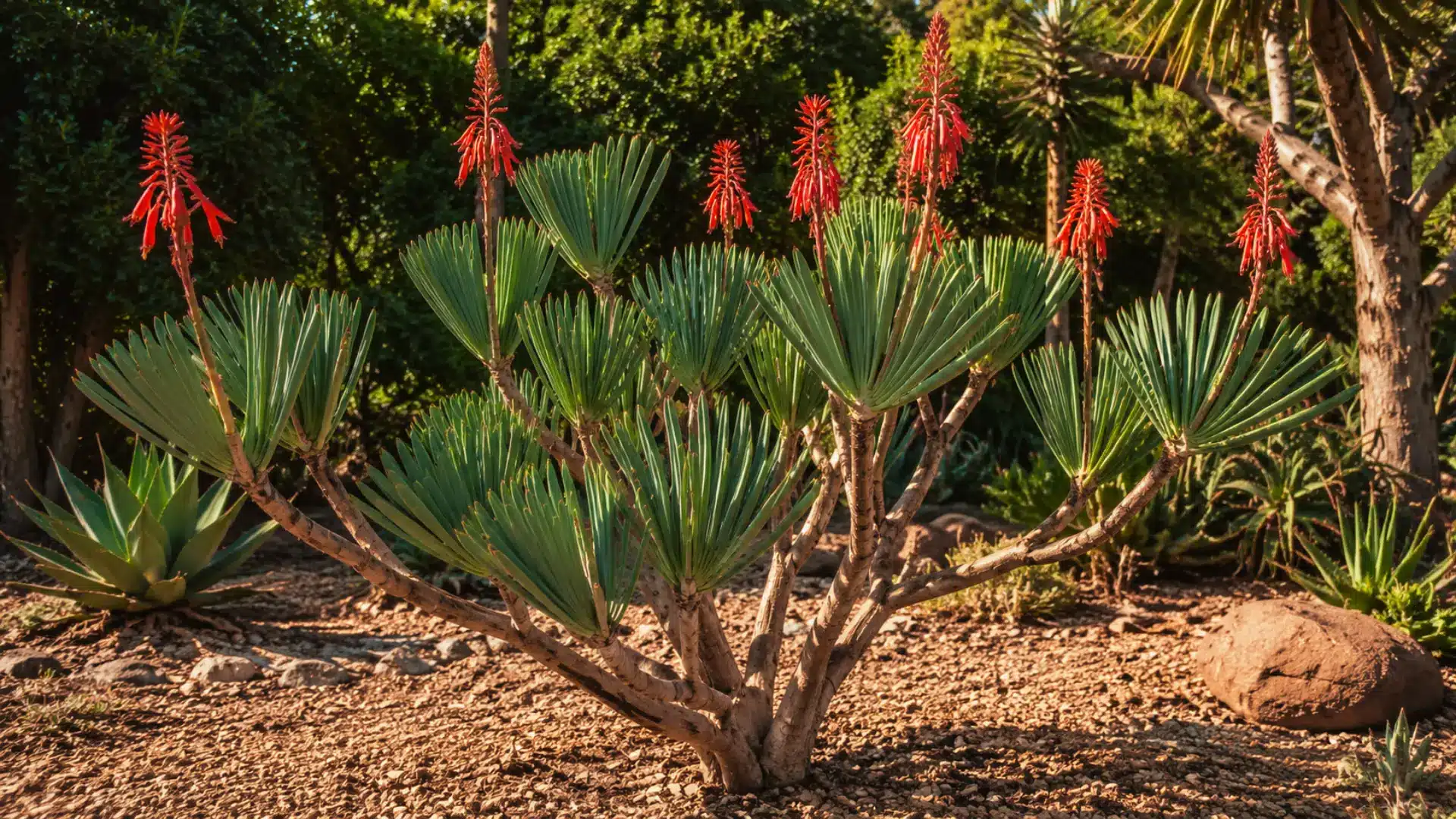
Fan aloe has flat blue-green leaves arranged in two opposite rows. Each branch ends in a neat fan, giving the plant a sculptural shape. Older plants develop woody stems and may grow into a large shrub or small tree.
- Botanical name: Kumara plicatilis
- Sun requirements: Full sun to light afternoon shade
- Height: 5 to 8 feet
- Flower color: Red or orange-red
- Growth form: Branched shrub or small tree
25. Snake Aloe
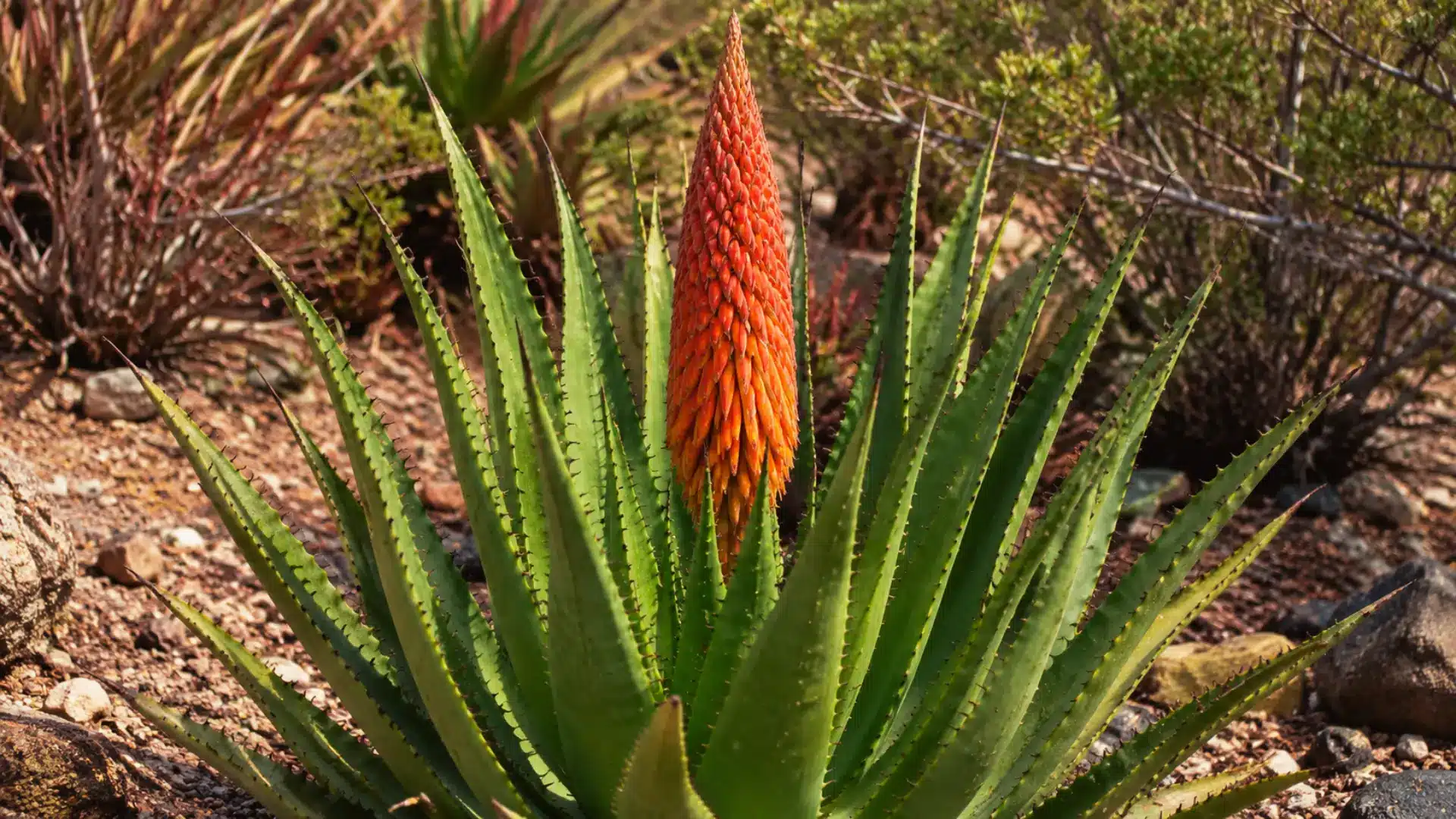
Snake aloe forms a large upright rosette of stiff green leaves with dark curved teeth. Its flower spike is covered by long overlapping bracts that partly hide the blooms, creating a scaled appearance. This unusual flower structure is its strongest identification clue.
- Botanical name: Aloe broomii
- Sun requirements: Full sun
- Height: 3 to 5 feet
- Flower color: Yellow, orange, or red
- Growth form: Large solitary rosette
26. Cape Aloe
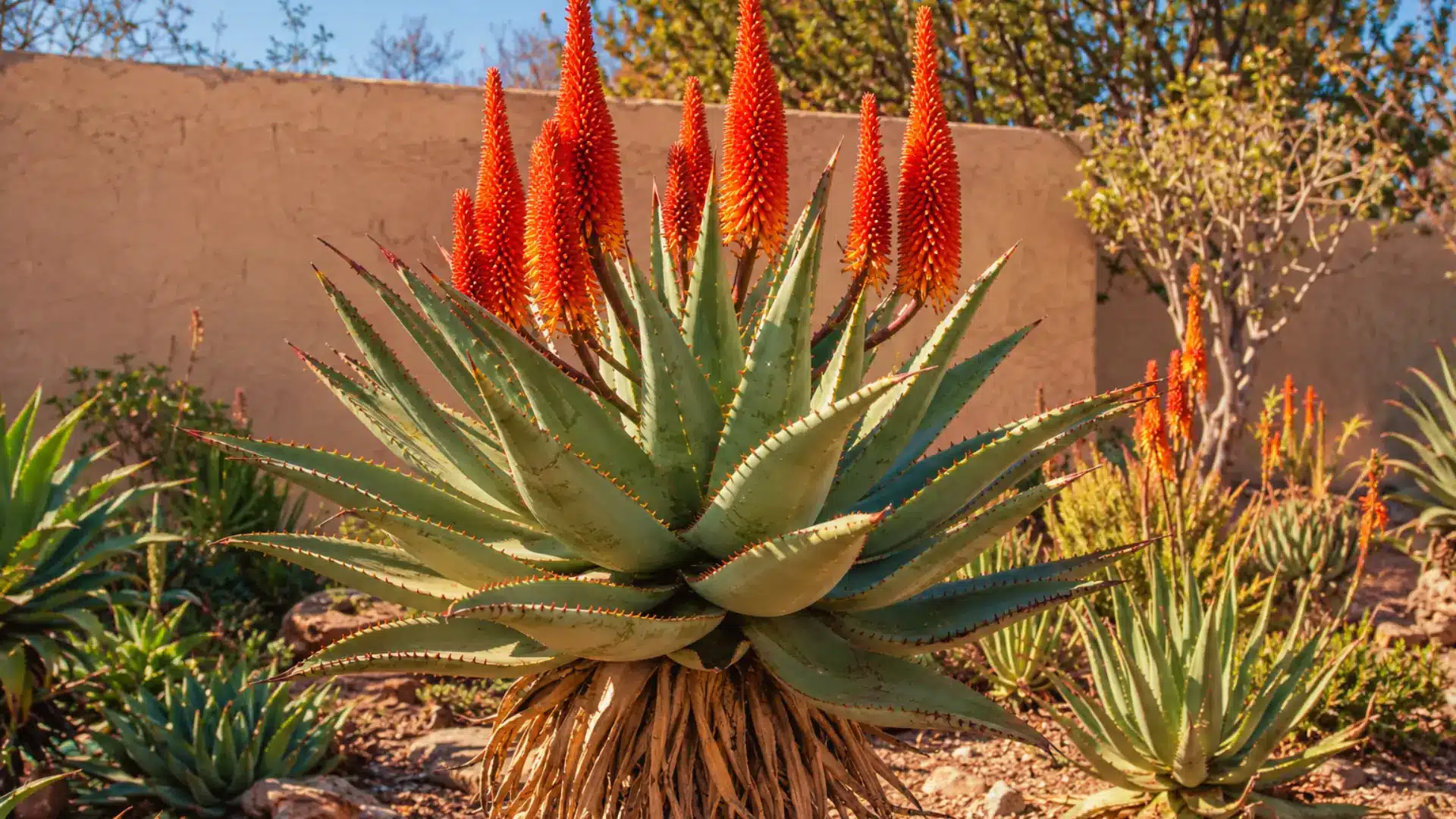
Cape aloe develops a tall single trunk topped by a broad rosette of heavily armed leaves. Sharp teeth line the edges and may also appear across the leaf surfaces. Old leaves often remain attached around the trunk, adding to its bold tree-like form.
- Botanical name: Aloe ferox
- Sun requirements: Full sun
- Height: 6 to 10 feet
- Flower color: Red, orange, or yellow
- Growth form: Single-trunk tree aloe
27. Mountain Aloe
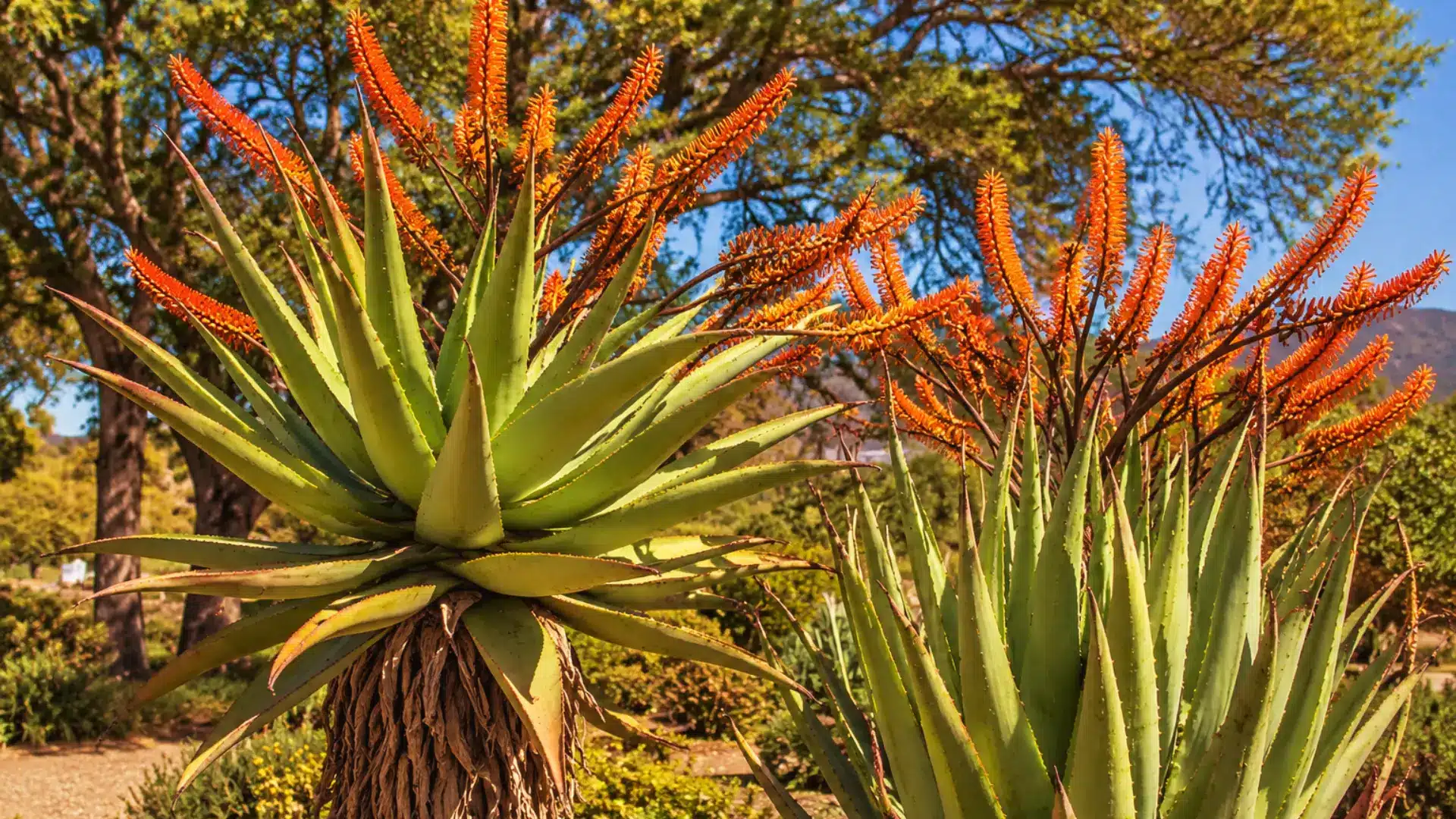
Mountain aloe has a thick trunk and a large crown of gray-green leaves covered with strong teeth. Its flowers grow on wide branches that spread almost sideways. This broad flower structure helps distinguish it from other tall aloe species.
- Botanical name: Aloe marlothii
- Sun requirements: Full sun
- Height: 8 to 15 feet
- Flower color: Red, orange, or yellow
- Growth form: Large tree aloe
28. Malagasy Tree Aloe
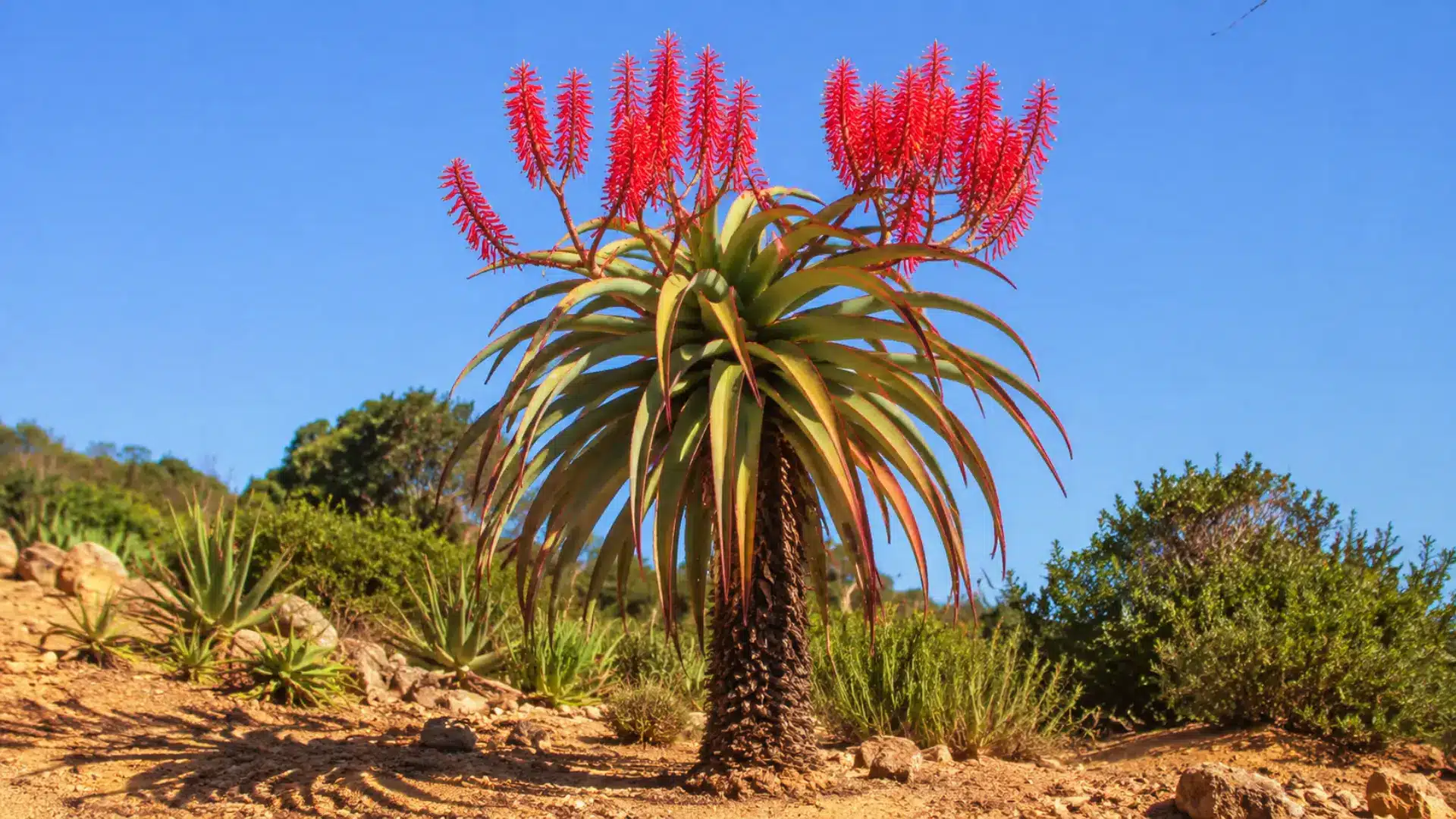
Malagasy tree aloe has a straight trunk topped by a large rosette of long, curved leaves. The leaf edges often turn red during cool or dry weather. Its bright red flower clusters rise above the crown and create a dramatic seasonal display.
- Botanical name: Aloe vaombe
- Sun requirements: Full sun
- Height: 8 to 12 feet
- Flower color: Bright red
- Growth form: Single-trunk tree aloe
29. Tree Aloe
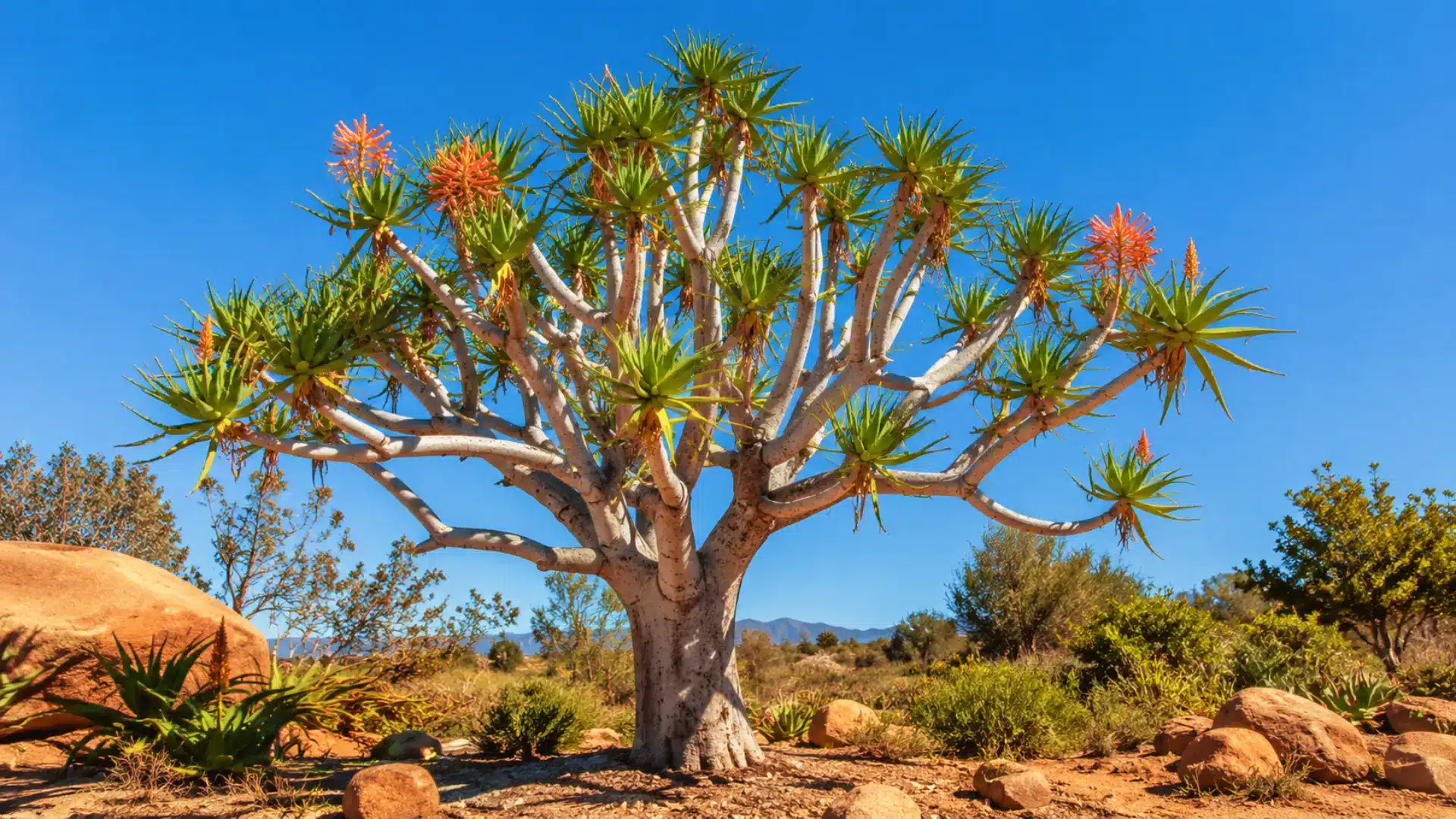
Tree aloe grows into a large tree with a thick trunk and rounded branching crown. Smooth gray branches end in clusters of narrow green leaves. It needs a warm climate and plenty of space, making it better suited to large landscapes than containers.
- Botanical name: Aloidendron barberae
- Sun requirements: Full sun to light shade
- Height: 20 to 50 feet
- Flower color: Salmon, pink, or orange
- Growth form: Large branching tree
30. Tilt-Head Aloe
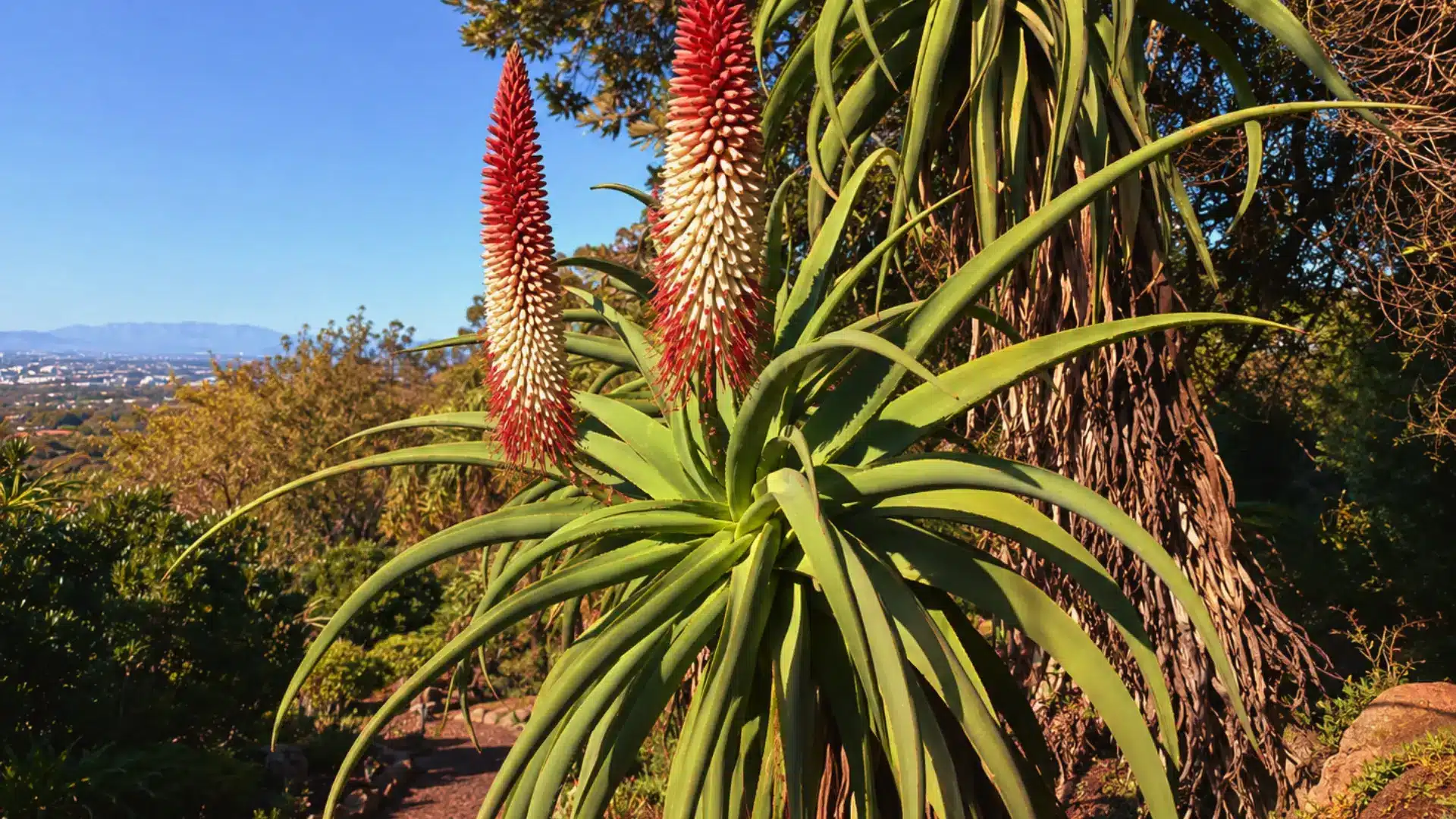
Tilt-head aloe forms a tall trunk topped by one large rosette that often leans noticeably to one side. Its blue-green leaves have pink or red toothed margins. The flower buds begin deep red before opening into pale green or cream-colored blooms.
- Botanical name: Aloe speciosa
- Sun requirements: Full sun
- Height: 8 to 12 feet
- Flower color: Red buds with pale green or cream flowers
- Growth form: Single-trunk tree aloe
Care Tips for Different Types of Aloe Plants
Although many aloe species share similar care needs, various types may require specific attention to light exposure, temperature, and protection during winter. Here are some general care tips that are relevant to the majority of aloe plants.
- Light: Provide bright light. Move indoor plants into direct sunlight slowly to prevent scorched patches.
- Water: Soak the soil thoroughly, then wait until it dries before watering again.
- Soil: Use a loose, gritty succulent mix that allows extra water to drain quickly. A pot that’s just slightly larger than the root ball keeps drainage working as intended, a sizing detail that matters just as much as the mix itself when caring for an aloe vera plant.
- Container: Choose a pot with an open drainage hole. Never leave it standing in collected water.
- Temperature: Protect tropical and tree-like species from frost. Check the needs of cold-tolerant varieties separately.
- Feeding: Apply a diluted succulent fertilizer during active growth. Avoid frequent or heavy feeding.
- Repotting: Move the plant when roots fill the pot, offsets crowd the parent, or the aloe becomes unstable.
Soggy soil poses a greater risk than short dry periods for most types of aloe plants. Species-specific care still matters, especially for spiral aloe and varieties from cooler or wetter habitats.
Aloe Safety for Skin Use, Eating, and Pets
Do not treat every aloe as interchangeable with aloe vera. Ornamental species may contain different compounds, and nursery labels are not always accurate.
- Confirm the species before applying gel to your skin.
- Do not eat an unidentified aloe or add it to homemade drinks.
- Keep aloe plants away from dogs and cats that may chew leaves. Aloe is listed as toxic to dogs, cats, and horses, with vomiting, lethargy, and diarrhea as the most common signs of ingestion, so contact a veterinarian after any suspected exposure, especially if these signs or unusual tiredness follow.
- Keep aloe plants out of reach of young children. The gel and latex layer beneath the skin can cause irritation or digestive upset if handled or consumed without knowing the species.
Safety varies between species. A broad safety claim cannot be applied to every aloe plant, which is why confirming the species before any skin, food, or household use matters.
Which Aloe Is Right for You?
Aloe plants range from tiny spotted rosettes that sit comfortably on a windowsill to towering trees that can grow taller than a house.
Start with growth form, then compare leaf markings, edge teeth, mature size, and flowers to narrow your options down.
Use the three groups in this guide as your starting point: common and container-friendly types if you are working with limited space, colorful ground-cover varieties if you want seasonal color across open ground, and shrub or tree-like forms if you have room for something structural and long-lived.
When identification stays uncertain, wait for new growth or flowers before settling on a final name.
Frequently Asked Questions
What Features Are Most Reliable for Aloe Identification?
Growth form is usually the first clue. From there, check leaf markings, edge teeth, and offset behavior. Flowers confirm the identification when leaves look similar between species. For example, spiral aloe is identified almost instantly by its geometric leaf arrangement, while snake aloe is best confirmed by its unusual overlapping flower bracts.
Which Aloe Species Are Easiest to Identify?
Spiral aloe, fan aloe, coral aloe, tiger aloe, and tilt-head aloe stand out because of their leaf arrangement, growth form, or smooth edges, which are highly distinctive.
How Can I Tell Aloe Vera From Similar Succulents?
Aloe vera has fleshy gray-green leaves, small edge teeth, basal offsets, and yellow flowers. Agave looks similar but has firmer, more rigid leaves and a sharp terminal spine at the tip of each leaf.
Why Does My Aloe Look Different From Online Photos?
Light, water, age, temperature, and stress can change leaf color and shape. Young plants may also look very different from mature specimens.
Which Aloe Types Are Best for Indoor Containers?
Lace aloe, tiger aloe, spider aloe, tiger tooth aloe, and small aloe vera plants suit bright indoor spaces because they stay compact and handle containers well.
Final Takeaway
Choosing the right aloe for your home starts with paying attention to the little details.
I like to look at leaf shape, colors, and growth habits before deciding where a plant will thrive. You can make better choices when you understand what your aloe needs and give it the right care from the beginning.
When you learn about different types of aloe plants, you can find a variety that fits your space, light, and routine.
I enjoy seeing these tough plants add beauty and character while asking for very little care. Keep watching your aloe grow and change over time.
Drop a comment below and let me know what you think about this wide variety of aloe plants.