Capacity is the number that gets printed in large type. It is rarely the best place to start.
A cart that holds a large load is no help if its wheels catch on the gate. A wheelbarrow that turns neatly around a raised bed may still be awkward if you cannot balance it on the return trip.
The right choice depends less on the biggest number in the product listing and more on the route you will travel every week.
Before comparing models, take a tape measure and walk the whole route. Five measurements will usually narrow the choice to a four-wheel cart, a one- or two-wheel wheelbarrow, or a smaller solution.
1. Measure the Narrowest Part of the Route
Start at the storage spot and finish where the load will be dumped. Measure the tightest gate, side path, shed door, and gap between beds.
Compare that clearance with the complete outside width of the tool. The tray width is not enough. Wheels, axle caps, frame hardware, and handles can extend beyond it.
A single-wheel wheelbarrow usually has an advantage on a narrow path because the front wheel follows one line. A two-wheel wheelbarrow needs more width. A four-wheel garden cart may be the widest option, especially when the wheels sit outside the bed.
Leave working room rather than planning for a perfect scrape-through fit. A loaded tool moves differently from an empty one, and a tire can wander on soft ground.
2. Check the Sharpest Turn
Width tells only half the story. Mark the tightest corner and picture the whole tool moving through it.
A single front wheel can pivot close to a raised bed or compost bin. The tradeoff is that the user must lift the handles and control the side-to-side balance. A four-wheel cart supports itself while parked, but the rear wheels follow a wider arc. Long handles also need room to swing.
Try the turn with a broom handle, empty tote, or cardboard outline before buying. This simple check can reveal that a large cart clears the gate but cannot line up with it.
If your route has several ninety-degree turns, a compact wheelbarrow may be easier to place. If the route is straight and open, the stability of a four-wheel cart becomes more useful.
3. Walk the Surface And Note the Grade
Look for loose gravel, soft lawn, roots, ruts, curbs, steps, and sloped sections. Do not treat “works on grass” as a complete answer. Firm, level turf and wet, rutted turf are different jobs.
Wheel width, tire pressure, total loaded weight, and the number of wheels all affect how easily a hauler rolls or sinks. Pneumatic tires can soften bumps but need pressure checks and can go flat. Solid tires avoid flats but may pass more vibration to the handles.
On a steep section or steps, do not choose by tool format alone. Reduce the load, use a different route, or move the material in smaller containers. Follow the manufacturer’s instructions for the exact model. An online capacity figure is not a safe target for every yard.
4. Define the Load You Move Most Often
Choose for the normal Saturday job, not the heaviest project you can imagine.
Loose mulch, compost, and soil favor a wheelbarrow when the material must tip into a precise spot. The open tray is quick to load, and one front wheel can be aimed at the edge of a bed.
Bags, pots, hand tools, and mixed cleanup favor a four-wheel cart. The load stays supported while the cart is parked, which helps when items are added one at a time.
Stone, pavers, and other dense materials need a different calculation. Split the load. Check the tub floor, axle, tire type, and manufacturer’s instructions. Do not use the advertised maximum as the amount you should move on every trip.
For leaves, gloves, and a few hand tools, a tarp, tote, or folding wagon may be enough. A large yard tool should earn the storage space it takes.
5. Measure the Storage Footprint
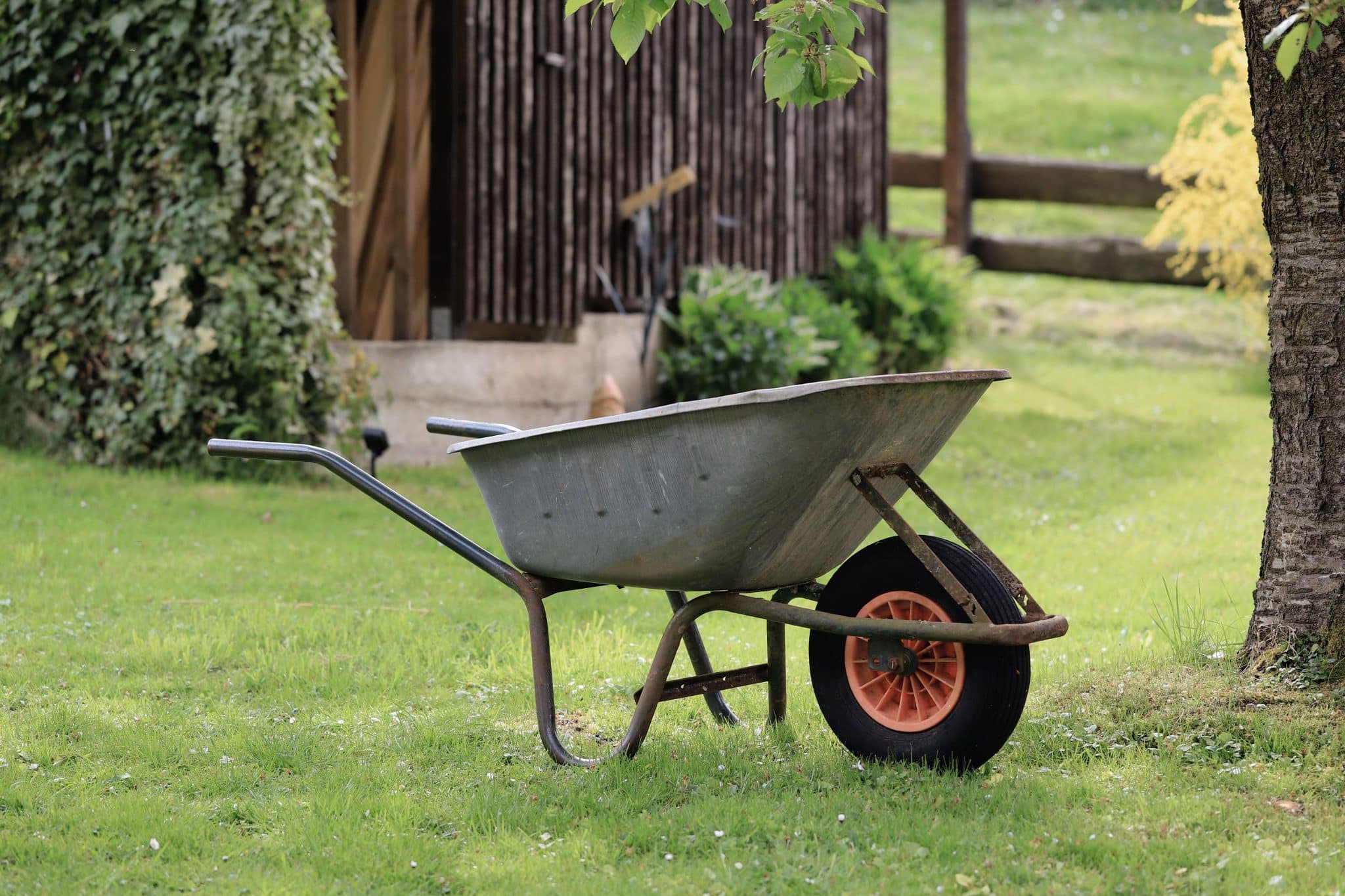
Measure where the tool will live after a wet or muddy job. Include the handle, wheels, and the room needed to put it away without blocking a door, car, or walkway.
A four-wheel cart usually needs more floor space. Some wheelbarrows can stand upright, but do not assume the model you are considering is designed or stable for that position. Folding handles and removable sides also vary by model.
Outdoor storage has its own cost. Sun and water can age a plastic tray, wood handle, tire, or metal fastener. A covered spot is better than an exposed corner, but it still needs drainage and room for cleaning.
If there is no practical storage place, solve that problem before shopping. Renting or borrowing for one seasonal delivery may be cheaper than storing a tool that gets used twice a year.
What Each Format Does Well
A four-wheel garden cart is a good starting point for an open, fairly flat route and mixed loads. It supports the load while parked and can reduce the need to balance a single wheel.
The tradeoffs are a wider turning circle and a larger storage footprint. A dump-bed model can help with loose material, but the latch and hinge should be easy to reach without leaning across the load.
A single-wheel wheelbarrow suits narrow paths, tight turns, and loose material that needs to land in one place. Its strength is control at the front wheel. The tradeoff is that the user lifts and balances part of the load while moving.
A two-wheel wheelbarrow sits between the two. It gives more side-to-side support than a single wheel while keeping a familiar tray. The extra wheel also makes the front wider and reduces the tight pivot.
None of these formats is automatically easier for every person. Pulling, pushing, lifting, and balancing feel different. The Canadian Centre for Occupational Health and Safety advises looking at the load, the task, the workplace, and the person together.
Material such as water, sand, or concrete can also shift its center of gravity while moving. NIOSH likewise recommends considering force, posture, repetition, and the work environment rather than judging a handling task by weight alone.
Run An Empty-Route Test First
Once the tool is assembled, take it through the full route empty. Check the narrowest opening and sharpest turn. Make sure the handles do not strike a fence or bed.
For the first working trip, use a smaller, stable load that does not block your view. Stop if a wheel catches, the load shifts, or you cannot hold the tool in a comfortable position. Check the assembly, tire, load, and slope instructions before adding more.
The best yard hauler is not the one with the largest capacity. It is the one that clears the route, handles the job you repeat, and fits back into storage when the work is done.