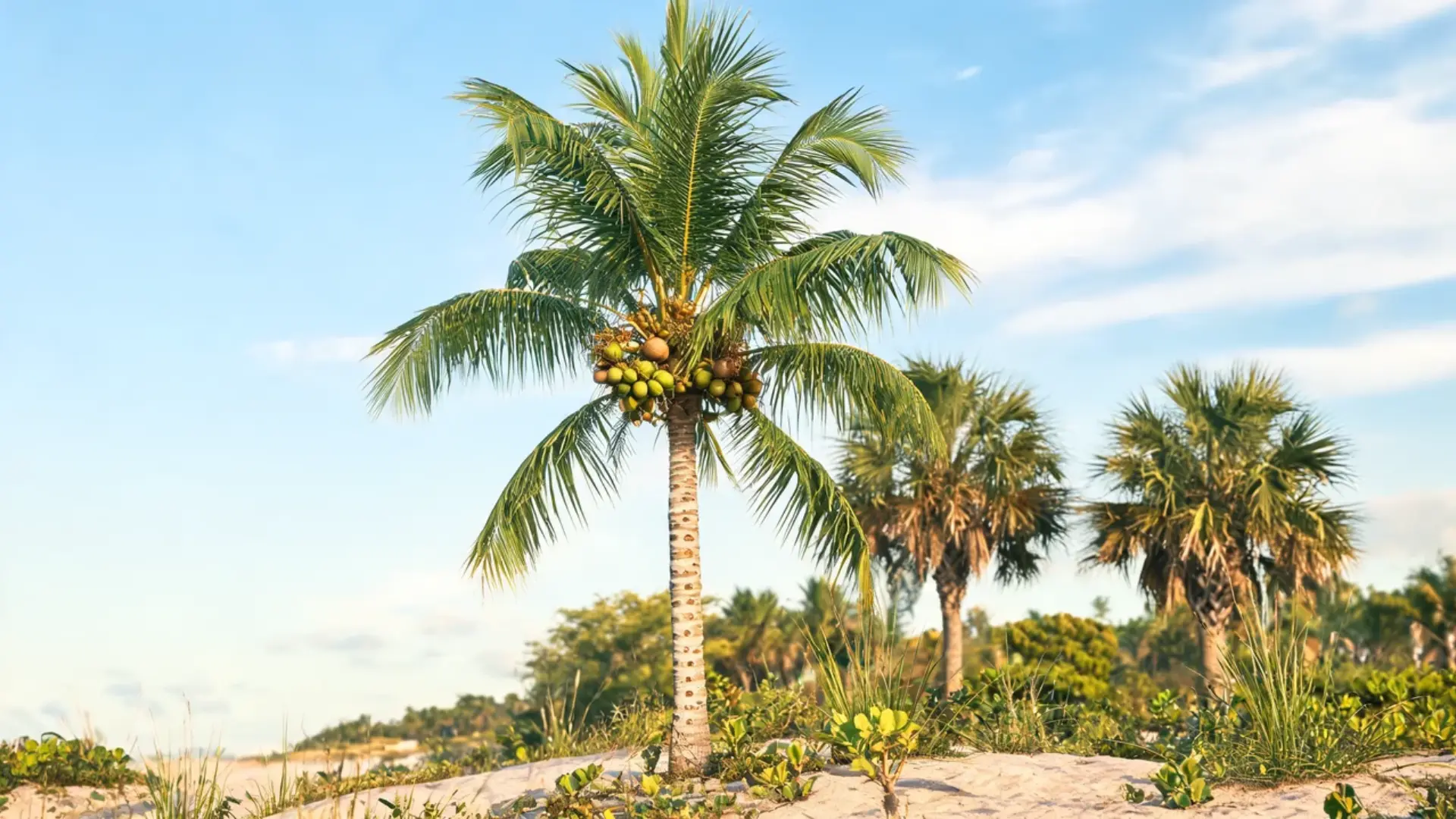
Palm trees as a group produce a surprising range of fruit. Walk through any palm collection, and you’ll find trees growing dates, oily fruit used for cooking, small berries, or seeds prized mostly for decoration.
Ahead is a look at how coconut palms fit into the wider palm family, why so few relatives grow coconuts, how the fruit develops from flower to husk, where coconut palms can realistically survive and fruit, and the coconut palm types found across Florida.
By the end, you’ll know what sets a coconut palm apart and why that difference matters.
Do Coconuts Grow on Palm Trees?
Yes, coconuts grow on palm trees, but they grow specifically on coconut palms. The coconut palm is scientifically known as Cocos nucifera. It belongs to Arecaceae, the palm family, which includes thousands of species with very different fruits, growth habits, and climates they tolerate.
Being a member of that family doesn’t mean much on its own. Other palms in the same family produce dates, oily fruit, small berries, or ornamental seeds instead of coconuts. That’s why a tall trunk and a crown of large fronds aren’t enough to identify a coconut palm.
Plenty of palm species share that general look without ever producing a coconut. What sets Cocos nucifera apart is how much comes from a single fruit: coconut water, oil, milk, coir fiber, and the meat itself, all harvested from one tropical palm.
Relationship Between Coconut Palms and Other Palm Trees
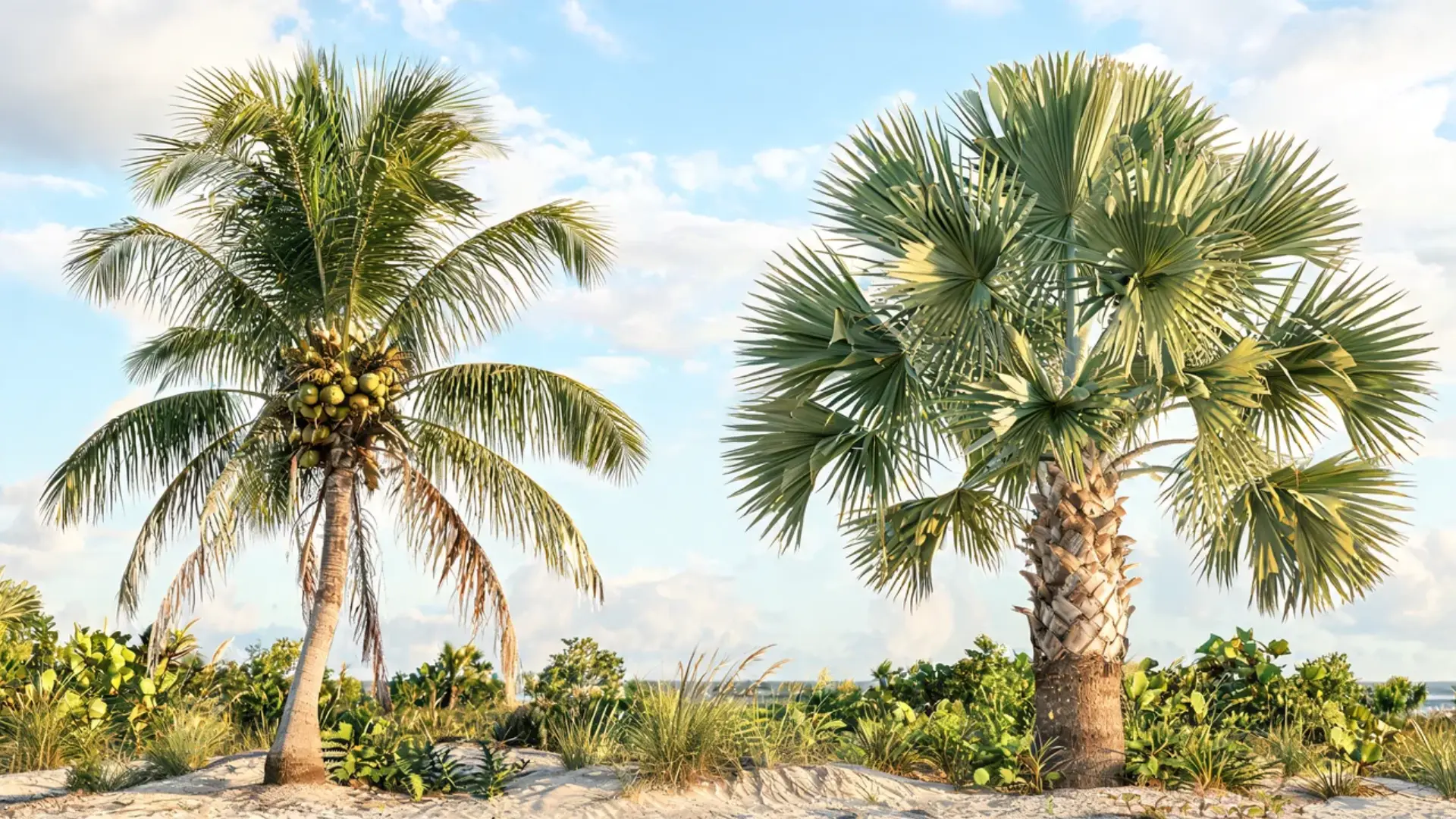
The short answer is family, not fruit. Only coconut palms actually produce coconuts, since sharing a common ancestry says nothing about what each species grows. Here is how four common types compare.
| Feature | Coconut Palm | Date Palm | Areca Palm | Fan Palm |
|---|---|---|---|---|
| Scientific Name | Cocos nucifera | Phoenix dactylifera | Dypsis lutescens | Washingtonia / Livistona spp. |
| Fruit | Coconuts | Dates | Small inedible berries | Small berries, not edible |
| Frond Shape | Long, feather-shaped | Feather-shaped, stiffer | Feather-shaped, slender | Broad, fan-shaped |
| Growth Habit | Single tall trunk | Single trunk | Clustering, multiple stems | Single tall trunk |
| Typical Height | Up to ~100 ft | 50–80 ft | 20–30 ft | 30–100 ft (varies by species) |
| Cold Tolerance | Very low; tropical only | Moderate; some varieties handle light frost | Low; tropical/subtropical | Varies widely; some handle real cold |
Fruit, frond shape, and cold tolerance vary widely even among closely related palms, so identifying a species by looks alone can be misleading. Checking these traits together gives a clearer answer than judging by appearance or family ties alone.
Types of Coconuts in Florida
Florida’s coconut palms fall into two broad groups: tall and dwarf. Both are the same species, Cocos nucifera; the split comes down to mature height, spread, and how each fits a landscape, not different kinds of coconut.
One thing worth clearing up: green, yellow, and brown coconuts aren’t separate types either. Color shifts with cultivar and maturity, not species.
1. Tall Coconut Palms
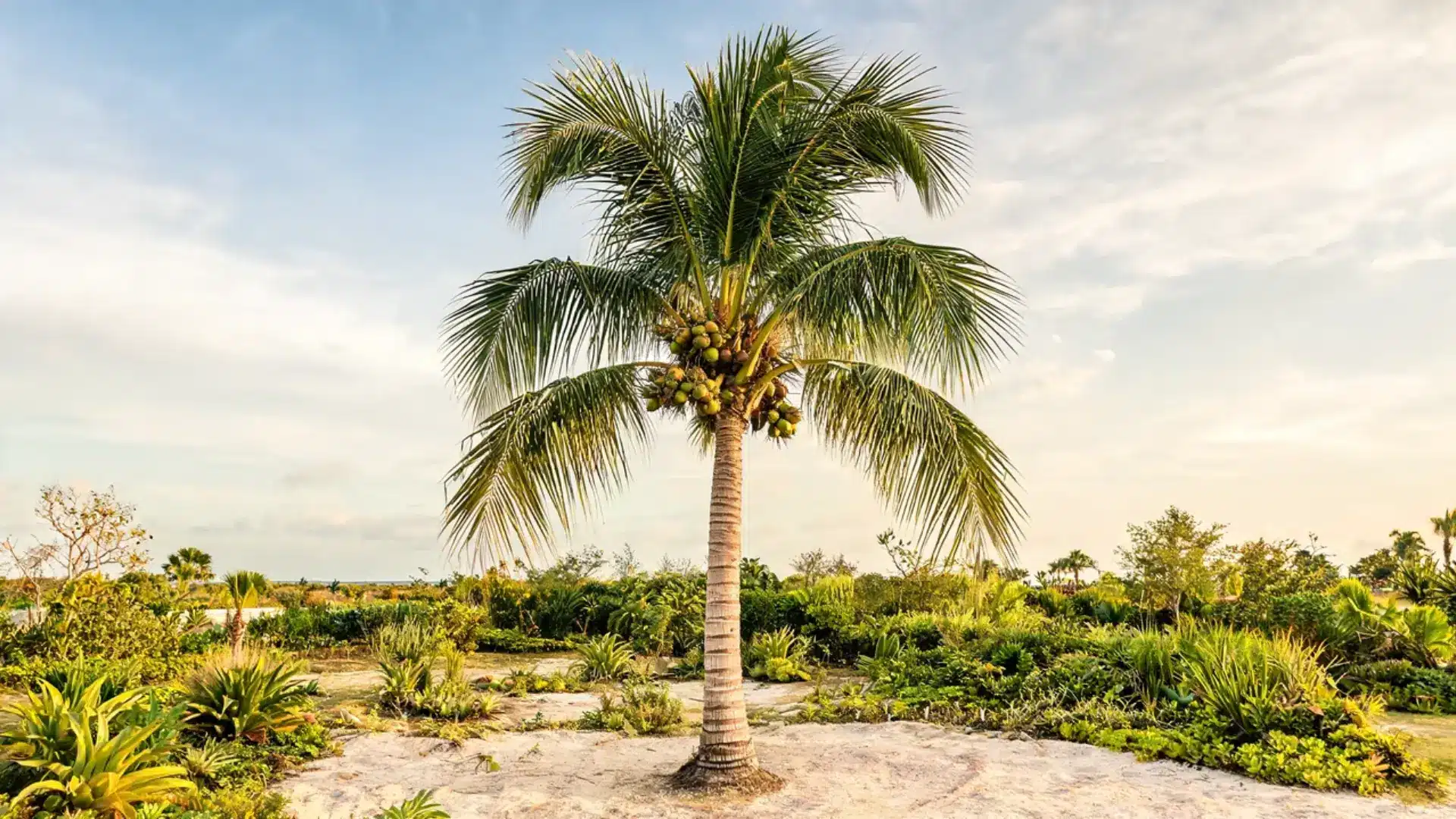
Tall coconut palms grow long trunks topped with a broad crown of feather-shaped fronds. Their size makes them a better fit for large, open landscapes with room to spare in both directions, the kind of scale often seen in front yard palm tree landscape ideas built around a single statement tree.
- Growth Type: Tall
- Mature Height: Up to about 100 feet
- Canopy Width: Approximately 20 to 30 feet
- Growth Habit: Single tall trunk with a broad crown
- Fruit Position: Clusters beneath or between the lower fronds
- Best Suited For: Large tropical gardens, open coastal properties, spacious landscapes
- Main Consideration: Mature height can make fruit and crown maintenance difficult
2. Dwarf Coconut Palms
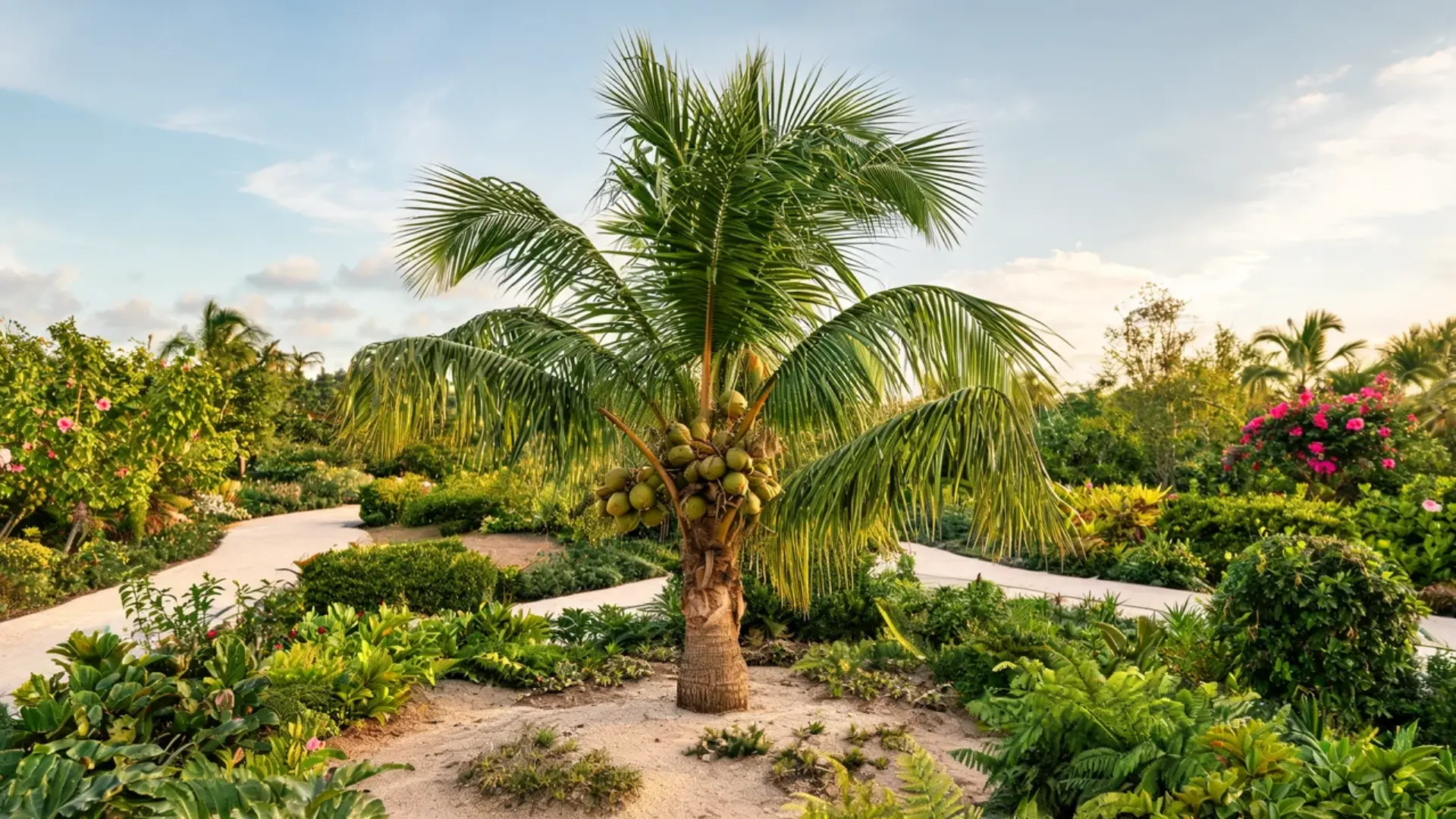
Dwarf coconut palms stay shorter than tall cultivars, though they’re still substantial outdoor plants. The reduced height brings the crown and fruit closer to eye level, which suits landscapes without much vertical room to spare.
- Growth Type: Dwarf
- Mature Height: Approximately 16 to 30 feet
- Mature Spread: Approximately 15 to 25 feet
- Growth Habit: Shorter trunk with a full crown of feather-shaped fronds
- Fruit Position: Clusters close to the crown beneath the fronds
- Best Suited For: Smaller tropical gardens with adequate overhead room
- Main Consideration: Still a large outdoor palm, not a small indoor plant
3. Hybrid Coconut Palms
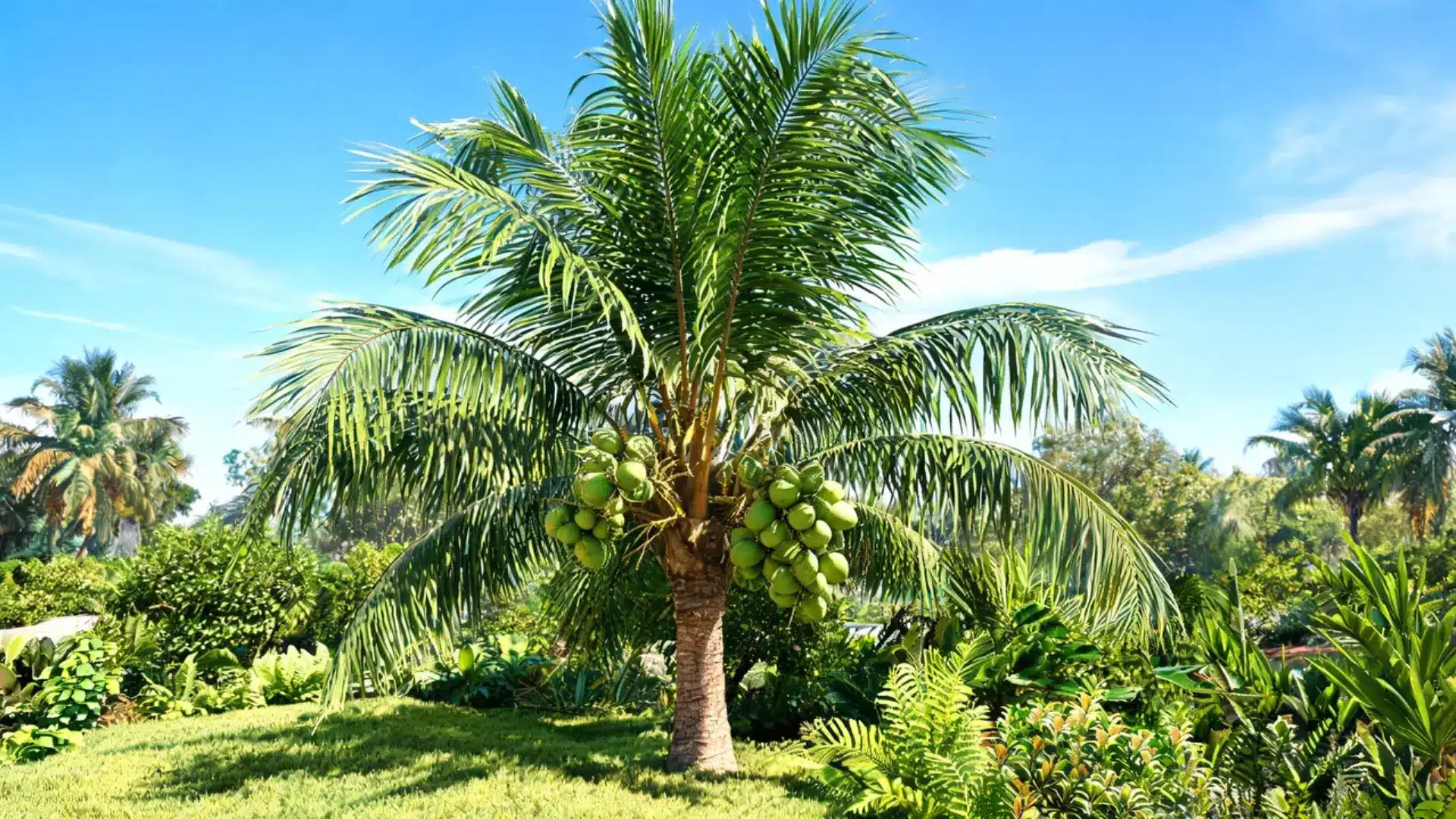
Hybrid coconut palms are produced by crossing selected tall and dwarf coconut varieties. They’re often grown to combine useful traits from both groups, such as a more manageable height, strong growth, and good fruit production. Their exact size and appearance can vary depending on the parent cultivars.
- Growth Type: Hybrid
- Mature Height: Typically between dwarf and tall coconut palms
- Mature Spread: Approximately 15 to 25 feet
- Growth Habit: Single trunk with a full crown of feather-shaped fronds
- Fruit Position: Clusters beneath the crown among the lower fronds
- Best Suited For: Tropical and coastal landscapes where growers want traits from both tall and dwarf palms
- Main Consideration: Mature size, fruit color, and growth rate can vary by hybrid, so the specific cultivar matters when choosing one for a Florida landscape
How Can You Identify a Coconut Palm?
Once you know the two growth habits, spotting a coconut palm comes down to reading the trunk, fronds, and fruit together, not judging by size alone.
| Feature | What to Look For |
|---|---|
| Trunk | Single slender trunk, no branching; slightly wider base; visible rings or leaf scars; straight or gently curved growth |
| Fronds | Long, feather-shaped leaves with dozens of narrow leaflets; fronds arch outward; full crown at the top of the trunk |
| Fruit | Coconuts grow in clusters, never alone; fruit forms near the crown, beneath or among the lower fronds; nothing grows lower on the trunk |
Height alone won’t confirm it, though. Plenty of palms share that same tall, leafy silhouette while producing dates, berries, seeds, or nothing edible at all, even when they look tropical enough to guess otherwise. It’s the trunk, fronds, and fruit together that settle the question, not any single trait on its own.
How Do Coconuts Grow on Coconut Palms?
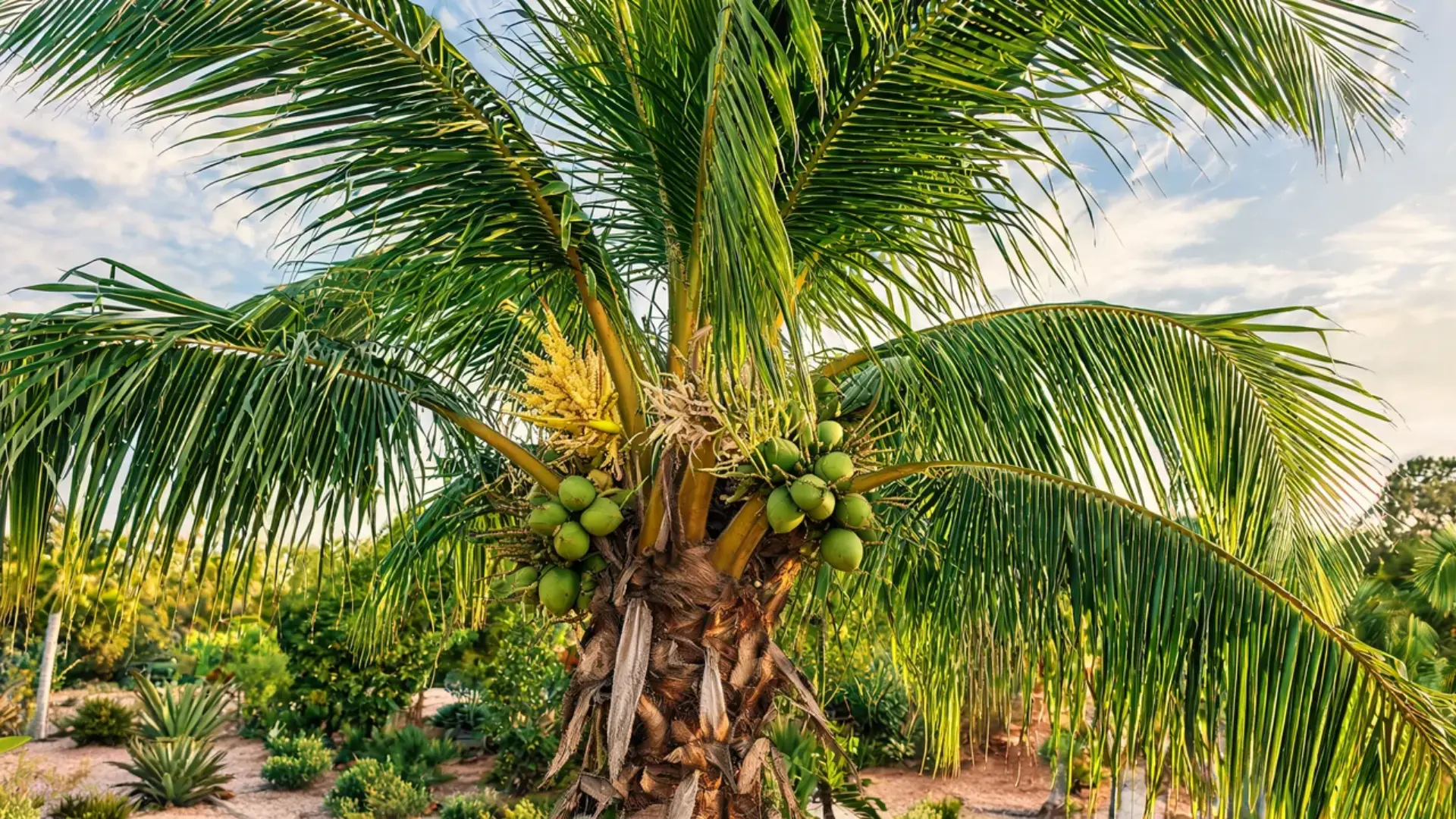
Coconuts don’t appear overnight. Each one starts as a flower, moves through pollination, then spends time developing into the fruit people actually recognize. Coconut palms typically begin flowering around 4 to 6 years of age.
Coconut Palm Flowers Develop First: Flowering starts beneath the lower fronds, where the palm produces a branching flower structure carrying both male and female flowers, tiny and easy to miss next to the fruit they’ll eventually produce. Before anything can form, these flowers need time to mature, especially the female ones, which must reach the right stage before fertilization can begin.
Pollination Leads to Fruit Formation: Once mature, pollen moves from male flowers to receptive female ones, carried by wind or insects depending on the palm’s environment. When fertilization succeeds, a young coconut starts forming right where the female flower was, close to the crown and tucked beneath the fronds.
The Coconut Matures Beneath the Fronds: Coconuts grow in clusters beneath the crown, several maturing at once on the same flowering structure. As each one grows larger, its color and shape shift with the cultivar, ranging from green to yellow or brown.
Growing Conditions for Coconut Palms
Coconut palms need warmth, moisture, the right soil, and steady sun to grow well and fruit reliably.
| Condition | What Coconut Palms Need | Why It Matters |
|---|---|---|
| Temperature | Tropical warmth year-round | Frost or freezing damages the palm; repeated cold snaps stunt or kill it; reliable production needs steady warmth, not just a few mild months |
| Humidity & Moisture | Warm, humid air plus consistent moisture | Sets it apart from desert palms built for dry conditions; without enough moisture, growth slows, and fruiting suffers |
| Soil | Sandy, well-draining soil | Explains why it thrives near beaches, but it still needs regular freshwater; waterlogged soil hurts growth as much as poor drainage |
| Sunlight & Exposure | Full direct sun; tolerance for wind and salt | Lets it grow in exposed coastal spots where other species struggle |
These requirements explain why coconut palms can grow in some parts of Florida but are unsuitable for colder areas of the state. The young spear leaf at the crown is especially vulnerable, and UF/IFAS Extension recommends wrapping it in frost cloth ahead of any hard freeze.
Coconut Palms in Florida
Coconut palms thrive in Florida’s warmest coastal areas, especially South Florida and the Keys, where winters stay mild, and humidity remains high. In much of the rest of the state, even true coconut palms struggle to handle the local climate.
Cold is the biggest limit. Even a short cold snap can damage leaves, reduce fruiting, and weaken younger palms. Central and North Florida are usually too cold for reliable, long-term growth.
Not every palm you see is a coconut palm. Check the trunk, feather-shaped fronds, and visible coconut clusters before identifying one. Before planting, also consider local temperatures, cold exposure, soil drainage, and available space. Coconut palms perform best where frost is rare and warm conditions last most of the year.
Common Uses of Coconut Palms
Coconut palms earn their keep well beyond the fruit itself, since almost every part of the tree has a practical use. Here are the main ways people put coconut palms to work.
- Food and Drink: The coconut alone provides flesh, water, and milk, along with oil pressed for cooking and skincare, placing it firmly among the more useful entries on any tropical fruits list. Some coconut palms are also tapped for their sap, which gets turned into vinegar, sugar, and other fermented products.
- Fiber and Household Materials: The husk yields coir, twisted into rope or woven into mats, baskets, and brooms. Larger husk and frond sections often serve as roofing in tropical regions.
- Shells, Wood, and Fuel: The hard shell becomes bowls, decorative objects, or charcoal. Once a palm’s productive life ends, its trunk is often repurposed as timber or simply used as fuel.
From food and fiber to shells and timber, coconut palms leave little to waste, which is part of why they remain such a valuable crop across tropical regions worldwide.
Frequently Asked Questions
Is coconut a nut or a fruit?
Botanically, a coconut is a drupe, not a true nut. Drupes are fruits with a fleshy or fibrous outer layer surrounding a hard shell that protects a single seed inside, which is exactly how a coconut is built. The “nut” in its name is more about common usage than accurate classification.
How old is a coconut palm before it produces fruit?
A coconut palm typically starts producing fruit around 6 to 10 years after planting, though dwarf varieties can begin flowering a bit earlier than tall ones.
Can an indoor coconut palm produce coconuts?
Realistically, no. Mature, fruiting coconut palms need far more space, sunlight, warmth, and time than an indoor environment can offer. Indoor coconut palms are almost always grown as ornamental plants, not for fruit, since they never reach the size or receive the sustained tropical conditions a palm needs to flower and fruit successfully.
How many coconuts can one palm produce in a year?
A healthy coconut palm can produce anywhere from 50 to 150 coconuts a year. That range varies quite a bit based on the palm’s size, its cultivar, the local climate, and how well it’s cared for.
Final Takeaway
Coconuts grow on palm trees, but only on coconut palms, known scientifically as Cocos nucifera. Coconut palms belong to the wider palm family, while other palms may produce dates, berries, oil fruits, or ornamental seeds instead.
Their growth depends on warmth, humidity, sunlight, moisture, and frost protection, which explains why they thrive mainly in tropical and coastal climates. Coconuts in Florida fall into two broad types by growth habit: tall and dwarf, each suited to different landscapes and available space.
When identifying or planting one, focus on the trunk, feather-shaped fronds, fruit clusters near the crown, and whether the local climate can support long-term growth. Compare these features with nearby palms, and drop a comment below with the coconut palm question you still have.