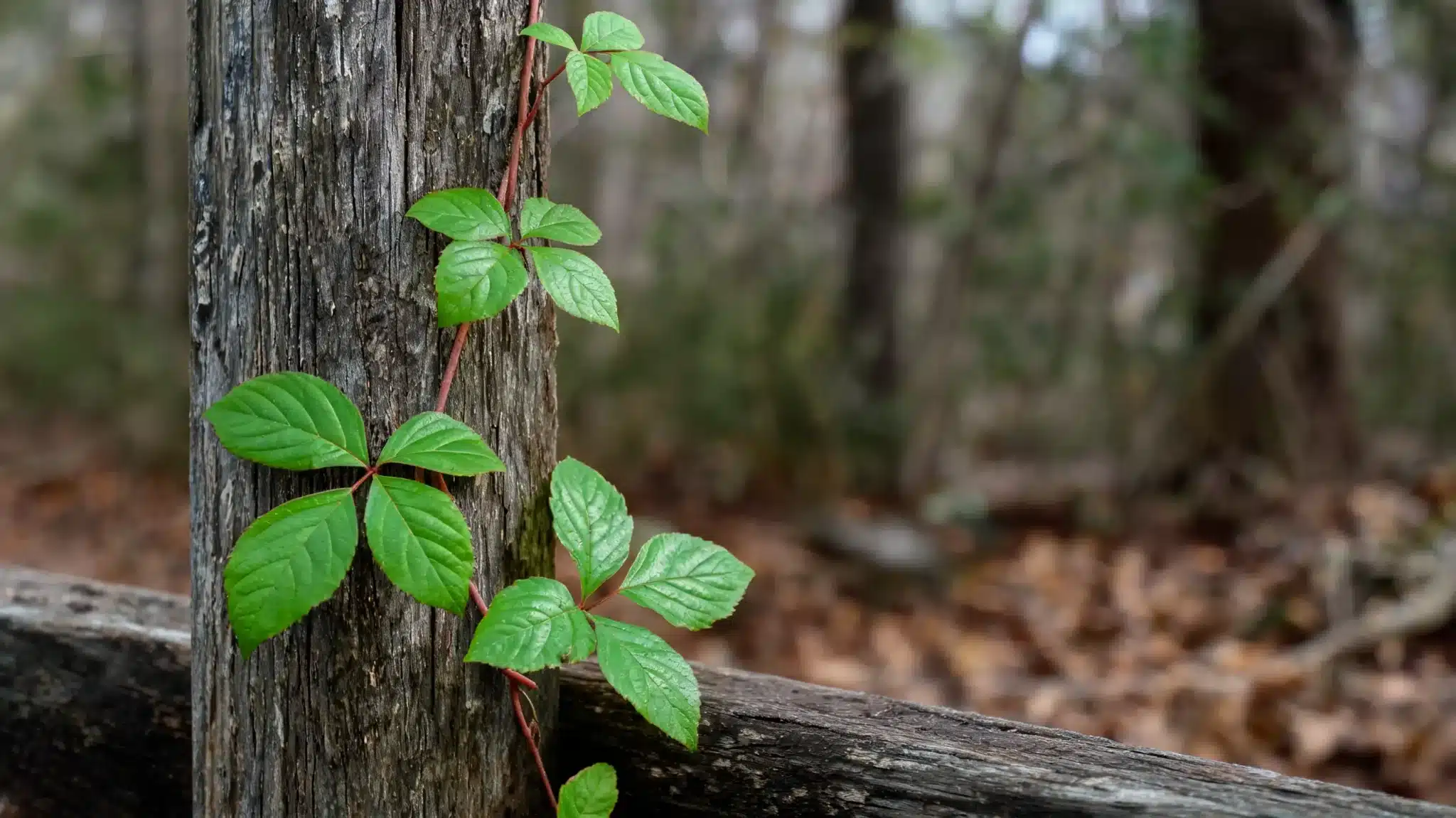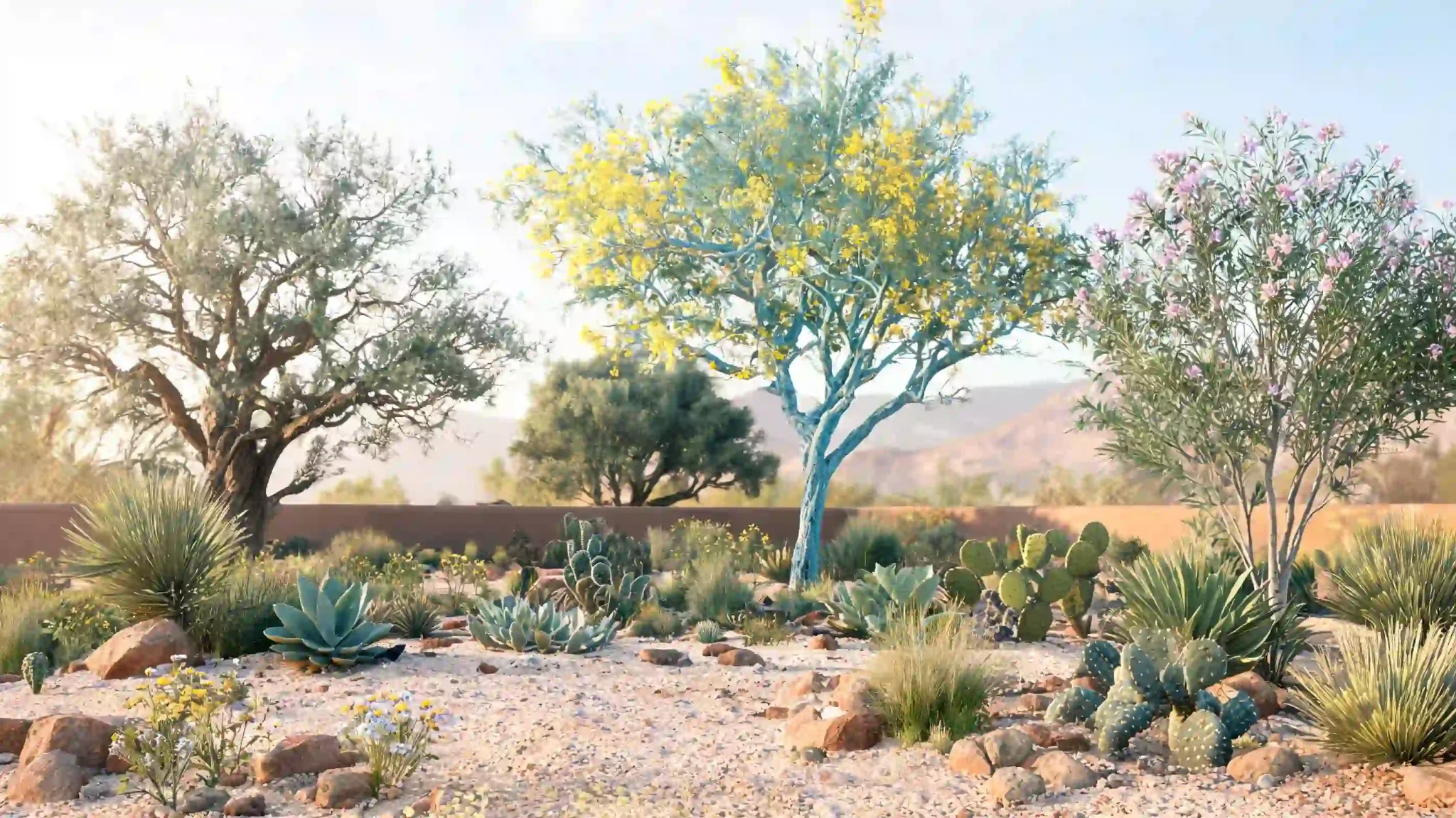
There is something really enjoyable about looking at the trees that shape America’s desert scenery. They give these wide, sunny places a look that feels calm, striking, and full of character.
Some stand out with unusual shapes, while others blend beautifully into the surrounding landscape. I always find it interesting how each one can make a place feel a little different.
If you enjoy nature, warm landscapes, or simply discovering plants you may not see every day, this topic is a fun one to explore. So, come along and take a closer look at some memorable desert favorites together.
Desert Tree at a Glance
These are woody plants built to survive in hot, dry regions with little rainfall. They use special traits to limit water loss and reach or store moisture.
These species come in many forms, from small patio trees to wide shade trees. Homeowners outside true desert regions often weigh these low-water species against other low-water plants before deciding which fits their yard.
These trees also provide shade, food, nesting space, and cooler spots for other plants and animals. The table gives a quick look at their common traits, water needs, growing conditions, and value in dry landscapes.
| Feature | Description |
|---|---|
| Scientific name | Varies by species; examples include Prosopis, Parkinsonia, Chilopsis, and Olneya. |
| Common examples | Mesquite, palo verde, Acacia, desert willow, ironwood, and palo blanco. |
| Climate | Hot, sunny areas with low rainfall and long dry periods. |
| Main traits | Small leaves, green bark, water-storing tissue, or roots that reach deep for moisture. |
| Water needs | Usually low after the tree becomes established. |
| Typical size | Varies from compact patio trees to broad shade trees. |
| Landscape value | Provides shade, flowers, wildlife shelter, and soil protection. |
| Key checks | Mature spread, thorns, litter, cold tolerance, drainage, and root behavior. |
Why Do Desert Trees Matter?
These species matter because they make dry places cooler and more livable. Their shade protects the soil, lowers heat around homes, and gives nearby plants a better place to grow.
Trees such as palo verde and desert willow provide flowers for bees, butterflies, and hummingbirds, while mesquite pods and other fruits feed birds and small animals. Their branches also give wildlife shelter and nesting space.
Fallen leaves form a natural mulch that helps the soil hold moisture, reduces erosion, and adds organic matter. In home landscapes, they can also provide privacy, seasonal color, and useful shade without needing as much water as many other tree types.
Best Desert Tree Types and Varieties
Desert regions support a range of tree species built for heat, low rainfall, and poor soil. Four main species are covered in detail, each with its own types:
- Mesquite (Prosopis species): Screwbean, Western Honey, Texas Honey
- Palo Verde (Parkinsonia/Cercidium species): Blue, Foothill, Desert Museum, Mexican
- Acacia: Sweet, Twisted, Shoestring, Weeping, Catclaw, Whitethorn
- Desert Willow (Chilopsis linearis): single-trunk, multi-trunk, and low-litter cultivars like ‘Bubba’
Beyond these four, several standalone species – Desert Fern, Southern Live Oak, Bottle Tree, Palo Blanco, Sissoo, Olive, Texas Ebony, Texas Mountain Laurel, Saguaro, Cascalote, Aleppo Pine, Eucalyptus, and Ironwood – round out the choices, each offering its own shape, bloom time, and maintenance needs.
Mesquite Trees
Mesquite trees are drought-tolerant species within the genus Prosopis. Their types include Screwbean, Western Honey, and Texas Honey, each with different size, branch form, thorns, and watering needs.
1. Screwbean Mesquite
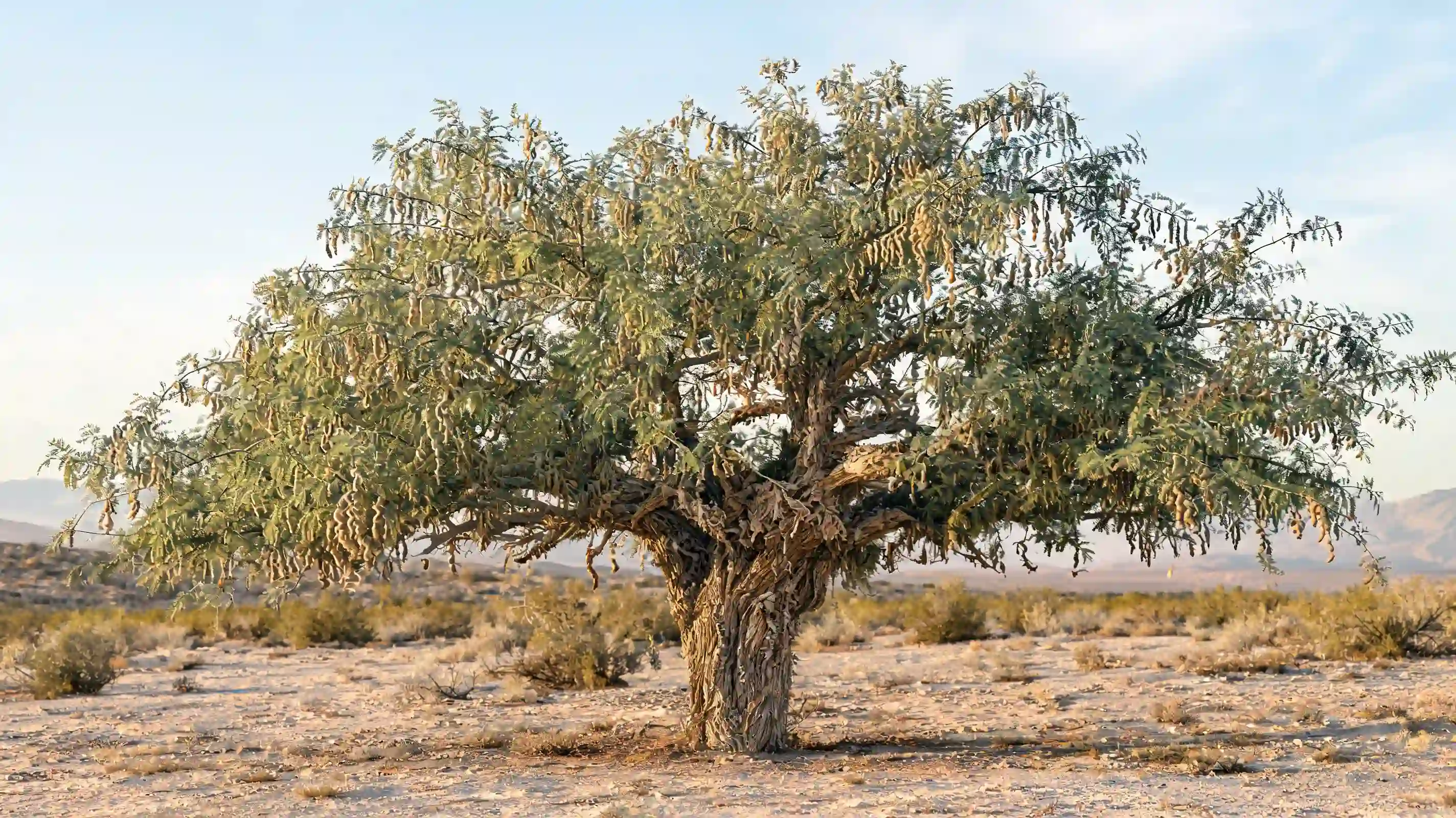
- Scientific name: Prosopis pubescens
- Size: Small to medium
- Habitat: Southern Nevada desert
- Form: Wide, rugged, filtered canopy
Screwbean mesquite usually grows as a broad shrub in the wild but can be trained into a tree. It has shaggy bark, gray-green leaflets, twisted seedpods, and good drought tolerance. Supplemental water speeds growth, but too much can weaken its natural form and increase pruning needs.
2. Western Honey Mesquite
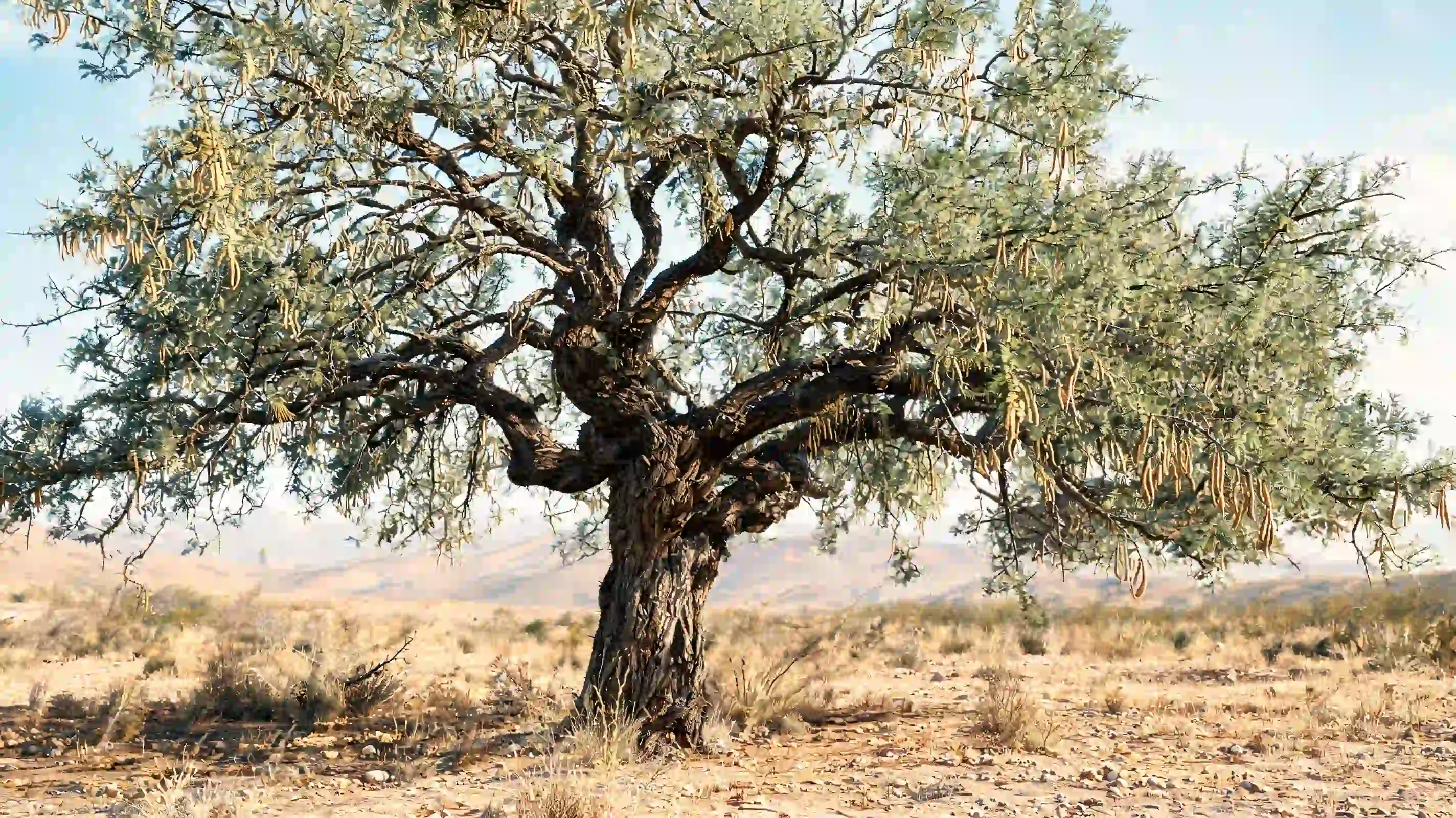
Scientific name: Prosopis glandulosa ‘Torreyana’
Size: Medium to large
Habitat: Desert landscapes
Form: Broad, spreading, twisting canopy
Western honey mesquite can reach 25 to 30 feet tall and 30 to 45 feet wide. It has gray-green foliage, dark rugged bark, and tan seedpods. Most forms have thorns, while ‘Maverick’ is thornless. Its wide spread makes it better suited to large yards.
3. Texas Honey Mesquite
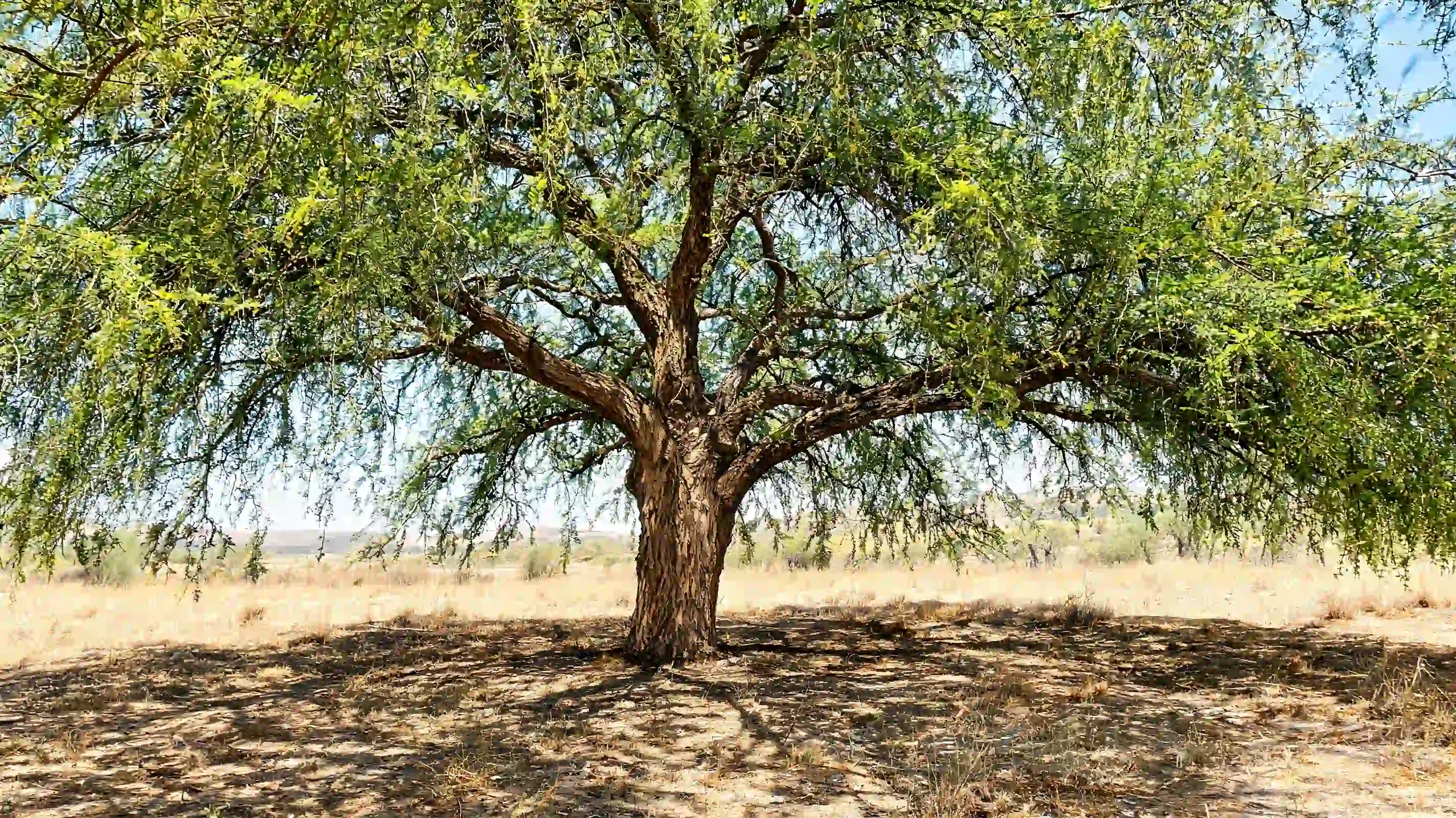
Scientific name: Prosopis glandulosa ‘Glandulosa’
Size: Medium to large
Habitat: Dry, open landscapes
Form: Wide, bright green, weeping canopy
Texas honey mesquite needs ample room because its branches grow upward and outward before hanging down at the tips. Its tan bark develops furrows with age, and its bright foliage creates filtered shade. The tree has thorns, tolerates cold near 0°F, and grows well in dry soil.
Palo Verde Varieties
Palo verde refers to several tree species in Parkinsonia and Cercidium. Its types include Blue, Foothill, Desert Museum, and Mexican palo verde, each differing in size, thorns, drainage needs, and root strength.
4. Blue Palo Verde
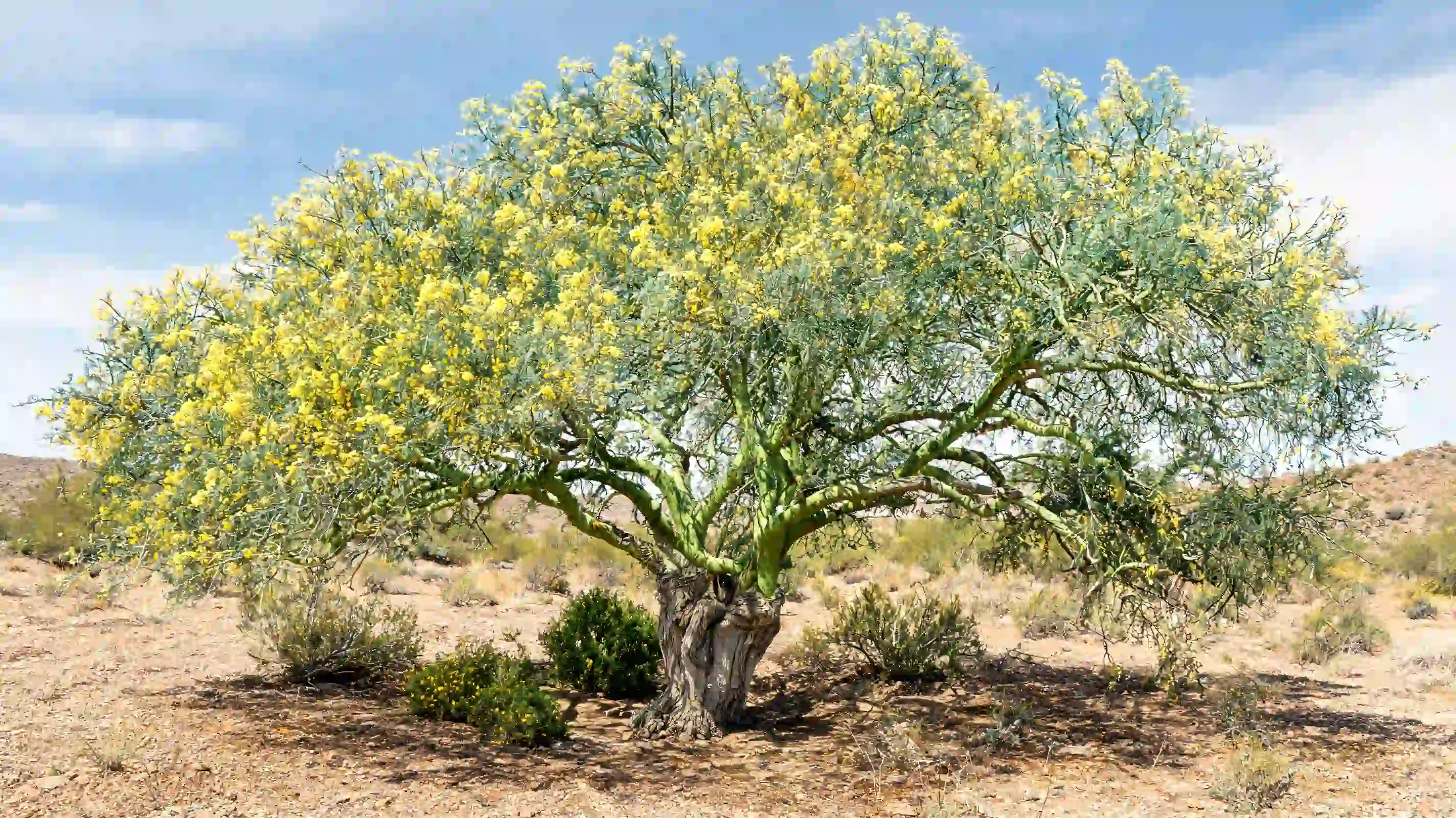
Scientific name: Cercidium floridum
Size: Medium to large
Habitat: Well-drained desert soils
Form: Wide, blue-green canopy
Blue palo verde produces a bold spring bloom that turns its entire canopy into a soft yellow glow. Its blue-green bark shifts to rough gray with age, and its branches often twist into striking shapes. The canopy offers deep yet filtered shade, letting other desert plants grow beneath. It tolerates cold down to 15°F.
5. Foothill Palo Verde
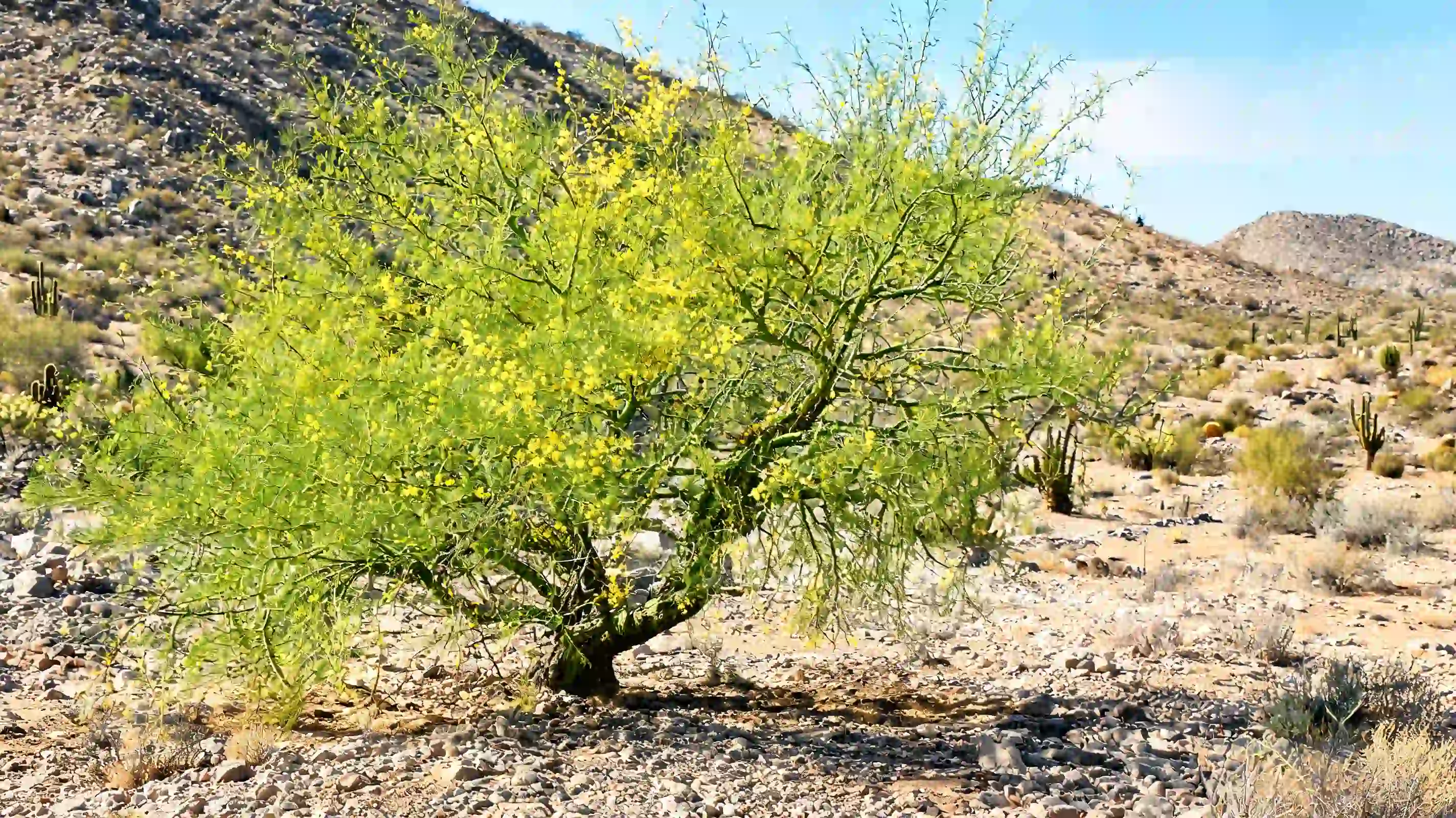
Scientific name: Cercidium microphyllum
Size: Small to medium
Habitat: Rocky, well-drained desert soils
Form: Compact, twisted canopy
Foothill palo verde stays the smallest of its family, growing slowly into a dense, craggy form. Its tiny, sparse leaves cast light shade, while its tangled twigs create natural cover for nesting birds. This slow grower suits tighter desert spaces well. It tolerates cold down to 15°F and needs minimal upkeep once established.
6. Desert Museum Palo Verde
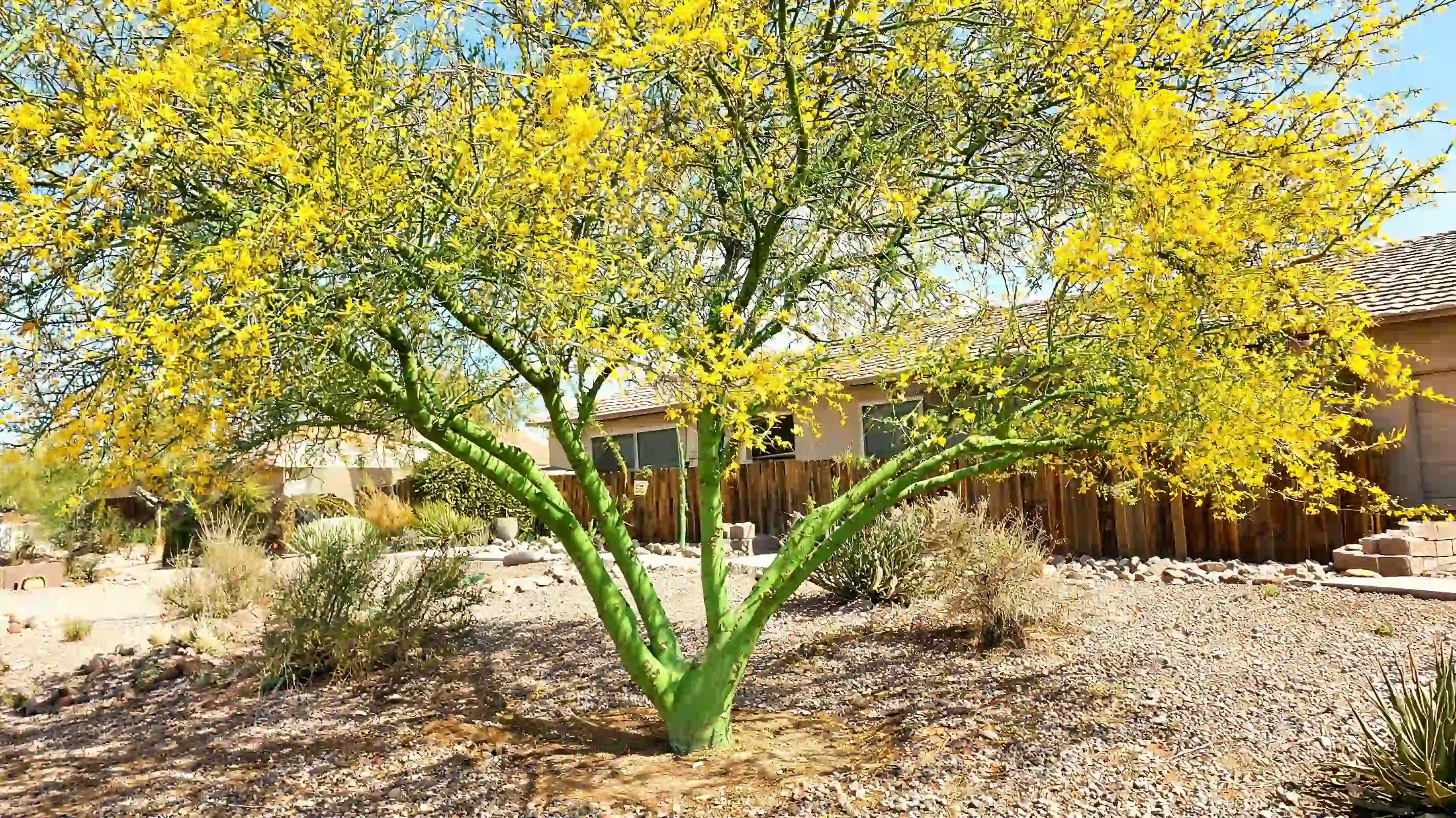
Scientific name: Parkinsonia x ‘Desert Museum’
Size: Medium to large
Habitat: Tolerant of poor desert soils
Form: Open, thornless canopy
Desert Museum palo verde grows quickly into a thornless tree with larger, longer-lasting yellow blooms than its relatives. Its open canopy allows other plants to grow well beneath it. Since it’s grafted, weak rootstock unions can cause it to topple, so check for a solid graft before buying. It tolerates cold down to 17°F.
7. Mexican Palo Verde
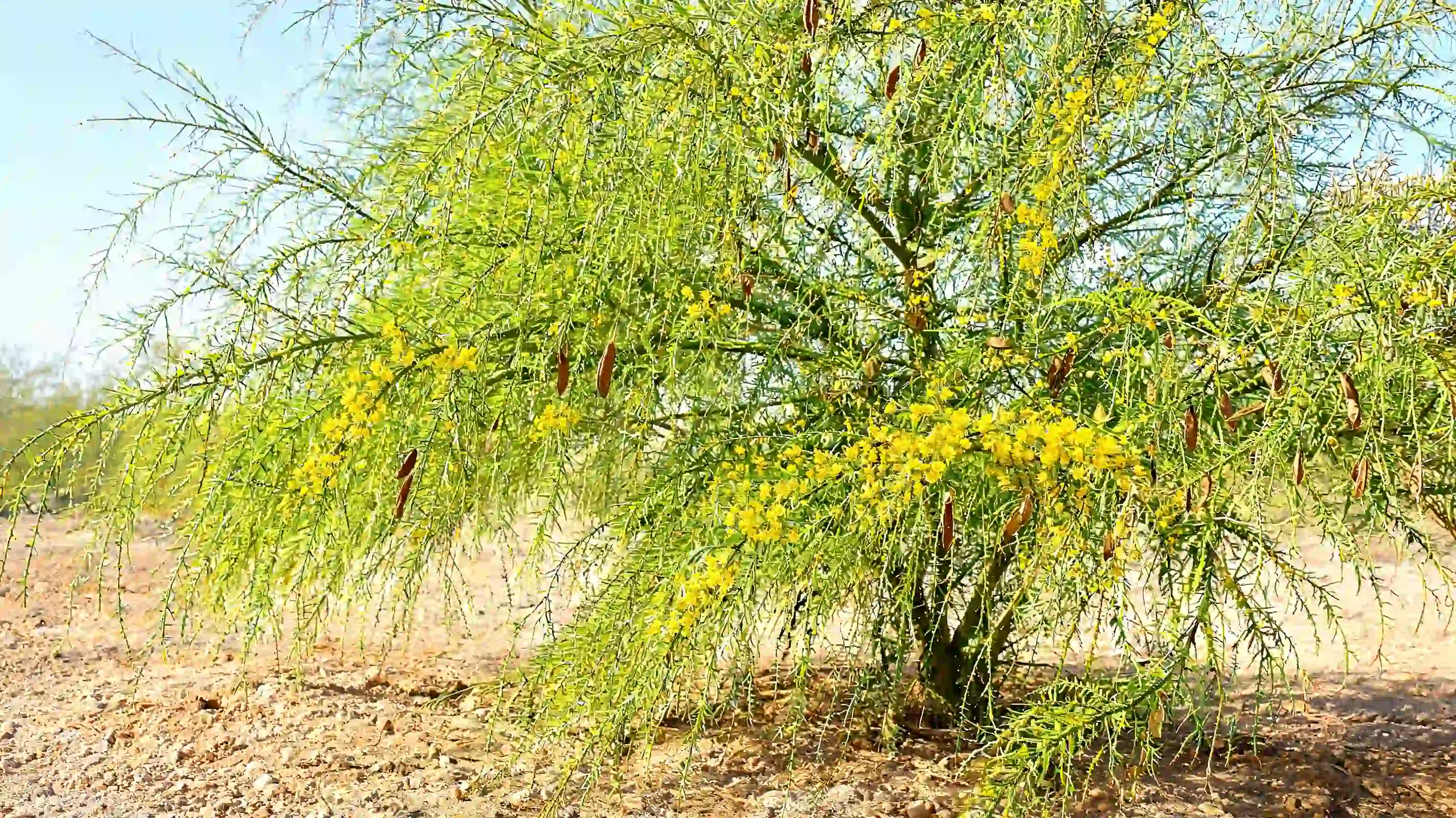
Scientific name: Parkinsonia aculeata
Size: Medium to large
Habitat: Tolerant of desert soils, low water
Form: Weeping, open canopy
Mexican palo verde produces attractive flowers but carries more drawbacks than other varieties. It has thorns, weaker wood, and reseeds heavily after blooming, adding extra maintenance. It’s also more prone to palo verde borers. Despite this, its open form and easy availability keep it a common pick. It tolerates cold down to 15°F.
Acacias for Low-Water Landscapes
Acacias are desert species prized for fragrant yellow blooms and airy foliage in low-water landscapes. Several types fall under this species, differing in form and thorns – Sweet, Twisted, Shoestring, Weeping, Catclaw, and Whitethorn Acacia, covered next.
8. Sweet Acacia
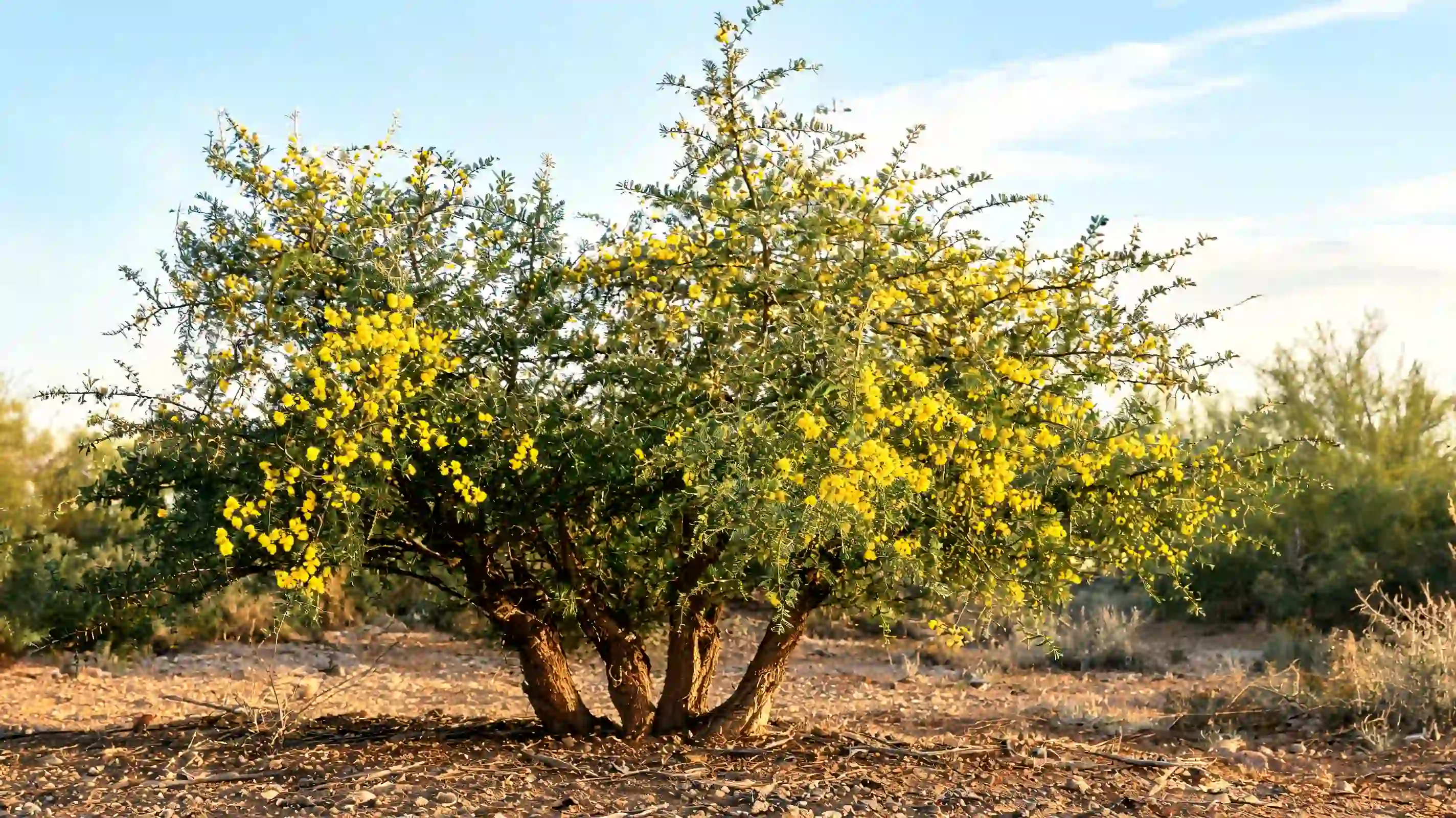
Scientific name: Acacia farnesiana / Acacia smallii
Size: Medium
Habitat: Native desert soils
Form: Multi-trunked, airy canopy
Sweet Acacia grows into a naturally multi-trunked tree with a light, airy texture from its tiny leaflets. Fragrant yellow puffball flowers bloom each spring, though small thorns along the foliage call for care near walkways.
It stays evergreen, grows well in native desert soils, and draws birds that nest within its branches. It tolerates cold down to 10°F, making it a reliable low-water pick.
9. Twisted Acacia
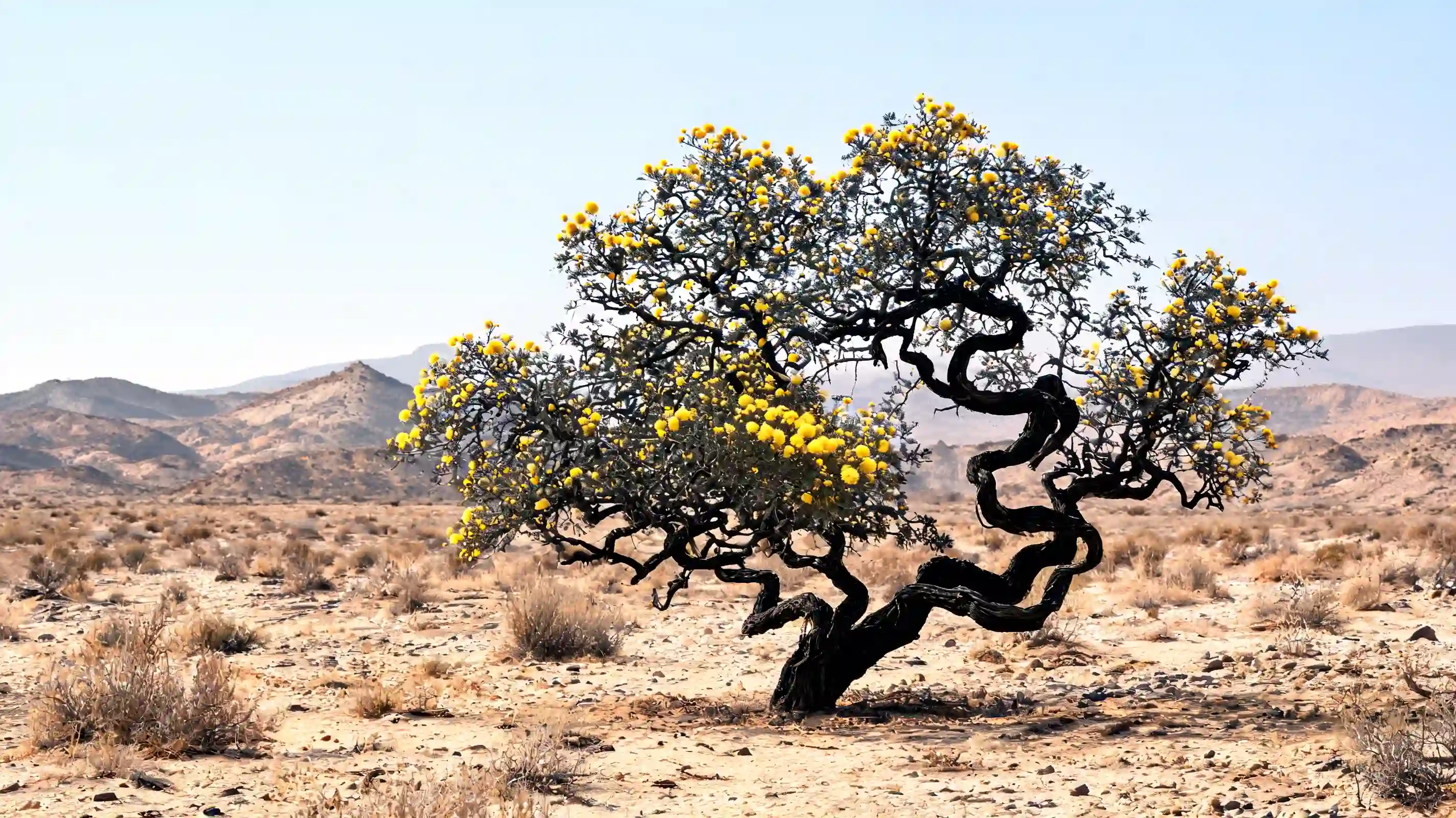
Scientific name: Acacia schaffneri
Size: Small to medium
Habitat: Tolerant of desert soils
Form: Bold, twisted branches
Twisted Acacia stands out for its tiny, dark green leaflets set against almost-black wood, with short, tightly dividing branches giving it a bold, unusual form. It reaches about 20 feet tall and wide, blooming with fragrant yellow puffballs each spring.
Highly drought- and soil-tolerant, it makes an excellent bird-nesting tree, though it drops some litter and tolerates cold only down to 20°F.
10. Shoestring Acacia
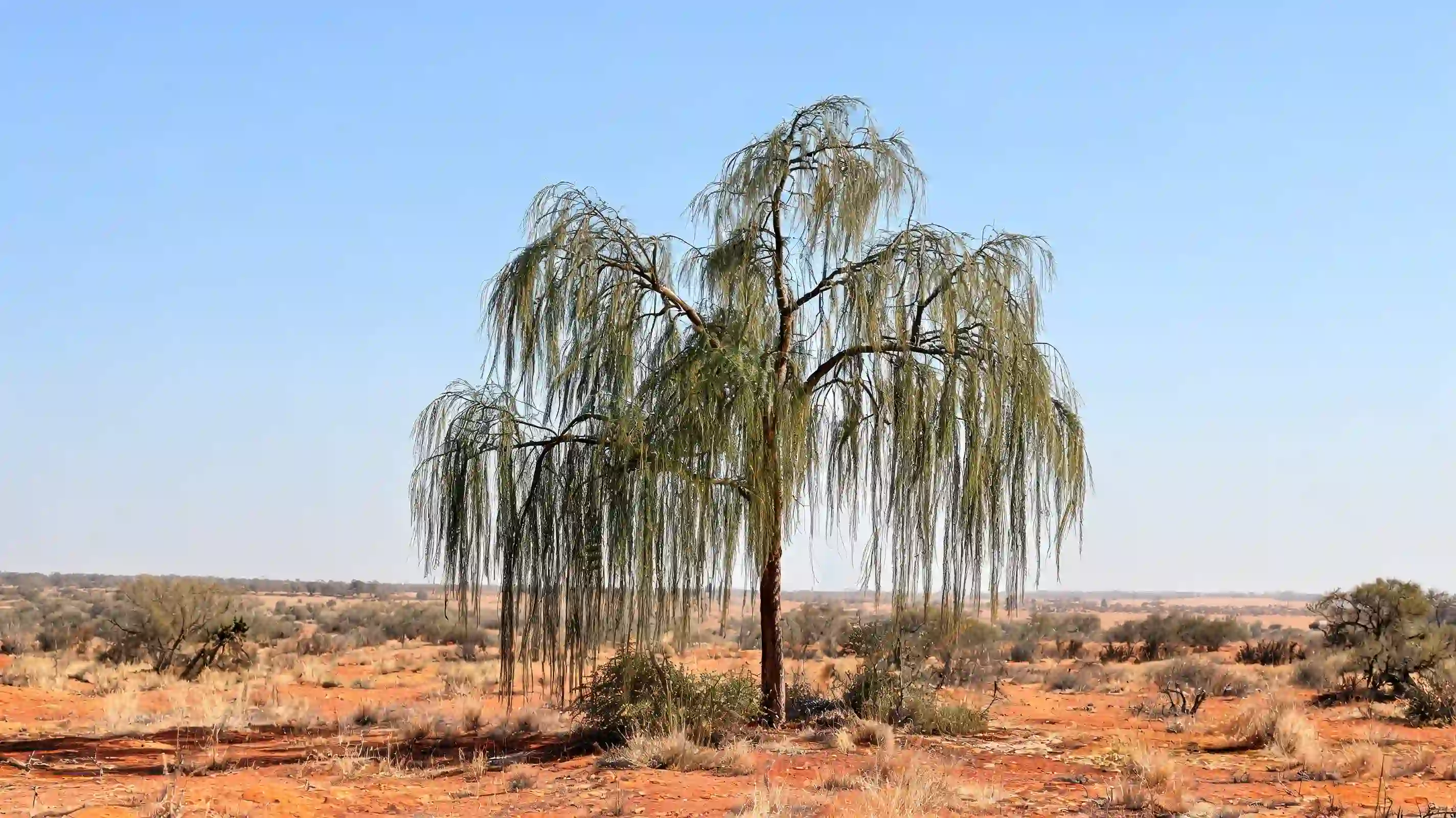
Scientific name: Acacia stenophylla
Size: Medium to large
Habitat: Desert soils; avoid pool areas
Form: Upright, weeping canopy
Shoestring acacia grows upright with a soft, weeping form and long, thread-thin phyllodes instead of true leaves. Reaching about 30 feet tall and 20 feet wide, its distinctive silhouette creates striking shadow patterns, though its messy litter makes it unsuitable near pools.
Fast-growing but somewhat weak-wooded, it can suffer branch failure and tolerates cold only down to 20°F, so plant it with some care.
11. Weeping Acacia
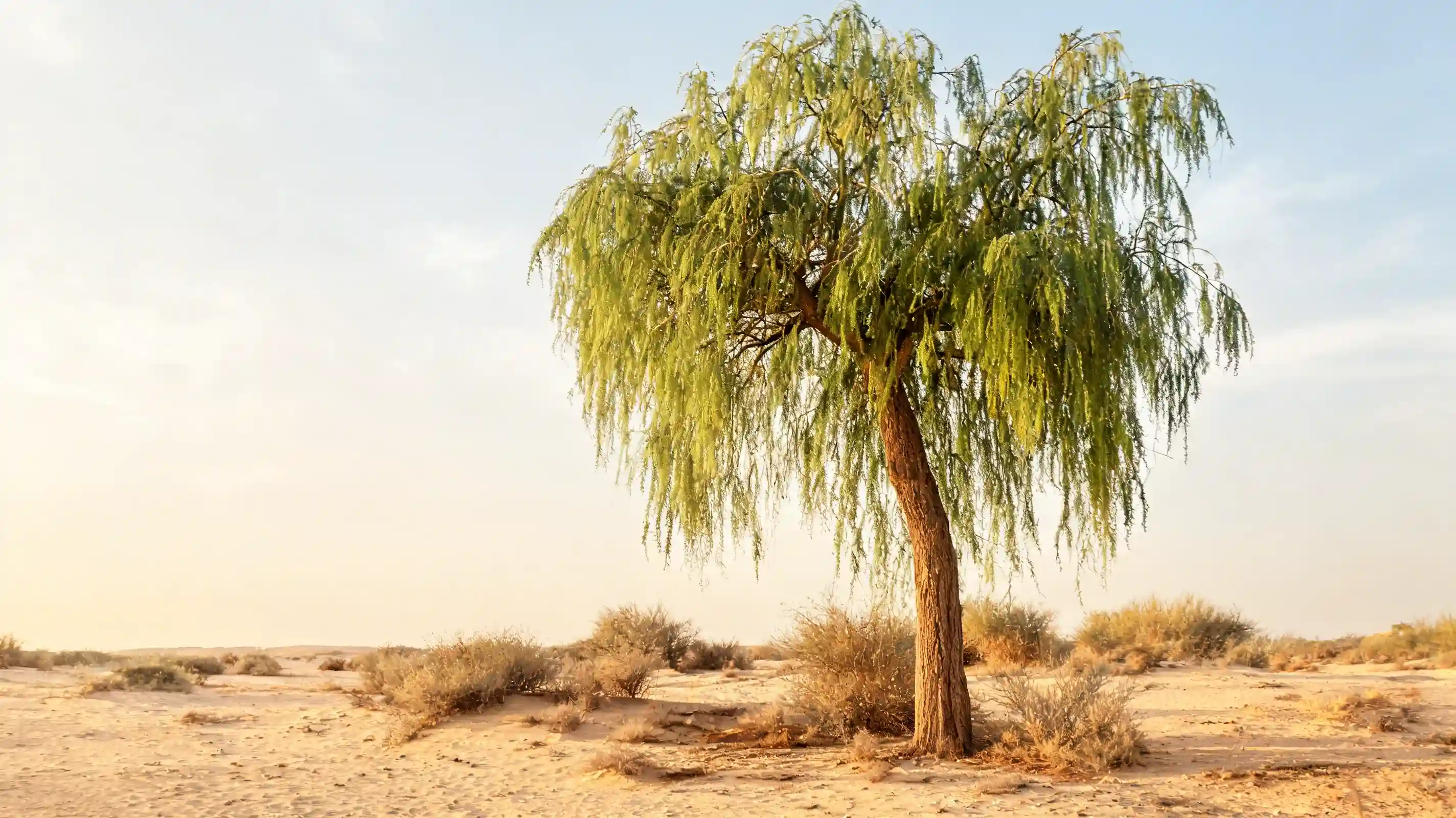
Scientific name: Acacia salicina
Size: Medium to large
Habitat: Desert soils
Form: Softly weeping, upright
Weeping Acacia closely resembles shoestring acacia but grows slightly taller, with a less pronounced weeping habit and shorter, three-inch narrow leaves. Also known as willow acacia, it shares the same graceful, airy silhouette but is harder to find at nurseries.
It suits landscapes that want a softer, more upright alternative to the shoestring form, with similar drought tolerance and desert-soil adaptability.
12. Catclaw Acacia
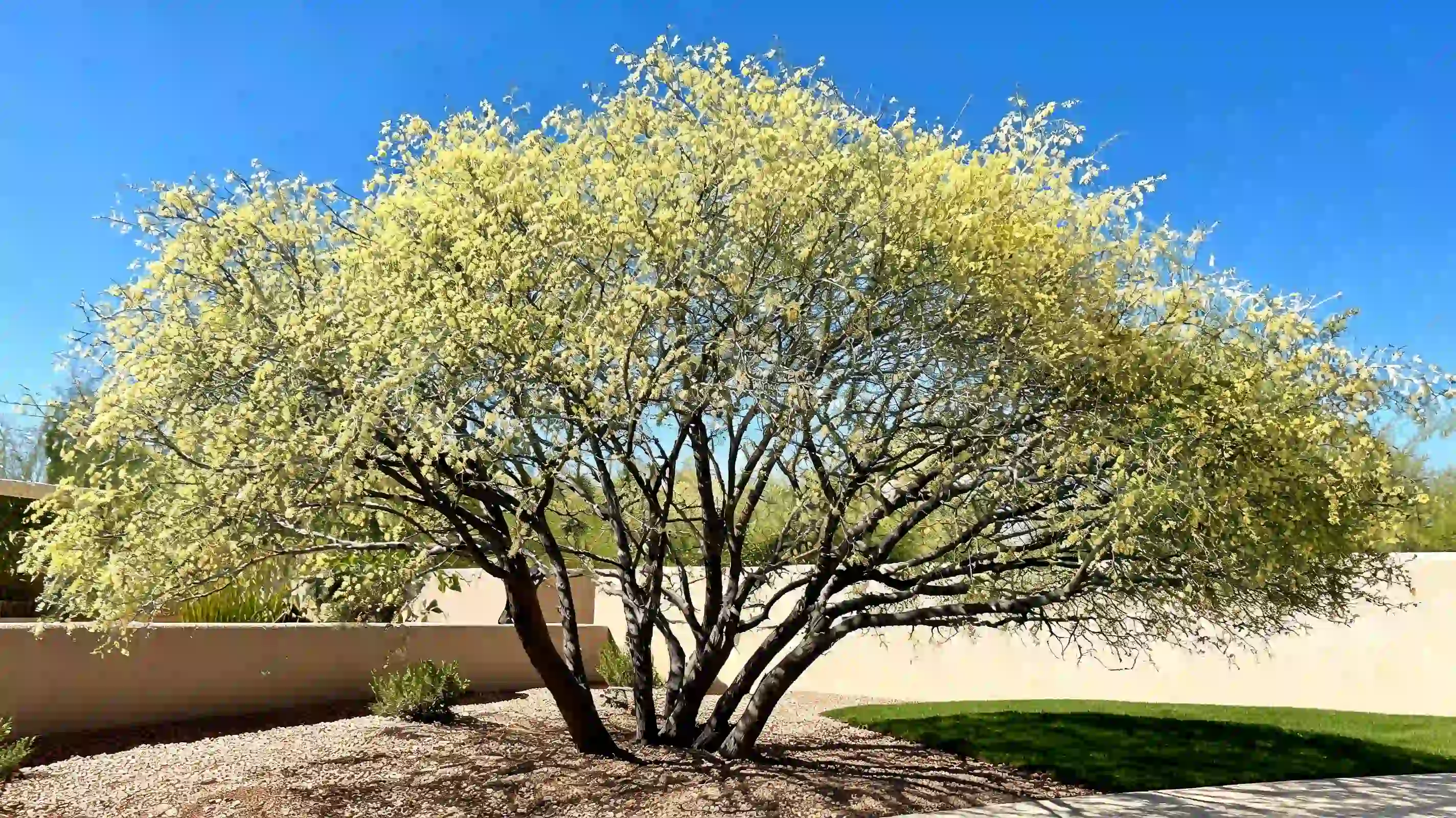
Scientific name: Acacia greggii
Size: Small
Habitat: Native to Southern Nevada
Form: Open, airy shrub-to-tree
Catclaw acacia grows natively as a large desert shrub, reaching about 15 feet when trained into tree form. Its ragged, weathered bark gives it an aged look, while sweetly fragrant spring flowers soften its rugged appearance.
Extremely drought-tolerant, it can go months without water. Its curved, cat-claw-like thorns make pruning painful but attract nesting birds. It tolerates cold down to 0°F.
13. Whitethorn Acacia
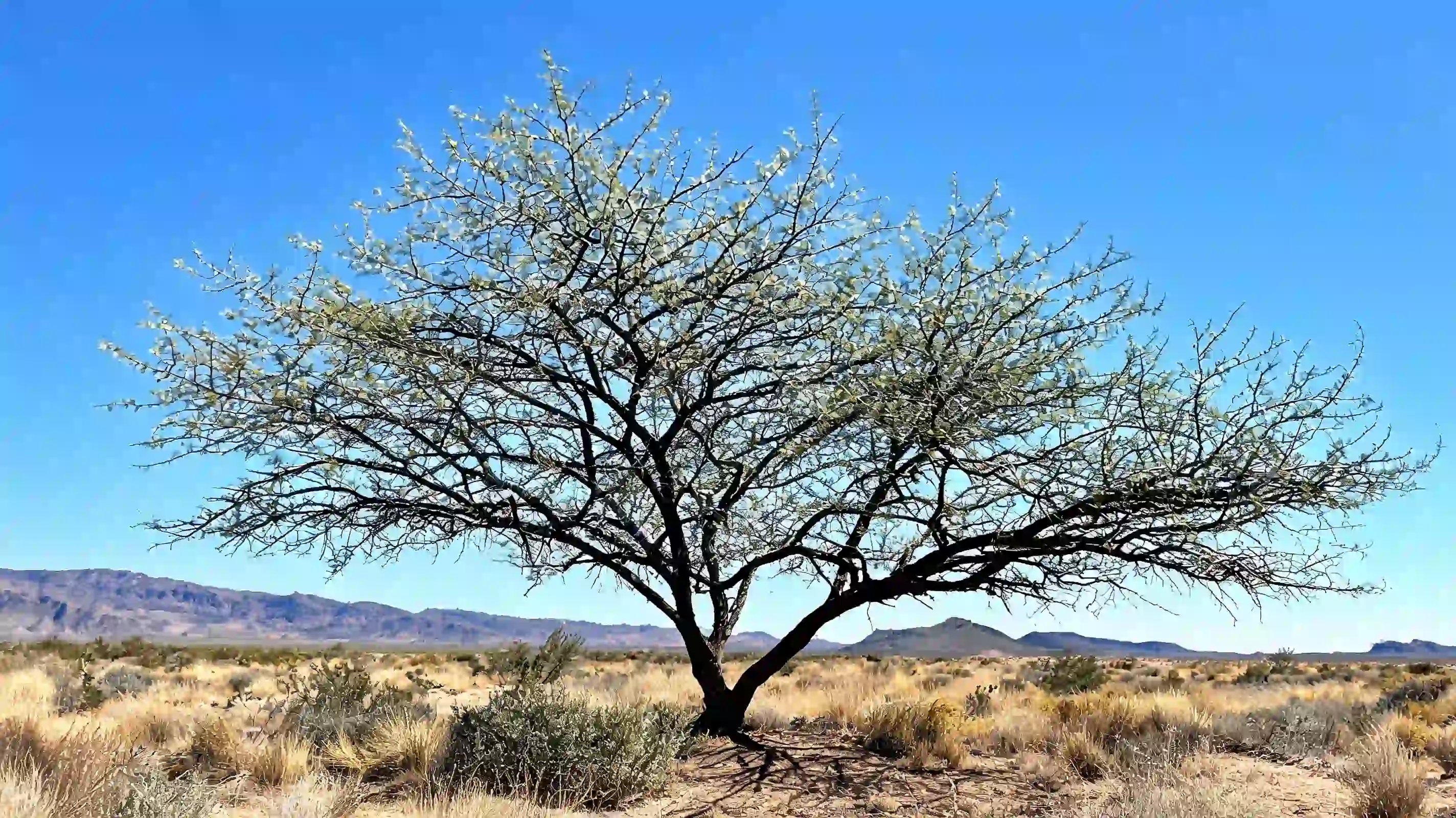
Scientific name: Acacia constricta
Size: Small
Habitat: Small desert yards
Form: Single or multi-trunk, feathery canopy
Whitethorn acacia suits small desert yards well, maturing to about 15 to 18 feet tall and wide as a single or multi-trunk tree. Its late spring to summer bloom is wonderfully fragrant, followed by long, thin seedpods.
Tiny, feathery leaves cast light shade perfect for underplanting. Deciduous and cold-hardy down to 0°F, it can be tricky to find at nurseries.
Desert Willow and Modern Varieties
Desert willow (Chilopsis linearis) is a thornless flowering tree suited to dry landscapes. It may grow with a single trunk or several stems, while cultivars such as ‘Bubba’ and ‘Timeless Beauty’ often produce fewer seedpods and need less cleanup.
14. Single-Trunk Desert Willow
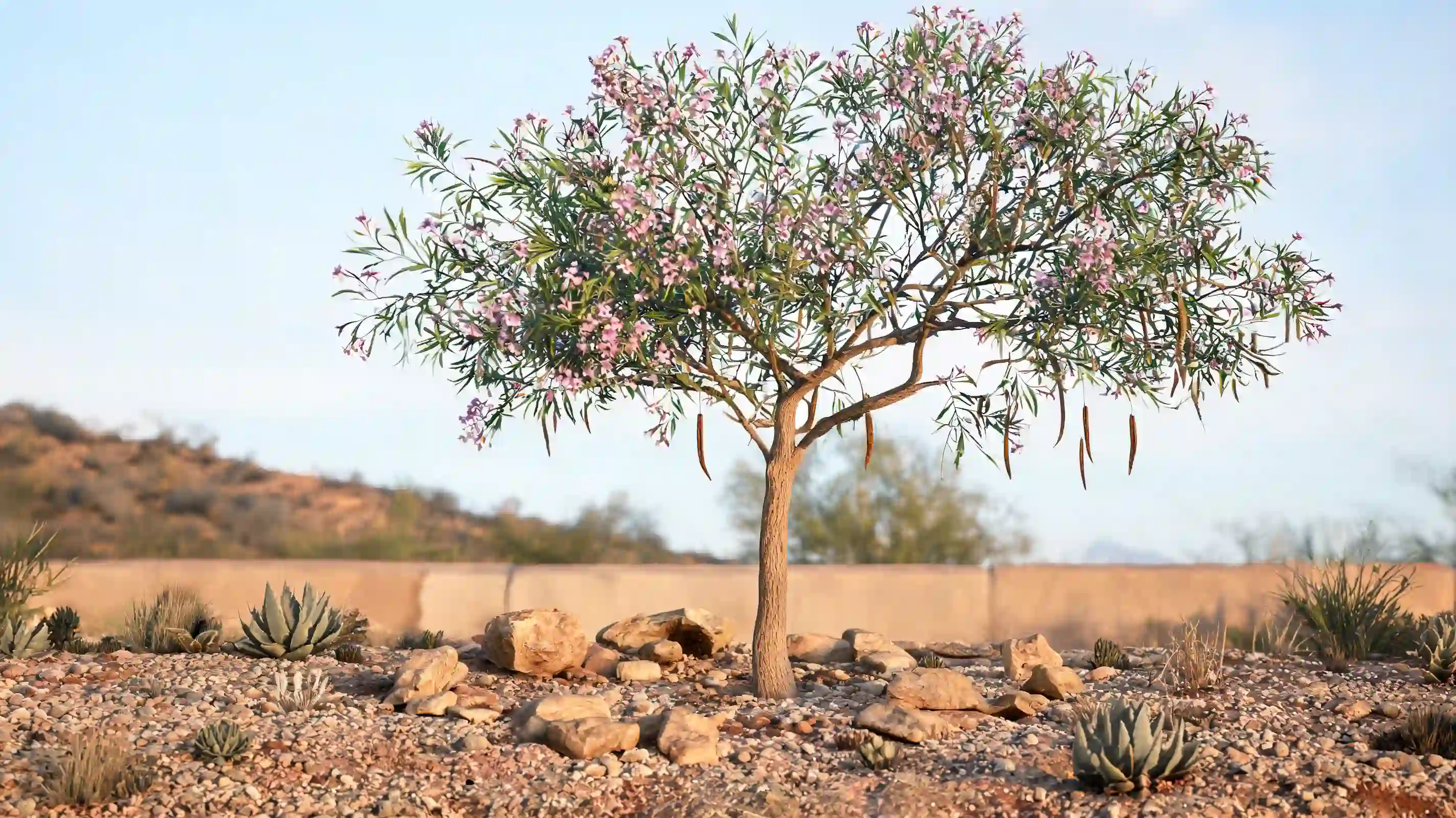
Scientific name: Chilopsis linearis
Size: 8 to 30 feet
Habitat: Parks, roadsides, and residential landscapes
Form: One main trunk
A single-trunk desert willow grows from one main stem and develops an open crown. Narrow leaves and flowers brighten the tree from spring through fall. It loses its foliage in winter and forms long seed capsules. Its small-to-medium size suits many residential planting areas.
15. ‘Bubba’ Desert Willow
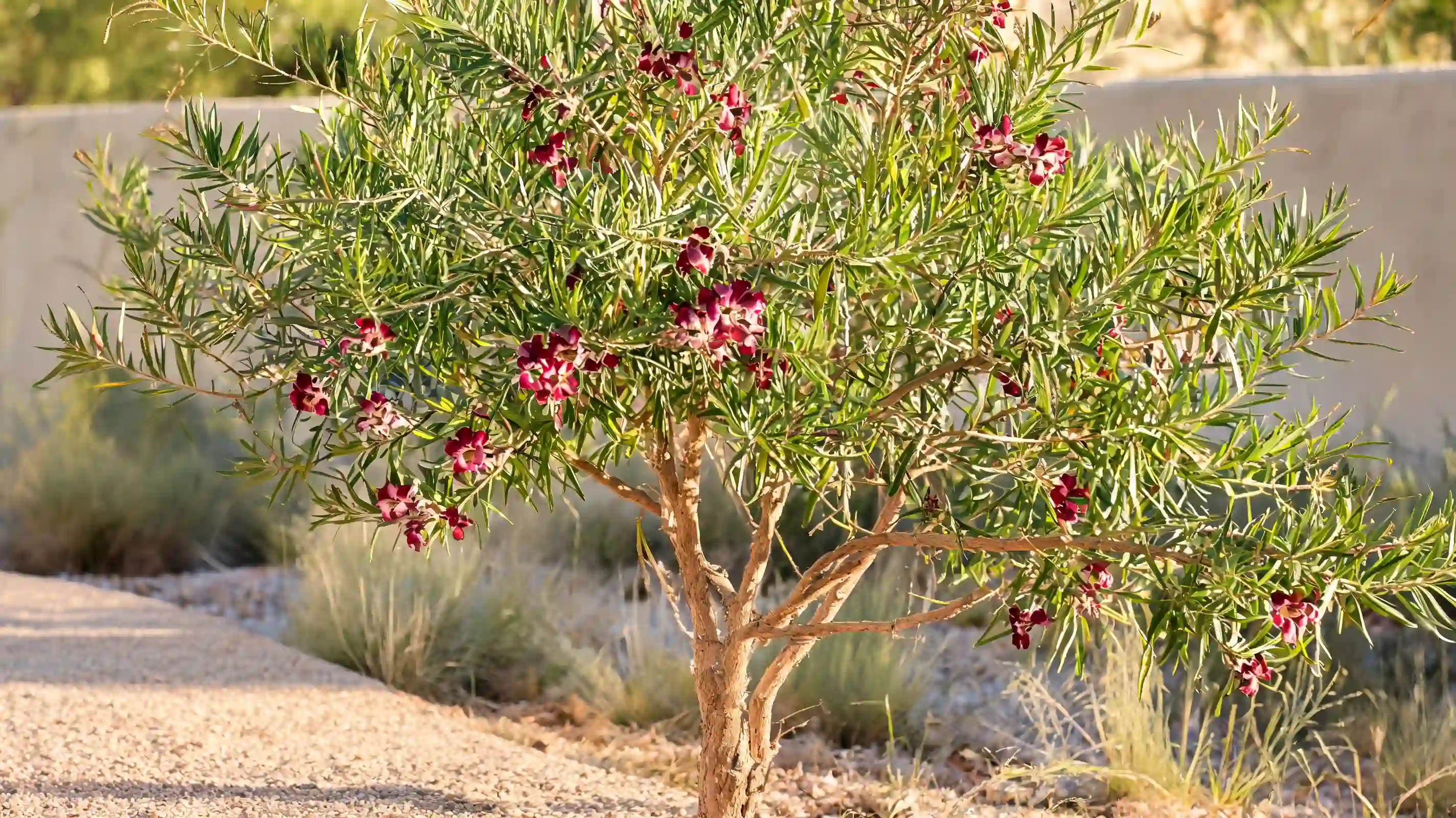
Scientific name: Chilopsis linearis Bubba’
Size: Small to medium
Habitat: Dry residential landscapes
Form: Flowering canopy with limited pod production
‘Bubba’ is a desert willow variety valued for its flowers and reduced seedpod production. It offers the narrow leaves, seasonal bloom, and drought tolerance linked with the species. The tree still drops its leaves in winter, but fewer pods can mean less cleanup near patios, paths, and garden beds.
Other Desert Trees
These trees expand planting choices for dry yards, offering shade, flowers, seasonal color, wildlife support, or compact growth. Match their size, roots, litter, cold tolerance, and water needs to the site before planting.
16. Desert Fern
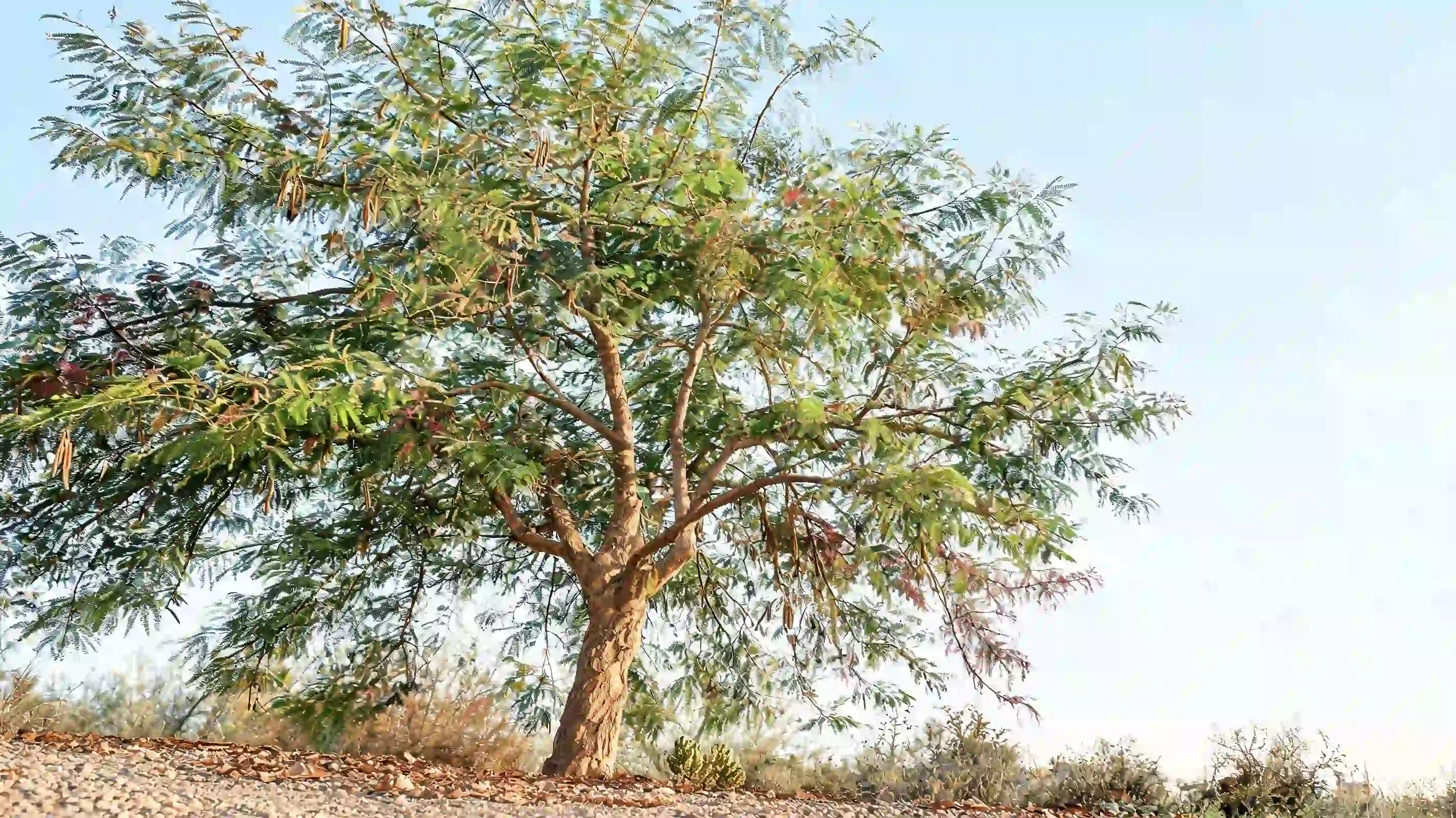
Scientific name: Lysiloma thornberi
Size: Medium
Habitat: Southwestern desert gardens
Form: Thornless, fern-like canopy
Desert fern has soft, divided leaves and may reach 15 to 45 feet in height and width. Its foliage can turn maroon in winter or drop during colder weather. Brown seedpods follow, but the tree remains valued for shade, reflected-sun tolerance, and low risk near paths.
17. Southern Live Oak
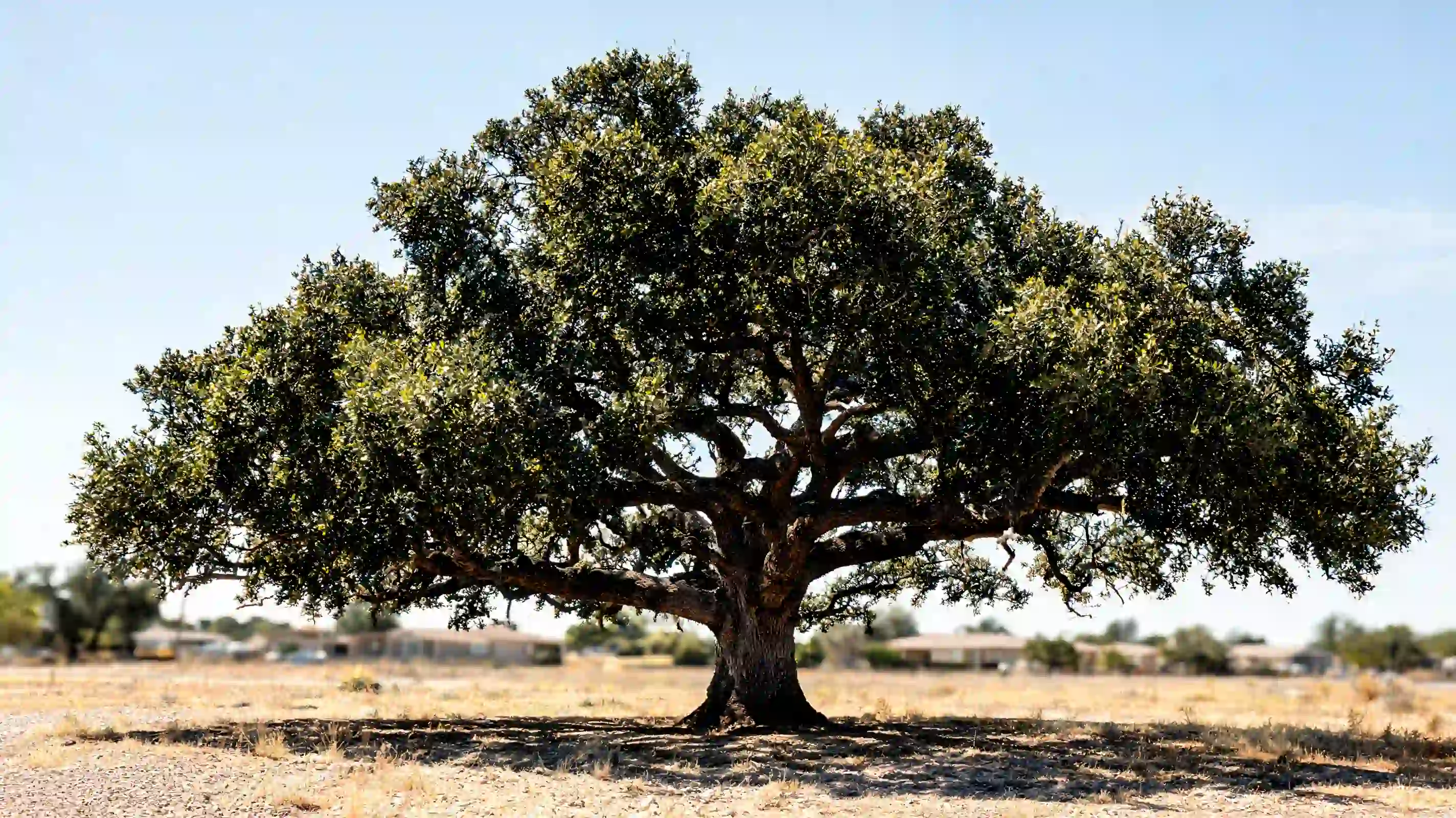
Scientific name: Quercus virginiana
Size: Medium to large
Habitat: Suburban desert landscapes
Form: Dense, evergreen canopy
Southern live oak handles full sun and reflected heat while requiring little routine care. It is thornless and keeps its foliage through the year. Although it can reach 40 to 60 feet outside desert regions, growth is often smaller in dry climates, making mature spacing important.
18. Bottle Tree
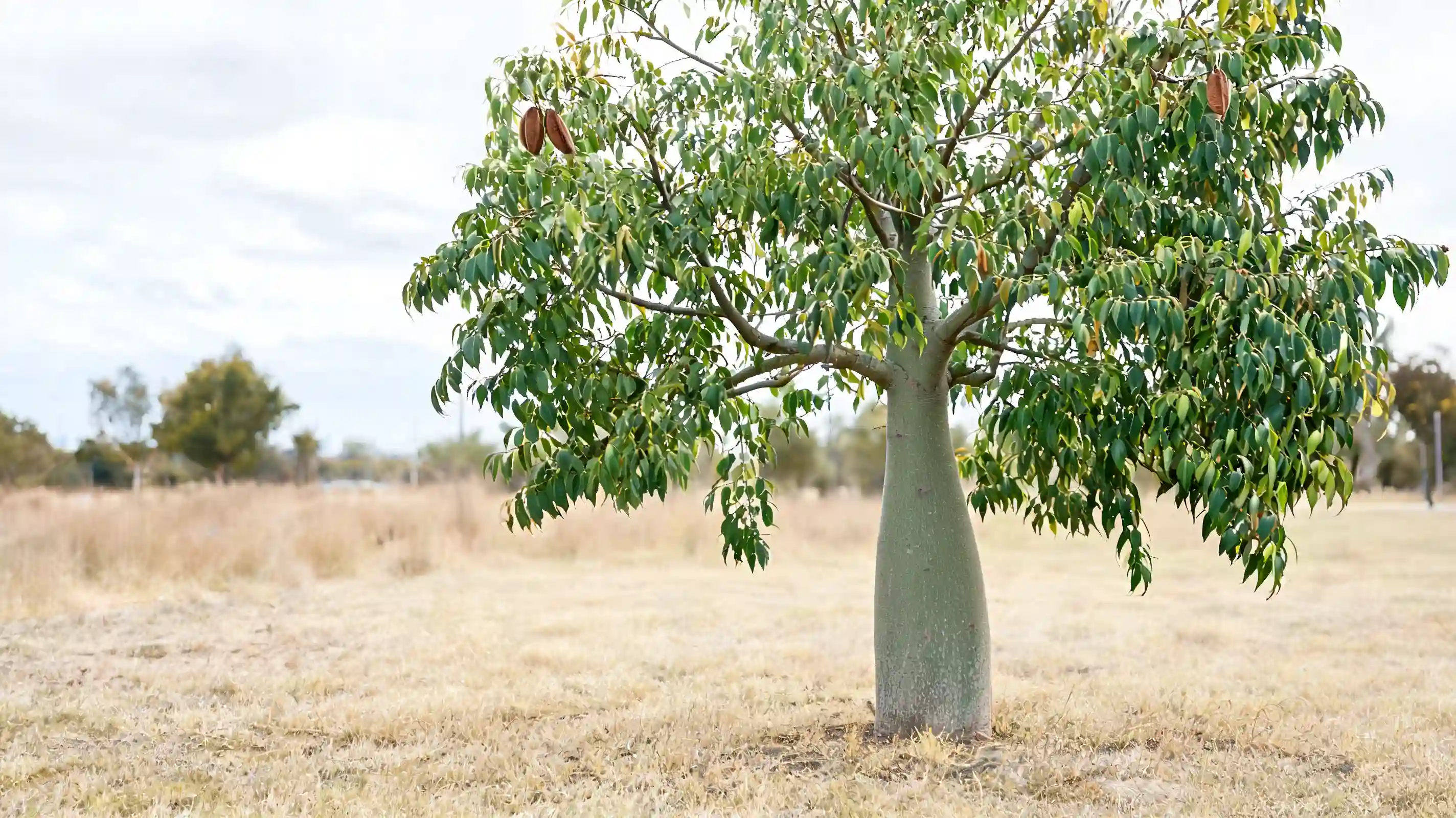
Scientific name: Brachychiton populneus
Size: Large
Habitat: Mild, dry climates
Form: Upright canopy with hanging branches
Bottle tree has a smooth trunk, shaped leaves, and evergreen foliage during mild winters. It may reach 30 to 45 feet tall and 30 feet wide. Large brown pods contain irritating fibers. Avoid planting it where Texas root rot has affected nearby trees or soil.
19. Palo Blanco
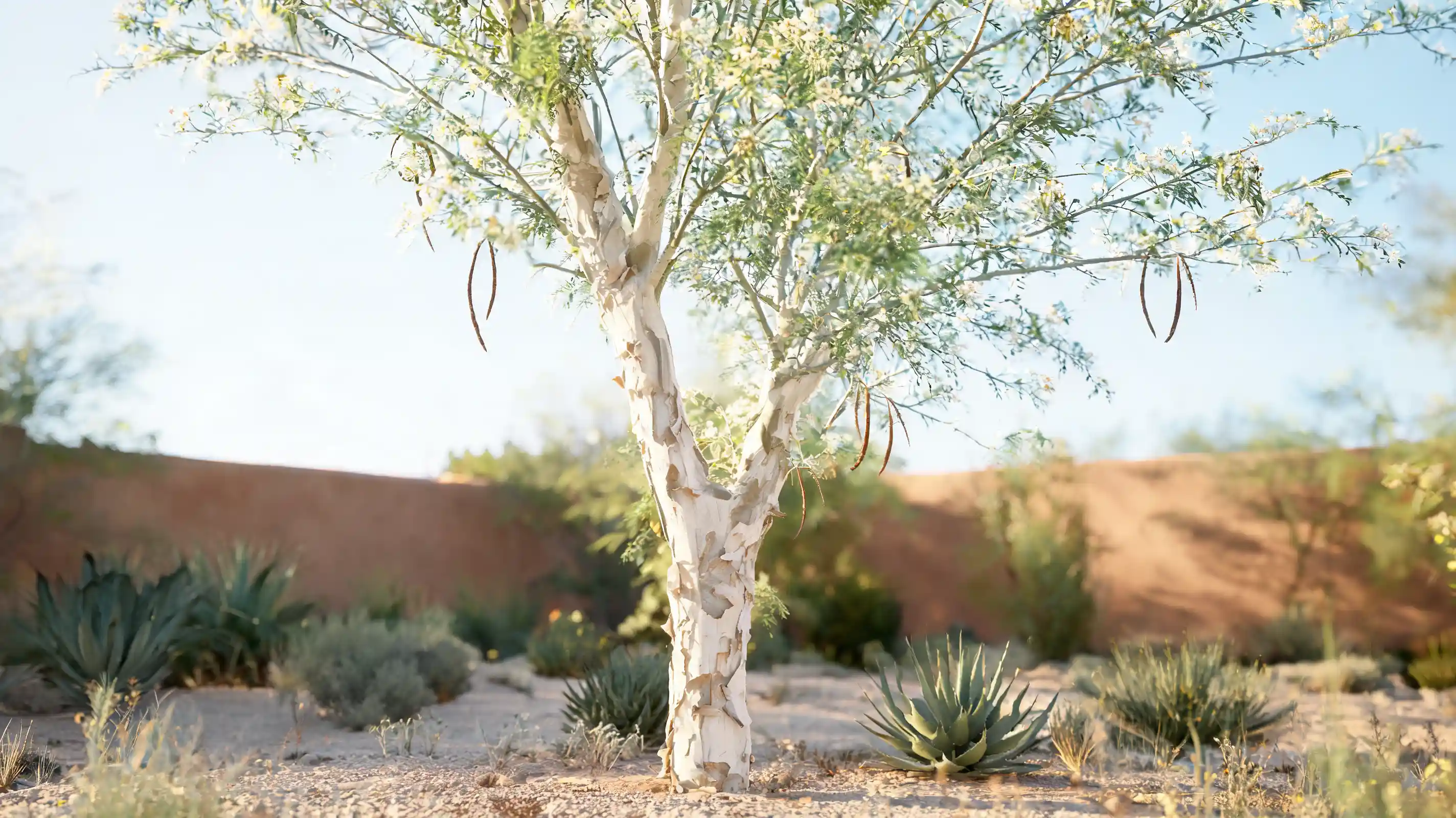
Scientific name: Acacia willardiana
Size: Small
Habitat: Hot, reflected-sun sites
Form: Narrow canopy with white trunk
Palo blanco is known for white bark that peels in thin sheets. It reaches about 15 to 20 feet tall and 10 feet wide, making it ideal for patios and small spaces. Tiny leaves create little litter, while spring flowers and seedpods add interest. Only light pruning is usually needed.
20. Sissoo Tree
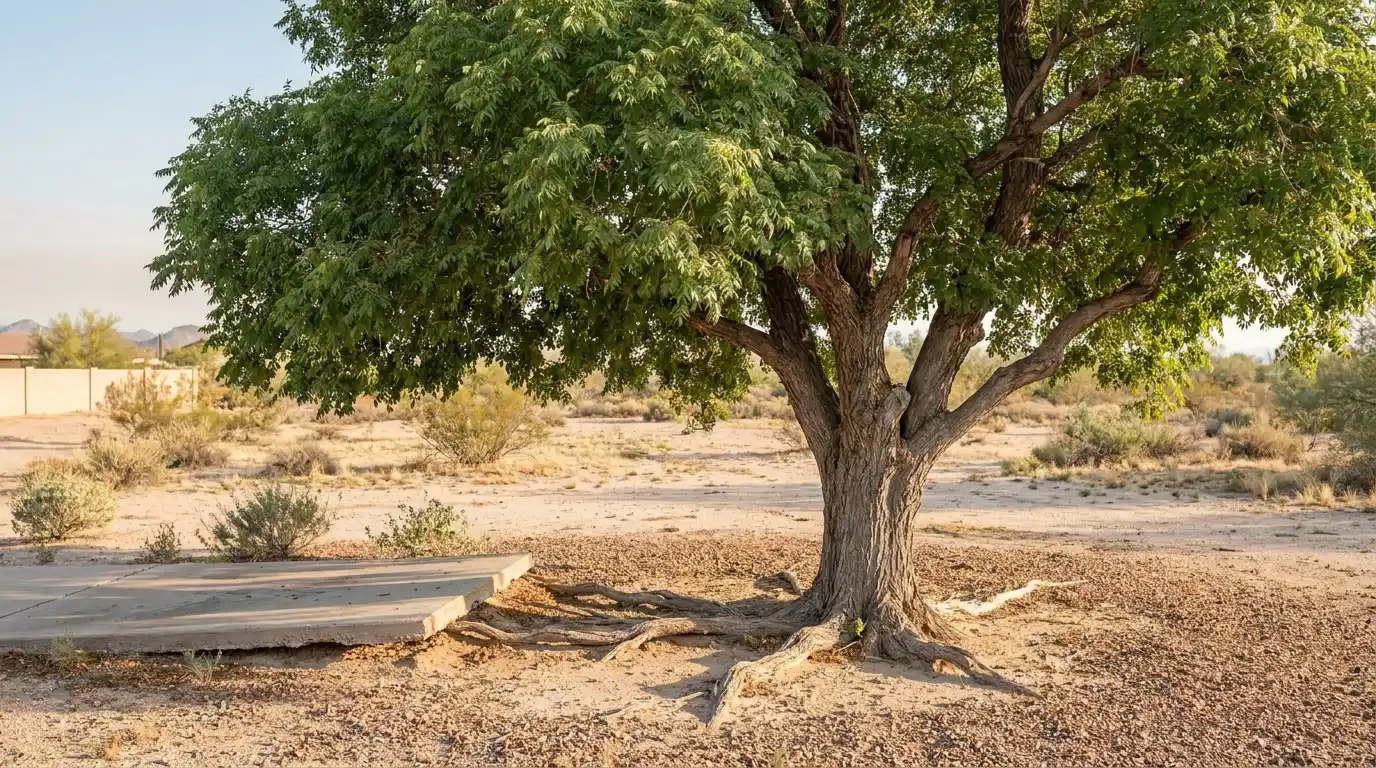
Scientific name: Dalbergia sissoo
Size: Large
Habitat: Parks and broad open spaces
Form: Fast-growing shade canopy
Sissoo grows quickly and provides dense green shade, but it is poorly suited to average residential yards. Its roots may lift sidewalks or affect patios, pools, and walls. Shallow watering can push roots near the surface. Plant it only where there is ample room and no nearby structures.
21. Olive Tree
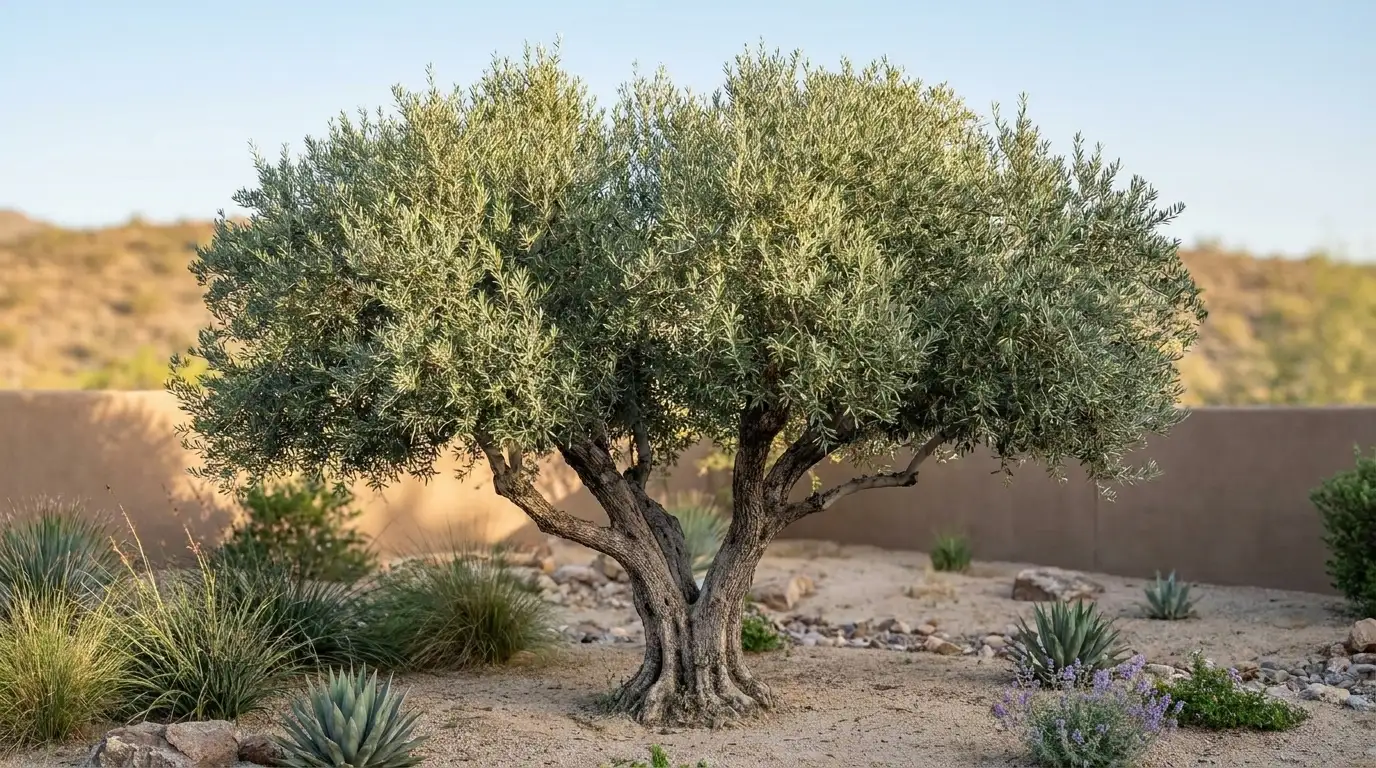
Scientific name: Olea europaea
Size: Medium
Habitat: Sunny, dry landscapes
Form: Evergreen, often multi-trunked
Olive trees grow slowly to about 20 to 30 feet tall and wide. They are thornless and provide lasting shade with gray-green foliage. Fruiting forms may create pollen or cleanup concerns, while non-fruiting selections such as ‘Swan Hill’ reduce those issues. Keep natural branching instead of severe shaping.
22. Texas Ebony
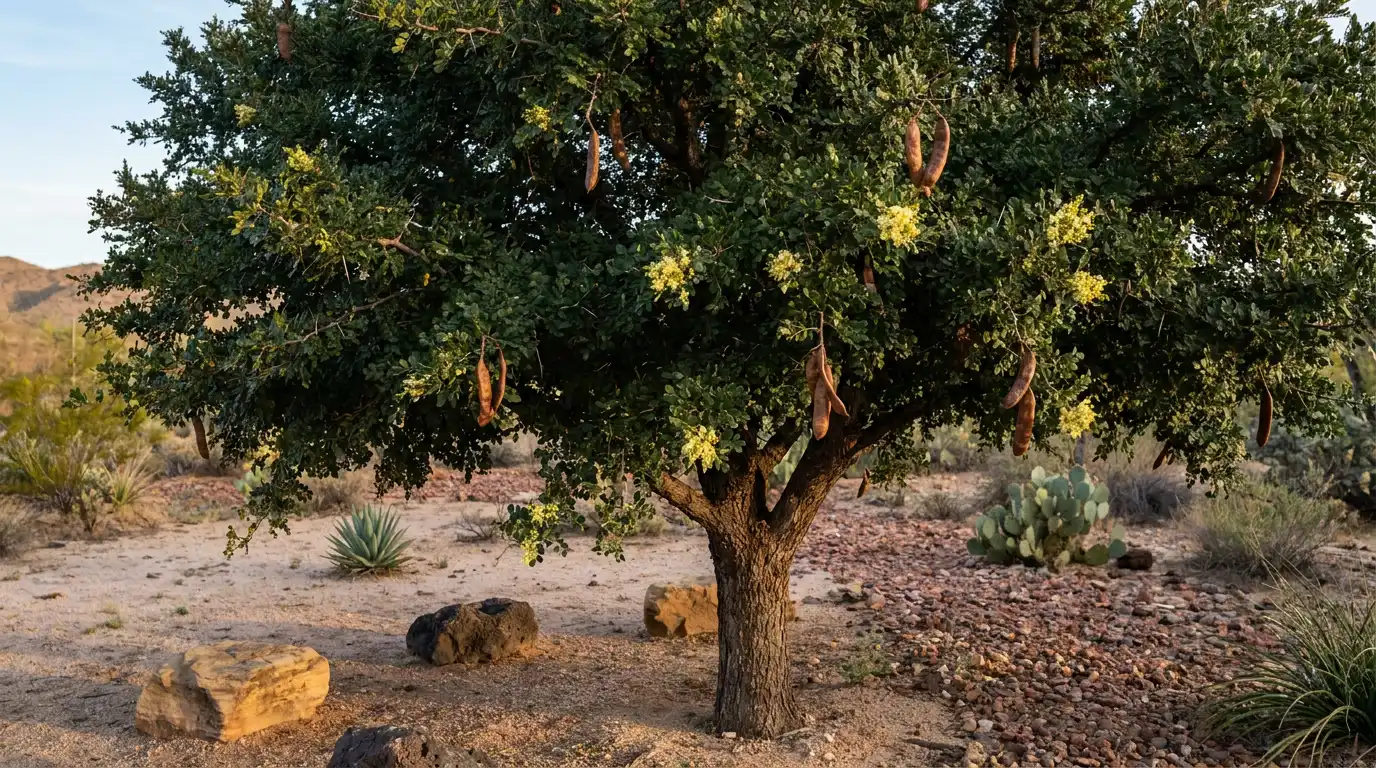
Scientific name: Ebenopsis flexicaule
Size: Medium
Habitat: Hot desert landscapes
Form: Dense, dark evergreen canopy
Texas ebony grows slowly to about 15 to 30 feet tall and 15 to 20 feet wide. It has dark leaves, a brown trunk, thorns, and large seedpods. Fragrant yellow flowers appear in late spring. The tree handles heat well but may suffer near 15°F, so regional cold matters.
23. Texas Mountain Laurel
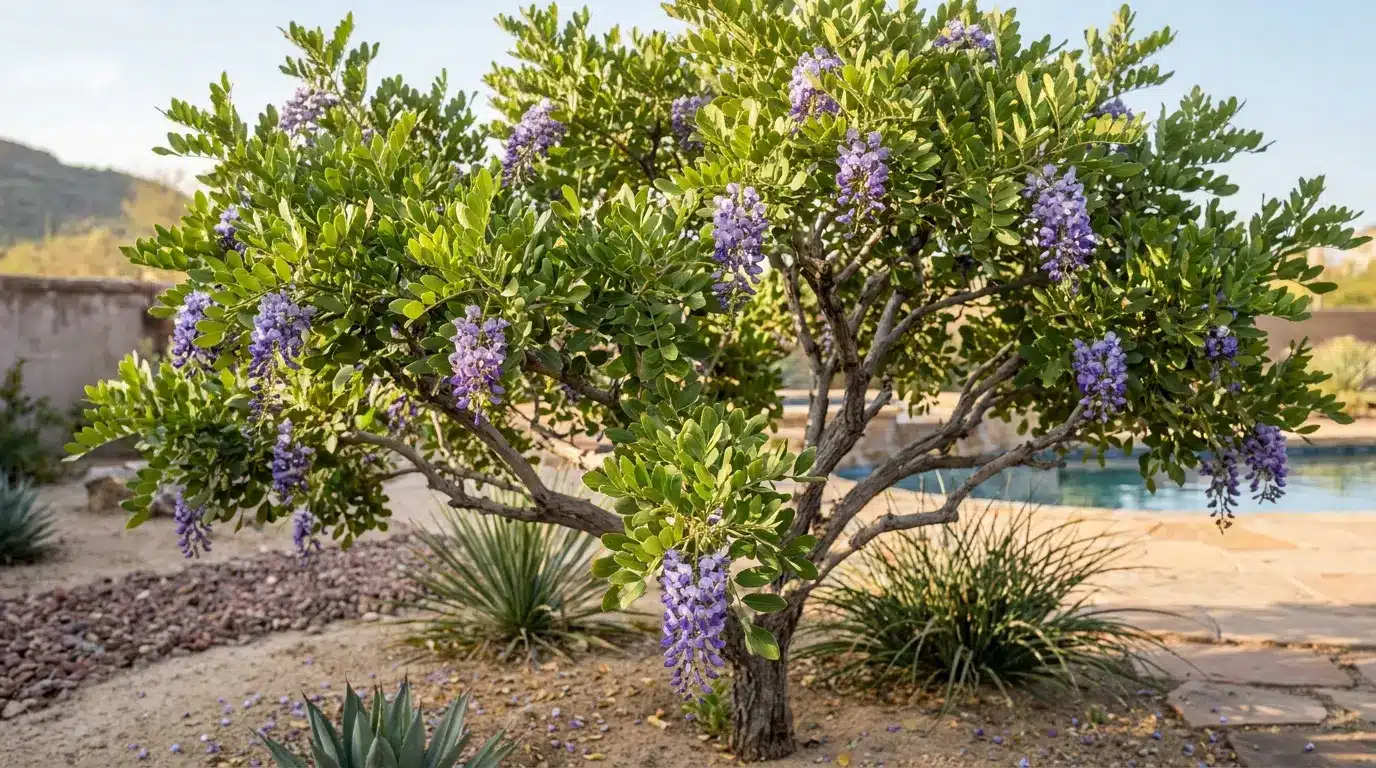
Scientific name: Sophora secundiflora
Size: Small
Habitat: Sunny yards and pool areas
Form: Evergreen shrub or small tree
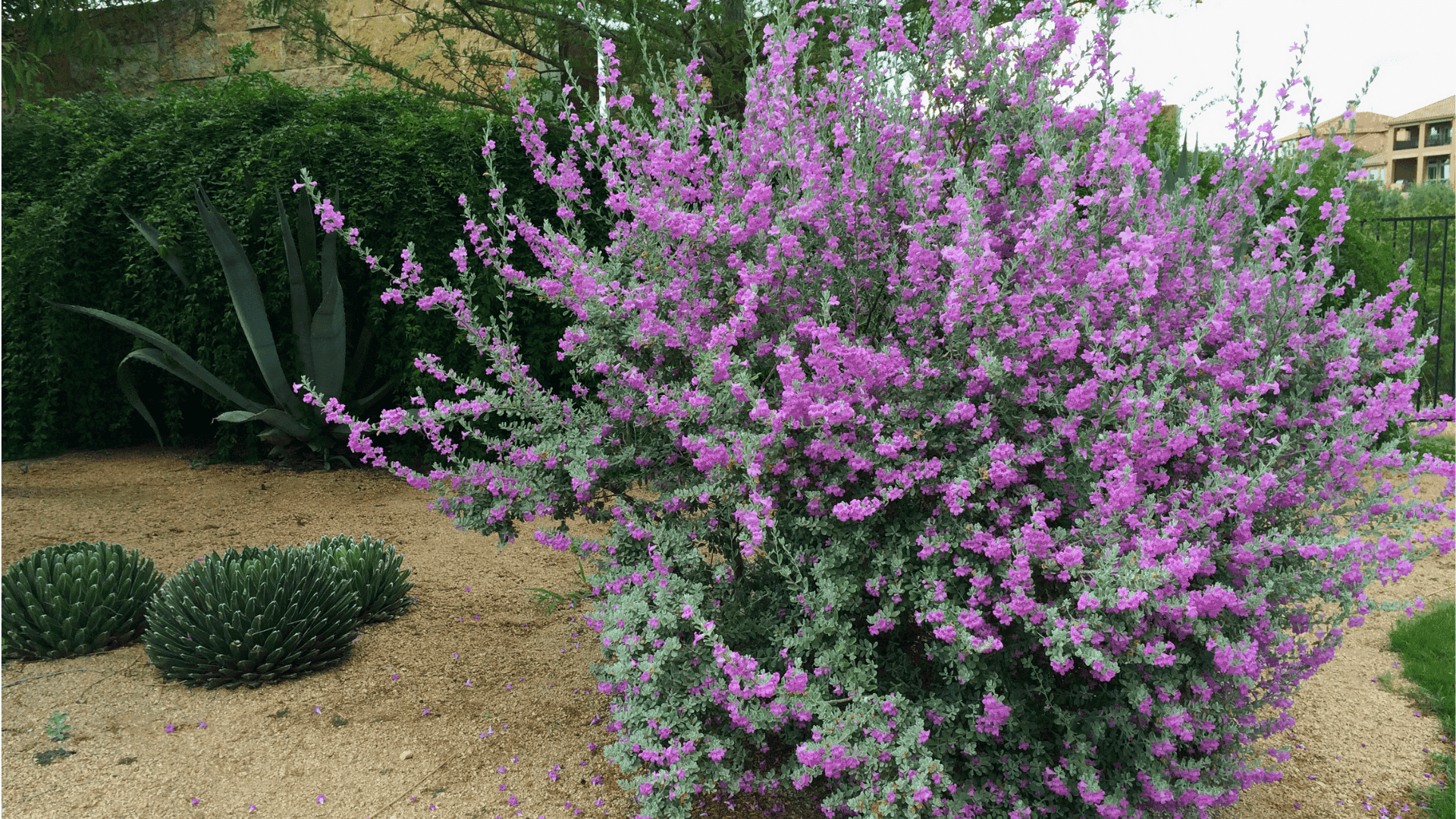
Texas mountain laurel reaches about 15 feet tall and 10 feet wide. It has bright leaves, fragrant purple flowers, and low litter, making it useful near pools. Once established, it tolerates drought and poor soil. Spring and summer caterpillars may strip leaves, so regular checks are helpful.
24. Saguaro as a Tree-Like Cactus
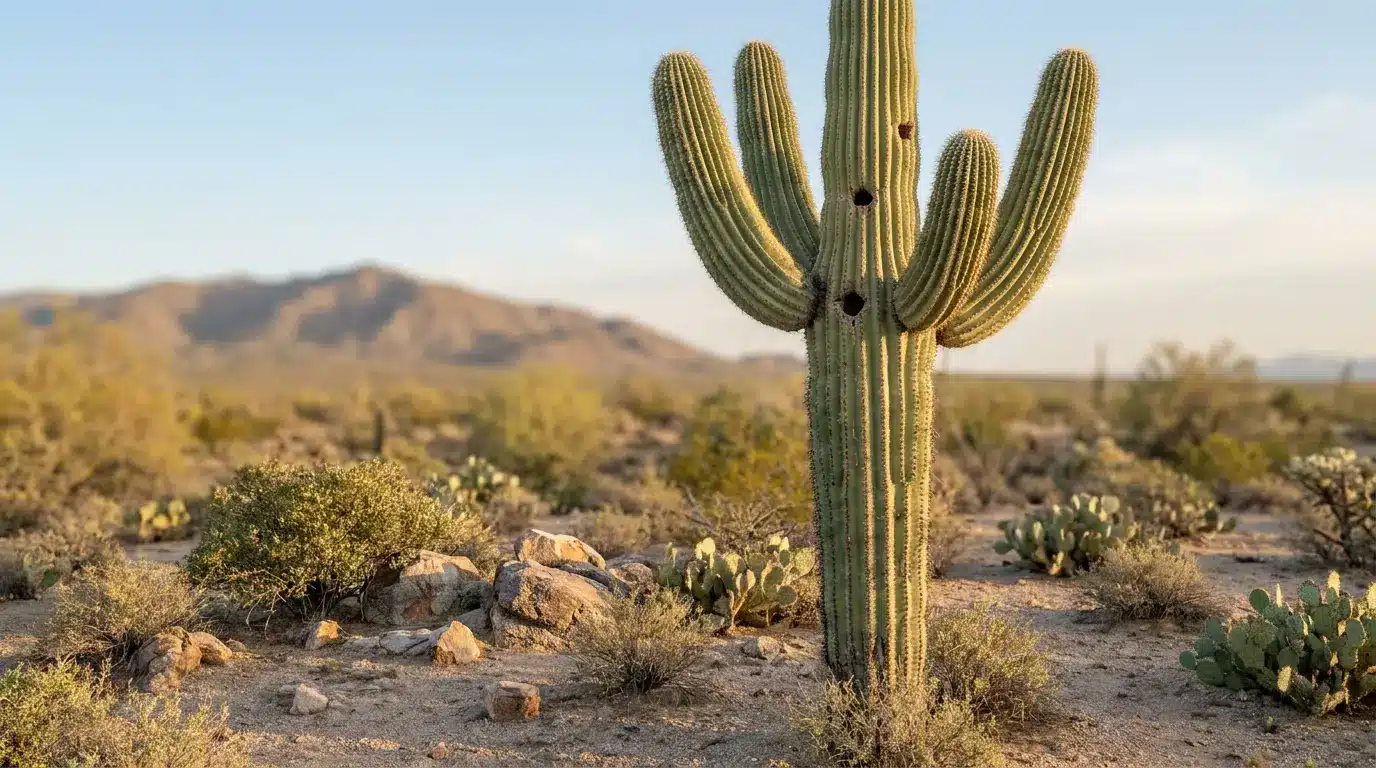
Scientific name: Carnea gigantea
Size: Tall cactus
Habitat: Sonoran desert
Form: Ribbed, column-shaped stem
Saguaro is not a true tree, but its height and branching shape give it a tree-like role. It can reach about 40 feet and live for more than 150 years. Ribbed stems store rainwater, waxy skin limits water loss, and spines protect the plant. Birds use cavities for nesting.
25. Cascalote
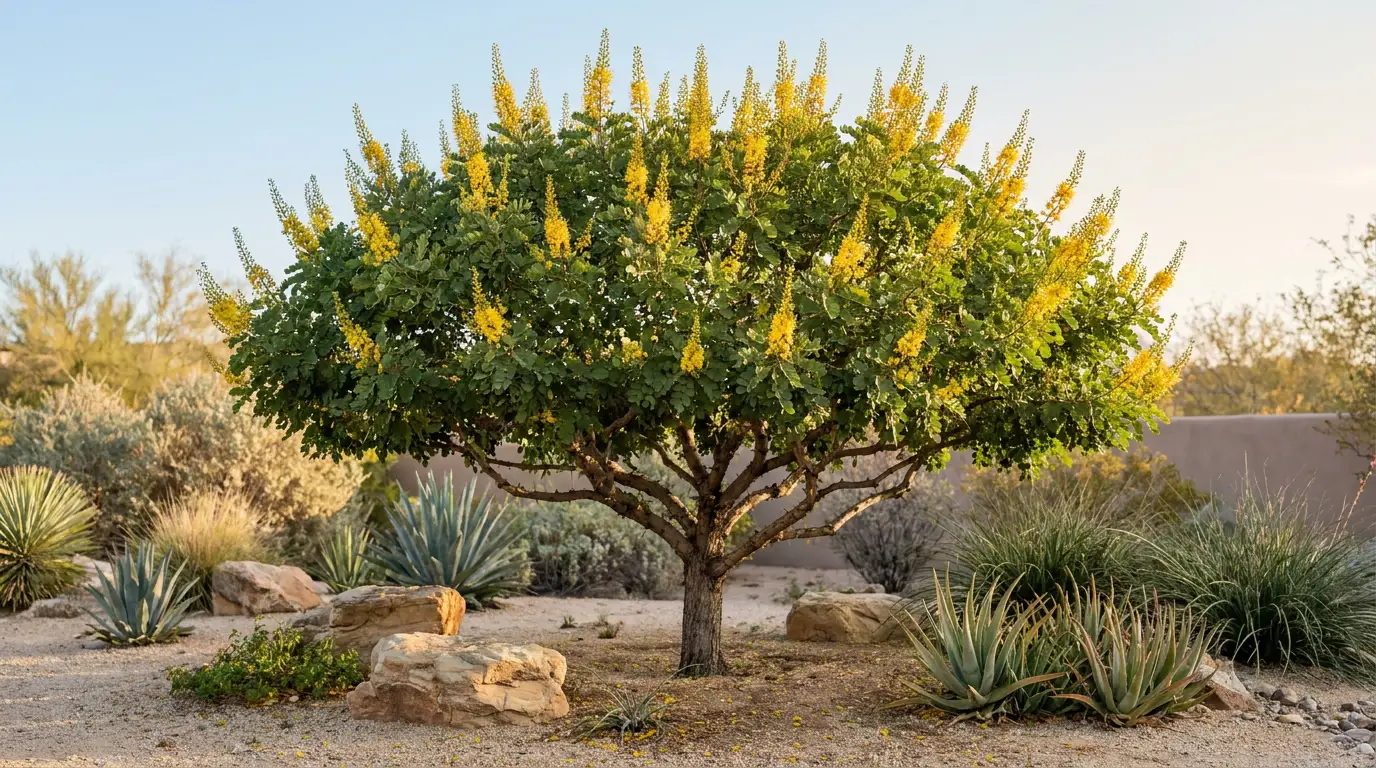
Scientific name: Caesalpinia cacalaco
Size: Small
Habitat: Warm desert gardens
Form: Evergreen canopy with rounded leaves
Cascalote reaches about 15 feet tall and wide. Yellow flower plumes open during November and December, adding color when many trees are not blooming. Standard forms have thorns and should stay away from busy paths.
26. Aleppo Pine
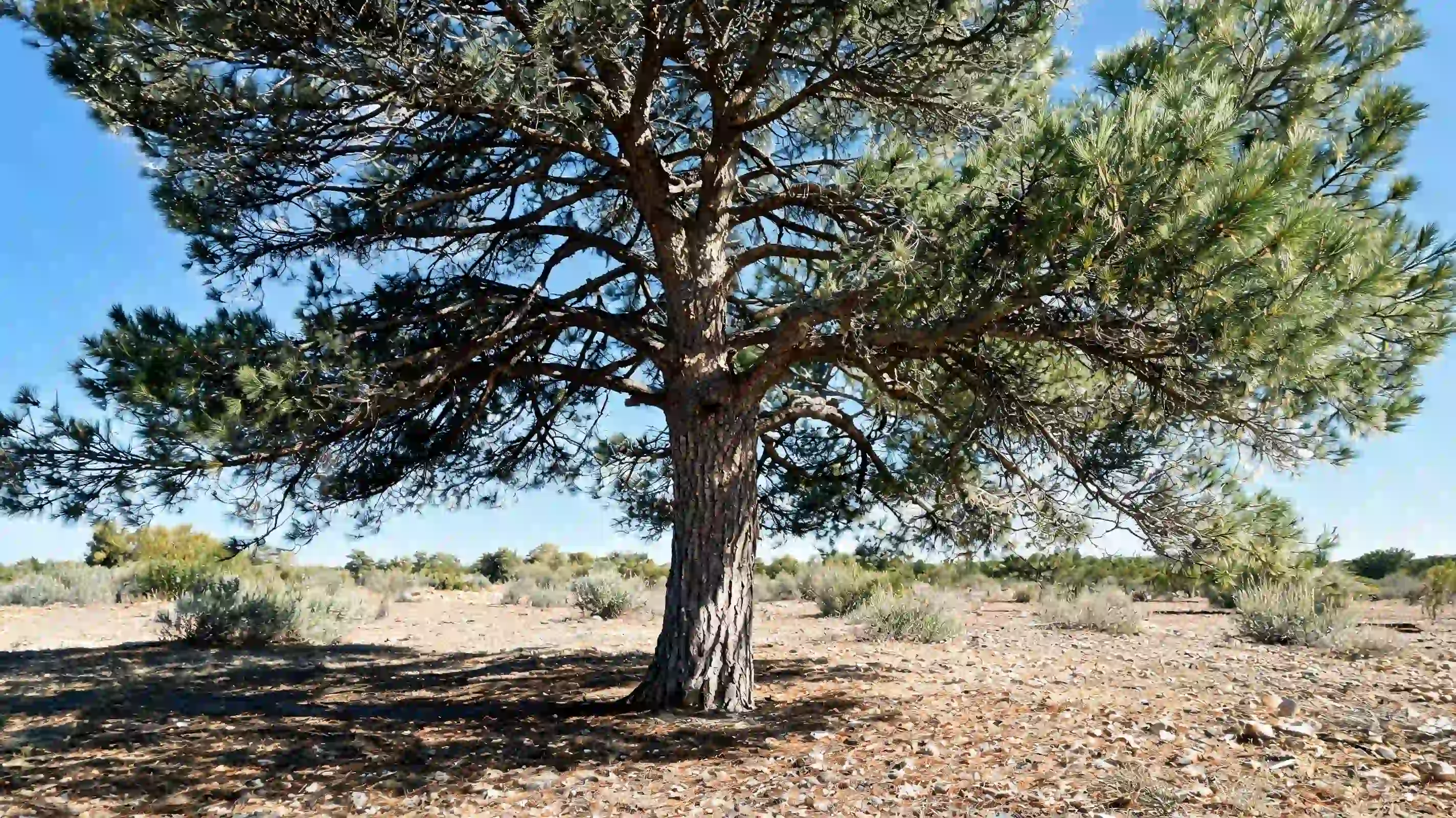
Scientific name: Pinus halepensis
Size: Large
Habitat: Lower desert suburbs
Form: Tall evergreen shade canopy
Aleppo pine may grow 30 to 60 feet tall, so it needs a broad site. Its heavy shade can limit grass below, while fallen needles form useful mulch as they break down. High salt levels in soil, reclaimed water, or irrigation water may weaken the tree and reduce long-term health.
27. Forman’s Eucalyptus
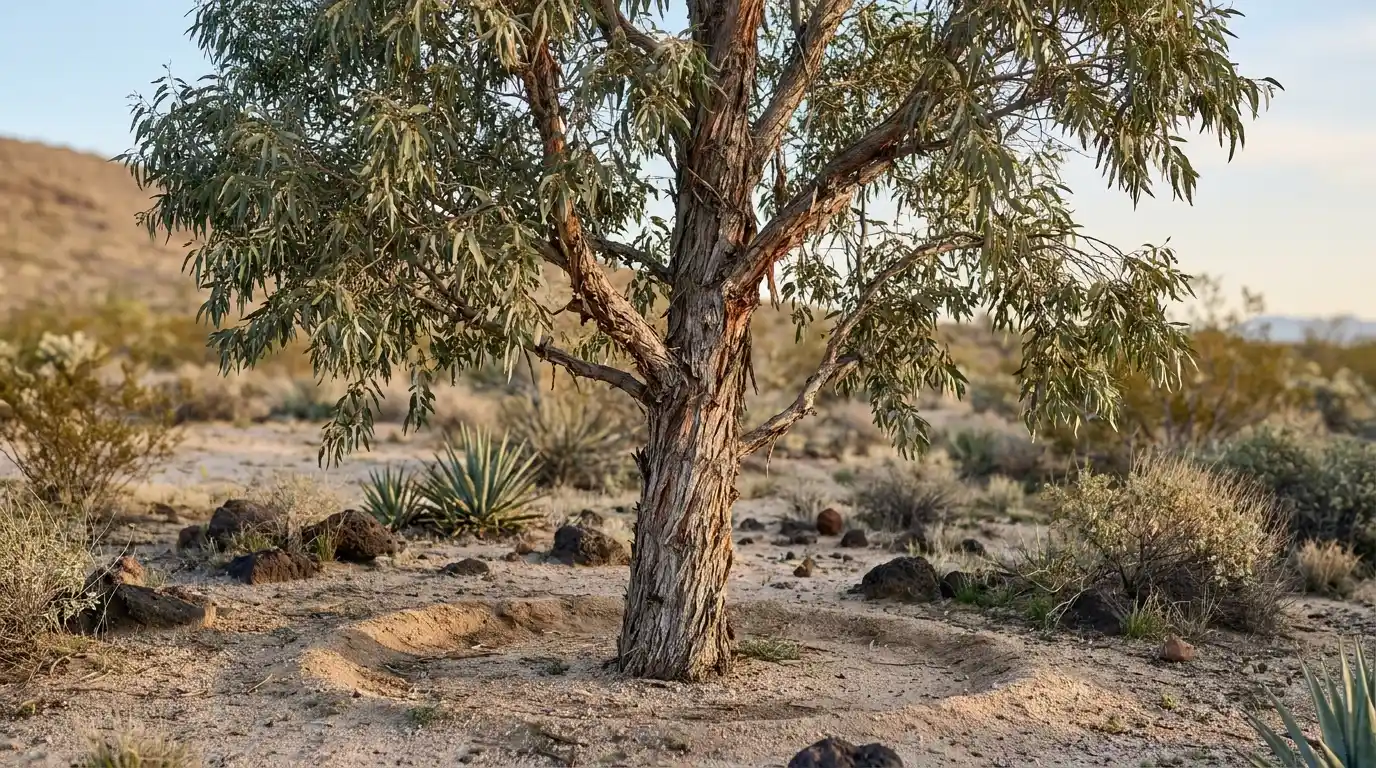
Scientific name: Eucalyptus formanii
Size: Small
Habitat: Low-water desert landscapes
Form: Open, spreading evergreen canopy
Forman’s eucalyptus grows about 15 to 18 feet tall and 12 to 15 feet wide. It has gray-green foliage, shaggy bark, and branches that hang slightly downward. It handles temperatures near 10 to 15°F and uses little water, though it needs more moisture than highly drought-tolerant desert species.
28. Desert Ironwood
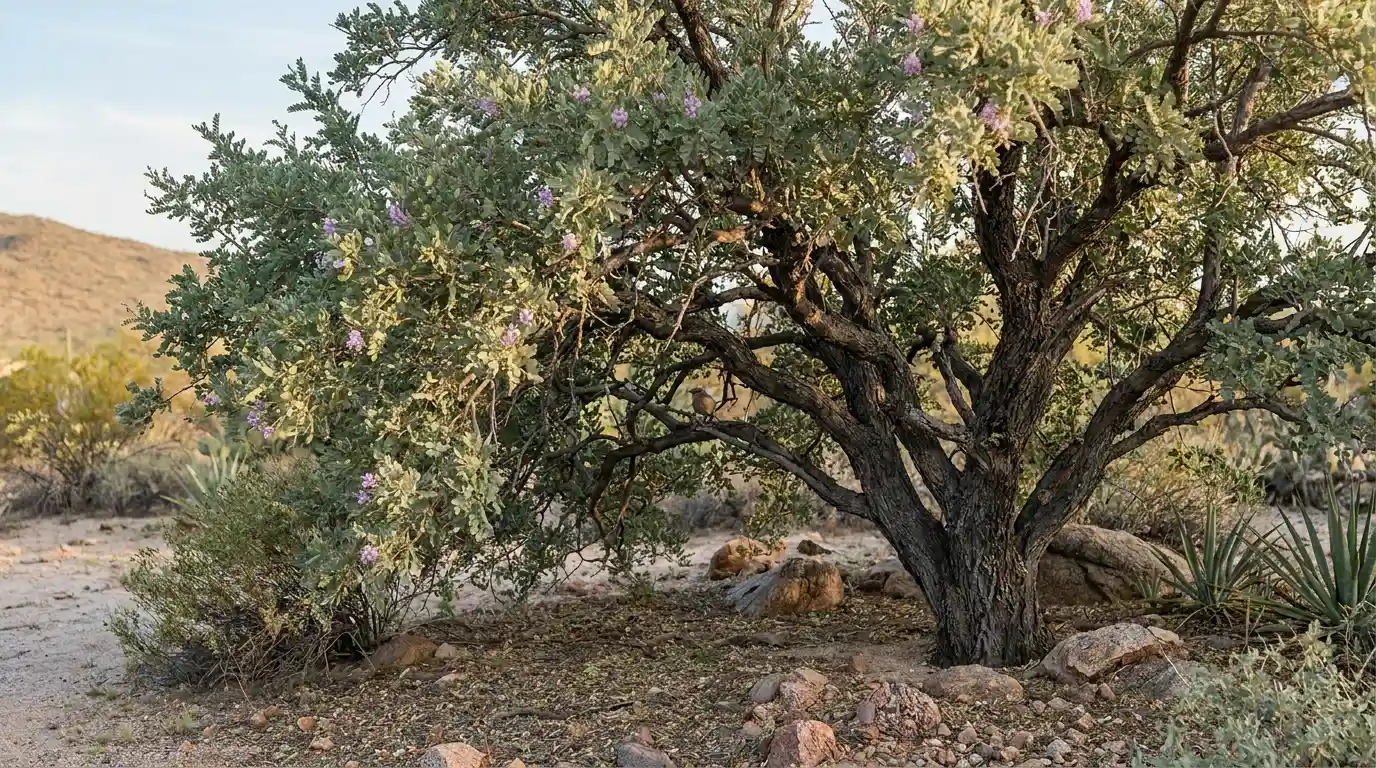
Scientific name: Olneya tesota
Size: Medium
Habitat: Sonoran desert environments
Form: Slow-growing, sheltering canopy
Desert ironwood has dense wood, small, thick leaves, and strong drought tolerance. Its slow growth reduces resource demand in poor soil. Fallen leaves add organic matter, while branches provide cover for birds and insects. This tree suits landscapes where native habitat value matters more than quick shade or rapid growth.
Desert Tree Selection Criteria
Choosing the right species starts with matching the plant to the site, not picking the fastest grower or brightest flowers. The University of Arizona Cooperative Extension advises reviewing mature plant size against nearby structures and utility lines before a single tree goes into the ground.
- Growth rate: Fast trees often need more pruning and may form weaker branches when overwatered.
- Mature size: Check full height and spread before planting near walls, roofs, paths, pools, or power lines.
- Thorns and litter: Keep thorny or messy trees away from walkways, play areas, and pool edges.
- Cold tolerance: Choose species that can handle the lowest winter temperatures in your region.
- Soil and roots: Palo verdes need good drainage, while sissoo roots may damage paving and nearby structures.
A careful match lowers future upkeep and gives the tree enough room to stay healthy and stable.
General Guidance for Dry and Arid Landscape Design
Dry landscapes work well when trees support the whole planting area, not only one spot. Use their shade, fallen leaves, and open canopies to improve comfort and soil conditions.
| Design goal | Practical approach |
|---|---|
| Reduce heat | Place shade trees near exposed outdoor areas. |
| Support plants | Use filtered canopies so smaller plants still receive sunlight. |
| Protect soil | Leave suitable leaf litter as mulch to slow moisture loss and erosion. |
| Help wildlife | Include flowering or pod-producing trees for food, shelter, and nesting. |
| Manage water | Use deep, wide soakings instead of frequent shallow watering. |
A balanced layout combines shade, habitat, and soil protection. Keep open areas between plant groups so trees can develop naturally.
Planting and Care for Desert Trees
Plant these trees in well-draining soil. In heavy ground, keep palo verdes slightly raised and avoid setting them too deep. After planting, use deep, wide soakings instead of frequent surface watering.
This encourages a broader root area and limits weak, overly fast growth. Pairing these trees with lower-growing companions, such as the picks in drought-tolerant shrubs for every yard, can round out a layered bed while keeping overall water use low.
Before planting a grafted Desert Museum palo verde, inspect the graft union for peeling, splitting, or a clear size mismatch between the trunk and rootstock. In salty soil, occasional leaching with a longer watering cycle can move salts beneath the roots.
For African sumac, remove root suckers at their attachment point and avoid cutting more than one-quarter of the foliage during a single year.
Common Mistakes to Avoid
Small planting and care errors can create long-term problems for these species.
- Planting too deep: Palo verdes need good drainage and may perform better on slightly raised ground where soil drains slowly.
- Using frequent shallow watering: This can keep roots near the surface and reduce stability. Deep, wide soaking supports stronger root spread.
- Removing too much growth: Heavy pruning can trigger weak water sprouts and spoil the tree’s natural shape.
- Ignoring graft quality: Desert Museum palo verde should have a sound graft union to lower the risk of failure.
- Placing messy trees near pools: Flowers, pods, needles, or fruit can increase cleanup.
Careful planting and steady maintenance help trees keep a balanced form.
Frequently Asked Questions
What is the best desert tree for a yard?
Desert willow is a strong yard choice because it is thornless, suits smaller spaces, offers seasonal flowers, and includes low-seed cultivars that reduce cleanup. The best option still depends on your available space, winter cold, soil drainage, and how much litter you are willing to manage.
Which desert trees need the least water?
Catclaw acacia, mesquite, palo verde, desert ironwood, and Texas mountain laurel need very little water once their root systems are fully established in the ground. Their exact needs still vary somewhat depending on local soil, plant age, summer heat, and how the tree was originally planted.
Which desert trees are best for small spaces?
Palo blanco, Foothill palo verde, Whitethorn acacia, Desert Fern, and Texas mountain laurel all suit smaller spaces well, since each stays compact or grows slowly. Still, check the mature width listed for each species before planting near walls, paths, patios, or swimming pools.
Which desert trees provide the most shade?
Mesquite, Blue palo verde, Southern live oak, olive, and Aleppo pine provide strong, reliable shade across a yard once their canopies fill in fully. Large canopies need ample open space to spread, while Aleppo pine in particular creates heavy shade that can limit grass growth beneath it.
Which desert trees are thornless?
Thornless choices include desert willow, Desert Museum palo verde, Southern live oak, palo blanco, olive, and Desert Fern, all confirmed to grow without spines along their branches. Some named cultivars stay thornless even when the standard, unselected form of that same species still carries thorns.
Wrap Up
Desert trees have a charm that is hard to ignore. There is something special about seeing them across the warm, open landscapes of America. Some have bold shapes, some have delicate leaves, and others simply add a beautiful desert feel to the view.
I always enjoy seeing how different these trees can look from one place to another. Each one seems to bring its own personality to the landscape.
Hopefully, you enjoyed exploring these desert trees as much as I did. Which one caught your attention the most? Drop a comment below and share your favorite. I would love to hear which tree stood out to you.