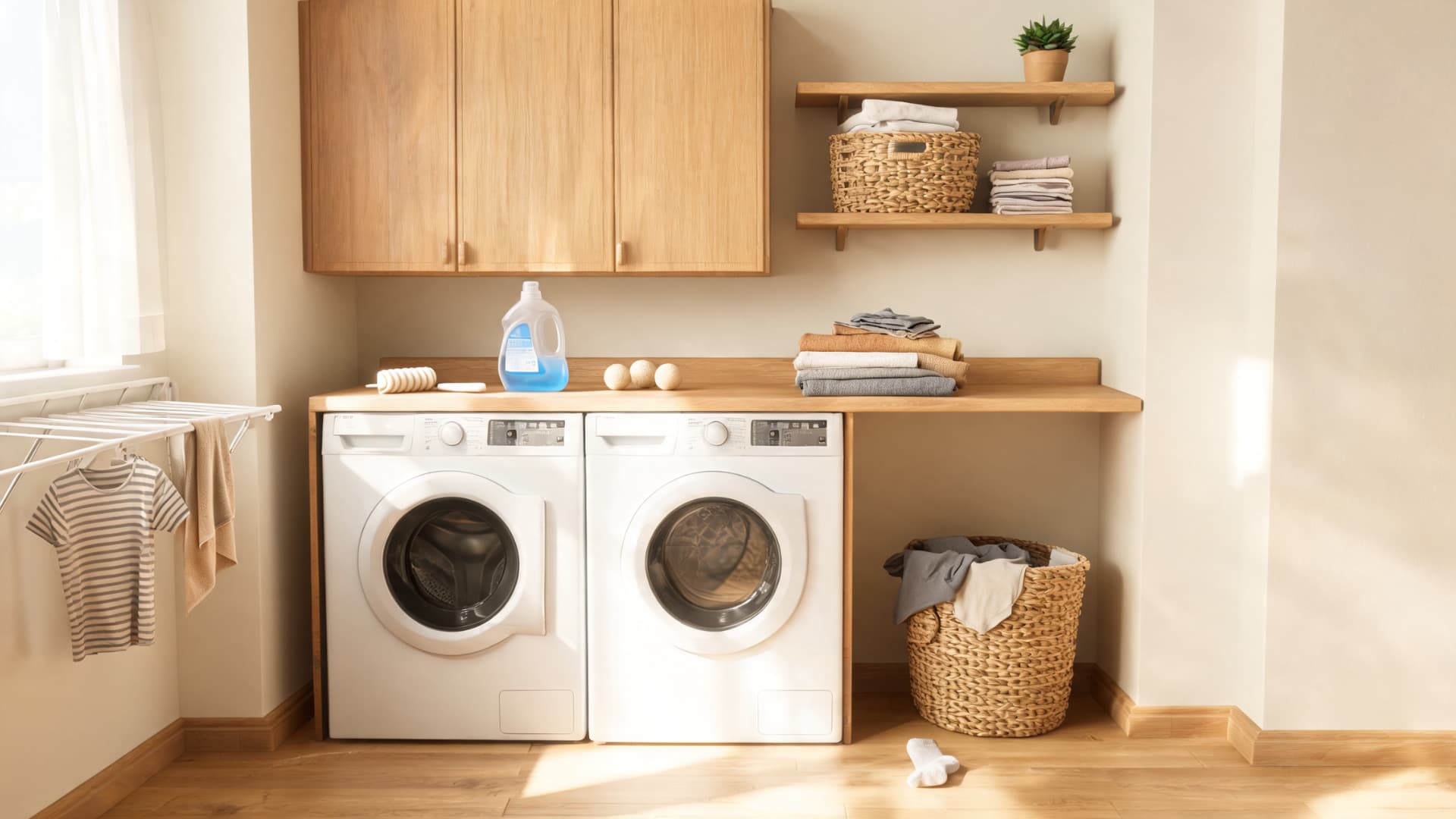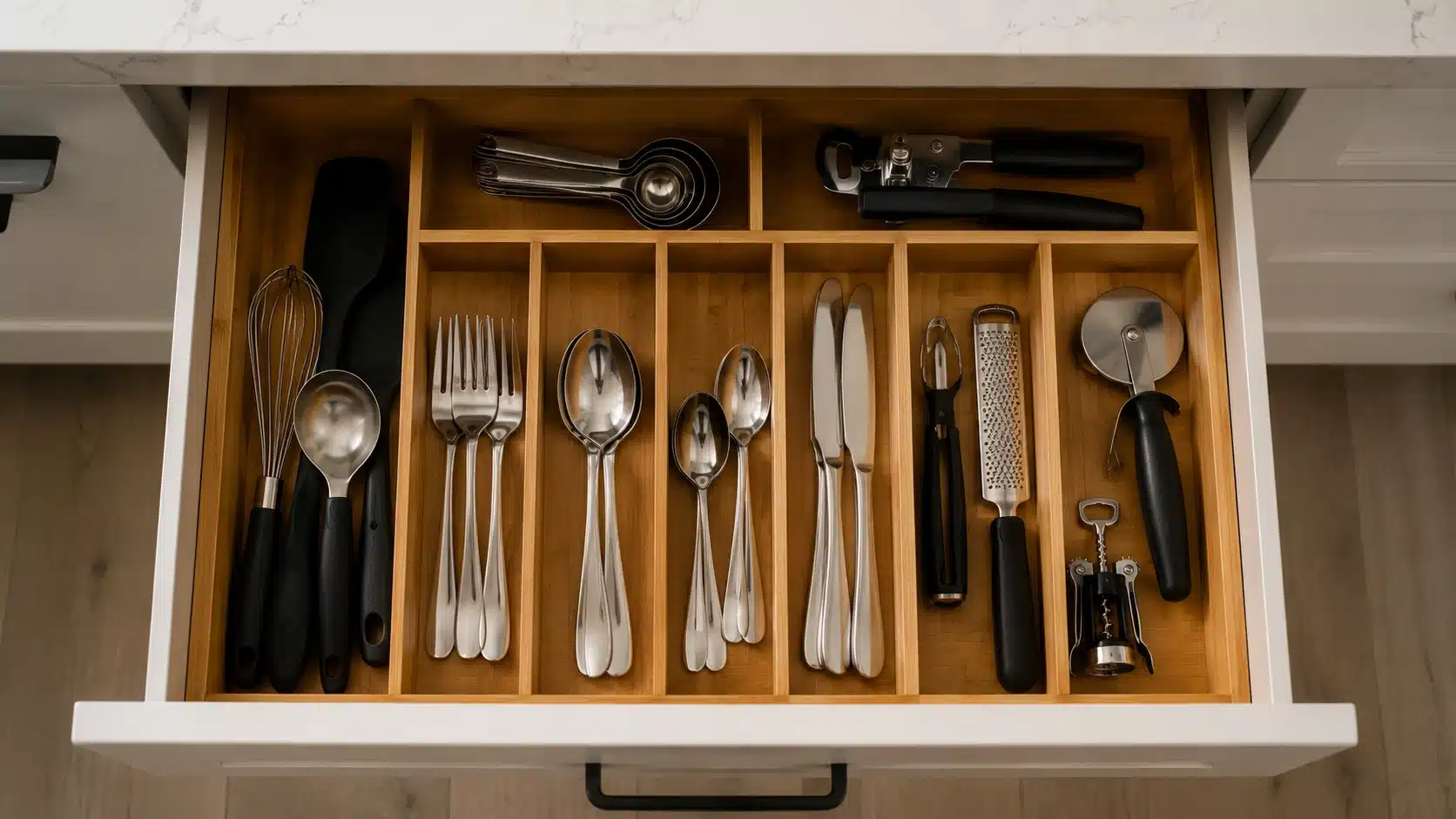
Learning how to organize kitchen drawers sounds simple until you are standing in front of a drawer where spatulas live next to batteries, and the only thing holding the system together is wishful thinking. The real problem is rarely the tools you own.
It is that most drawers were set up once and never matched to what they actually need to hold. The right kitchen drawer organizer for a shallow flatware drawer is completely different from what belongs in a deep drawer full of pots and lids.
Getting this match right is what separates a drawer you maintain from one that falls apart in two weeks. This guide covers everything, from organizer types and specific product picks to a step-by-step plan that holds up over the long term.
Why Kitchen Drawers Always End Up Cluttered
Most kitchen drawers fail for one reason: they have no defined purpose.
A drawer without a role collects everything. Add in the fact that the average home kitchen holds far more tools than are regularly used, and clutter builds fast.
Research on kitchen organization consistently shows that tools stored near their point of use are returned reliably, whereas tools stored “logically” but inconveniently end up on the counter permanently.
When the cooking spatula is three drawers from the stove, it never makes it back. The mental load of a disorganized kitchen is real, too.
Cluttered spaces slow down meal prep, create friction every time a drawer opens, and make cooking feel harder than it needs to be.
Understanding this is the foundation of any kitchen drawer organization approach that actually holds. The organizer is not the solution on its own.
The zone, the drawer role, and the right product working together are what create a drawer you will actually maintain.
Types of Kitchen Drawer Organizers: What Each One Does
Before buying anything, knowing what each organizer type is built for saves money and a wasted return. These tray-based options cover the most common kitchen drawer needs and work well right out of the box.
1. Cutlery Trays
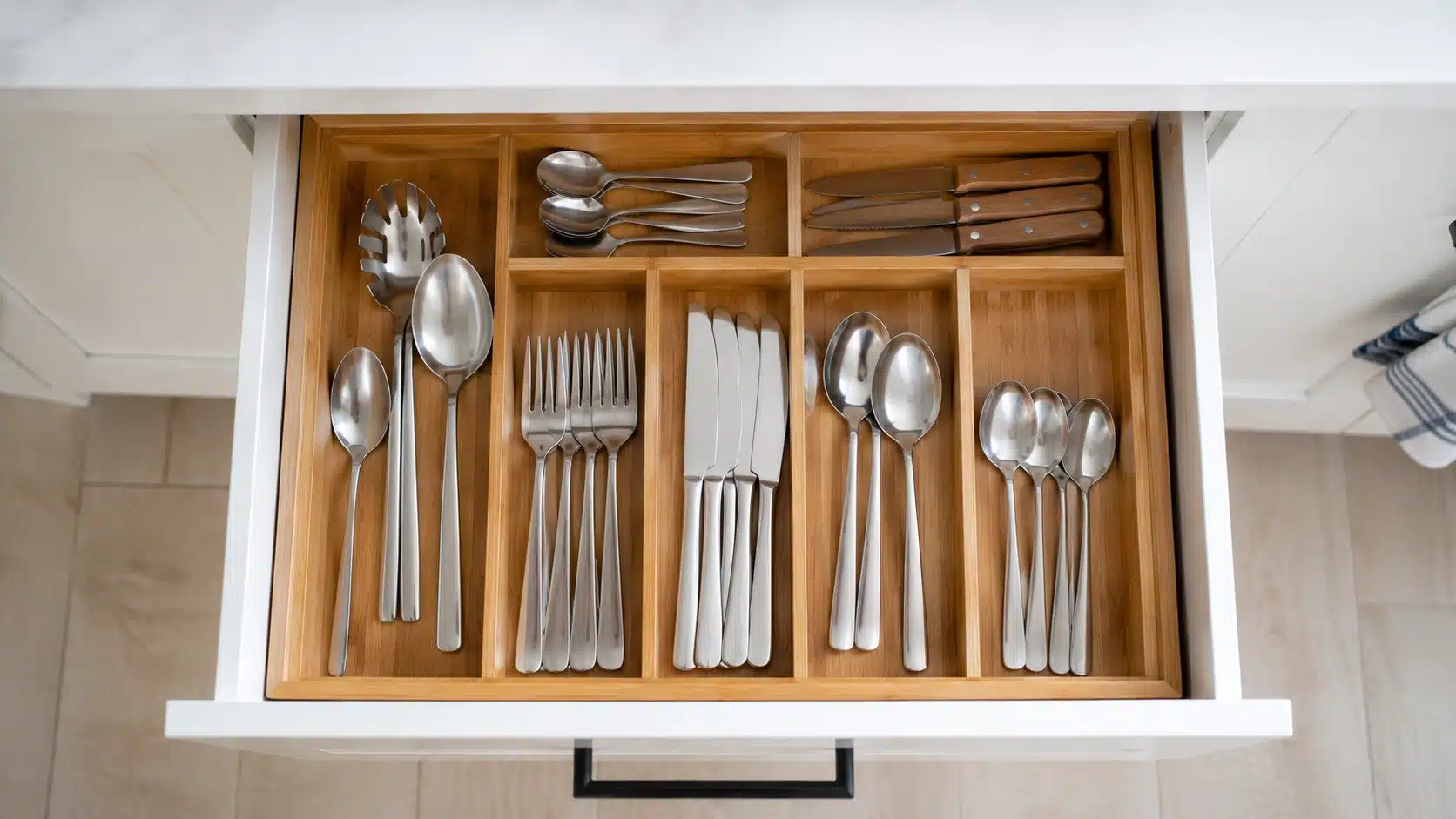
The most common starting point for any kitchen drawer organizer setup. A cutlery tray has five to seven fixed compartments sized for forks, knives, spoons, and small extras like bottle openers.
Best for shallow drawers near the dishwasher or dining area. Look for non-slip feet since flatware is heavy and will shift a tray without them. Standard trays rarely fill a drawer edge to edge, leaving a sliding gap on the sides.
2. Expandable Utensil Trays
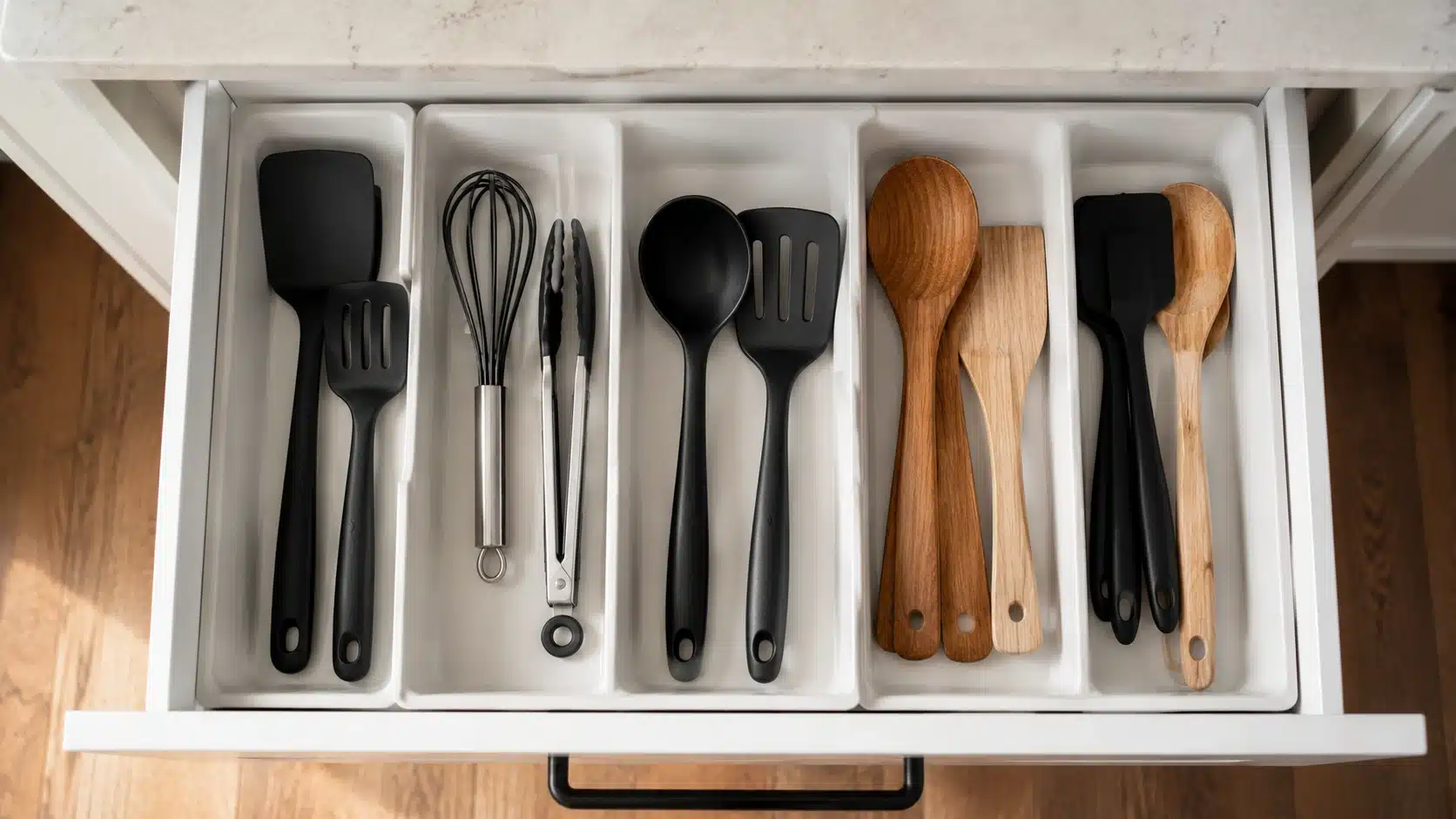
A practical middle ground between a fixed cutlery tray and fully adjustable dividers. The frame telescopes side to side to fill a drawer width, with fixed internal compartments.
The OXO Good Grips Utensil Drawer Organizer is one of the most tested examples, scoring well for non-slip feet and compartments deep enough for spatulas and tongs alongside smaller tools. Better suited to mixed-use drawers than a standard cutlery tray, though the fixed compartment sizes limit flexibility.
3. Spice Drawer Inserts
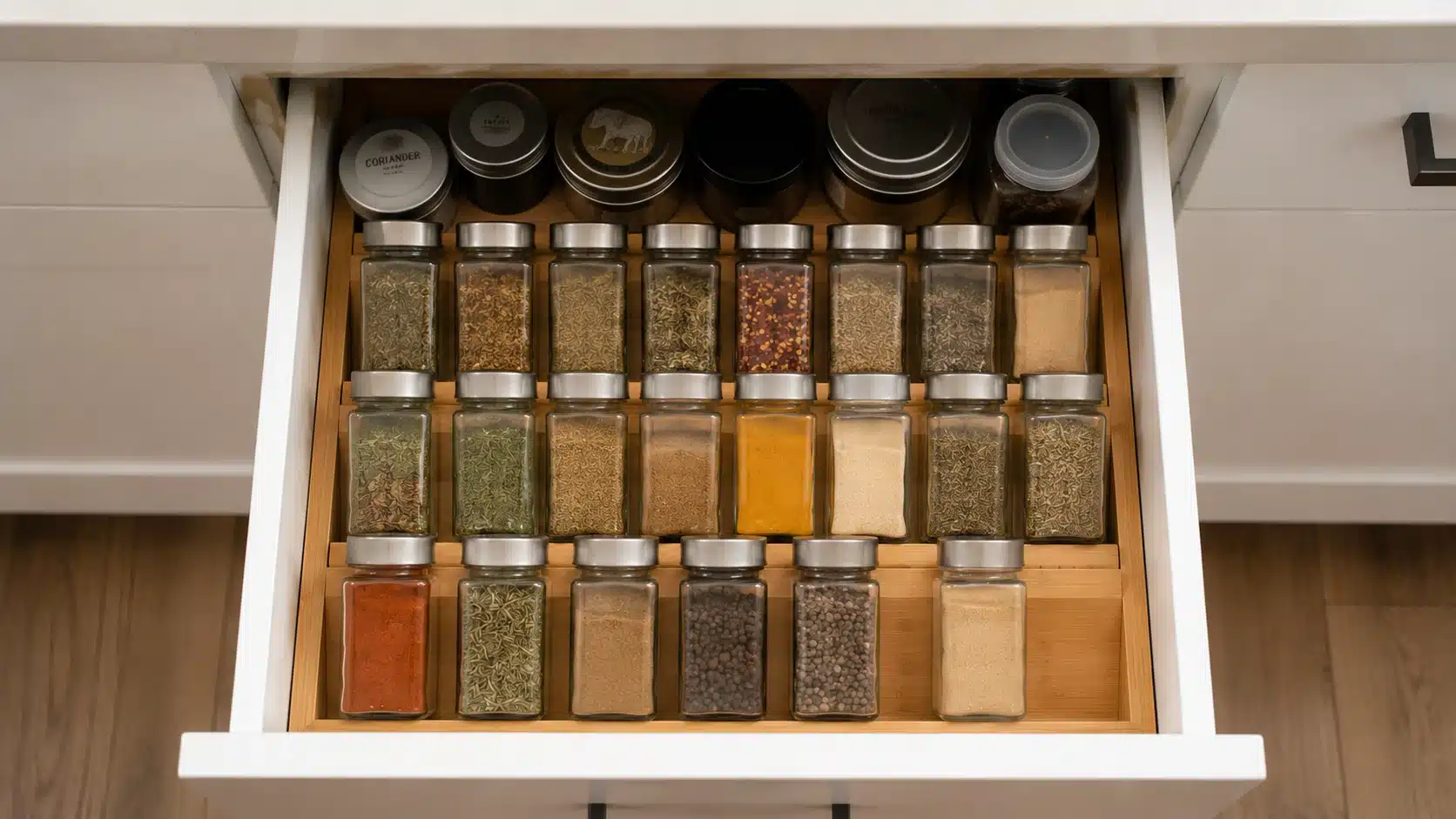
Angled trays that hold spice jars label-up so every option is readable at a glance without lifting a single jar. A spice drawer organizer insert belongs in a shallow drawer near the stove, where spices are reached for most during cooking
The angled design fits one to two rows of standard spice jars. Best for kitchens where cabinet spice storage turns every cooking session into a search through stacked bottles.
4. Wrap and Bag Organizers
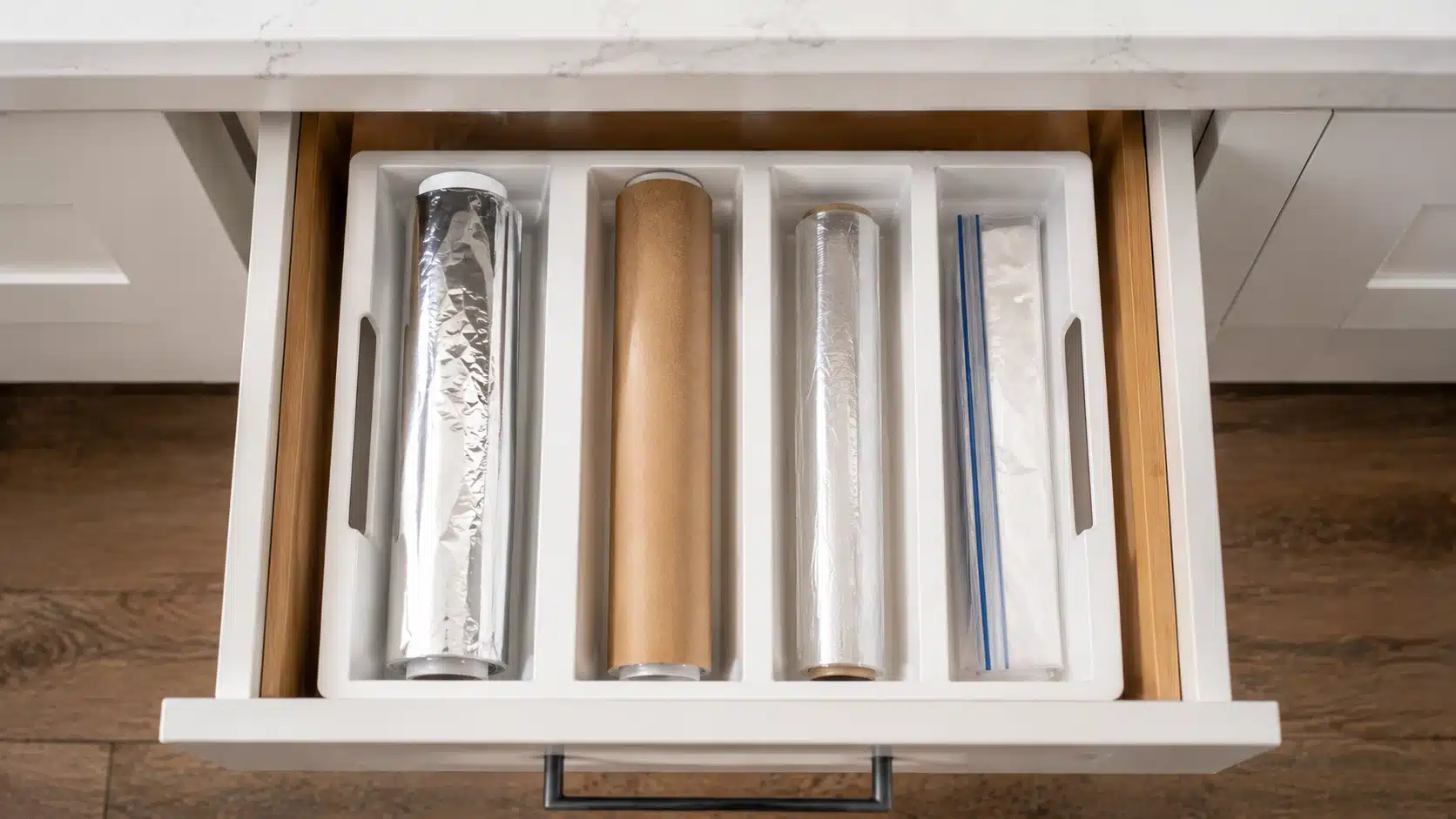
Vertical dispensers or tiered holders that keep foil, parchment, plastic wrap, and food storage bags upright and separated. Without one, rolls unravel, and bags collapse into a pile.
Works well in a food storage drawer or a lower drawer near the prep counter. Some versions include a serrated cutting edge built into the holder, so you can tear off a sheet without pulling the entire box out of the drawer.
5. Drawer Liner
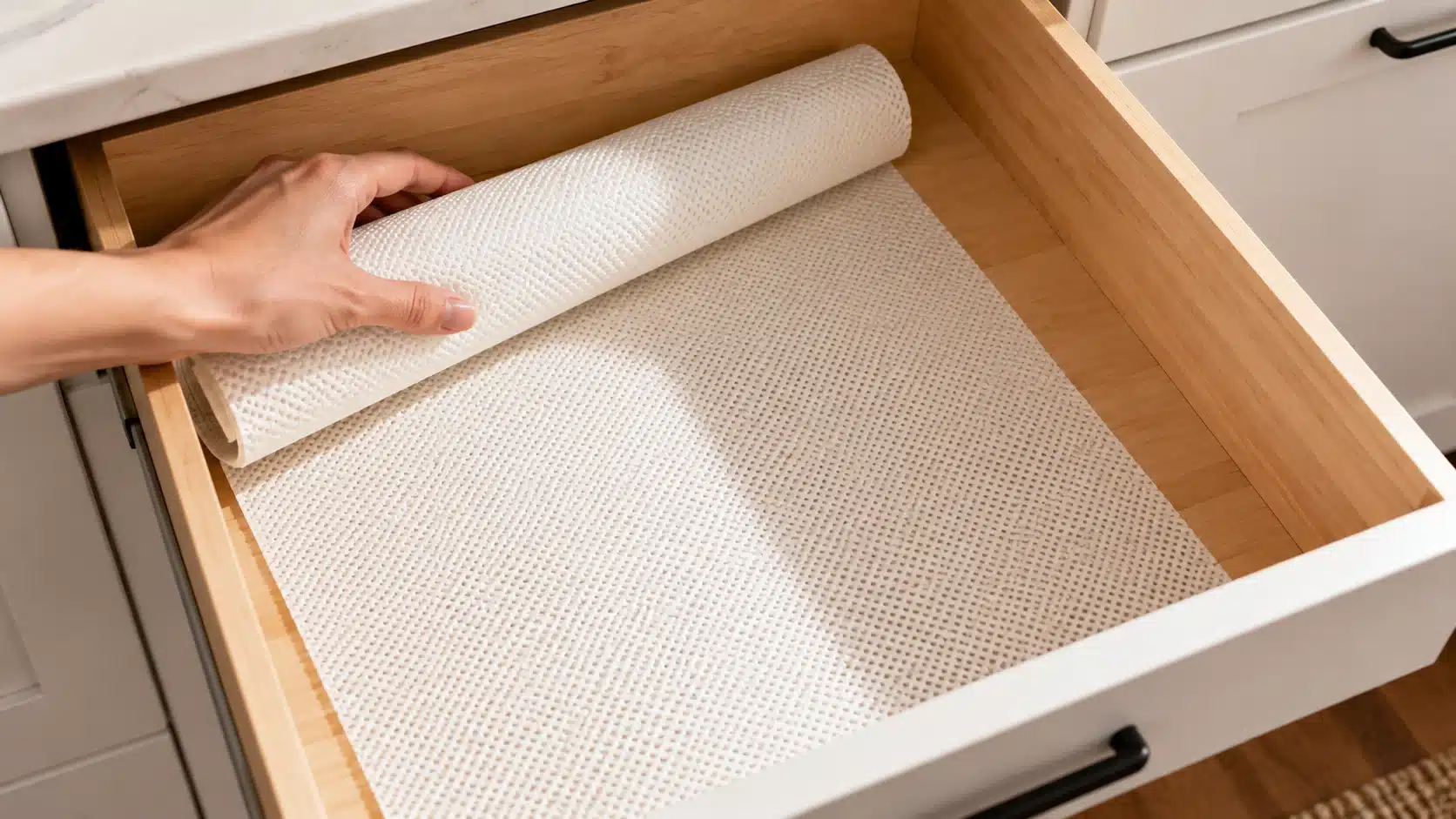
Not a standalone organizer, but the most important supporting layer in any drawer system. Non-adhesive grip liner cut to the interior dimensions of the drawer stops every tray and bin from sliding when the drawer opens.
Without it, even a well-fitted organizer drifts out of position over time, pulling items out of their sections. Cut it once, lay it flat, and every organizer placed on top stays put reliably.
Specific Product Recommendations by Use Case
Every product below has been tested or consistently well-reviewed across major kitchen and home organization publications. Match the use case to your drawer before ordering. Here are some products you can buy for your drawers:
| Product | Best For | Price Range | Standout Feature |
| The Container Store Bamboo Drawer Organizers | Large utensil drawers | ~$22 for 2 | Spring-loaded, expands 18 to 22.25 inches, no tools needed |
| Utoplike 4-Piece Bamboo Drawer Dividers | Wide cooking drawers | ~$20 to $28 for 4 | Padded non-slip ends, fits 15 to 21.6 inch drawer widths |
| SpaceAid Bamboo Utensil Drawer Organizer | Deep drawers, mixed utensils | ~$30 to $45 | 12-slot design, deep compartments, scratch-resistant solid bamboo |
| OXO Good Grips Expandable Utensil Drawer Organizer | Mixed utensil drawers | ~$20 to $30 | Non-slip feet, expandable frame, removable trays for easy cleaning |
| madesmart 8-Piece Interlocking Bin Pack | Junk drawers, baking tools | ~$15 to $20 | Interlocking, fully reconfigurable, BPA-free plastic in mixed sizes |
| SpaceAid Bamboo Drawer Dividers with Inserts | Customizable sections, mixed tools | ~$20 to $28 | Includes insert panels to subdivide rows, expandable from 17 to 22 inches |
Prices may shift by retailer and season. Measure the interior drawer width, depth, and height before ordering any of these, as several bamboo products have been reported to have minor size discrepancies between listed and actual dimensions.
Structural Drawer Organizers: Dividers and Bins That Build a System
These organizer types go beyond a simple tray. Each one creates a customizable structure inside the drawer, making them the better fit for deep drawers, large utensils, and spaces where a standard tray simply will not do the job.
1. Adjustable Drawer Dividers
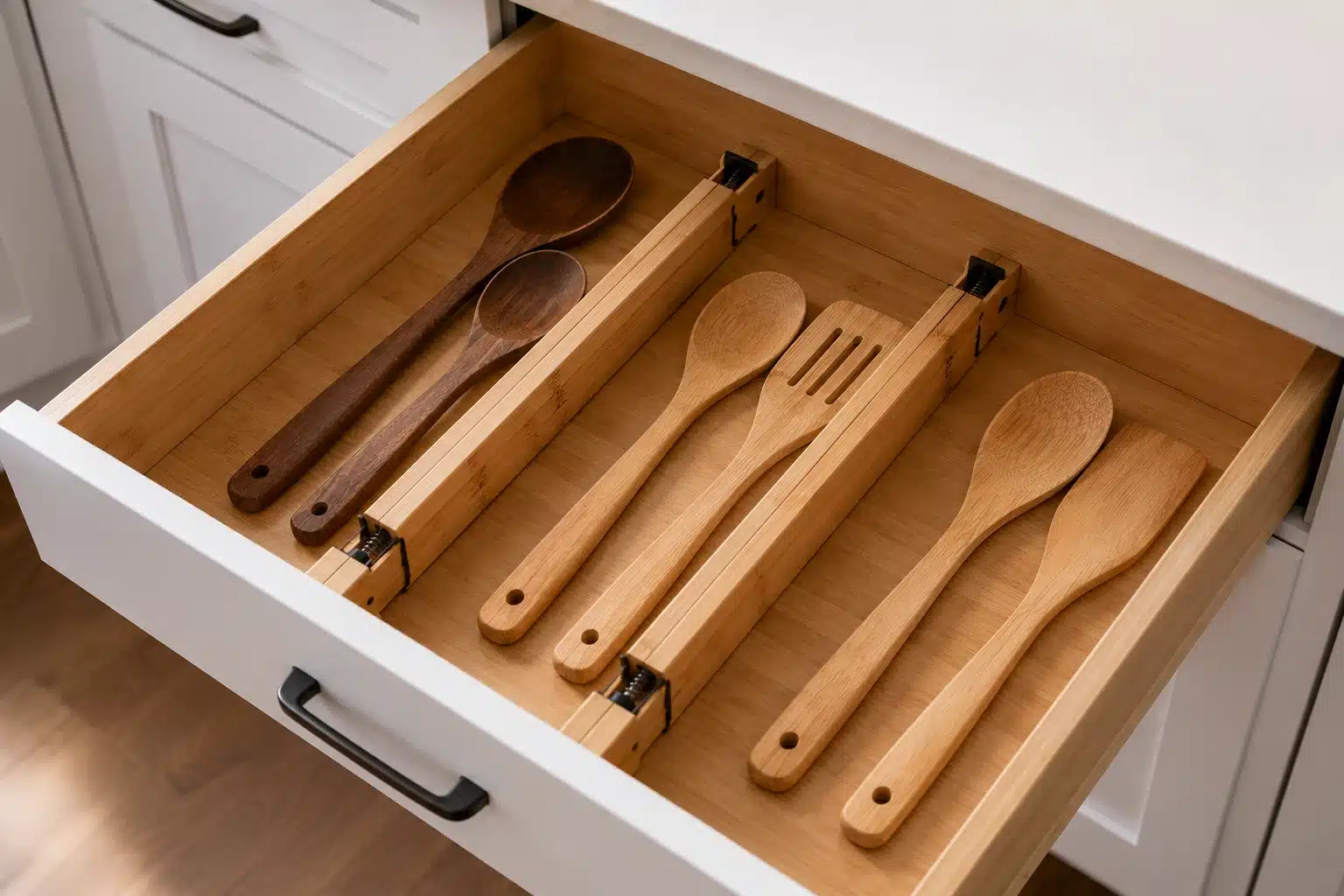
Spring-loaded bars that press against drawer walls to create sections without tools or adhesives. Before buying, check the expansion range, end material, and whether the pads are non-slip.
- Best for: Wide drawers near the stove holding tools longer than 11 inches
- Fit range: Most bamboo drawer dividers expand from 17 to 22 inches; measure your drawer width first
- Top picks: The Container Store bamboo dividers and Utoplike 4-piece set, both well-reviewed for grip and stability
- Watch out for: Dividers rated for narrower drawers than yours will not hold tension and will slide
Once installed, adjustable dividers are the lowest-maintenance structural option available. No glue, no permanent changes. They lift out in seconds when the layout needs updating.
2. Modular Bins
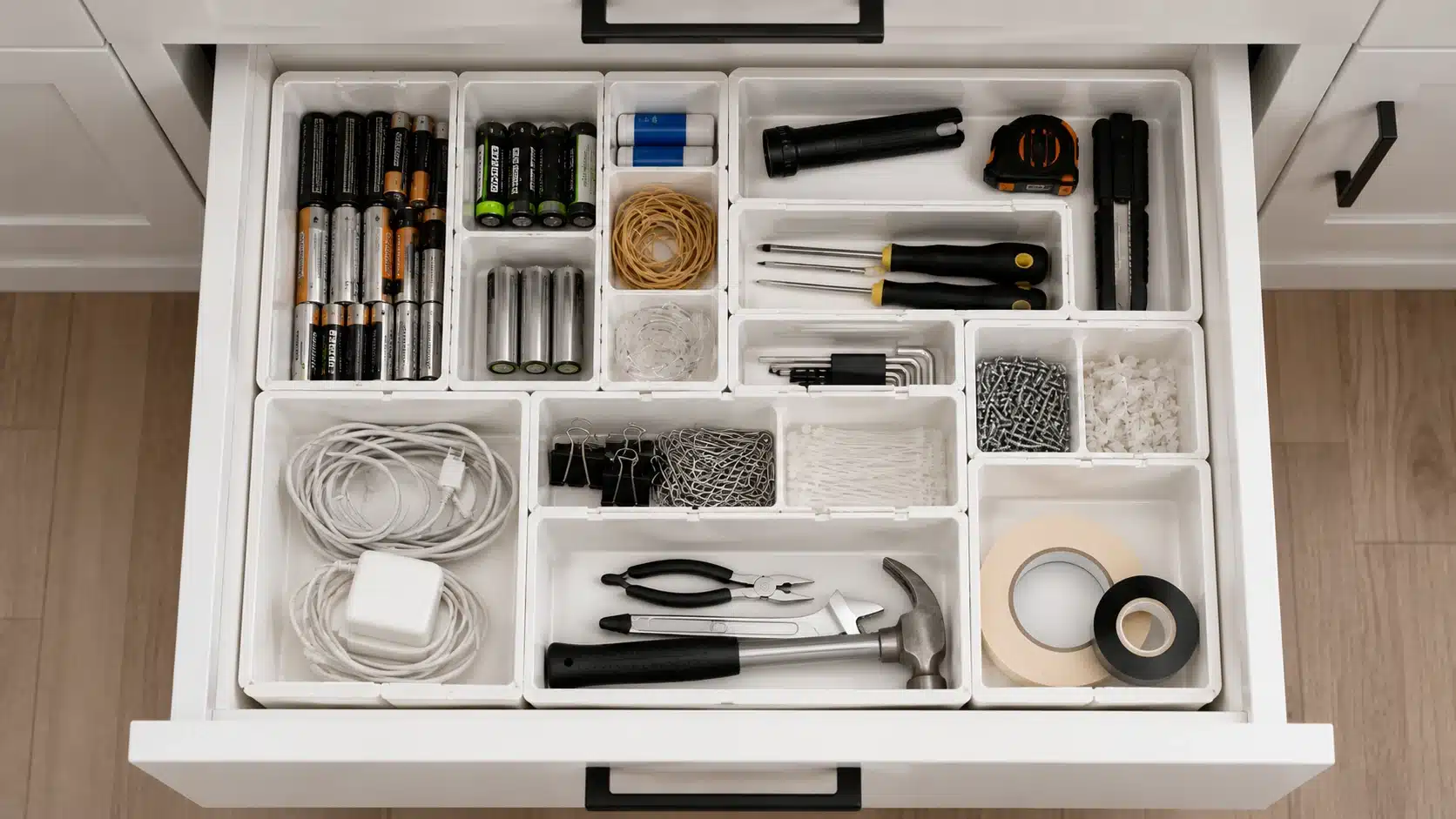
Separate, interlocking bins arranged in any configuration you need. The most useful sets come in at least three sizes, so small and large items each get a section that fits without wasted space.
- Best for: Junk drawers, baking tool drawers, and any drawer where item shapes vary too much for a standard tray
- Top pick: The madesmart Interlocking Bin Pack locks together so the layout holds even when the drawer opens fast
- Key requirement: Always place a drawer liner underneath; loose bins shift within days without it
- Avoid: Bins with no grip base in drawers that see heavy daily use; they migrate over time
Modular bins are the easiest system to adapt when a drawer’s purpose changes. The layout can be rearranged in under a minute rather than requiring a full organizer replacement.
3. Deep Drawer Pegboard Inserts
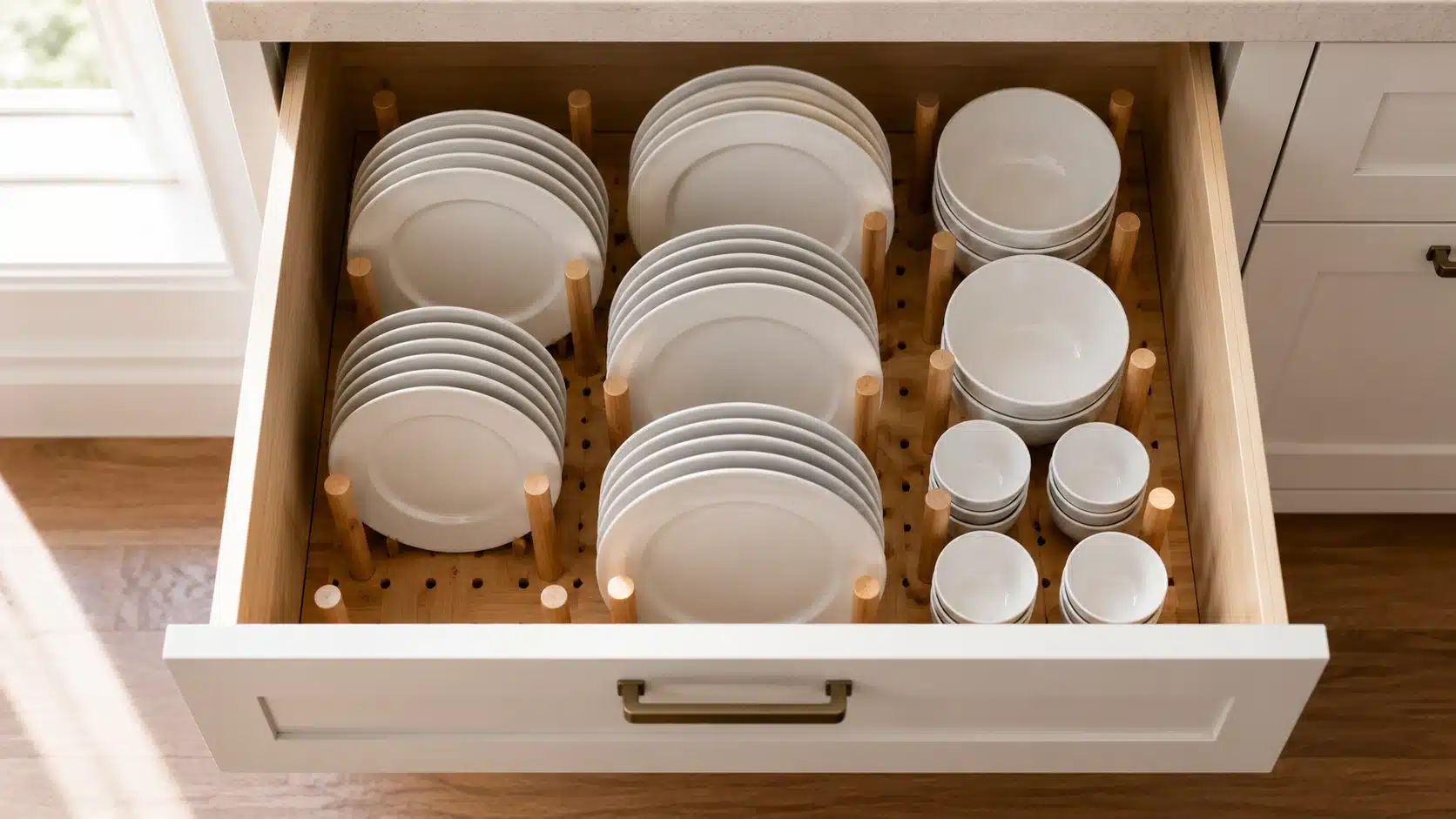
A peg grid that drops into a deep drawer and holds plates, bowls, and lids upright. The right insert changes how the entire drawer functions, replacing a stacked pile with individually reachable items.
- Best for: Deep drawers five inches or more near the dishwasher, storing everyday dishes, bowls, or pot lids
- Top pick: The Rev-A-Shelf drop-in organizer, the most customizable version with adjustable maple pegs and a clean finish
- Budget option: Adjustable peg inserts that drop in without trimming cost significantly less and suit standard-depth drawers
- Watch out for: The Rev-A-Shelf requires a table saw to trim to size, which does not suit buyers wanting a quick install
Peg spacing matters as much as peg height. Check the configuration against your actual plate and bowl sizes before purchasing to avoid items tipping or the drawer fitting fewer pieces than expected.
4. Two-Tier and Sliding Organizers
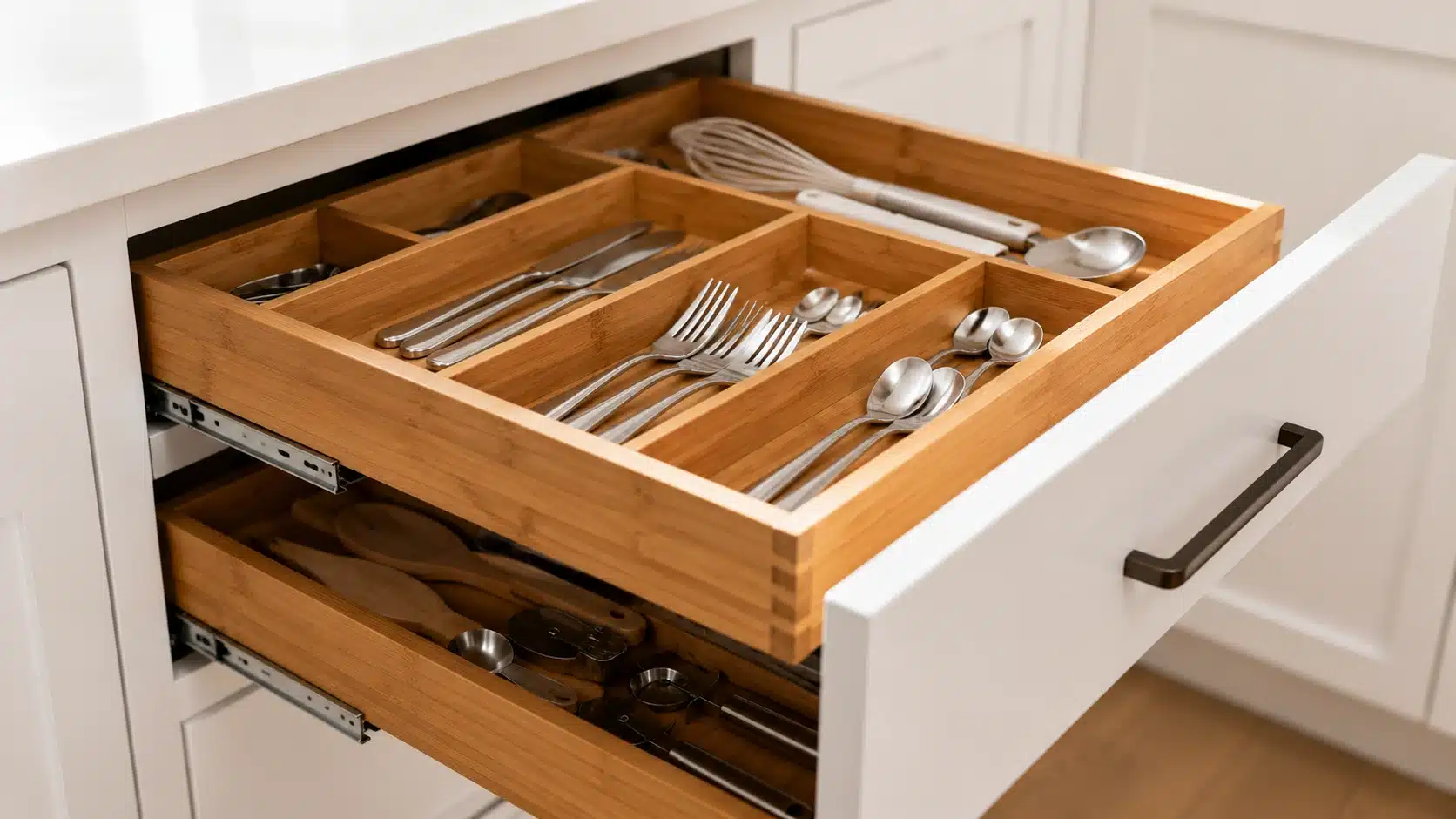
A sliding upper tray over a lower layer doubles usable space in a deep drawer without taking more floor area. These solve one specific problem: a deep drawer wasting its height on a single disorganized pile.
- Best for: Deep drawers in small kitchens and any drawer where stacking creates access problems
- Top pick: The SpaceAid Bamboo Utensil Drawer Organizer double-layer design with a built-in knife holder as a practical addition
- Key requirement: Many two-tier organizers need at least four to five inches of interior clearance; check the minimum height before ordering
- Watch out for: An upper tray that sticks or wobbles makes the lower layer harder to reach than a standard single-layer tray
When the sliding mechanism works smoothly, this is one of the most space-efficient options available. When it does not, it quickly becomes the most frustrating drawer in the kitchen.
5. In-Drawer Knife Organizers
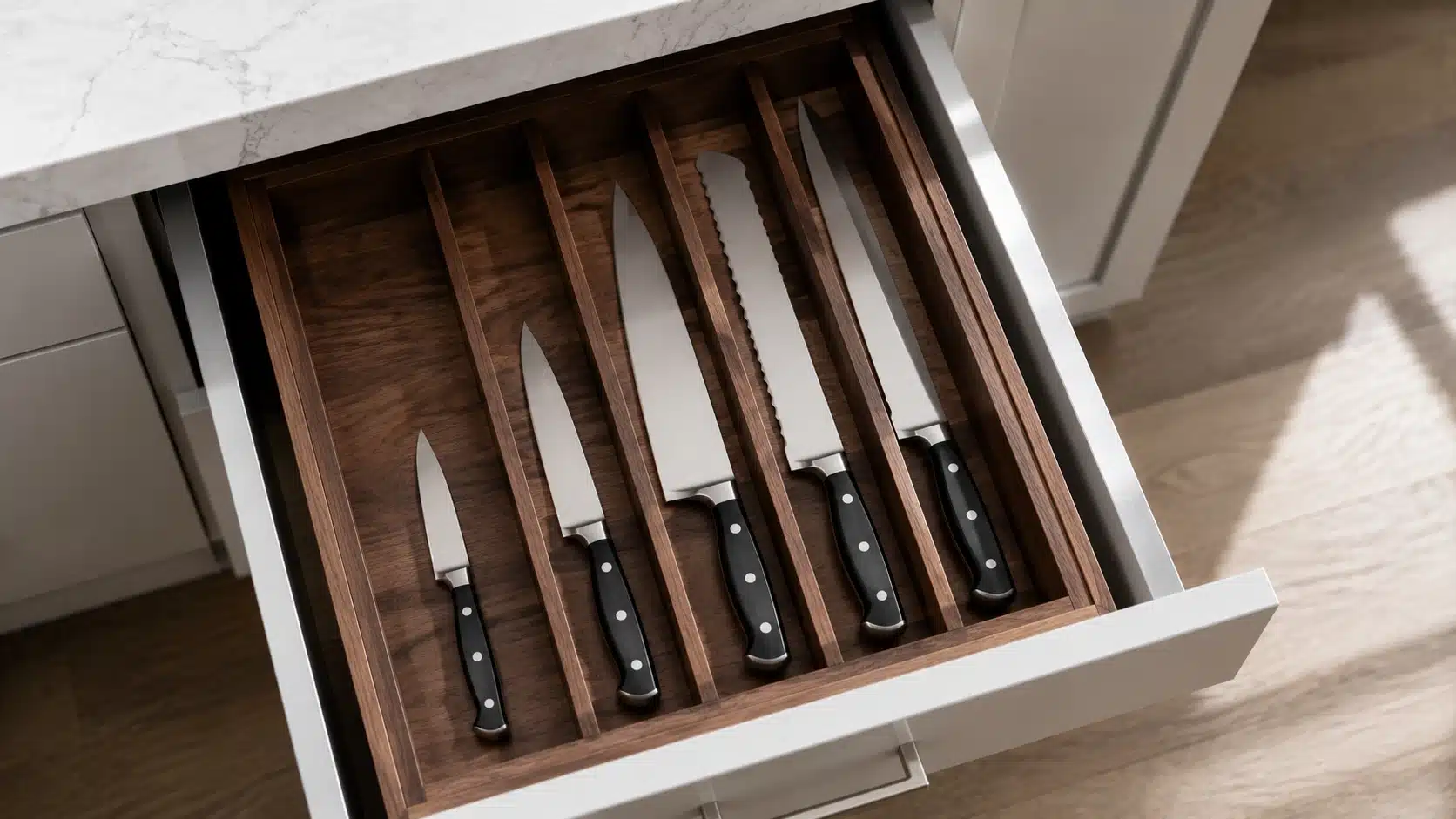
A foam or wood insert holding each knife by the blade at a fixed angle. A loose knife sliding in a drawer is a safety issue, not just an organizational one, so the insert fit matters significantly.
- Best for: Narrow prep drawers near the cutting board where blade safety and fast access both matter
- What to look for: A version with a honing rod slot keeps all blade-care tools in one section without occupying a separate drawer
- Fit note: Most in-drawer knife organizers suit drawers under two inches deep; confirm insert dimensions against your drawer height first
- Avoid: Foam-only inserts with no rigid backing alongside other tools; they compress and let blades shift over time
A well-fitted knife insert also protects the blade edge. Knives stored loosely dull faster than those held in a fixed slot, so the organizer pays for itself in blade longevity over time.
Step-by-Step: How to Organize Kitchen Drawers from Scratch
Once you know the organizer type that fits your drawer, the setup process is straightforward. Here is a reliable sequence that applies whether you are doing one drawer or all of them at once.
| Steps | Actions | Why It Matters |
| Step 1: Empty and clean | Pull everything out and wipe the interior, including corners | Crumbs and residue can harbor bacteria; a clean surface is easier to measure accurately |
| Step 2: Declutter first | Sort items into daily use, occasional use, and rarely used | Organizers contain what you keep, not fix what you have too much of |
| Step 3: Remove duplicates | Keep the best version of each tool; donate or discard the rest | Duplicates are the most common reason drawers overflow after organizing |
| Step 4: Assign a zone | Decide what each drawer is for before adding anything back | Items stored near where they are used get returned reliably; zone placement is what makes a system last |
| Step 5: Measure the drawer | Record the interior width, depth, height, and your longest tool | Skipping this step is the most common reason organizers get returned or sit unused |
| Step 6: Lay drawer liner | Cut the non-adhesive grip liner to fit before placing any tray or bin | Without a liner, even a well-fitted organizer slides out of position within days |
| Step 7: Place and fill by zone | Put the most-used tools at the front; less-used items toward the back | Front-loading daily tools reduces friction and keeps the system from slipping back to disorder |
| Step 8: Fill to 70 to 80 percent | Leave some breathing room in each section rather than packing it full | A drawer with space to spare is faster to use and far easier to maintain over time |
Skipping even one of these steps, especially measuring and liner placement, is what causes most organized drawers to revert within weeks. The order matters as much as the steps themselves.
DIY Kitchen Drawer Organizer Ideas That Work Without Buying Anything
Not every drawer needs a purchased insert. Some of the most reliable solutions are made from what is already available. Here are some easy DIY ideas:
- Tension rods mounted vertically in a deep drawer hold baking sheets, cutting boards, and pot lids upright with no drilling and no cost.
- Shoe box lids make ready-made shallow bins for junk drawers. They are already stiff, the right depth, and free.
- Drawer liner folded into a border creates a low DIY divider between sections in any shallow drawer.
- Repurposed containers such as ramekins, soap dishes, or small spice boxes corral twist ties, rubber bands, and bag clips without taking up extra space.
- Custom wood dividers, cut to exact interior dimensions, offer the best fit of any option. A basic set takes about an hour with a miter saw and a few pieces of 1×2 lumber.
DIY options work best as a starting point. Once you know which zones and sizes actually work for a drawer, a purchased organizer becomes a much more confident and accurate buy.
Bamboo vs Plastic vs Acrylic vs Metal: Which Material to Choose
Material affects cleaning time, longevity, and how well an organizer suits a specific drawer. The right choice comes down to the drawer’s function, not appearance alone:
| Material | Best For | Key Trade-Off |
| Bamboo | Utensil and visible drawers that stay dry | Sturdy and good-looking, but absorbs moisture and warps near spills |
| Plastic | Junk drawers, food storage, and frequent-wash drawers | Easiest to clean and most affordable, but lacks the finish of bamboo or acrylic |
| Acrylic | Spice and flatware drawers where quick visibility matters | Transparent and stain-resistant, but scratches with abrasive cleaning |
| Metal | Heavy tool and silverware drawers were lighter trays that flexed | Durable under weight, but slides or rattles without rubber feet |
When unsure, plastic is the safest starting point. It suits most drawer types, wipes clean in seconds, and costs the least if the size or fit turns out to be off.
Tips for Keeping Your Drawers Organized Long Term
Setting up an organized drawer is the easy part. Keeping it that way over months of daily use is where most systems break down. These habits make the difference:
- Weekly reset: Spend 30 seconds per drawer returning anything out of place. Consistent small resets stop drift from compounding.
- Wipe organizers monthly: Pull the tray out, wipe it, and the drawer interior. The NSF notes bacteria and mold collect in kitchen compartments that are rarely cleaned.
- One-in, one-out: Before adding a new tool, remove any tools no longer in use. This keeps drawer capacity stable over time.
- Monthly junk drawer check: A five-minute clear-out stops the junk drawer from spilling into adjacent storage.
- Reassign zones every six months: Cooking habits shift. A drawer that made sense last year may need a different role now.
None of these habits takes more than a few minutes. The difference between a drawer that holds for two years and one that reverts in two weeks is almost always consistency, not the organizer itself.
Common Mistakes That Undo Good Drawer Organization
Most organized drawers revert to chaos within weeks because of a handful of recurring mistakes, not because the organizer was wrong. Here are some mistakes you should definitely avoid:
- Buying before measuring: An organizer that does not fit is not just useless; it makes the drawer harder to use than before.
- Keeping duplicates. Two spatulas, three peelers, four can openers. Duplicates fill sections with items that add no daily value. Keep the best one, donate the rest.
- Using small compartments for large tools: A flatware tray will not hold a 14-inch spatula. The tool ends up on top of the dividers, and the organizer does nothing.
- Storing tools far from where they are used: A spatula kept across the kitchen from the stove ends up on the counter every time. Proximity drives things being put back.
- Filling every inch of space: A drawer packed to capacity is frustrating to use. Aim for 70 to 80 percent full so items remain visible and reachable.
- Skipping drawer liner: Without a liner, trays slide forward every time the drawer opens, gradually pulling items out of their sections.
- Never cleaning the organizer: A crumb-filled tray feels less worth maintaining. A monthly two-minute wipe-down keeps the system from feeling like it has already failed.
Most of these mistakes are fixable in under ten minutes. Catching them early, before a drawer fully reverts, keeps the reset small rather than requiring a complete start-over.
Frequently Asked Questions
Do adjustable drawer dividers work in every drawer width?
Most spring-loaded bamboo dividers expand to fit drawers between 15 and 22 inches wide. Below 15 inches, they may not have enough tension to grip firmly. Above 22 inches, you may need two sets side by side. Always check the stated expansion range of the specific product against your measured drawer width before ordering.
Can you use kitchen drawer organizers in a rental without damaging anything?
Yes. Spring-loaded dividers, modular bins, and trays with non-slip feet require no adhesive, no drilling, and no permanent alteration to the drawer. They lift out completely and move when you leave. The only thing that might leave a faint impression is the non-adhesive liner, and even that peels up cleanly.
How do you organize a kitchen drawer that is too wide for standard trays?
Use two trays side by side with a row of modular bins filling the remaining gap, or buy an expandable organizer rated for wide drawers. The OXO Good Grips and Container Store bamboo dividers both expand to over 22 inches, making them more suitable for wide drawers than most standard fixed trays.
Is bamboo worth the extra cost over plastic drawer organizers?
For drawers that stay dry and are in visible locations when opened, bamboo is worth the price difference. It holds up longer than budget plastic in dry conditions and looks significantly cleaner in a well-organized kitchen. For drawers near food prep that collect grease, moisture, or residue, plastic is easier to maintain and costs less to replace if it stains.
What is the best way to organize a kitchen drawer that holds both small and large tools?
A two-tier or expandable organizer with compartments of mixed sizes works best here. The SpaceAid double-layer bamboo organizer handles a range of tool sizes well, with the upper layer holding smaller items and the lower section accommodating longer tools. Alternatively, a combination of one long-section bamboo divider and one modular bin in the remaining space gives you two different compartment sizes in a single drawer.
The Takeaway
From what I think, the single thing that undermines most attempts at kitchen drawer organization is skipping the measuring step and buying the first tray that looks good in a photo.
The kitchen drawer organizer that works is the one that fits your actual drawer, holds your actual tools, and is easy enough to wipe clean that you will actually do it.
Start with one drawer, use the type guide and product table above to find the right match, and go from there.
One drawer done properly is more useful than six drawers half-organized with the wrong tools. Drop a comment below and let me know if this helped you organize that messy drawer that embarrasses you.