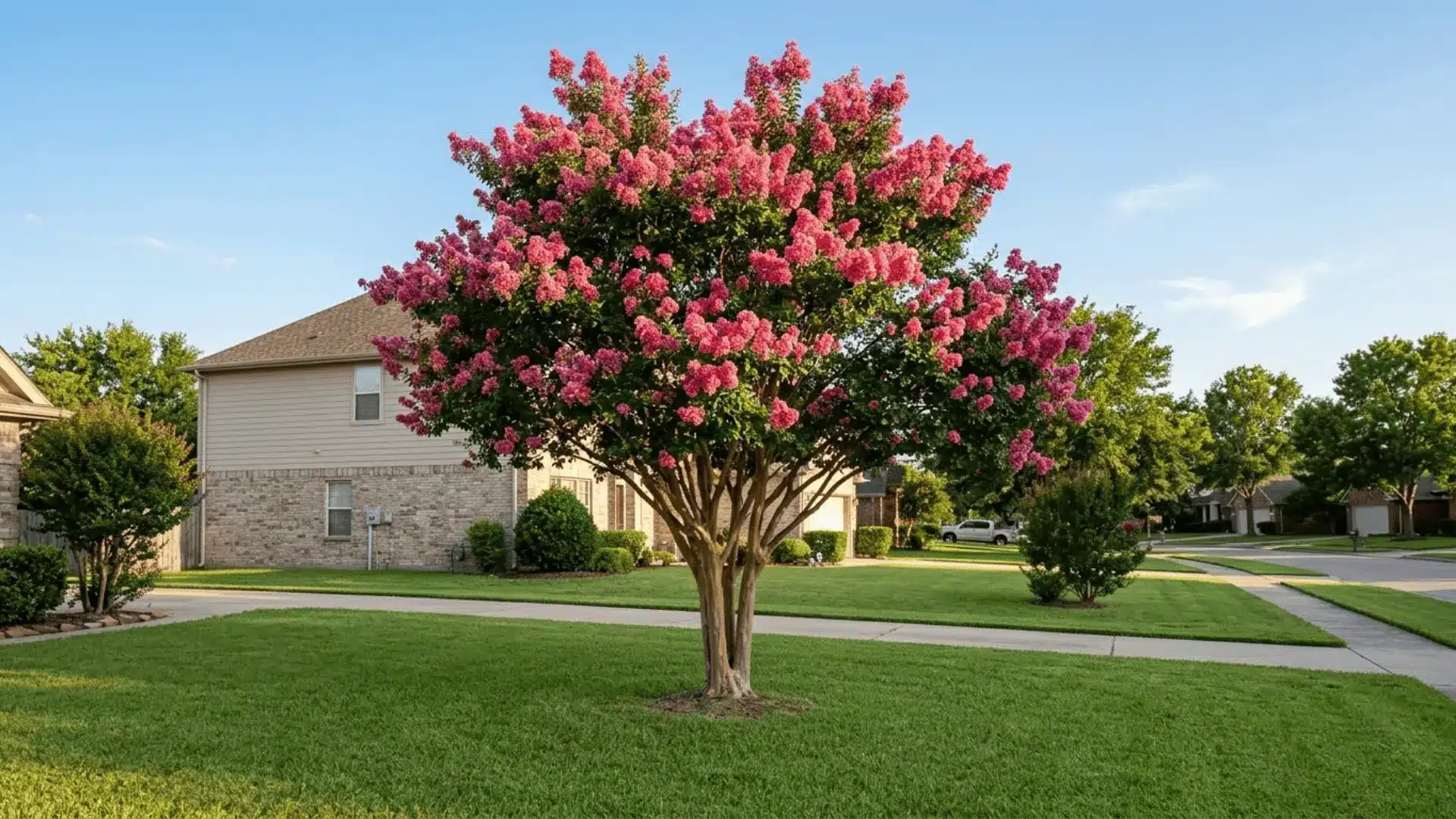
Crepe myrtles are the kind of trees that make a yard look like it was designed, not just planted. But even the prettiest tree can quietly become a problem when it ends up in the wrong spot.
Most placement mistakes don’t show up right away; they creep in over seasons, showing up as weak blooms, powdery leaves, or roots nudging where they shouldn’t.
And it often starts with an early decision many homeowners skip over, like whether a bush or tree form even suits their space.
From safe spots to dangerous areas, all you need to properly place your crepe myrtle is covered here.
Why Proper Crepe Myrtle Placement is Important?
Crepe myrtle placement isn’t just a landscaping preference; it genuinely shapes how well your tree grows and how little trouble it gives you over the years.
Plant it too close to a structure, a fence, or another plant, and you’re looking at crowded roots, blocked airflow, and a tree that blooms far below its potential.
The right spot means better flowering, fewer fungal issues like powdery mildew, and roots that spread without causing damage. It also means less pruning, less fixing, and less second-guessing down the road.
Good placement from the start saves a lot of backtracking later.
Crepe Myrtle Root System: What You Need to Know?
Crepe myrtle roots are generally non-invasive, which is reassuring, but that doesn’t mean placement is something you can overlook.
Roots can spread significantly wide, and surface roots have a way of interfering with nearby structures over time.
A few things worth knowing:
- Roots can extend 2 to 3 times the canopy width.
- They stay relatively shallow, making them more likely to surface near pavement or foundations.
- Structures like driveways, sidewalks, and garden beds can feel the pressure over the years.
The roots aren’t aggressive, but given enough time and the wrong placement, they will find a way to remind you they’re there.
Safe Planting Distances
Knowing exactly how far to plant your crepe myrtle from structures and other plants is what separates a thriving tree from a troublesome one.
Use this as your go-to reference before you dig.
| Planting Location | Recommended Distance | Risk if Too Close | Tip |
|---|---|---|---|
| House Foundation | 6–10 feet | Root pressure on the base | Go closer only with dwarf varieties |
| Driveways & Sidewalks | 5–8 feet | Cracked or lifted pavement | Account for canopy overhang too |
| Other Trees | 10–20 feet | Poor airflow, weak blooms | Wider spacing for larger canopies |
| Fences & Walls | 3–6 feet | Canopy crowding, fungal moisture | Err on the wider end in humid climates |
1. Distance from House Foundation
Keeping your crepe myrtle 6 to 10 feet away from the foundation gives the root system enough room to spread without pushing against your home’s base.
The right distance also depends on the variety; dwarf types can sit closer, while standard or large varieties need that full 10 feet to stay comfortable and grow without restrictions.
2. Distance from Driveways and Sidewalks
A gap of 5 to 8 feet between your crepe myrtle and any paved surface keeps surface roots from lifting or cracking the concrete over time.
It also leaves enough breathing room for the canopy to fill out naturally without overhanging in ways that become a maintenance headache every single season.
3. Distance from Other Trees
Crepe myrtles need 10 to 20 feet of space from neighboring trees to get adequate airflow and sunlight.
Planting too close invites powdery mildew, weak branching, and underwhelming blooms. The wider the canopy of surrounding trees, the more generous you want to be with that spacing.
4. Distance from Fences and Walls
A minimum of 3 to 6 feet from fences and walls keeps your crepe myrtle from growing into structures as the canopy widens with age.
This spacing also allows air to circulate freely around the tree, which goes a long way in preventing moisture buildup and the fungal issues that follow.
Hidden Risks of Poor Placement
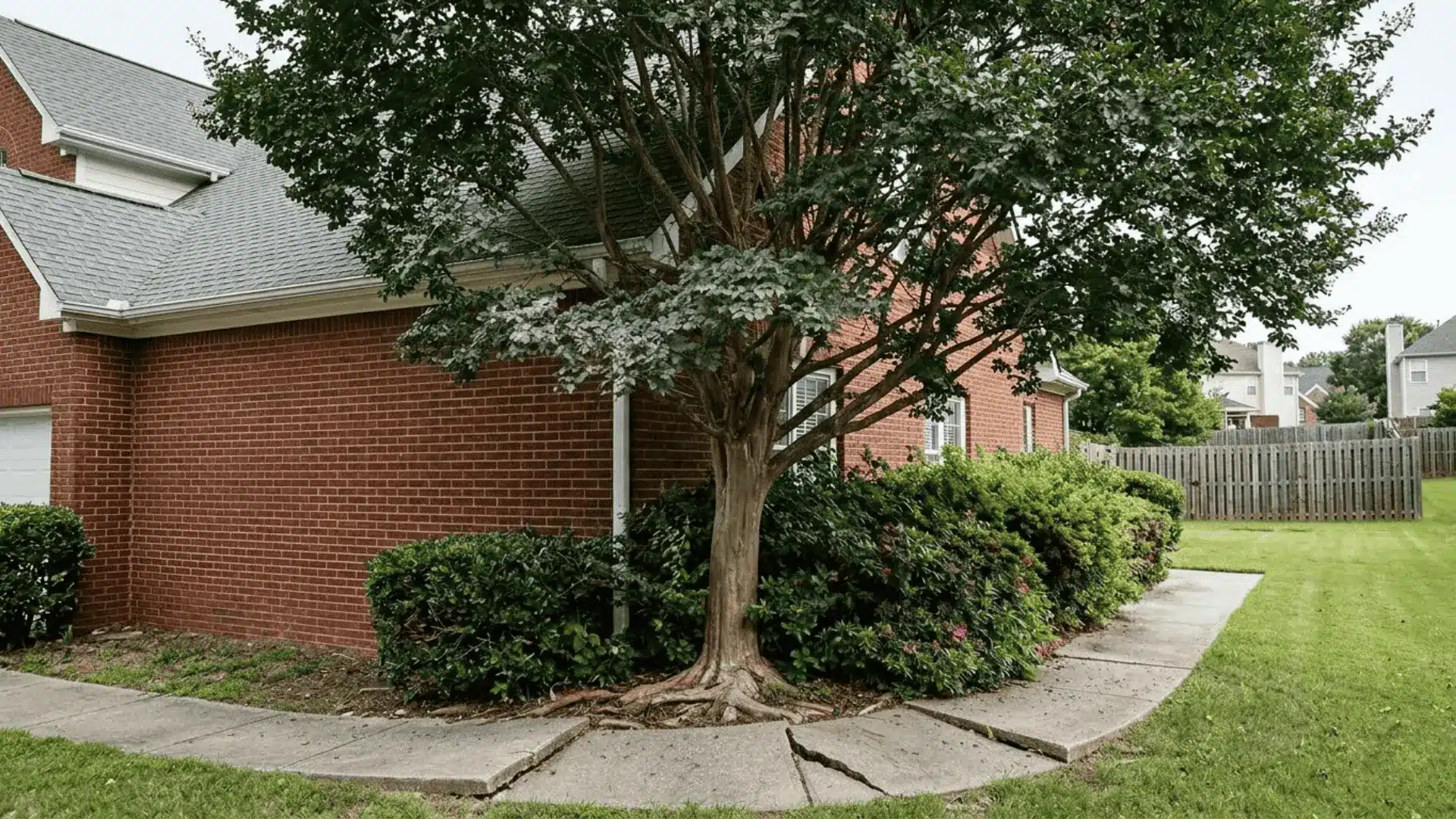
Poor placement doesn’t always show up immediately, but over time, it quietly works against your tree in ways that are frustrating to fix.
These are the risks that catch most homeowners off guard.
Risk 1: Planting Too Close to the House
A crepe myrtle planted too near your home restricts the airflow it genuinely needs. The canopy gets crowded, moisture lingers, and that combination makes the tree a magnet for powdery mildew and pests.
What starts as a framing choice for your home’s exterior slowly turns into a recurring maintenance problem that a better placement decision could have avoided entirely.
Risk 2: Root Interference with Hardscaping
Surface roots and paved surfaces don’t coexist well over time. As the tree matures, roots can push up against sidewalks, patios, and driveways, causing visible lifting and cracking.
Beyond the structural damage, it also makes mowing and general upkeep around the tree unnecessarily difficult, especially once the root spread becomes impossible to work around comfortably.
Risk 3: Poor Air Circulation Increases Disease Risk
Crepe myrtles are already prone to powdery mildew, and tight spacing makes that worse. When a tree is wedged between structures or plants, air barely moves through the canopy.
Moisture gets trapped, fungal conditions build up, and the tree ends up fighting disease more than it grows. Open, well-spaced placement is genuinely one of the simplest ways to keep this from becoming a seasonal battle.
Risk 4: Too Much Shade Reduces Flowering
Crepe myrtles are full-sun trees and need 6 to 8 hours of direct sunlight daily to bloom the way they’re meant to. Tucking one under a larger tree or against a shaded wall cuts into that significantly.
Interestingly, good placement that encourages blooming also makes your tree more attractive to hummingbirds and flowering trees. A poorly placed tree that barely flowers loses that benefit entirely, which defeats the whole point of growing one.
Risk 5: Overcrowding with Other Plants
When a crepe myrtle is planted too close to other shrubs or trees, it ends up competing for the same nutrients, water, and light.
None of the plants thrives in that situation:
- Root systems tangle and limit uptake
- Canopies overlap, blocking sunlight for all
- Growth slows across the board
- Blooms become sparse and underwhelming
Give it dedicated space, and it will reward you for it.
Best Locations to Plant Crepe Myrtle
Crepe myrtles are low-drama trees; they just need the right setting to do what they do best.
Full sun is non-negotiable, so open lawn spaces where sunlight isn’t competing with larger trees or structures are ideal.
A spot with room for the canopy to spread naturally means better airflow, stronger blooms, and a tree that grows on its own terms.
They also shine as focal point trees in a landscape, and if you’re working with a bush form you’d rather shape upward, training into a single trunk can open up even more placement possibilities.
Their layered blooms and textured bark get the visual attention they deserve without being crowded out by everything around them.
Placement Based on Crepe Myrtle Size
Not all crepe myrtles need the same amount of space, and knowing your variety before you plant saves a lot of reworking down the line.
| Variety | Height | Ideal Placement | Spacing Needed |
|---|---|---|---|
| Dwarf | Up to 4 feet | Containers, borders, small gardens | 3–5 feet apart |
| Semi-Dwarf | 4–12 feet | Mid-sized yards, foundation planting | 6–10 feet apart |
| Standard | 15–30 feet | Open lawns, large landscapes | 15–25 feet apart |
Crepe Myrtle Placement Near Utilities
Utilities are easy to forget when you’re planning a planting spot, but they’re worth a check before you dig.
Standard and semi-dwarf varieties can grow tall enough to interfere with power lines over time, making them a safety concern and a pruning obligation that never really ends.
Underground pipes deserve the same attention; while crepe myrtle roots aren’t aggressively invasive, shallow spreading roots near water or sewer lines can cause interference as the tree matures.
Always call 811 before planting to locate underground utilities and keep any crepe myrtle a comfortable distance from lines both above and below.
How to Fix Poorly Placed Crepe Myrtles?
If your crepe myrtle is already in a tricky spot, you have more options than you might think.
- Transplant young trees in late winter or early spring before new growth begins.
- Always prune to manage canopy spread, but avoid heavy cutting that stresses the tree.
- Relocate when roots start visibly interfering with structures or hardscaping.
- Choose a new spot that meets the full sun and spacing requirements before moving the tree.
- When transplanting, preserve as much of the root ball as possible for a smoother recovery.
Catching the problem early makes all the difference; the younger the tree, the easier it is to work with.
Crepe Myrtle Spacing Chart
A quick reference to match your variety to the right spacing before anything goes in the ground.
| Variety Type | Mature Height | Space from Structures | Space from Other Plants |
|---|---|---|---|
| Dwarf | Up to 4 feet | 3–5 feet | 3–4 feet |
| Semi-Dwarf | 4–12 feet | 6–10 feet | 5–8 feet |
| Standard | 15–30 feet | 15–20 feet | 10–20 feet |
| Large/Tree Form | 20–30+ feet | 20–25 feet | 15–25 feet |
Wrapping Up
Crepe myrtle placement really comes down to giving your tree the space and conditions it needs to grow without friction.
Get that right, and you’ll have a tree that blooms beautifully, stays healthy, and adds genuine character to your yard for years to come.
The little decisions made at planting time are the ones that matter most in the long run.
If you found this helpful or have questions about your specific setup, drop a comment below; we’d love to help you figure out the best spot for your crepe myrtle.