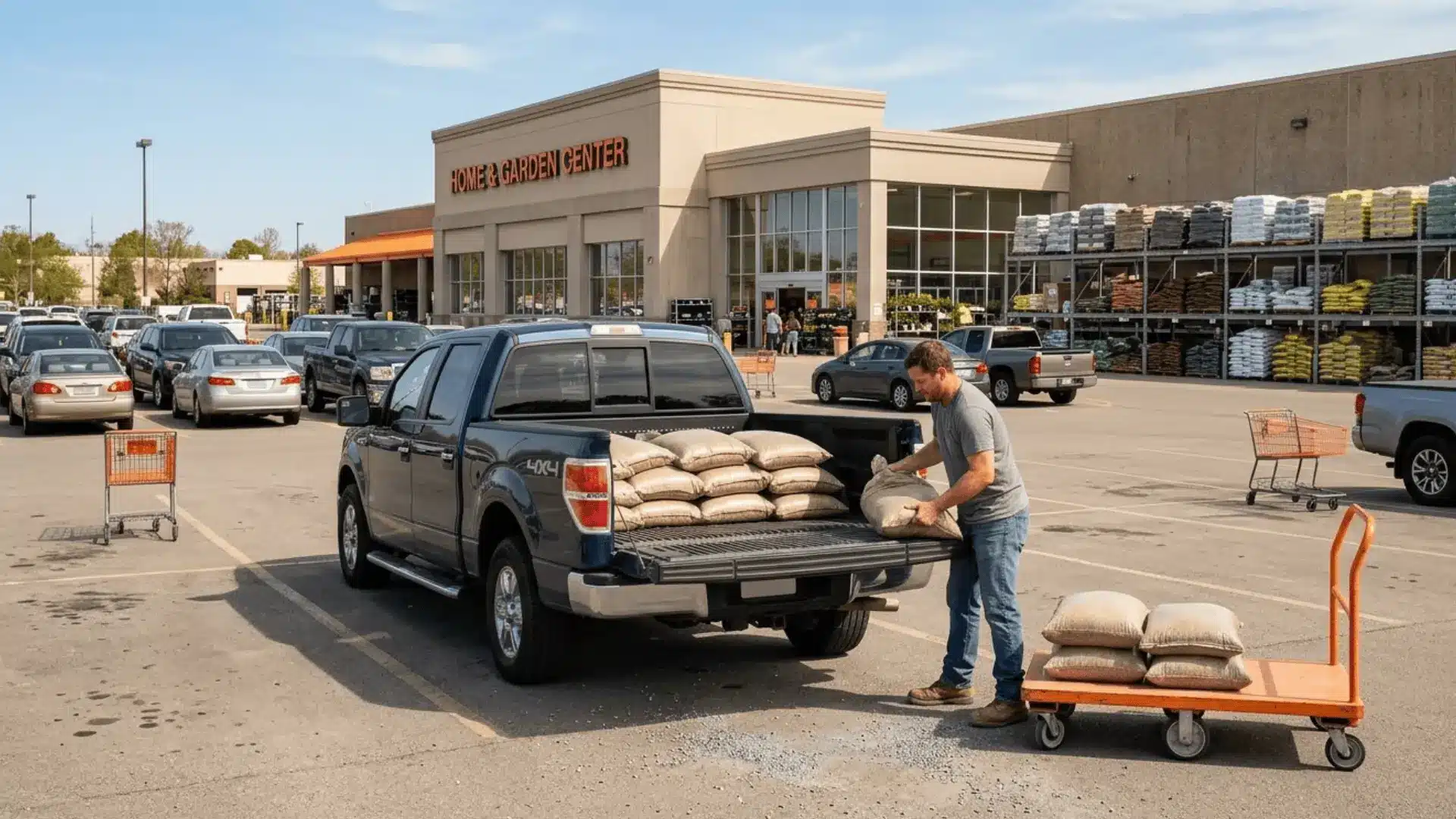
Gravel projects have a way of sneaking up on you, and that one simple question at the store, bags or bulk, can quietly make or break your budget before you even break ground.
Getting the math right means fewer trips, less waste, and a smoother project from start to finish.
Everything you need is here, from exactly how many standard bags add up to a full cubic yard, to real coverage examples for common projects.
You will also find an honest look at when buying in bulk actually saves you more than it costs.
Gravel Bags vs. Bulk Gravel: Understanding the Difference
Walk into any hardware store, and you will find gravel in labeled bags near seasonal displays: easy to grab, load, and second-guess at the register, wondering how many you need.
Before the math kicks in, it helps to know what you are working with and why the two options exist in the first place.
| Factor | Bagged Gravel | Bulk Gravel |
|---|---|---|
| Why it exists | Easy to transport, no truck needed | Cost-effective for large volumes |
| Common sizes | 50 lb and 80 lb bags | Sold by the cubic yard |
| Best for | Small beds, edging, quick repairs | Driveways, large pathways |
| Price | Higher per pound, no minimum order | Lower per unit, delivery minimums apply |
| Storage | Stackable, garage-friendly | Use soon after delivery |
| When to convert | When multiple bags start adding up | When verifying volume before ordering |
What One Cubic Yard of Gravel Actually Looks Like
A cubic yard is simply a cube measuring three feet in every direction, and seeing that volume in your head changes how you shop for gravel entirely.
What looks like a tidy pile in the store parking lot actually weighs somewhere between 2,700 and 3,000 pounds, and if you want a breakdown of that, gravel weight by yard varies depending on the type of stone you are working with.
Getting this number straight before you start loading bags into a trunk or placing a bulk order saves you from the kind of miscalculation that doubles your weekend plans.
How Much Gravel is in Each Bag?
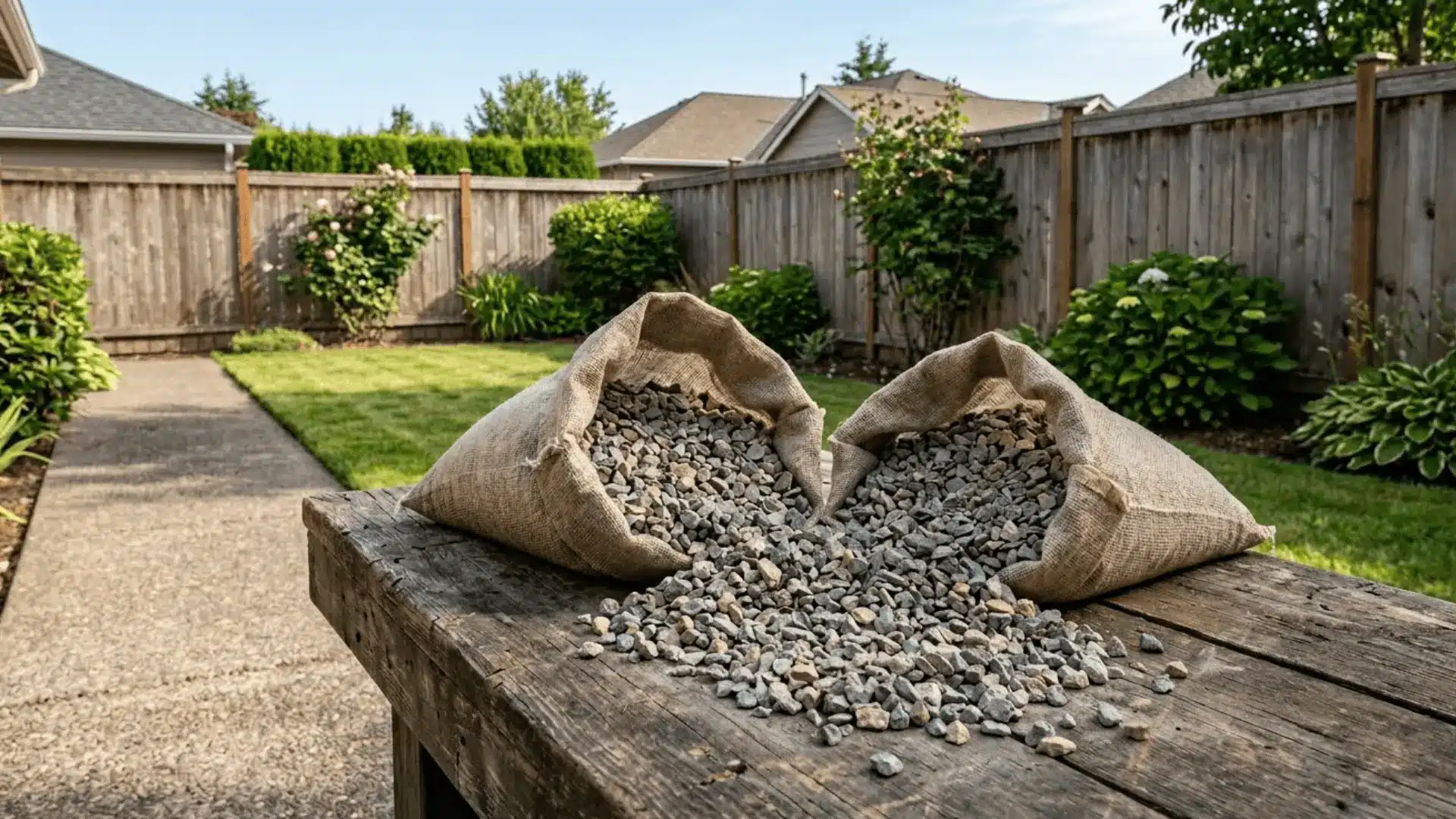
Not all bags are created equal, and the weight printed on the front does not always tell the full story. The number that actually matters for your project is the volume inside, measured in cubic feet.
Volume of a 50 lb Bag
A standard 50 lb bag holds roughly 0.5 cubic feet of gravel. It is the lighter, easier-to-carry option that works well for small top-ups, narrow garden borders, and tight spaces where you are filling in rather than covering ground.
Handy as they are, you will need quite a few of them before you hit any meaningful coverage on a mid-sized project, so they are best thought of as a precision tool rather than a bulk solution.
Volume of an 80 lb Bag
An 80 lb bag is about 0.75 cubic feet, providing more material per trip. For pathways, raised beds, or large surfaces, this size is more efficient and often cheaper per pound.
The trade-off is the weight itself, which makes it a two-hand job and something worth thinking through if you are working solo or carrying bags across uneven ground.
Why the Number of Bags Can Vary?
If your bag count never seems to match what the calculator says, you are not doing the math wrong. A few real-world factors quietly shift the numbers before the gravel even hits the ground.
Gravel Type Differences
Not all gravel packs the same way, and the type you choose directly affects how far each bag stretches.
| Gravel Type | Density | Bags per Yard (approx.) |
|---|---|---|
| Pea Gravel | Moderate | 54 x 50 lb bags |
| Crushed Stone | Higher | 60 x 50 lb bags |
| River Rock | Lower | 48 x 50 lb bags |
| Decomposed Granite | High | 62 x 50 lb bags |
Moisture and Weight Changes
Gravel sold outdoors or stored uncovered can absorb moisture, which means wet gravel weighs more without adding volume.
You are essentially paying for water weight while getting the same cubic footage. This is worth keeping in mind when buying bagged gravel that has been sitting outside at the store, especially after rain.
Compaction and Settling
Freshly poured gravel always looks fuller than it does a few weeks later.
- Gravel settles and compacts over time, reducing visible coverage.
- High-traffic areas compact faster than decorative beds.
- Always add a buffer of ten to fifteen percent to your total bag count to account for settling after installation.
Coverage Area from Bagged Gravel
Knowing how many bags you need is only half the equation.
Understanding how far each bag actually spreads across your project space, much like how yard and truckload coverage work at a larger scale, is what keeps you from running short halfway through.
Coverage for 50 lb Bags
At roughly 0.5 cubic feet per bag, a single 50 lb bag covers about 2 square feet at a standard two-inch depth. That translates to a small garden border, a stepping stone surround, or a narrow decorative strip along a fence line.
For anything larger, the bags add up quickly, which is why mapping out your square footage before heading to the store makes a noticeable difference.
Coverage for 80 lb Bags
An 80 lb bag covers closer to 3 square feet at the same two-inch depth, which adds up faster than it sounds across a longer pathway or a mid-sized bed.
A small backyard path about ten feet long and two feet wide needs fewer 80 lb bags than 50 lb ones for a clean finish. When coverage equals convenience, larger bags offer better value per trip.
How to Calculate Gravel Bags for Your Project?
The math behind gravel is simpler than it looks, and running through it once before you shop saves you from overbuying or making a second trip mid-project.
- Step 1: Measure your area by multiplying the length and width of the space in feet to get your square footage.
- Step 2: Choose your depth, keeping in mind that most landscaping projects work well at two inches, while driveways typically need closer to four.
- Step 3: Convert to cubic feet by multiplying your square footage by your depth in feet (two inches = 0.167 ft).
- Step 4: Divide by bag volume using 0.5 for 50 lb bags or 0.75 for 80 lb bags to get your total bag count.
Quick example: A pathway that is ten feet long and three feet wide at two inches deep gives you thirty square feet. Multiply by 0.167 to get five cubic feet. Divide by 0.75, and you are looking at roughly seven 80 lb bags to finish the job cleanly.
Running these numbers takes less than five minutes and gives you a confident starting point before you even pull into the parking lot.
Real Project Examples
Seeing the numbers applied to actual projects makes the whole conversion process click faster than any formula.
Here is how bag counts break down across three common setups at a standard two-inch depth.
| Project | Area | Cubic Feet Needed | 50 lb Bags | 80 lb Bags |
|---|---|---|---|---|
| Small Garden Bed | 10 ft x 4 ft | 13.4 cu ft | 27 bags | 18 bags |
| Backyard Pathway | 20 ft x 3 ft | 20 cu ft | 40 bags | 27 bags |
| Small Patio Area | 12 ft x 12 ft | 48 cu ft | 96 bags | 64 bags |
When Buying Bulk Gravel is a Better Choice
Bags are convenient up to a point, and past that point, bulk gravel starts making a lot more sense financially and logistically.
Before committing to either route, gravel prices per ton are worth looking into so the cost comparison actually holds up in your local market.
- Large projects cross the tipping point fast, and anything requiring more than half a cubic yard will almost always cost less per pound when ordered in bulk.
- Bulk delivery removes the heavy lifting, with suppliers dropping the material directly where you need it rather than you hauling dozens of bags from a store.
- The cost per cubic yard drops significantly in bulk, sometimes by as much as half, compared to buying the equivalent volume in bagged form.
- No packaging waste means less cleanup, fewer torn bags to deal with, and a more efficient workflow from start to finish.
Once your project stretches beyond a couple of cubic yards, the bulk route stops being just a convenience and starts being the obvious financial decision.
Final Thoughts
Gravel projects have a way of feeling more manageable once the numbers are on your side.
Working with fifty-pound or eighty-pound bags gets so much easier when you know exactly how many it takes to fill a cubic yard, and that knowledge alone means smarter shopping, less overspending, and a cleaner finish.
If the project has grown past what bags can reasonably handle, bulk is always worth pricing out.
Drop your project dimensions in the comments, and we can help you figure out the bag count before you make the trip.