If you’ve ever searched for the perfect lawn watering schedule, you’ve probably found dozens of different answers. Some experts recommend watering twice a week.
Others suggest deep watering every few days, while some emphasize early morning irrigation regardless of the season. The problem is that none of these recommendations apply to every lawn.
According to RainPoint, smart irrigation doesn’t begin with choosing a universal schedule—it begins with understanding what’s happening in your own yard. Soil composition, grass variety, rainfall, temperature, root depth, and even different areas of the same landscape all influence how much water plants actually need.
That’s the philosophy behind the RainPoint Smart Watering Ecosystem, which combines connected irrigation hardware with environmental sensing to help homeowners make watering decisions based on local conditions instead of routine.
Healthy Irrigation Starts With Understanding Your Landscape
Every lawn and garden is different, even within the same neighborhood.
A lawn that receives full afternoon sun may dry out much faster than a shaded side yard. Raised vegetable beds often need water more frequently than established shrubs with deeper root systems.
Sandy soils drain quickly, while clay soils hold moisture much longer. Even two homeowners growing the same type of grass may need different watering routines because of differences in drainage, slope, tree cover, or local rainfall.
Seasonal weather adds another variable. During periods of extreme summer heat, evaporation increases and plants may require closer attention. After several days of steady rain, however, additional irrigation may do more harm than good by keeping the soil overly saturated.
These changing conditions are why experienced gardeners rarely rely on a fixed calendar alone. Instead, they observe what’s happening in the landscape and adjust irrigation accordingly. Smart irrigation works best when it supports that decision-making process—not when it replaces it.
Connecting Information Before Turning on the Water
Making better watering decisions starts with having better information.
Traditionally, homeowners might check a weather forecast, inspect the soil by hand, adjust a hose timer, and hope everything works together. While each step is useful, they often remain separate parts of the watering routine.
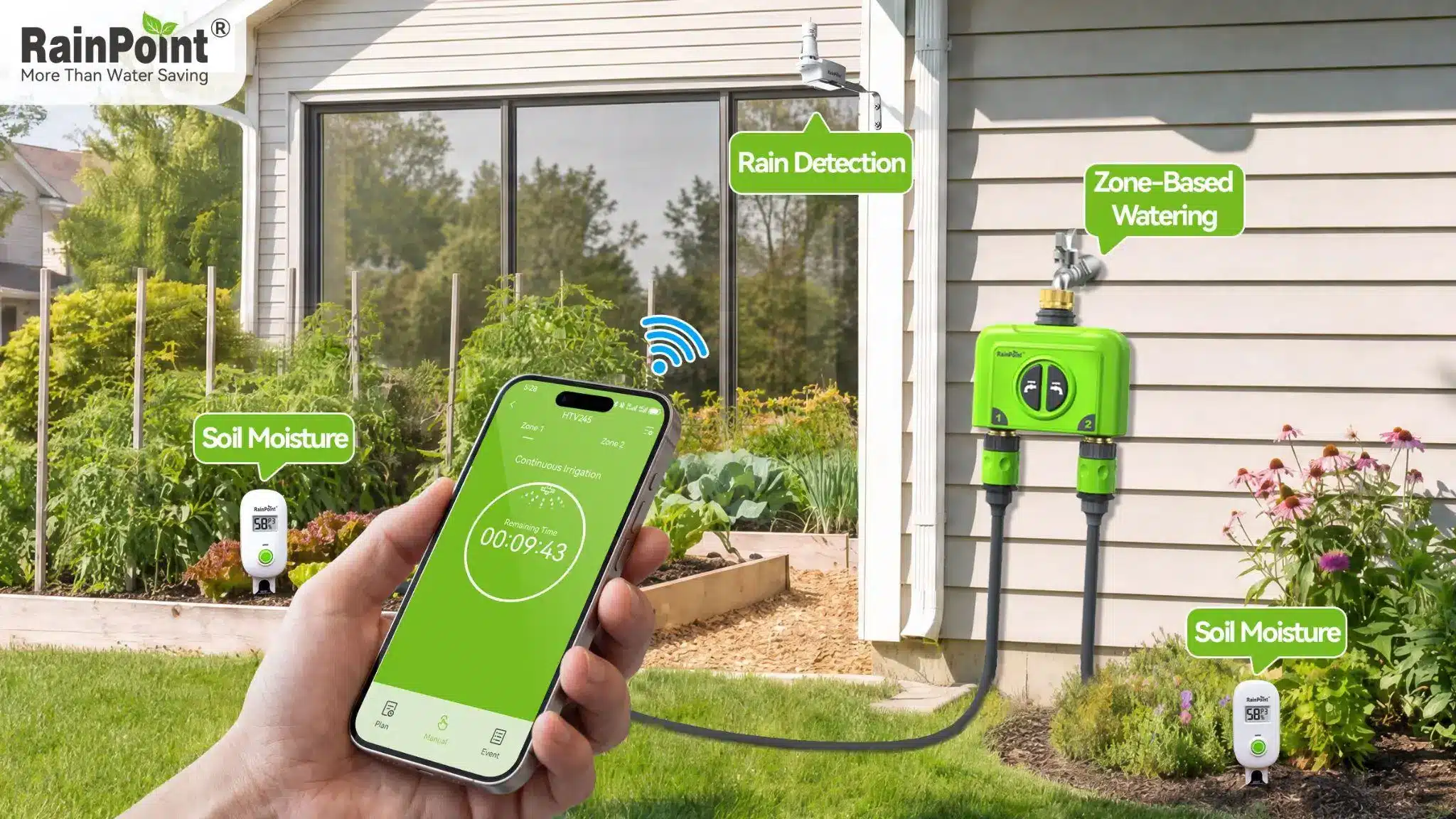
RainPoint takes a more connected approach. Its Smart Watering Ecosystem brings together a gateway, dual-zone smart water timer, soil-moisture sensor, and rain sensor, with the RainPoint Home app serving as the central interface for monitoring and control. Instead of relying on one source of information, homeowners can monitor soil conditions, rainfall, watering schedules, and connected devices together.
This is what RainPoint calls Connect—bringing the water source, irrigation equipment, environmental data, plants, and homeowners into one coordinated ecosystem.
Better Control Means Better Watering Decisions
One of the biggest challenges in irrigation is that different areas of a yard rarely need the same amount of water. Lawns, flower beds, vegetable gardens, shrubs, and newly planted trees all respond differently to weather and soil conditions.
RainPoint’s dual-zone smart water timer allows homeowners to manage two watering zones independently instead of applying a single schedule everywhere. A sunny lawn can follow one irrigation plan while flower beds or vegetable gardens receive a completely different schedule based on their own needs.
Environmental sensors provide another layer of guidance. The soil-moisture sensor helps indicate when moisture levels remain sufficient around plant roots, while the rain sensor can trigger an automatic rain delay when rainfall is detected.
Through the RainPoint Home app, homeowners can also review watering schedules, make remote adjustments while traveling, and adapt irrigation plans as weather conditions change.
These tools give homeowners more confidence in their watering decisions by replacing assumptions with real-time information. RainPoint calls this Control—making it easier to adjust irrigation as weather, soil conditions, and plant needs change throughout the season.
Continue Adapting as Seasons Change
Healthy landscapes are built over time, not through a single watering schedule.
Spring growth, summer heat, autumn cooling, and changing rainfall patterns all influence how much water plants require throughout the year. Even established lawns benefit from occasional adjustments as environmental conditions evolve.
The final piece of RainPoint’s framework is Continue. Every season brings different growing conditions, so watering shouldn’t remain the same all year. Small adjustments over time can help lawns and gardens stay healthier while making irrigation easier to manage.
For busy homeowners, frequent travelers, or anyone managing multiple planting areas, remote access through the RainPoint Home app makes it easier to stay connected to the landscape without needing to be physically present.
Historical watering records, environmental data, preset season settings, and flexible scheduling also make seasonal adjustments simpler over time.
 Smart Irrigation Is About Better Decisions, Not More Water
 Smart Irrigation Is About Better Decisions, Not More Water
There is no single lawn watering schedule that works for every yard.
Every landscape responds differently to changing weather, soil conditions, and seasonal growth. Paying attention to those changes and adjusting irrigation when needed will almost always produce better results than following the same routine week after week.
That’s the thinking behind RainPoint’s Connect, Control, Continue approach. By combining environmental information with flexible irrigation management, RainPoint helps homeowners spend less time second-guessing their watering routine and more time enjoying healthy lawns and gardens.