Fertilizer Burn: Can Your Lawn Still Be Saved?
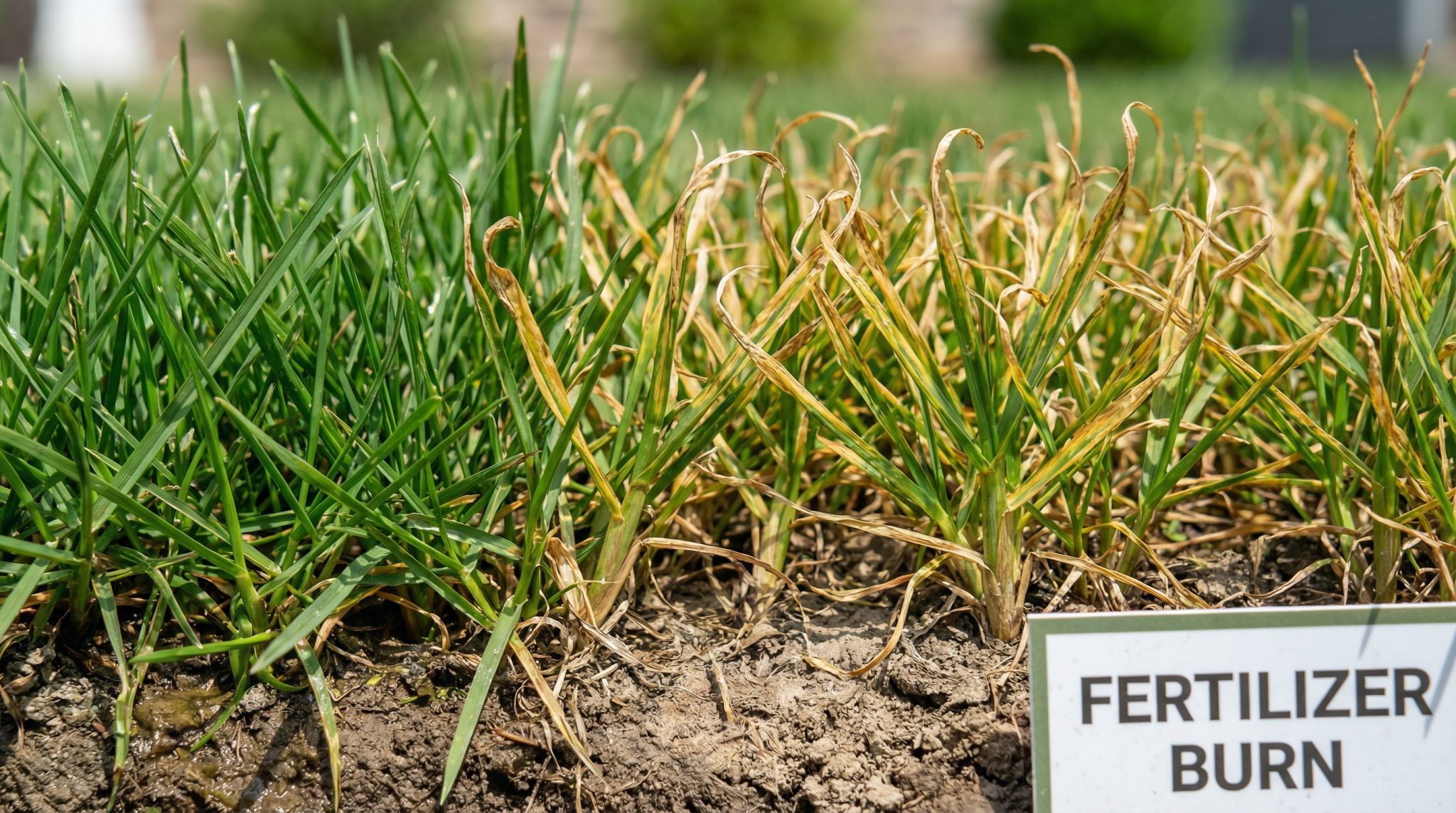
So you fertilized like a responsible adult… and now your lawn looks like it got into a fight with a toaster. Brown streaks, crispy patches, weird stripes that weren’t there last week. Yep sounds like fertilizer burn.
Before you spiral and start pricing out sod like you’re auditioning for a landscaping reality show, take a breath. A burned lawn can bounce back… if you figure out what happened and move fast (and if your grass isn’t already fully toast toast).
Let’s talk about what fertilizer burn actually is, how to spot it, and what to do today like, go put shoes on today.
What fertilizer burn actually is (aka: salty betrayal)
Fertilizer burn is mostly a salt problem. Fertilizer nutrients behave like salts, and when there’s too much in one spot, it literally pulls water out of the grass instead of helping it. Think of it like drinking seawater when you’re dehydrated. (Your grass is basically doing a tiny dramatic faint.)
And the type of fertilizer you used changes how quickly things go downhill:
- Liquid fertilizer: burn can show up within hours to 1 day
- Quick release granular: usually 1-3 days
- Slow release: sneaks up on you 7-21 days later
So if you fertilized Saturday and by Tuesday you’ve got brown racing stripes? That tracks.
If you’re seeing “burn” six weeks later? That’s probably something else picking a fight with your lawn.
The dead giveaway: the pattern (your spreader leaves receipts)
Here’s the thing that makes fertilizer burn weirdly easy to diagnose: spreader pattern clues often show up in very specific shapes like your lawn is recreating a geometry worksheet.
Common fertilizer burn patterns:
- Stripes → spreader overlap (classic “I went a little too thorough” move)
- Checkerboard/squares → doubling back on turns
- Circles/arcs → rotary spreader throw pattern
- Dark, concentrated spots → spills… or standing still with the hopper open (ask me how I know)
Also: look closely at the soil surface. Sometimes you’ll see white, crusty residue that’s fertilizer salt sitting there like it owns the place. You generally won’t see that with disease, bugs, or drought.
Bonus visual clue: grass often goes dull/gray-ish first, then yellow/brown starting at the tips, because that’s where it dries out fastest.
My two minute “is this fertilizer burn or am I just panicking?” check
Go do these quick checks before you do anything dramatic:
- Timing check: does the damage show up in the right window for the fertilizer type?
- Pattern check: do you see stripes, arcs, squares, or spill spots?
- Residue check: any white crust on the soil?
- Tug test: gently pull the grass
- If it’s anchored and you feel resistance: promising
- If it pulls up like a bad wig: not great
- Root/crown peek: (yes, you’re doing lawn surgery)
- White/firm roots + pale crown: alive, just mad
- Black/mushy roots + brown crown: likely dead
If the timing and the pattern match, you’re probably looking at fertilizer burn.
“But what if it’s something else?” (the usual impostors)
A few lawn problems love to cosplay as fertilizer burn:
- Drought stress: usually develops over weeks, not days, and looks more evenly sad across the lawn. Grass is limp and bendy, soil is dry everywhere.
- Disease: tends to make random patches or expanding circles that don’t match spreader paths. You might see spots/lesions on blades or fungal fuzz.
- Grubs/pests: patches lift up like a rug because roots are gone. Dig a little if you find grubs, congratulations, you’ve met your enemies.
Quick feel test:
- Crunchy/snaps easily = often burn
- Bends/flops = more drought-ish
Okay. It’s fertilizer burn. Now what?
If you caught it fast (within 48 hours), you’ve got the best odds.
Fertilizer burn is worst at the beginning because the salt concentration is highest right after application. Your job is simple:
Flush it. With water. A lot of water.
If you’re within 24 hours:
- Water immediately aim for about 1 inch of water over the area.
- The goal is to dissolve granules and move salts away from the roots.
- You may see improvement within a few days.
If you’re in the 24-72 hour window:
- Still very recoverable start heavy watering now.
- Plan on about ½ inch daily for the next week.
- If it’s already brown and crispy, you’re in the “wait and babysit it” phase, but it can still come back.
If it’s been a week or more:
- Do the tug test + root check.
- If roots look okay, keep watering and be patient.
- If roots are shot, you’ll likely be reseeding later but still flush first so you’re not planting new seed into salty doom.
One important note: heat speeds everything up. If it’s over about 85°F, what would’ve taken days can happen overnight. Also, dry soil concentrates salts like a tiny punishment chamber.
When to stop hoping and start planning a reseed
Here’s the checkpoint I use (because I need a line in the sand or I’ll stare at the lawn forever like it’s going to apologize):
If you’ve been watering consistently and you see no new green by around day 21, those fully brown sections are probably not coming back.
At that point, shift your energy to reseeding prep once you’ve flushed the area well. (It’s not defeat. It’s a new chapter. A grass glow up.)
The one thing that matters most
If you do nothing else, do this:
Grab your hose and flush the burned areas today.
Not “later this week.” Not “after I google it for two more hours.” Today.
Most moderate fertilizer burns heal with consistent watering and time. Severe burns might need reseeding, but either way, the recovery starts the moment you get water moving through that soil.
And next time… maybe don’t “just eyeball it” and avoid too much fertilizer. (Again. Ask me how I know.)