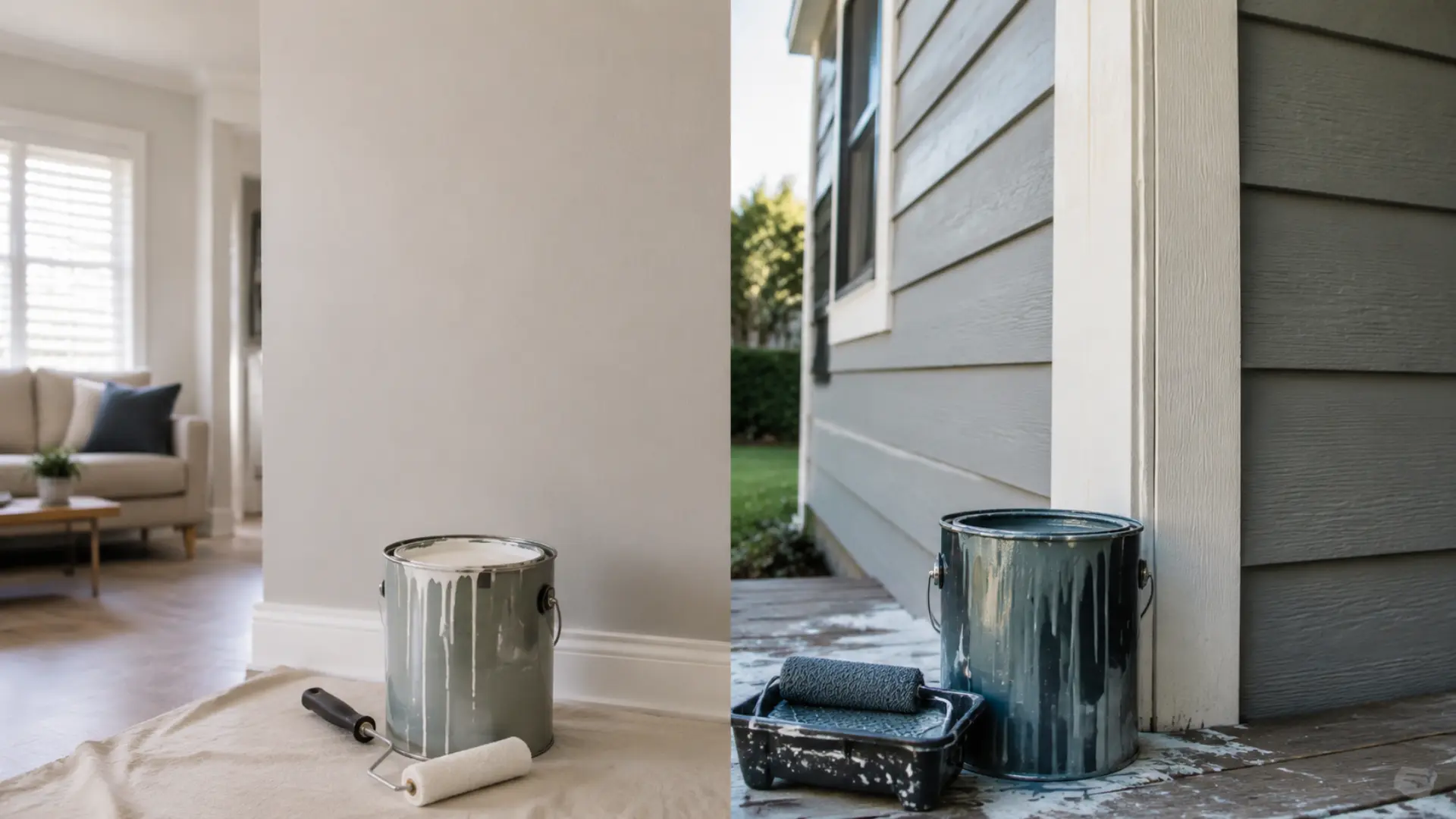
Leftover exterior paint can technically go on an indoor wall, and it’s worth figuring out if you can use exterior paint inside the house before you grab that can instead of buying a separate one.
The paint will go on smoothly and adhere just fine, but going on well and belonging there long term are two different things.
Exterior formulas are built to survive sun, rain, and temperature swings, and those same additives cause problems once they are trapped inside a closed room.
Understanding what separates the two paint types makes it easier to see where an exterior can actually earns its keep indoors, and where it doesn’t.
What Makes Exterior Paint Different?
Exterior paint has to withstand direct sunlight, pounding rain, snow, humidity, and temperature swings without cracking, fading, or growing mildew.
To handle all that, manufacturers add stronger resins and UV blockers.
These keep the color from breaking down under constant sun exposure. They also add mildewcides that fight moisture buildup on siding, trim, and decks.
Wood surfaces like fences, decks, and trim boards need paint built to handle constant weather exposure, and picks that actually hold up on weathered wood can vary quite a bit by brand and formula.
Flexibility is another key feature. Exterior surfaces expand in summer heat and contract in winter cold. Without that stretch, the paint would split or peel within a season or two.
What Makes Interior Paint Different?
Manufacturers keep the level of volatile organic compounds, or VOCs, low in interior paint. That keeps the odor mild, so the paint doesn’t leave your home smelling harsh for days after a fresh coat.
The binders and pigments are chosen for smooth application and a clean, even finish on walls and ceilings. Many formulas also include additives that make scuffs, fingerprints, and light stains easier to wipe away.
Indoor surfaces are not exposed to sun or rain. So interior paint prioritizes looks and comfort over toughness.
That is why it tends to go on smoother, dry with a nicer sheen, and hold up well in rooms where people are cooking, walking, or lounging every day.
Interior vs. Exterior Paint
Here’s how interior and exterior paint compare across VOC levels, drying time, finish, durability, and cost.
Prices vary by brand, quality tier, and region, so treat the cost row as a general range rather than a fixed number.
| Feature | Interior Paint | Exterior Paint |
|---|---|---|
| VOC Levels | Low, safer for indoor air | Higher, needs ventilation |
| Odor | Mild, fades quickly | Strong, lingers longer |
| Finish | Smooth, focused on appearance | Textured, focused on durability |
| Flexibility | Minimal, not needed indoors | High, expands and contracts with weather |
| UV Resistance | Not required | Strong, prevents fading in sunlight |
| Mildew Resistance | Light protection | Heavy-duty, fights moisture and mold |
| Cleaning Ease | Easy to wipe and scrub | Not designed for frequent cleaning |
| Drying Time Indoors | Fast, made for enclosed spaces | Slow, can trap fumes indoors |
| Best Used For | Walls, ceilings, trim, furniture | Siding, decks, fences, outdoor trim |
| Cost | Roughly $20 to $60 per gallon | Roughly $25 to $70 per gallon |
Can You Use Exterior Paint Inside?
Yes, exterior paint will adhere to most indoor surfaces without much trouble, including drywall, wood trim, and masonry walls.
It goes on the same way interior paint does, and in many cases, the coverage looks just as solid once it dries. That said, the fact that it sticks and looks fine on day one does not mean it is the right product for the space.
Application success is different from long-term suitability. Air quality, off-gassing, and how the finish holds up over time all matter too, especially once the paint has been on the wall for a while.
There are a few situations where exterior paint can make practical sense inside a home, particularly in spaces that are not part of everyday living areas:
- Garages
- Workshops
- Utility rooms
- High-moisture areas with proper ventilation
- Unfinished spaces
Where You Should Avoid It?
Some rooms can’t handle what exterior paint releases into the air. Here’s where it’s best to steer clear:
- Bedrooms: Long hours spent sleeping mean prolonged exposure to fumes.
- Nurseries: Babies and young kids are especially sensitive to VOCs.
- Living Rooms: Heavy daily use makes lingering odor and off-gassing hard to avoid.
- Kitchens Without Proper Ventilation: Trapped fumes mix poorly with cooking heat and steam.
- Small enclosed rooms: Limited airflow lets odors and chemicals build up fast.
This is general safety guidance, not medical advice. If anyone in your home is pregnant, elderly, or has asthma or another respiratory condition, treat that as an extra reason to stick with interior-rated paint, and check with a doctor before starting any project that involves strong fumes.
What Happens If You Use Exterior Paint Inside?
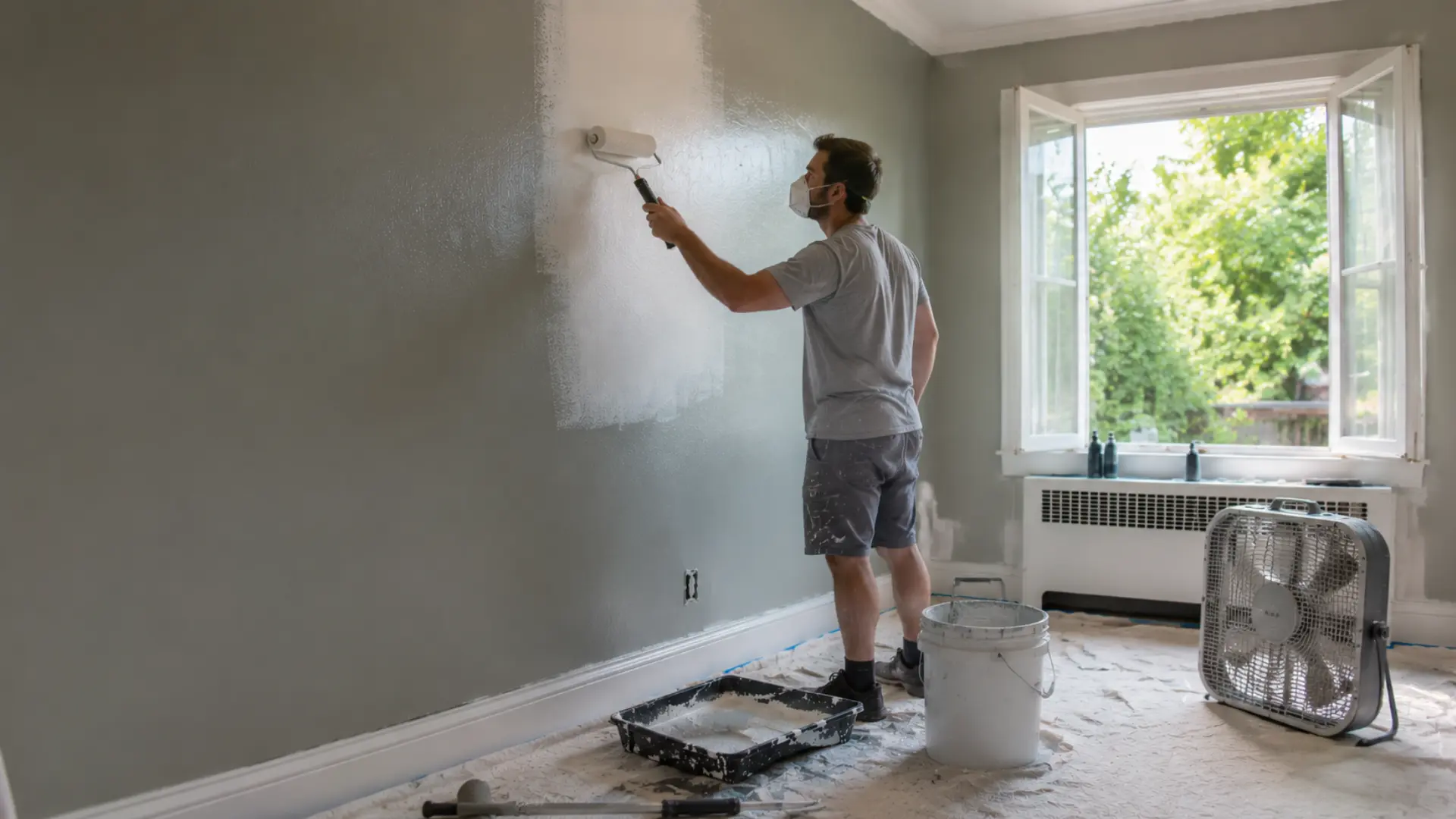
Using exterior paint indoors creates a handful of problems, and most show up gradually instead of all at once.
1. Higher VOC Levels
VOCs are chemicals that evaporate into the air as paint dries. Outdoors, they disperse quickly and cause little concern.
Indoors, without the same airflow, VOCs build up and linger, sometimes leading to headaches, dizziness, or throat irritation. Exterior paint typically carries higher VOC levels than interior paint.
That means stronger odors and a longer off-gassing period once it’s applied inside. This is exactly why low-VOC interior paints are the go-to choice for bedrooms, living rooms, and other spaces where people spend hours at a time.
2. Longer Drying and Curing Time
Interior paint is formulated to dry fairly quickly in stable, temperature-controlled rooms.
Exterior paint behaves differently because it is formulated to cure slowly outdoors, where airflow and shifting temperatures help it set properly.
Indoors, that same slow-curing formula can stay tacky far longer than expected, sometimes for days. High humidity and poor ventilation make the problem worse. Moisture gets trapped near the surface, and drying time stretches out.
3. Stronger Paint Smell
Exterior paint is designed to handle open-air conditions, so its odor is meant to fade into the atmosphere rather than linger in a closed room.
When used indoors, that same smell has nowhere to go. It often becomes noticeably stronger and lasts longer than typical interior paint fumes.
If exterior paint must be used inside, open windows and run fans. Give it extra ventilation time to clear out lingering odors safely.
4. Different Finish and Appearance
Exterior paint is engineered for durability, not decorative polish, so it often lacks the smooth, refined finish people expect on interior walls.
Sheen levels can look different under indoor lighting, sometimes appearing patchy, overly glossy, or textured in a way that feels out of place.
Natural light outdoors hides imperfections. Indoor lighting highlights them instead, so flaws in texture or coverage become more noticeable once the paint goes up.
5. Adhesion and Peeling Problems
Exterior paint does not always bond well with indoor surfaces if the wrong primer is used or if the surface is not properly prepped.
Skipping steps like cleaning, sanding, or priming can lead to peeling, bubbling, or uneven adhesion over time.
Exterior formulas aren’t designed with indoor wall materials in mind, so proper preparation becomes even more critical to avoid early paint failure.
A Couple More Drawbacks
A couple of downsides do not fit neatly into the five problems above, but they are worth flagging before you commit:
- Touch-ups get harder down the road if the exterior paint line gets discontinued, since matching the color and finish later becomes difficult
- You’re paying for weatherproofing chemicals that serve no purpose once the paint is on an indoor wall
Using exterior paint indoors can create a handful of problems, and most of them show up gradually rather than all at once.
Can Interior Paint Be Used Outside?
Interior paint can technically be brushed onto an outdoor surface, but it will not last. It lacks the protective additives built into exterior formulas. So the finish starts breaking down almost immediately once it’s exposed to the elements.
Using it outside usually leads to fading, cracking, or peeling within a short amount of time.
Why Interior Paint Usually Fails Outdoors?
Interior paint is formulated for stable, sheltered environments. It skips the reinforced ingredients that outdoor conditions demand.
Once applied outdoors, it quickly shows signs of wear, since it was never built to withstand constant sun, moisture, or swinging temperatures.
Interior paint lacks protection against:
- UV rays
- Rain
- Temperature changes
- Mold and mildew growth
Exterior Paint vs. Interior Paint: Which One Should You Choose?
Choosing the right paint comes down to matching the formula to the environment it will actually live in. Here is what to look for on each side.
Best Paint for Interior Walls
- Low VOC Options: Safer air quality for everyday living spaces, like Behr Premium Plus Low VOC Interior Paint
- Washable Finishes: Easier cleanup for high-traffic walls, such as Sherwin-Williams Cashmere Interior Paint
- Smooth Application: Even coverage without heavy texture
- Low Odor: Minimal smell during and after painting
- Good Stain Resistance: Holds up against scuffs, fingerprints, and spills, like Benjamin Moore Regal Select
Rooms with lots of natural light or greenery tend to look best with soft, warm white shades instead of a stark, cool white.
Best Paint for Exterior Surfaces
- UV resistance: Prevents fading from constant sun exposure, such as Behr Marquee Exterior Paint
- Weather protection: Stands up to rain, snow, and humidity
- Flexible coating: Expands and contracts with outdoor temperature swings, like Sherwin-Williams Duration Exterior Paint
- Mildew resistance: Fights moisture buildup on siding, trim, and decks
The sheen you pick matters just as much as the formula, since how different finish levels perform changes what a room looks and feels like day to day.
Choosing Paint by Room Type
Each room puts different demands on paint, based on how much time you spend there and what the walls are exposed to.
Let’s have a look at what to use and why.
| Area | Recommended Paint | Why |
|---|---|---|
| Bedroom | Low-VOC interior paint | Hours of sleep mean lower fumes matter most here |
| Bathroom | Moisture-resistant interior paint | Shower humidity can bubble or mildew standard paint |
| Kitchen | Washable interior paint (satin or semi-gloss) | Grease and steam need a finish that wipes clean |
| Garage | Durable interior or exterior paint | Temperature swings and chemical exposure need tougher coating |
| Exterior Siding | Exterior paint | Sun and rain need UV blockers and flexible resins |
Matching the paint to the room comes down to what that room actually puts the paint through, day after day.
How Humidity Affects This Indoors?
Humidity slows down any paint’s dry time. Exterior paint’s already-slow cure means indoor moisture can sit on the surface even longer than it would in a dry climate.
A closed-up room with the air conditioning running can actually trap fumes worse than open air outside would. Central air recirculates the same indoor air instead of pulling in fresh air.
If you are using exterior paint indoors in a humid climate, plan on running exhaust fans or a window unit that pulls in outside air for several extra days past whatever the can recommends.
Give it more time than you think it needs before treating the room as finished.
A Few More Things to Know Before You Choose
A few more qualities affect how well a paint performs. Knowing these details ahead of time can save you from a repaint down the road.
1. Drying Time
These are general ranges. Check your product label to confirm. Interior paint dries to the touch in 30 to 60 minutes, recoats in about 4 hours, and cures fully in 2 to 4 weeks.
Exterior paint dries in 1 to 2 hours, recoats in 4 to 8 hours, and cures in up to 4 weeks outdoors, though it slows down further once it’s inside.
2. Paint Coverage
Interior paint typically covers 350 to 400 square feet per gallon on smooth drywall. Exterior paint covers less, around 250 to 350 square feet per gallon, since siding, brick, and stucco are rougher and more porous.
These are general estimates, so check the can for your product’s exact number. Textured surfaces and drastic color changes often need an extra coat.
3. Durability and Resistance
Exterior paint is built to survive UV rays, driving rain, humidity, and temperature swings without cracking or fading. Interior paint focuses on washability, stain resistance, and a smooth finish for everyday living instead.
That rugged durability sounds like an upgrade, but it doesn’t help indoor walls. Homes need surfaces that look good and clean up easily, not weatherproofing.
What Do DIY Communities Say About Using Exterior Paint Inside?
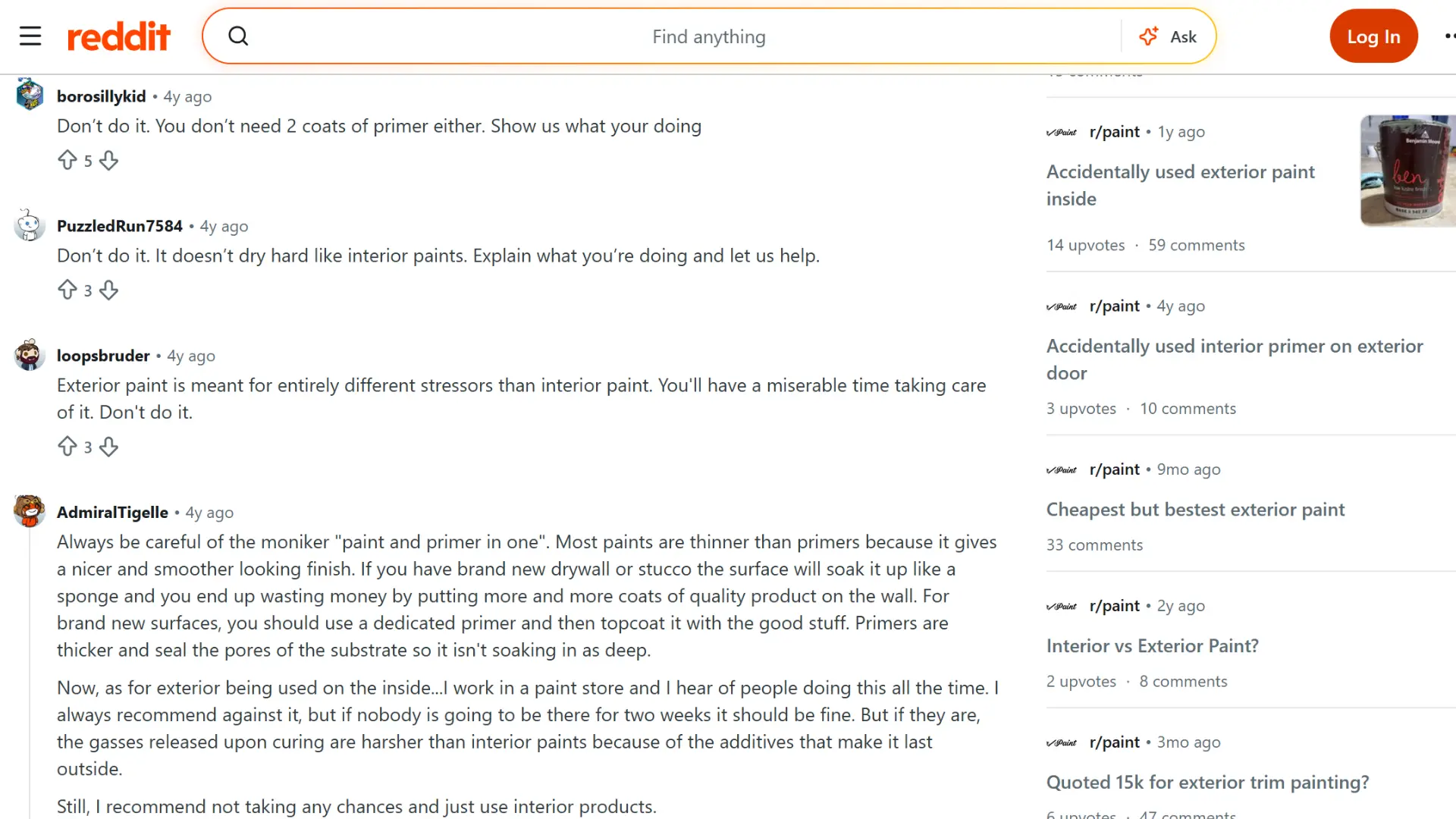
Homeowner forums and DIY boards show mixed experiences, but the advice is fairly consistent.
Many people share stories of using leftover exterior paint in low-stakes areas without major issues, while others warn against it after dealing with lingering odors or a finish that never quite looked right indoors.
I can’t point to a single verified source for this, so take it as a general pattern rather than a hard statistic, but professionals who weigh in on these threads almost always steer people back to using the paint made for the specific space.
Saving a little money upfront often is not worth the hassle if things go wrong later.
- Some users report success in garages and utility areas.
- Many recommend avoiding it for bedrooms and living spaces.
- Professionals usually suggest using the paint designed for the intended location.
- Leftover paint savings often don’t outweigh long-term concerns.
How to Use It Safely Indoors?
If you still plan to paint indoors with an exterior formula, these precautions can reduce the risks:
- Improve Ventilation: Open windows and run fans to keep air circulating during the project and for several days afterward, so fumes can escape instead of building up.
- Wear Proper Protective Equipment: Use a respirator mask, gloves, and safety glasses to limit direct exposure to VOCs and other chemicals in exterior formulas.
- Avoid Sleeping Areas or Children’s Rooms: Extended time in these spaces makes off-gassing and long-term air quality concerns more serious.
- Allow Extra Curing Time: Give the space several extra days beyond the usual timeline before moving furniture back in or resuming normal use of the room.
- Check the Product Label for Indoor Restrictions: Manufacturers often list specific warnings about indoor use and ventilation directly on the can.
- Use a Primer, if Needed: The right primer improves adhesion between exterior paint and indoor surfaces while helping reduce absorption and uneven texture.
Final Thoughts
Exterior paint won’t fall apart on an indoor wall, but humidity makes the drawbacks worse than they’d be in a dry climate.
Save it for the garage, the workshop, or a utility room nobody lingers in, and let real interior paint handle the rooms where your family spends its time.
I have matched enough leftover cans to the wrong room over the years to know that a fresh can of interior paint is cheaper than repainting twice.
Have you tried using exterior paint indoors? Tell me how it held up in the comments. I would like to hear what worked and what did not.
Frequently Asked Questions (FAQs)
Is Exterior Paint Toxic to Use Indoors?
Exterior paint may release stronger odors and VOCs, making interior-rated paint a safer choice.
How Long Does the Smell of Exterior Paint Last Indoors?
The smell can last from several days to weeks, depending on ventilation and paint type.
Can Exterior Paint Be Used on Bathroom Walls?
Some exterior paints may resist moisture, but bathroom-specific interior paint is usually better.
Does Exterior Paint Last Longer than Interior Paint Indoors?
Not necessarily, because durability depends on the surface, environment, and paint formula.
Can I Use Leftover Exterior Paint on a Closet or Garage?
Yes, these areas may be more suitable if the space is well ventilated.