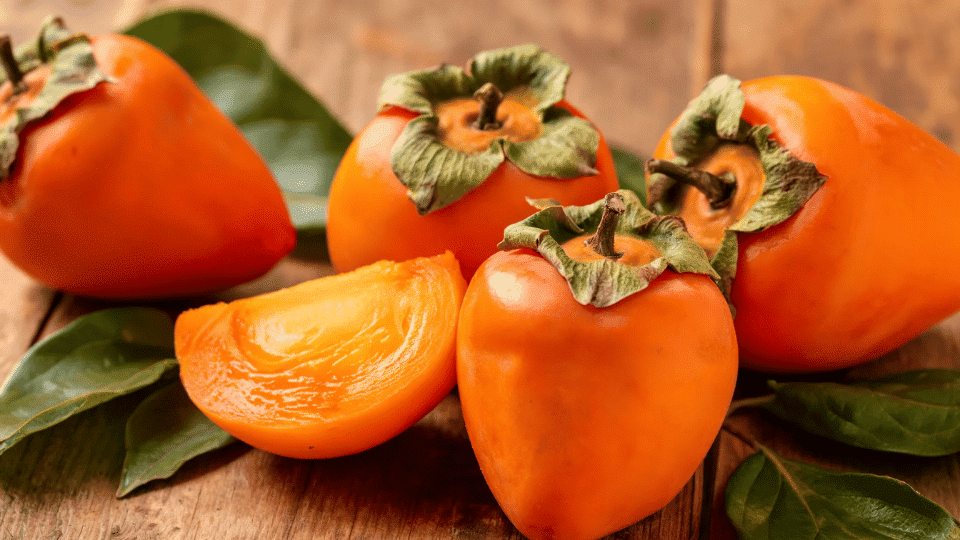
Persimmons can be confusing because two orange fruits may need completely different treatment. Some are crisp and sweet, while others are firm. Others taste harsh until they soften into a spoonable pulp.
That difference is why understanding the types of persimmons matters before buying, slicing, or baking with them.
I like starting with texture because it tells me more than color ever will.
The fuyu persimmon is the easy-to-eat fresh type many shoppers recognize, but Hachiya, Saijo, American, Chocolate, and Sharon each bring something different to the table.
Let’s get right into it!
What Makes Persimmons Different From Each Other?
Persimmons are fall and winter fruits from the Diospyros genus. The type most often sold in grocery stores is the Asian or Japanese persimmon, Diospyros kaki.
American persimmons come from a different species, Diospyros virginiana, and are usually smaller with a deeper flavor.
The biggest difference is not just size, color, or sweetness. It is how the fruit’s tannins behave as it ripens. Tannins are natural compounds that can make an unripe fruit feel dry and puckery in your mouth.
That one detail changes how each persimmon should be eaten, stored, cooked, or dried. It also explains why one variety works in a salad while another belongs in pudding.
The Two Main Types of Persimmons
Nearly every persimmon becomes easier to understand once you know whether it is astringent or non-astringent. This split affects texture, timing, and use.
| Type | What It Means | Texture When Ready | Common Examples |
|---|---|---|---|
| Astringent persimmons | High tannins when firm | Very soft, jelly-like | Hachiya, Saijo, Tanenashi, American persimmon |
| Non-astringent persimmons | Lower astringency when mature | Firm, crisp, or slightly soft | Fuyu, Jiro, Izu, Suruga |
Astringent persimmons need patience. If you eat them firm, they can make your mouth feel dry and chalky. In astringent types like Hachiya, water-soluble tannins decrease as the fruit softens.
Non-astringent types like Fuyu can be eaten when the flesh is mature but still firm.
This is the simplest rule in the whole fruit: soft-eating types need full ripeness, while firm-eating types are ready much sooner.
Astringent Persimmons
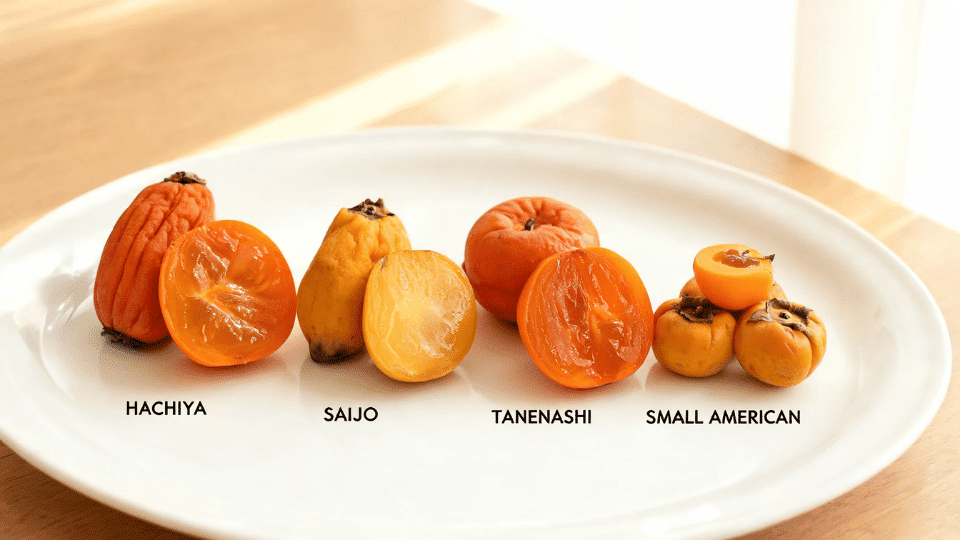
Astringent persimmons are not inferior fruit. They simply need to ripen until the tannins fade and the flesh becomes soft, sweet, and rich.
1. Hachiya Persimmon
Hachiya is the classic astringent persimmon found in many US stores. It has a tall, acorn-like shape and should not be eaten while firm. When fully ripe, the flesh turns soft, glossy, and almost custard-like.
Its sweetness becomes deep enough for desserts, smoothies, and baked goods. It is a soft-eating astringent type.
- Best use case: Baking, puddings, quick breads, smoothies, and ripe pulp.
- Taste profile: Honeyed, rich, mellow, and dessert-like when fully soft.
- Buying cue: Choose firm fruit only if you can wait for it to ripen at home.
2. Saijo Persimmon
Saijo is a smaller astringent persimmon with a strong reputation among fruit growers. It usually has an elongated shape and becomes excellent only after softening.
Compared with Hachiya, it is often considered a more specialized variety, especially for people interested in home orchards, drying, or concentrated sweetness. It is less common in regular grocery displays.
- Best use case: Drying, soft fresh eating, and small-batch preserves.
- Taste profile: Very sweet, concentrated, and slightly caramel-like.
- Comparison factor: Better for flavor seekers than casual first-time shoppers.
3. Tanenashi Persimmon
Tanenashi is an astringent persimmon often associated with seedless or nearly seedless fruit. It ripens into a smooth, sweet flesh that works well when softened.
Tanenashi, among persimmons that must be eaten soft, like Hachiya, while still having its own flavor identity.
- Best use case: Drying, pulp, baking, and cooked preparations.
- Texture note: Smooth flesh makes it easier to process than seedier types.
- Comparison factor: More useful for preservation than crisp fresh snacking.
4. American Persimmon
American persimmon comes from Diospyros virginiana, not the Asian persimmon species commonly sold in stores. The fruits are usually smaller and can look wrinkled when they are finally ready.
Their flavor is often more intense than grocery-store persimmons, with a darker sweetness that suits traditional baking and preserves.
- Best use case: Native fruit recipes, jams, breads, and backyard harvests.
- Taste profile: Date-like, brown-sugar rich, sometimes earthy or spiced.
- Buying cue: Expect this more from farmers’ markets, foraging, or home trees.
Non-Astringent Persimmons
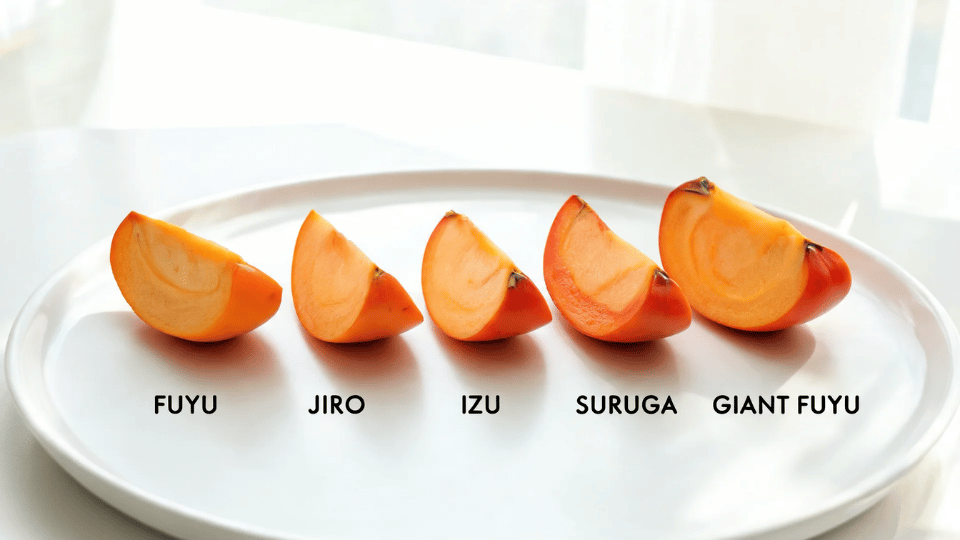
Non-astringent persimmons are the easiest types for fresh eating because they do not need to become jelly-soft before they taste pleasant.
5. Fuyu Persimmon
Fuyu is the best-known firm-eating persimmon. It is usually squat, flat, and tomato-like, with orange skin and dense flesh.
The fuyu persimmon fruit can be eaten crisp or allowed to soften slightly. Fuyu is a non-astringent variety that can be eaten firm and crisp, or left to soften.
- Best use case: Fresh slices, salads, cheese boards, roasting, and lunchboxes.
- Taste profile: Mildly sweet with pear, date, or brown-sugar notes.
- Comparison factor: More forgiving than Hachiya because it is edible while firm.
6. Jiro Persimmon
Jiro is another non-astringent persimmon that often looks similar to Fuyu. It is usually flat, firm, and easy to slice.
The key reason to mention Jiro is for comparison: shoppers and gardeners may see the name next to Fuyu and wonder whether it behaves differently. It still belongs in the crisp, fresh-eating group.
- Best use case: Raw eating, fruit plates, salads, and simple snacks.
- Texture note: Firm enough to hold clean slices without falling apart.
- Comparison factor: Similar to Fuyu, but often discussed more in cultivar listings.
7. Izu Persimmon
Izu is an early-ripening non-astringent persimmon. It matters more to growers and fruit enthusiasts than to everyday supermarket shoppers.
Its main appeal is timing, since it can mature earlier than some other firm-eating varieties. That makes it useful for people comparing harvest windows or planning a backyard persimmon tree.
- Best use case: Early-season fresh eating and home orchard planning.
- Taste profile: Sweet and mild when mature.
- Comparison factor: More about harvest timing than dramatic flavor difference.
8. Suruga Persimmon
Suruga is a later-season non-astringent variety known for sweetness at maturity. It is not as instantly recognizable as Fuyu, but it helps readers understand that firm-eating persimmons are not limited to one cultivar.
For a shopper, it may be a rare find. For a grower, it can extend the season.
- Best use case: Fresh eating later in the persimmon season.
- Taste profile: Sweet, dense, and clean rather than sharp.
- Comparison factor: Useful when season length matters more than store availability.
9. Giant Fuyu / Gosho Persimmon
Gosho is often discussed as a “giant Fuyu” type. Gosho is among the firm-eating specialty persimmons grown alongside types like Tsurunoko, Maru, and Hyakume.
Its value is simple: it gives readers a larger, Fuyu-like option without introducing a completely different eating style.
- Best use case: Fresh slices, platters, and large-format serving.
- Texture note: Firm-eating, like other non-astringent persimmons.
- Comparison factor: Similar role to Fuyu, but with a bigger fruit size.
Specialty Persimmon Types Worth Knowing
Some persimmons do not fit neatly into the everyday Fuyu-versus-Hachiya shopping pattern because pollination can change their flesh and eating quality.
10. Chocolate Persimmon / Tsurunoko
Chocolate persimmon, often linked with Tsurunoko, can develop brown-streaked flesh when pollinated. The name does not mean it tastes exactly like chocolate.
It usually points to darker flesh and richer flavor associations. Chocolate is a pollination-variant, non-astringent cultivar, in which sufficient seeds can affect whether tannins disappear.
- Best use case: Specialty fresh eating and fruit tastings.
- Taste profile: Rich, spiced, brown-sugar-like, and less ordinary.
- Buying cue: Cut fruit may reveal whether it has developed the expected brown flesh.
11. Cinnamon Persimmon / Hyakume
Hyakume is often associated with warm, cinnamon-like flavor notes and brownish flesh. It belongs with the more unusual persimmons because pollination can influence the eating experience.
Hyakume has specialty names such as chocolate, cinnamon, and brown sugar persimmons, which makes it useful for readers exploring rare cultivars.
- Best use case: Specialty markets, tastings, and fresh eating when properly ripe.
- Taste profile: Warm, sweet, gently spiced, and less neutral than Fuyu.
- Comparison factor: More complex than common firm-eating grocery varieties.
12. Maru Persimmon
Maru is another specialty persimmon often discussed with brown-fleshed or pollination-varying types. Its appeal is not basic convenience. It is more about unusual flavor and appearance.
Varieties like Tsurunoko and Maru need pollination to become non-astringent, making them less predictable than Fuyu or Hachiya.
- Best use case: Curious fruit buyers, tastings, and rare cultivar comparisons.
- Taste profile: Sweet, deep, and sometimes described with cinnamon-like notes.
- Buying cue: Seeds or darker flesh may suggest better pollination.
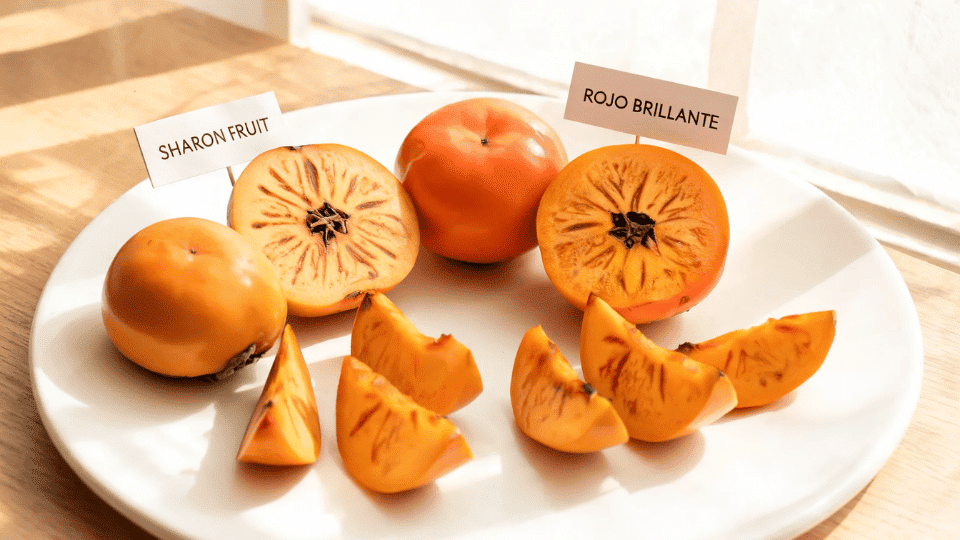
13. Sharon Fruit
Sharon fruit is a commercial persimmon often sold ready-to-eat while still firm. It is commonly associated with de-astringency treatment, which makes it easier for grocery-store shoppers.
Innovations have made astringent varieties, such as Sharon fruit, edible while still firm, thereby increasing their market presence.
- Best use case: Convenient snacking, packed lunches, and easy slicing.
- Taste profile: Mild, sweet, and approachable rather than highly complex.
- Comparison factor: Treat it as a commercial eating style rather than simply another Fuyu name.
14. Rojo Brillante Persimmon
Rojo Brillante is a major Spanish commercial cultivar. It is naturally astringent, but it is often sold after treatment, so shoppers can eat it firm.
This is why some imported persimmons behave differently from what their category might suggest. Rojo Brillante, among astringent varieties, is made edible while firm through modern handling.
- Best use case: Firm sliced fruit, grocery-store snacking, and fresh plates.
- Texture note: Dense and sliceable when sold after de-astringency treatment.
- Comparison factor: Naturally different from Fuyu, even when sold firm.
The Four Persimmon Subcategories Growers Use
Growers classify persimmons more precisely by combining astringency with whether seeds or pollination can change the fruit’s flesh.
| Subcategory | Full Name | Plain Meaning | Examples |
|---|---|---|---|
| PCNA | Pollination-constant non-astringent | Firm-eating, whether seeded or not | Fuyu, Jiro |
| PCA | Pollination-constant astringent | Must soften before eating | Hachiya, Saijo, Tanenashi |
| PVNA | Pollination-variant non-astringent | Seeds can reduce astringency | Chocolate, Hyakume, some Maru types |
| PVA | Pollination-variant astringent | Pollination changes flesh, but fruit may still be astringent | Some specialty cultivars |
Readers do not need these terms to buy a simple fruit snack. They matter when the variety changes with seed development.
In pollination-variant non-astringent cultivars, tannins may only disappear if enough seeds form. With fewer seeds, some flesh can remain astringent.
That is why specialty fruit can feel less predictable than Fuyu or Hachiya. The variety name matters, but pollination can matter too.
Fuyu vs Hachiya Persimmons
Fuyu and Hachiya are the two persimmon names readers are most likely to see in US stores, and their differences are practical.
| Feature | Fuyu | Hachiya |
|---|---|---|
| Main category | Non-astringent | Astringent |
| Shape | Short, flat, tomato-like | Tall, acorn-like |
| Eating stage | Firm, crisp, or soft | Fully soft only |
| Texture | Apple-like to tender | Jelly-like when ripe |
| Best uses | Fresh eating, salads, roasting | Baking, pulp, puddings |
Fuyu is the safer choice when you want fruit you can slice immediately. Hachiya is better when you want soft, sweet pulp for cooking or desserts.
Fuyus are firm and crisp for raw use, while Hachiyas are best fully ripe and soft for scooping or baking.
Choose Fuyu for crisp eating and Hachiya for soft, dessert-style recipes. That one choice prevents the most common persimmon mistake.
How to Choose the Right Persimmon Type
Choosing persimmons becomes easier when you match the variety to texture, ripeness stage, and the way you plan to use them.
- For fresh, crisp eating, choose Fuyu, Jiro, or treated Sharon fruit, as they slice neatly and do not need a spoon.
- For baking: Choose Hachiya, Tanenashi, or American persimmon because their ripe flesh blends smoothly into batter.
- For drying: Choose Saijo, Hachiya, or Tanenashi because their sweetness concentrates well as the moisture leaves.
- For salads: Choose Fuyu or Jiro because they keep their shape beside greens, cheese, nuts, and vinaigrettes.
- For rare flavors: Look for Chocolate, Cinnamon, Hyakume, or Maru when you want something beyond a standard grocery-store fruit.
- For native fruit interest: Choose American persimmon if you want a US-native option with old-fashioned flavor.
I usually decide by texture first, then flavor. That keeps the choice practical instead of turning every persimmon name into a memory test.
How to Ripen and Store Different Persimmons
Storage depends on the persimmon’s type. Some need time to soften fully, while others are best kept crisp for slicing and snacking.
Let Astringent Persimmons Soften
Keep Hachiya, Saijo, Tanenashi, and American persimmons at room temperature until they feel very soft. A colorful skin is not enough. The flesh should feel delicate, heavy, and almost jelly-like before eating.
Once ripe, use the pulp within a few days or refrigerate it briefly. For baking later, scoop the ripe flesh into a freezer-safe container and freeze it.
Keep Non-Astringent Persimmons Firm
Fuyu, Jiro, and similar firm-eating persimmons are more flexible. Leave them at room temperature if you want them sweeter and softer. Refrigerate mature fruit when you want to slow down the ripening and keep the texture crisp.
These types work best when sliced cleanly for salads, snacks, cheese boards, or packed lunches. The skin is usually edible, though peeling helps for a smoother texture.
Check for Spoilage
Softness alone does not mean a persimmon has gone bad. Hachiya and American persimmons are often best when they look almost overripe. Still, discard fruit with mold, leaking liquid, a sour smell, or collapsed flesh.
A ripe persimmon should smell sweet and feel soft. A spoiled one usually smells fermented, sharp, or alcoholic.
Common Mistakes When Identifying Persimmon Types
Persimmons are easy to misread because color, shape, variety names, and commercial treatment do not always tell the full story.
- Judging only by orange color: Color can show maturity, but it does not prove the fruit is ready to eat.
- Eating firm Hachiya too early: This is the mistake that creates the dry, puckering mouthfeel.
- Assuming every flat fruit is Fuyu: Jiro, Sharon fruit, and other commercial persimmons can look similar.
- Treating Sharon fruit as Fuyu: Sharon fruit is usually a commercial treated persimmon, not simply another name for Fuyu.
- Confusing Chocolate persimmon with black sapote: Chocolate persimmon is a persimmon cultivar name; black sapote is a different fruit.
- Ignoring de-astringency treatment: Some naturally astringent persimmons are sold firm because postharvest handling has changed how they are eaten.
Better identification helps readers avoid waste. It also makes the fruit more enjoyable because each variety gets used at its best stage.
Frequently Asked Questions
Are persimmons a fruit or a berry?
Persimmons are fruits, and botanically they are often treated as berries because they develop from a flower’s ovary and contain seeds. That classification is separate from how cooks use them. In the kitchen, they behave like sweet fall fruit for snacking, baking, drying, or preserving.
Can you eat persimmon skin?
Yes, persimmon skin is generally edible, especially on Fuyu-type fruit. Some people peel it because the texture can feel thick or slightly tannic. For a clean bite, rinse the fruit, remove the leafy top, and slice it with or without the peel.
What do persimmons taste like?
Persimmons can taste like honey, pear, apricot, date, brown sugar, pumpkin, or mild spice. The flavor depends on the variety and the stage of ripeness. Firm-eating types are usually cleaner and crisper, while soft-eating types often taste richer, sweeter, and more dessert-like.
When are persimmons in season in the United States?
Persimmons are primarily a fall and early-winter fruit in the United States. EatingWell notes that they are seasonally available from October to February. Timing can still shift by region, variety, weather, and whether the fruit is locally grown or imported.
Are persimmons good for savory dishes?
Yes, persimmons work well in savory dishes when balanced with salt, acid, fat, or herbs. Firm Fuyu-style fruit suits salads, grain bowls, salsas, roasted vegetables, and cheese boards. Softer persimmons can be blended into glazes, sauces, dressings, or chutney-style pairings.
Conclusion
Understanding the types of persimmons makes the fruit much easier to buy, ripen, and use well. Astringent varieties reward patience with soft, rich pulp, while non-astringent types give you crisp slices sooner.
Specialty cultivars add another layer through pollination, seed development, and unusual flavor notes. For me, the safest starting point is still the fuyu persimmon fruit, then softer Hachiya-style varieties once confidence grows.
I would keep this page handy during persimmon season and compare it with the fruit you find. Comment on the variety you picked up, especially if the label was unclear.