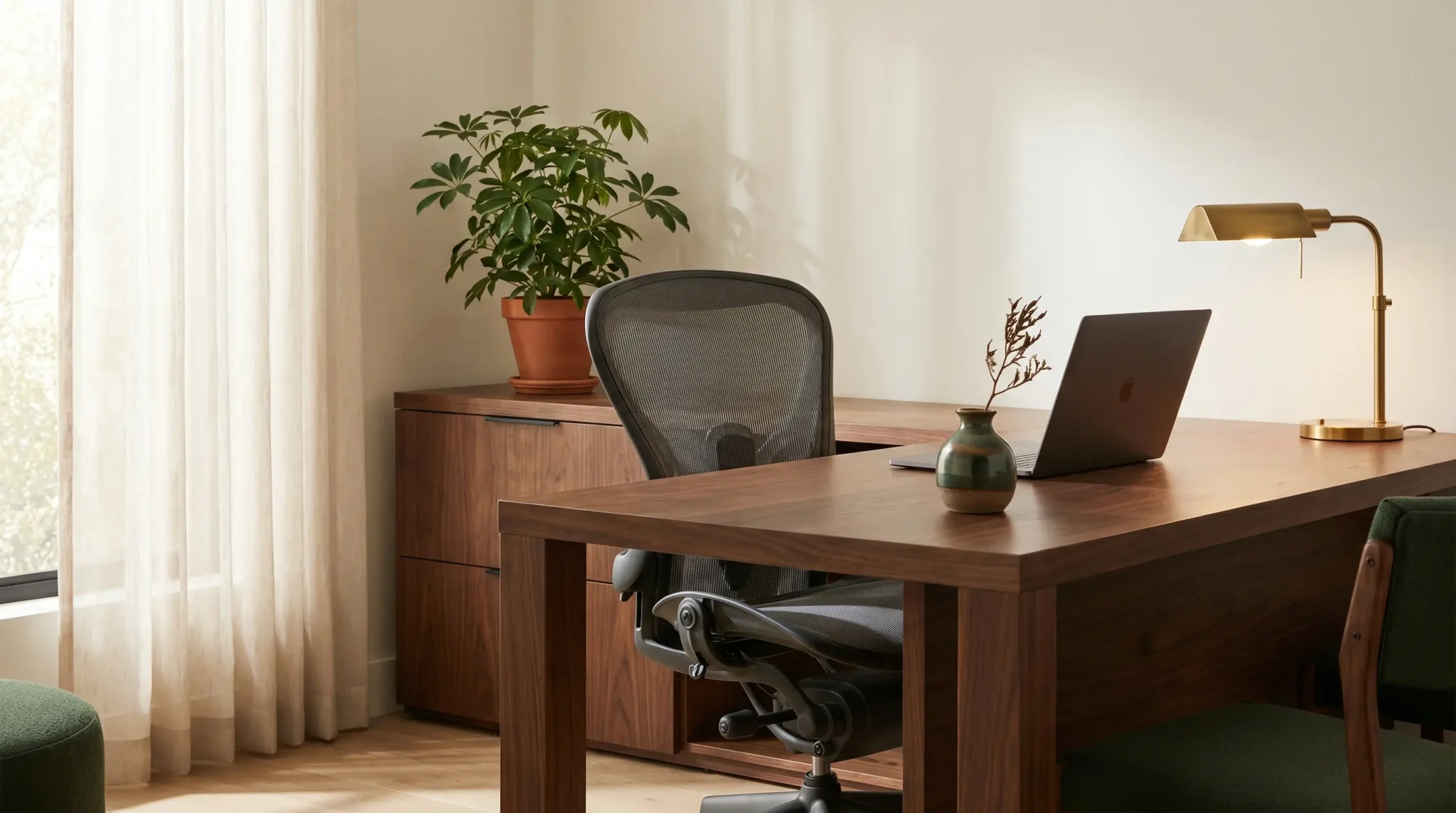
The work-from-home revolution isn’t temporary—it’s a fundamental shift in how we approach our careers and our living spaces. Yet I visit home after home where people are struggling with makeshift office setups that were supposed to be “temporary” three years ago. A laptop on the dining table. A spare bedroom with a folding chair. A corner of the living room that never quite feels right.
Creating a functional home office isn’t about recreating corporate America in your house. It’s about designing a space that supports your productivity, protects your physical health, and maintains the boundaries between work life and home life. And it starts with understanding that your furniture choices make or break this equation.
The Hidden Cost of Bad Office Furniture
Let’s talk about what happens when you try to save money on office furniture.
I have a friend—a software developer—who spent $8,000 on a high-end laptop and three monitors but balked at spending $800 on a quality office chair. After six months of back pain, he’s now seeing a chiropractor twice a week at $90 per visit. The math doesn’t work out in his favor.
Bad office furniture doesn’t just make you uncomfortable. It creates physical problems (back pain, neck strain, wrist issues), productivity losses (constant position shifting, difficulty concentrating, fatigue), professional image concerns (cheap furniture visible during video calls), and space inefficiencies.
With strategic furniture choices, your home office can be more functional than any corporate cubicle you’ve ever inhabited.
The Foundation: More Than Just a Desk
Your desk is where you’ll spend 40+ hours a week. This is not the place to economize.
Executive Desk Sets: The Complete Solution
For professionals who need a serious workspace, an executive desk and credenza set provides integrated functionality that no single piece can match.
Why Full Office Sets Make Sense:
Unified Design: When your desk, credenza, and hutch come from the same collection, they’re designed to work together. Cable management systems align. Heights match. Finishes are perfectly coordinated.
Workflow Optimization: Executive sets are designed around how people actually work—desk surface for active work, credenza for reference materials within arm’s reach, hutch for display and less-frequently accessed items, plus keyboard trays and wire management.
Psychological Impact: There’s something about a proper executive setup that signals “this is a professional workspace.” It affects how you feel about your work and how others perceive you during video calls.
Flexibility for Growth: Quality sets can be reconfigured as your needs change. Need more filing space? Add a filing cabinet from the same collection.
Desk Selection Criteria
Size Reality Check: A desk that’s too small forces you to pile papers and supplies, creating visual chaos. I recommend:
- Minimum 60″ wide for single monitor setups
- 72-80″ wide for multi-monitor professionals
- L-shaped configurations if you need distinct work zones
Surface Material: Solid wood (classic, durable, impressive), wood veneer over engineered core (stable, consistent), or laminate (budget-friendly, easy to clean).
Storage Integration: Your desk should include file drawers, shallow drawers for office supplies, grommets or cable management for wire routing, and locking drawers if needed.
The Chair: Your Most Important Investment
I’m going to say something controversial: spend more on your chair than your desk.
A $500 desk will serve you fine for years. But sitting in a $150 chair for eight hours a day? That’s a recipe for chronic pain and potential medical bills.
What to Look For
Adjustability: Your chair needs height adjustment, lumbar support adjustment (crucial for lower back health), armrest height and width adjustment, seat depth adjustment, and recline tension control.
Material Quality: Mesh backs for breathability, memory foam seats for comfort without heat buildup, and quality casters.
Build Quality: Check the chair’s weight rating. Higher ratings usually indicate better construction regardless of your actual weight.
Storage Solutions That Actually Work
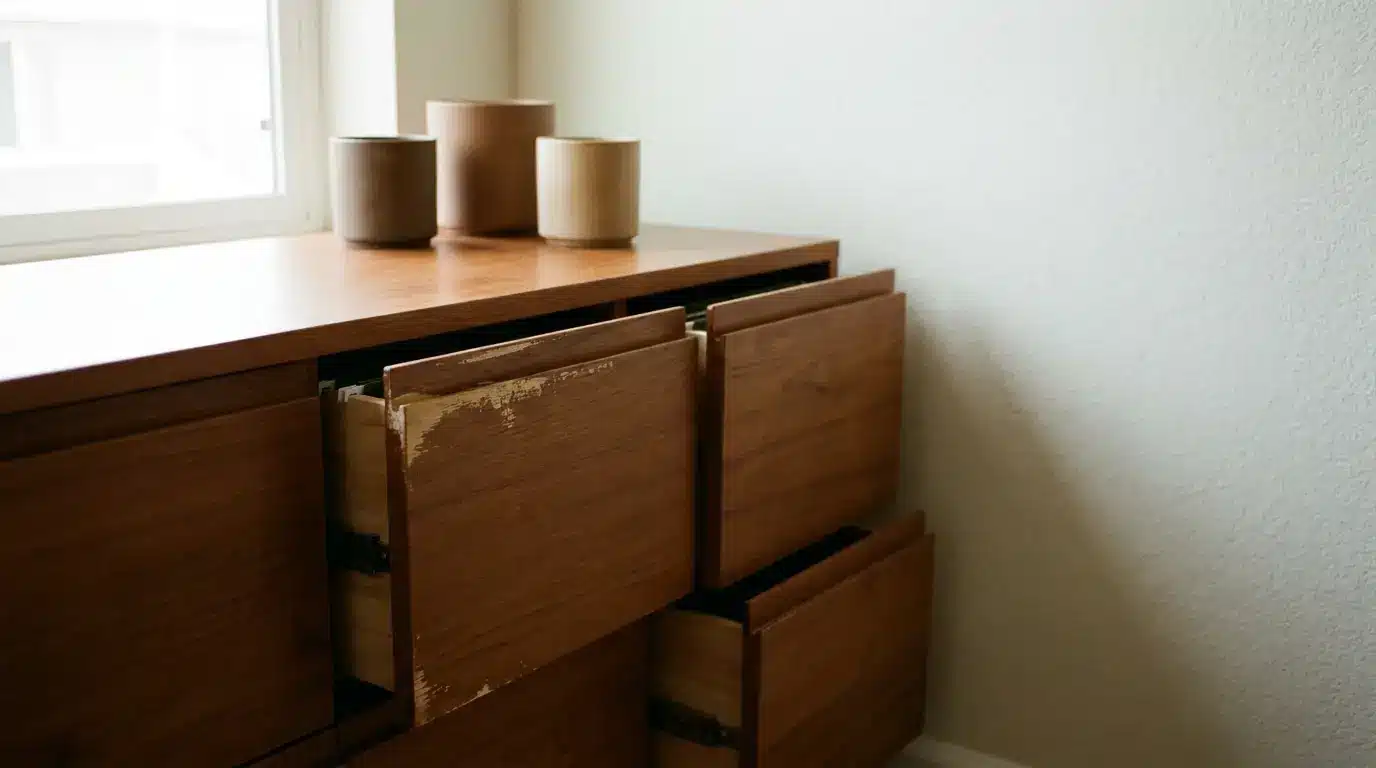
The biggest mistake people make with home office storage is treating it like a traditional office. You’re not just storing work files—you’re storing supplies, personal items, maybe household paperwork too.
Smart Storage Strategies
The Five-Zone Approach:
- Active Projects: Keep on desk surface (daily use)
- Current Reference: In desk drawers or credenza (weekly use)
- Periodic Reference: In filing cabinets or bookcases (monthly use)
- Archives: In labeled boxes or storage cabinets (annual use)
- Supplies: In dedicated supply storage
Most home offices fail because everything ends up in Zones 1 or 2, creating clutter and stress.
Filing Solutions
Even as we digitize, we need physical filing for tax documents (7 years), property records (keep for life), insurance policies, and personal documents.
Look for filing cabinets with full-extension drawers (access the back), quality rails (cheap cabinets jam constantly), and locking capability (protect sensitive documents).
The Ergonomics of Productivity
Proper ergonomic setup:
Monitor Height: Top of screen at or slightly below eye level Keyboard Position: Elbows at 90-100 degrees, wrists neutral Mouse Placement: Same height as keyboard, close enough that you’re not reaching Chair Height: Feet flat on floor, thighs parallel to ground, knees at 90 degrees Desk Height: Typically 28-30 inches
Your furniture needs to accommodate these requirements. Can your desk support a monitor riser? Does it have a keyboard tray? Is there room for an ergonomic mouse pad?
Creating Professional Boundaries in Your Home
One of the biggest challenges of working from home is the blurred line between work and personal life. Your furniture choices can help create psychological boundaries.
The Door Matters
If you have a dedicated room, make it feel like an office with heavier, more substantial desk that creates gravitas, professional finishes (wood tones or sophisticated colors), and guest seating for when colleagues or clients visit.
Shared Spaces
Working in a living room or bedroom? Your furniture needs to hide work when you’re off the clock (armoires or secretary desks that close), blend with home decor, and minimize visual clutter through closed storage.
Technology Integration
Cable Management
Nothing ruins the look of a nice office faster than a tangle of cables. Quality office furniture includes grommets in strategic locations, cable trays under desk surfaces, and vertical cable management panels or channels.
Power Requirements
Count your devices: computer, monitors, phone charger, desk lamp, printer, possibly more. You need accessible power strips mounted under desk, USB charging ports integrated into desk, and surge protection.
Budget Allocation Strategy
If you’re furnishing a home office from scratch, here’s how I recommend allocating a $3,000 budget:
- Chair: $800 (27%) – Your health is worth it
- Desk: $1,000 (33%) – Your primary work surface needs to be solid
- Storage: $600 (20%) – Filing cabinet, bookcase, or credenza
- Lighting: $300 (10%) – Desk lamp and supplemental lighting
- Accessories: $300 (10%) – Monitor arms, cable management, desk pad
If that’s beyond your budget, phase the investment:
- Phase 1: Chair and desk ($1,800)
- Phase 2: Primary storage ($600)
- Phase 3: Lighting and accessories ($600)
Never skimp on the chair. You can work from a cheaper desk temporarily, but a bad chair damages your body daily.
Maintenance and Longevity
Quality office furniture should last 15-20 years with proper care:
Wood Furniture: Dust weekly, use coasters and desk pads, condition quarterly, keep away from direct sunlight.
Upholstered Chairs: Vacuum monthly, spot clean spills immediately, professional cleaning annually, replace casters if worn.
Metal and Laminate: Wipe with damp cloth weekly, use appropriate cleaners, check and tighten hardware annually.
Making the Investment
You spend more time at your desk than in your bed. You’re investing in your earning capacity, your health, and your professional image. Quality office furniture isn’t an expense—it’s infrastructure for your career.
Unlike trendy home decor that you might tire of, classic office furniture styles remain appropriate and functional for decades. That executive desk you buy today will serve you through multiple career phases, possibly your entire working life.
Your Home Office, Your Way
The beauty of a home office is that it can be exactly what you need it to be. No corporate furniture standards. No dealing with facilities management. Just you, creating a space that supports your best work.
Take the time to plan it right. Invest in quality pieces that will last. Set it up ergonomically. And create a space where you actually want to spend your working hours.
Because when your home office truly works, work itself becomes easier, more productive, and far more comfortable. And that’s when you realize that working from home isn’t a compromise—it’s an upgrade.