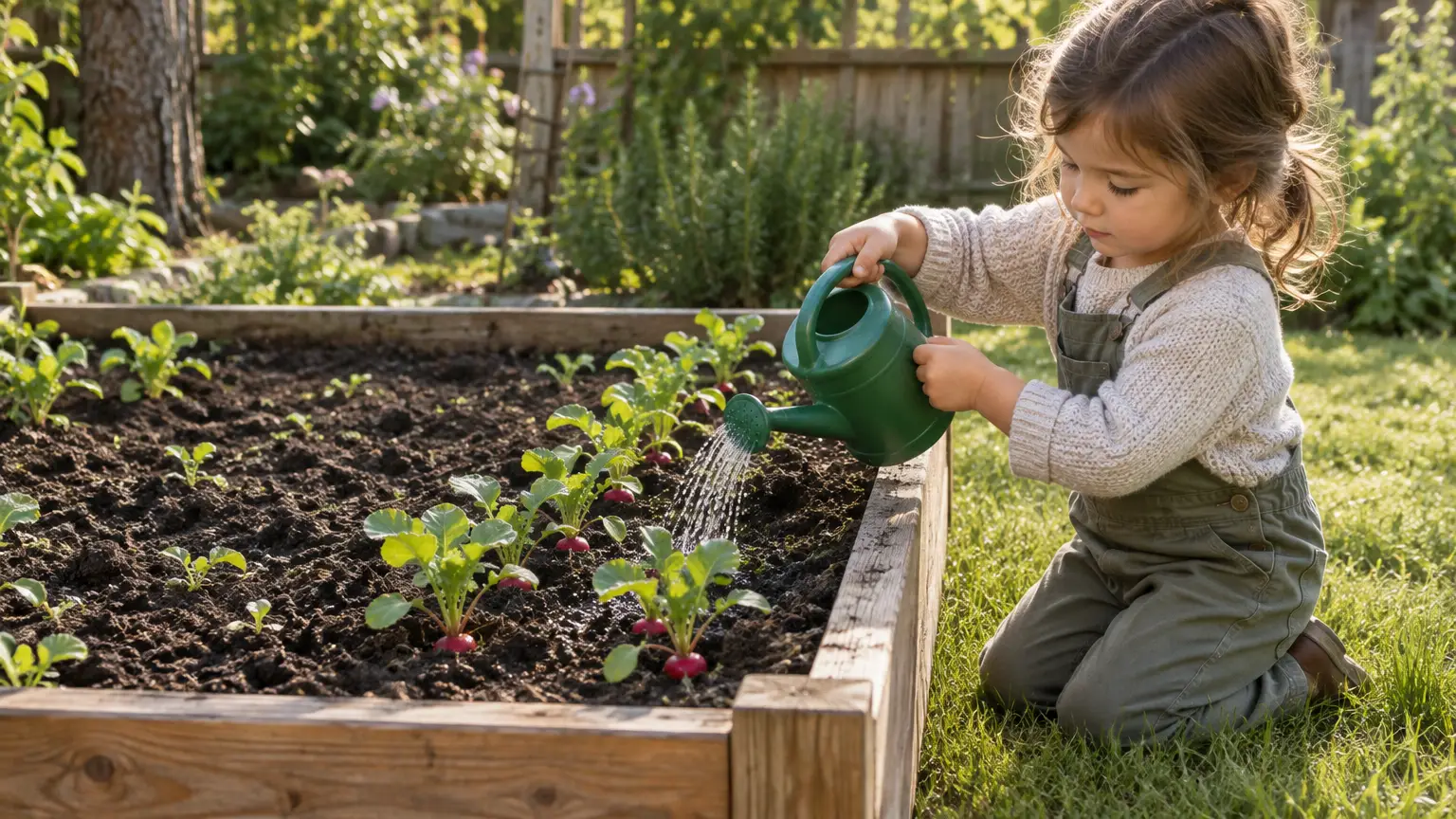
Ask a seven-year-old to sit still and concentrate, and you’ll probably get the opposite. Hand that same kid a watering can and a row of radish seedlings, though, and something shifts.
The task has a clear start and finish, the feedback is physical, and there’s a living thing that depends on getting it right. That’s a big reason so many parents and teachers have turned to the garden as a place where attention gets practiced instead of demanded.
Gardening with kids pays off twice. The first payoff happens in the dirt, where slow, hands-on jobs build the habit of noticing. The second shows up at the dinner table, where food a child grew is far more likely to get eaten. What follows covers both halves, from setting up a kid-sized garden and the daily chores that go with it to a long-haul fruit project and the harvest that finally lands on the plate.
Why the Garden Works as a Calming, Screen-Free Routine
Mindfulness, at its simplest, means paying close attention to what’s happening right now without rushing to judge it. For adults, that might look like a breathing exercise or a quiet walk.
Kids usually do better with something they can touch and move, which is why simple mindfulness exercises built for kids lean so heavily on physical objects, short time frames, and the five senses. A garden bed delivers all three without any setup, since there’s soil to feel, leaves to smell, and bugs to watch.
There’s also research suggesting green spaces do something specific for attention. In a 2004 national study published in the American Journal of Public Health, Frances Kuo and Andrea Faber Taylor asked parents to rate how their children’s attention held up after common after-school and weekend activities.
Their work on green outdoor settings and ADHD symptoms found that activities done in natural settings reduced symptoms more than the same activities done indoors or in built outdoor spaces. The study focused on kids with ADHD, but it’s a useful signal for any child who struggles to settle down after a long day of screens and classrooms.
The screen-free part matters too. A tablet is designed to grab attention in quick bursts, while a tomato plant asks for patience over weeks. Swapping even 20 minutes of evening scrolling for 20 minutes of garden chores gives kids a regular stretch where nothing is buzzing, pinging, or auto-playing. Over time, that daily window becomes a routine they expect, and routines are where calm habits take root.
Setting Up a Kid-Sized Garden
Kids focus better in a space that’s built for them, and that doesn’t take much lumber or money. A raised bed about 3 feet wide lets a child reach the middle from either side without stepping on the soil, and a height of 10 to 12 inches keeps the work at a comfortable kneeling level.
Untreated cedar boards, a few corner brackets, and a cordless drill are enough for a weekend build that older kids can help measure and assemble. If space is tight, a couple of 5-gallon buckets with holes drilled in the bottom work just as well for greens and herbs.
Fill the bed with a mix of garden soil and compost rather than straight native dirt, especially if your yard has the heavy clay common around the Gulf Coast. Loose, crumbly soil is easier for small hands to dig and much more forgiving when a seed gets planted a little too deep.
Let kids do the mixing with a hand trowel, since turning the soil over and picking out sticks and rocks is a calming job all by itself.
Small details make the space feel like theirs. Kid-sized gloves and tools keep them from fumbling with gear built for adults, and a watering can they can lift when full beats a hose every time.
Craft sticks make easy plant labels kids can write and decorate, and a cheap rain gauge gives them one more thing to check each day. When everything has a spot in a bucket or bin, cleanup becomes part of the routine instead of a fight at the end of it.
Garden Jobs That Build Focus
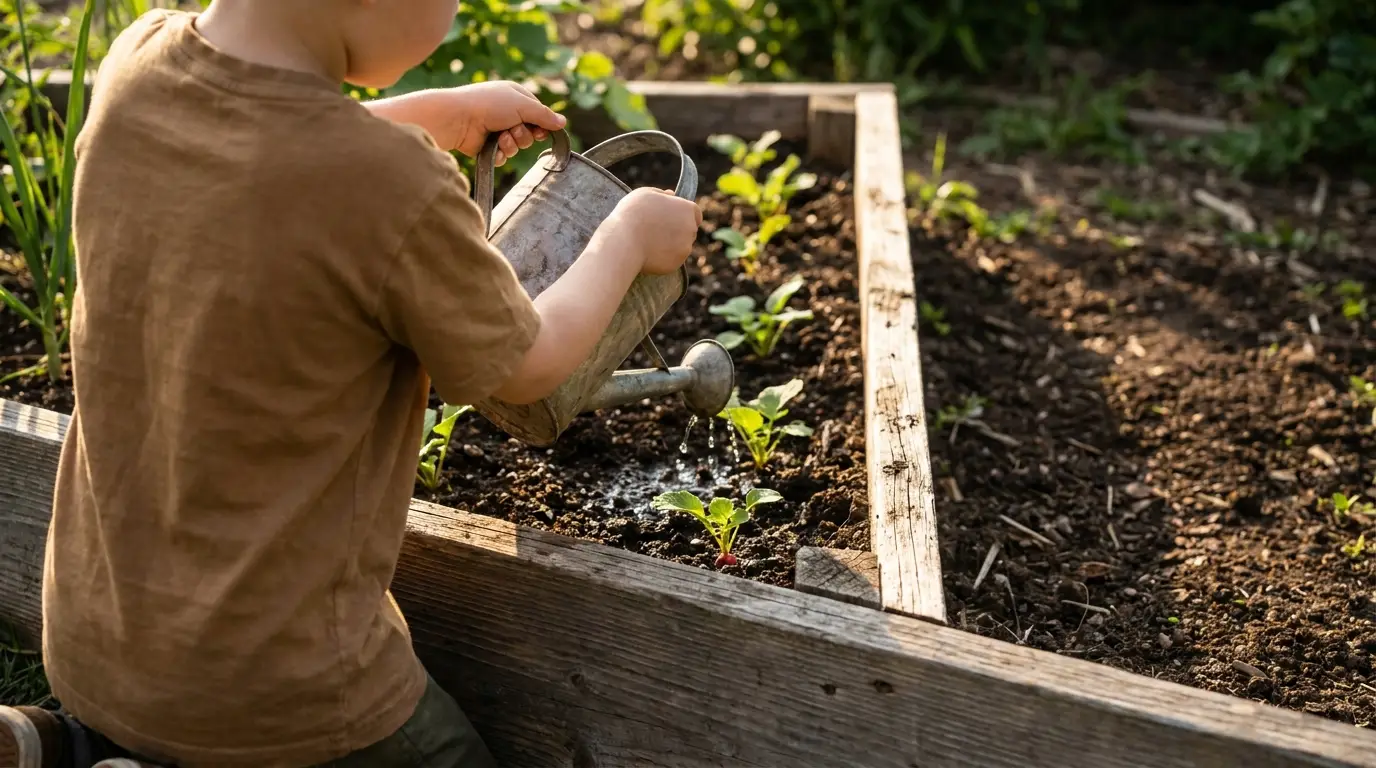
Not every garden task works equally well for young kids. The best ones are short, repeatable, and have a visible result, so a child can tell right away whether they did it well. Three jobs fit that description almost perfectly, and each one trains a slightly different kind of attention.
Watering
Watering teaches kids to slow down and read the plant instead of following a rule blindly. Show them how to push a finger an inch into the soil and decide whether it’s dry, then water at the base instead of spraying the leaves. A slow pour that soaks in, rather than a flood that runs off, takes steady hands and a little patience. Kids who learn this early also learn that more isn’t always better, which is a surprisingly useful lesson about overwatering anything.
Weeding
Weeding is close attention in its purest form. A child has to tell a carrot seedling from a blade of grass, which means looking at leaf shape, color, and how the plant rises from the soil.
Start them in a bed where the difference is obvious, then move to trickier rows as their eyes sharpen. Pulling weeds also gives restless hands something to do, and the growing pile is proof of progress they can see.
Watching Seeds Sprout
Seed-starting is where slowing down really pays off, because the reward arrives on nature’s schedule. Choosing fast-maturing fall crops like salad radishes keeps the wait manageable, since radishes sown in fall can be ready in roughly 25 to 40 days.
Give each child a small notebook to sketch the bed every few days and jot down what changed. That simple habit of checking, observing, and recording is the same skill kids need to follow a math problem or a story from start to finish.
A Long-Haul Project: Growing Avocados From Pit to Tree
Quick crops build momentum, but a project that stretches over seasons teaches a different kind of patience. Avocados work well for Gulf Coast families because the project starts in the kitchen, moves to the windowsill, and can end with a real tree in the yard. Each stage gives kids something new to watch, measure, and take care of.
Sprouting a Pit on the Windowsill
The windowsill part costs nothing but a pit, a jar, and a few toothpicks. Kids rinse the pit, push three or four toothpicks around its middle, and rest it on a glass with the broad end submerged.
The classic toothpick and water method can take anywhere from two to eight weeks to crack the seed and send out a root, so it’s a lesson in waiting that comes with a payoff. Have kids change the water every few days and measure the root with a ruler each week, and a kitchen chore turns into a running science log.
Here’s the honest part parents should share up front. A tree grown from a grocery store pit won’t produce the same fruit as its parent, and Texas A&M AgriLife avocado production notes warn that an ungrafted seedling can take 10 to 15 years to bear, if it ever does.
That’s fine, since the sprouted pit makes a handsome houseplant and a great first chapter. When kids are ready for a tree that’ll actually fruit, it’s time to head outside.
Picking a Cold-Hardy Tree for the Backyard
Cold is the biggest obstacle to growing avocados in Texas. AgriLife’s material notes that West Indian types tolerate almost no freezing temperatures, while Mexican types are the most cold-hardy, with some varieties handling 19 to 20 degrees Fahrenheit once mature.
The Harris County Master Gardener Association’s fruit tree sale has offered Mexican-type selections like Joey, Fantastic, Brazos Belle, and Pancho, with Joey listed as hardy to 15 degrees. Grafted trees like these are what make the project realistic, since AgriLife expects consistent production two to three years after they’re established.
Site prep is where kids can do real work. Avocados hate wet feet, so pick a well-drained spot on the south or southeast side of the house, where the structure blocks north wind and radiates warmth at night.
Kids can help dig, mound the soil, and spread mulch once the tree goes in after the last spring frost. When a freeze shows up in the forecast, draping the young tree with a blanket anchored to the ground becomes a family job that teaches them to watch the weather and act ahead of time.
Bringing the Harvest to the Table
Growing food changes how kids feel about eating it. The Texas Sprouts trial, a school-year program involving 16 low-income elementary schools near Austin and published in JAMA Network Open, paired garden lessons with cooking and taste tests.
Kids in the program ate more vegetables and fiber than kids in comparison schools, and researchers also saw improvements in blood sugar control and LDL cholesterol. The same thing tends to happen at home when the radishes, lettuce, and herbs on the plate came from a bed a child built and tended.
Let kids handle as much of the prep as their age allows. Younger ones can rinse greens and tear lettuce, while older kids can slice radishes, snip herbs, and build their own salad from the day’s harvest.
Once that avocado tree starts producing, the fruit gets its own lesson in patience, since avocados don’t ripen on the tree and have to be picked and held for several days until they soften. Mashing one with lime and salt, or slicing it over a garden salad, is a satisfying way to close out a project that started as a pit in a jar.
That homegrown avocado earns its spot on the plate for more than sentimental reasons. Folate, lutein, and fiber are among the nutrients in avocados tied to focus and learning, and the fruit’s healthy fats help keep energy steady through an afternoon of homework. It’s a fitting endpoint for a garden that started as a way to help kids slow down and pay attention.
Making It a Weekly Rhythm
The calm that gardening builds comes from repetition more than from any single afternoon. Set a standing time, like right after school or before dinner, and keep the jobs small enough to finish in 15 or 20 minutes.
Rotate tasks so each child gets a turn at watering, weeding, and logging what’s changed. Pair quick crops with longer projects, so there’s always something ready to harvest while the slow ones take their time.
Fall is a great time to start along the Gulf Coast, since cooler days make outdoor chores more pleasant and leafy greens and radishes thrive. A raised bed can go together over a weekend, a pit can go into a jar on the windowsill this week, and a grafted tree can follow in spring once kids are hooked.
By the time the first harvest reaches the table, the garden will have given them months of practice at slowing down, paying attention, and seeing a project through.