For many, the garden is a place of quiet productivity—a source of herbs, a patch of color, a weekend project. Rarely is it considered a fitness venue.
Yet, step outside with a task in mind, and you engage in a form of physical labor that has sustained human strength and mobility for millennia.
The repetitive motions of bending, lifting, twisting, and carrying that define gardening translate, quite directly, into a comprehensive workout. This is not about adding exercise to your life, but rather recognizing the exercise already woven into the care of your outdoor space.
In a climate like South Florida’s, where growing seasons blur and outdoor activity is possible year-round, the garden offers a consistent, accessible, and productive alternative to gym walls. It provides functional fitness—the kind that strengthens muscles in the sequences you actually use them, building a body capable of real-world tasks.
The Movement Analysis: A Functional Fitness Map
View your garden chores through the lens of exercise physiology, and a clear regimen appears. Each task engages specific muscle groups and energy systems, often in combination.
Take digging, the foundational act of turning soil. It is a compound movement. You drive the spade down with one leg and shoulder, then lift and twist to turn the load.
This sequentially engages the quadriceps, glutes, core, latissimus dorsi, and deltoids. It is a form of resistance training with an unstable load, demanding core stabilization with every motion.
Weeding, often done in a sustained squat or a hinged position, is less about brute strength and more about endurance and flexibility. Holding a low squat activates the glutes and thighs while challenging balance. The repetitive pulling motion works the forearms, biceps, and shoulders.
Perhaps most significantly, maintaining a proper posture while weeding—spine long, hinging from the hips—is a continuous isometric exercise for the entire core and posterior chain, fighting the urge to slump.
Mowing, particularly with a push mower, is steady-state cardio. On a typical lawn, you can easily log thirty minutes to an hour of moderate-intensity cardiovascular exercise, raising your heart rate and building stamina. The pushing motion adds an element of upper-body engagement, especially if navigating slight inclines.
Finally, tasks like hauling mulch, moving pots, or carrying watering cans are pure resistance work. They are farmer’s walks and loaded carries, fundamental exercises for building grip strength, shoulder stability, and core bracing under load.
Table: Garden Tasks as Functional Exercise Modalities
|
Garden Task |
Primary Muscle Groups Engaged |
Fitness Modality |
Form Tip |
|---|---|---|---|
|
Digging / Turning Soil |
Quadriceps, Glutes, Core, Lats, Shoulders, Forearms |
Strength & Power, Rotational Core Work |
Keep the spine neutral; use leg drive to lift, not just the back. |
|
Weeding / Planting |
Core (isometric), Glutes, Hamstrings, Forearms, Deltoids |
Muscular Endurance, Flexibility, Grip Strength |
Alternate between squatting and kneeling on a pad to vary strain. |
|
Mowing (Push Mower) |
Heart & Lungs, Quadriceps, Shoulders, Core |
Cardiovascular Endurance, Steady-State Cardio |
Maintain an upright posture; engage core as you push. |
|
Hauling Mulch / Moving Pots |
Traps, Forearms, Grip, Core, Glutes, Quadriceps |
Loaded Carry, Grip & Core Stabilization |
Hold loads close to the body; brace core before lifting. |
Prioritizing Preservation: Gardening Without Injury
The physical benefit of gardening is contingent on sustainability. An injury negates the progress. Therefore, the gardening session, like any workout, requires preparation and smart practices.
Begin with a brief warm-up. Five minutes of walking briskly around the yard, followed by dynamic stretches like torso twists, arm circles, and gentle lunges, increases blood flow to the muscles you’re about to use. It prepares the body for work.
The principle of proper lifting is non-negotiable. Bend at the knees and hips, not the waist. Keep the load—a bag of soil, a large pot—close to your center of gravity.
Use your leg muscles to power the lift, not your spine. For pushing and pulling tasks like mowing or raking, maintain a staggered stance and engage your core to generate force from your center, not just your arms.
Perhaps the most useful strategy is task rotation. Just as in a gym you wouldn’t perform fifty consecutive bicep curls, you should avoid spending two hours solely weeding in a forward-flexed position. Structure your garden time into intervals: twenty minutes of weeding, followed by ten minutes of walking to compost, then fifteen minutes of light pruning.
This alternates muscle groups, gives overworked muscles a brief rest, and prevents repetitive strain injuries in the shoulders, wrists, and lower back. Listen to your body; stiffness is expected, but sharp pain is a signal to stop.
The Complementary Discipline: Balancing the Physical Demand
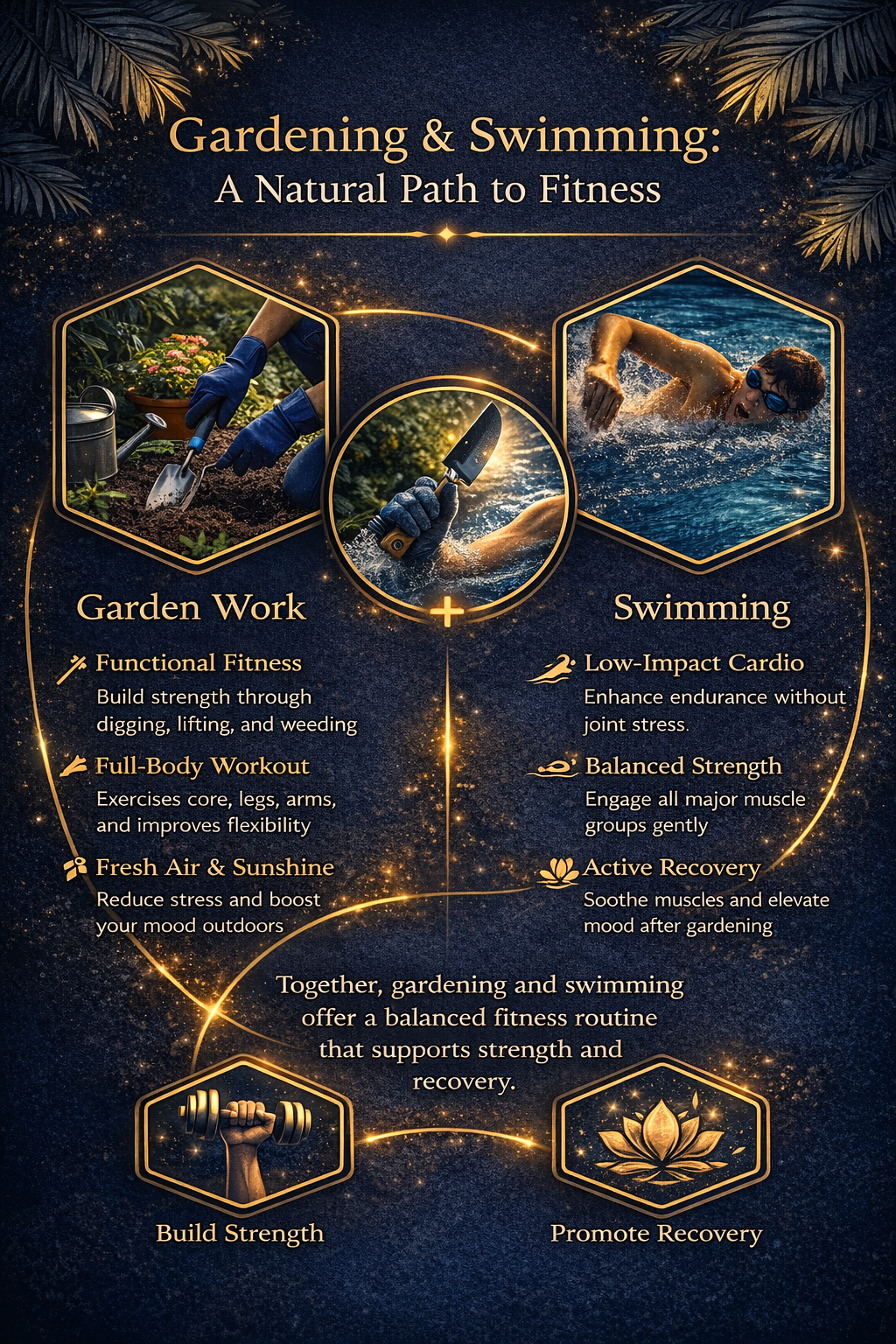
Gardening is demanding, often in asymmetrical and load-bearing ways. To build a resilient physique and enhance your gardening capacity, a complementary fitness discipline is valuable. The ideal counterpart would be low-impact, full-body, and focused on creating balanced strength and mobility without adding further strain to the joints.
Swimming meets these criteria precisely. It is an activity of zero impact, where the water’s support eliminates gravitational stress on the spine, hips, and knees—the very joints that gardening can challenge.
The resistance of water provides strength training for every major muscle group, with a particular emphasis on the back, shoulders, and core. This is crucial for gardeners, as a strong core is the foundational stabilizer for every lift, twist, and bend.
Moreover, the rhythmic, controlled breathing central to swimming promotes lung capacity and a mindful focus that can lower stress levels, mirroring the mental benefits many find in gardening. It is active recovery that builds the underlying strength to make your next gardening session more efficient and less taxing.
For those in Miami, where outdoor pools are accessible much of the year, integrating swimming into a weekly routine is a logical step.
The key to gaining these specific fitness benefits lies in consistent, purposeful practice. For adults or families looking to move beyond casual pool time to a structured, technique-focused approach, professional guidance can be instrumental. Schools like SwimRight Academy offer lessons that focus on efficient stroke mechanics, breathing control, and building endurance.
This kind of instruction transforms swimming from a simple splash into a true fitness regimen, one that directly supports the strength and stamina needed for both the garden and daily life.
It represents an investment in a sustainable, holistic approach to physical well-being, where the work in your garden is supported by the strength you build in the water.
The path to fitness does not always require a special membership or equipment. It can be found in the purposeful care of your own environment.
By approaching garden tasks with intention, respecting your body’s mechanics, and balancing their demands with a supportive practice like swimming, you cultivate more than plants—you cultivate enduring strength and vitality.