Brown Muhly Grass? Don’t Panic It Might Just Be Taking a Very Dramatic Nap
If you’ve got a clump of muhly grass in the yard that’s gone full crispy tan to brown and you’re already pricing out replacements… hold up. Muhly is one of those plants that loves to look dead for sport.
In my experience, most “my muhly is dying!” moments come down to a short list of fixable issues: too much water (bad drainage), too little water (drought stress), or a gross little secret hiding inside the clump (thatch buildup). And yes, sometimes it’s actually dead. But let’s not bury it before we check its pulse.
First: Is It Dead… or Just Being Muhly?
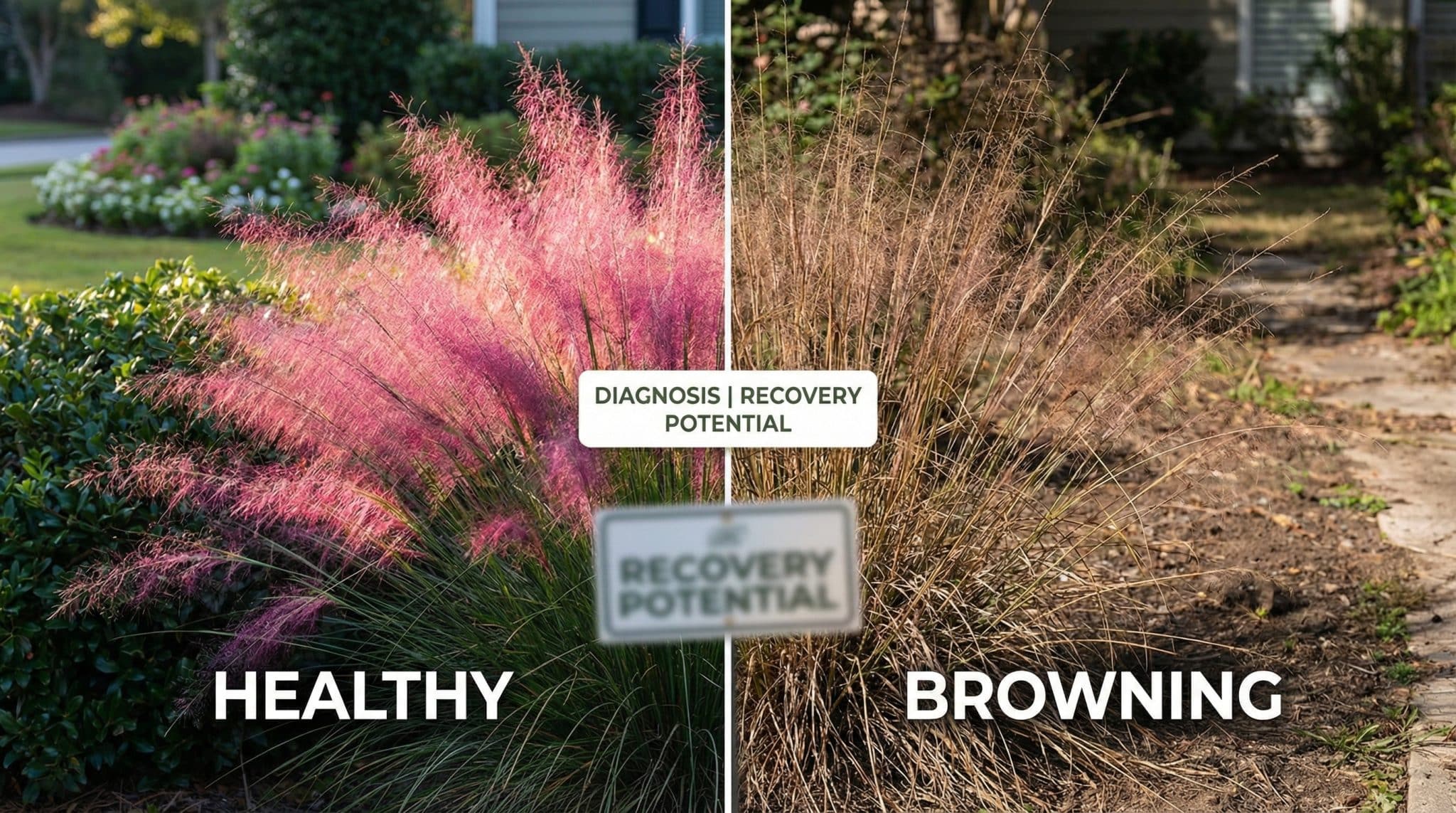
Muhly has a schedule. It puts on its pink plume show in fall, then fades to tan/brown and sits there all winter like, “I said what I said.”
Winter browning is normal dormancy. The top looks lifeless. The roots are basically hibernating until spring warmth sticks around.
Here’s the quickest way to tell if you’re dealing with normal dormancy or a real problem:
The “thumbnail test” (very scientific, much fancy)
Find the crown that tight base where all the blades come out of the ground. Press your thumbnail into it.
- Firm + cream/tan tissue: Alive. Just resting (or mildly annoyed).
- Mushy + dark + smells sour/rotten: That’s not dormancy. That’s trouble.
And one more sanity check:
Brown in January? Normal.
Brown in July? Not normal. (Unless you live on the surface of the sun.)
Also, muhly can be slow to wake up. I don’t declare it dead until about six weeks after everything else in my yard has started greening up. Some plants are early birds. Muhly is more of a “leave me alone, I’m sleeping in” type.
Okay, It’s Brown in the Growing Season Now What?
When muhly looks rough during spring/summer, I run through this quick mental checklist (while squinting at it like I’m on a gardening detective show):
1) Is the soil soggy or dry?
Dig down a few inches near the clump.
- Soggy = drainage/overwatering risk
- Powder dry = drought stress
2) Is the browning even, or spotty?
- Even browning / crispy tips: usually water stress (too little or too much)
- Spotty leaf blades with defined edges: more likely fungus
- Whole clump collapsing / soft at the base: root rot danger
3) What’s happening at the center of the clump?
If the outside looks “fine-ish” but the middle is turning into a dark, damp mess… that’s often thatch buildup (aka dead stuff packed inside like a wet sponge).
Now let’s fix the most common culprits.
Fix #1: Bad Drainage (A.K.A. “Stop Drowning Your Muhly”)
Muhly grass is tougher than it looks, but as any muhly grass care guide will tell you it does not want to sit in wet feet. If your plant looks floppy/collapsed or the base feels soft, I’d suspect drainage first.
The 30 minute drainage test
Dig a small hole (a few inches deep) nearby, fill it with water, and wait.
- If water is still sitting there after 30 minutes, your soil is holding water too long.
What to do:
- If it’s a mild case: stop watering and let it dry out.
- If your yard is heavy clay (hello, my old nemesis): you’ll get better results moving the plant to a raised mound or a slight slope than trying to “fix” the entire earth.
- If you amend: mix in coarse sand/grit (not fluffy potting mix) to improve drainage.
Also: mulch can quietly wreck your life
Mulch is great until it’s piled up against the crown like a damp blanket.
Keep mulch 1-2 inches max, and leave a 4-6 inch gap around the base so the crown can breathe. (Your muhly doesn’t want a mulch turtleneck.)
Fix #2: Drought Stress (Yes, Even “Drought Tolerant” Plants Get Cranky)
Established muhly is usually pretty chill about dry weather. But first year plants and anything dealing with a brutal heat wave might start browning at the tips and working inward.
A good clue: the soil is so dry you can’t even push a finger into it without feeling personally insulted.
How I water drought stressed muhly:
Instead of one heroic flood that runs off into the driveway, do short sessions spread out:
- Four 15 minute waterings across the day
- Aim to wet the soil 6-8 inches deep around the base
You’re not trying to make a swamp. You’re trying to get water down to the roots without it sprinting away.
If it’s the right problem, you should see the plant looking a little less offended within 7-10 days (but brown blades won’t turn green again you’re watching for new growth from the base).
Fix #3: Thatch Buildup (The “Gross Center” Problem)
This one is wildly common and almost nobody talks about it until their muhly starts looking thin and sad after a couple years.
Inside the clump, old dead blades build up. In nature, fire would clear it out. In your yard, it just sits there, holds moisture, and can rot the crown from the inside. Cute!
Check: Gently pull the clump open and peek into the center.
- If it’s packed with dead material and feels damp, or the center looks brown/black and soft… you’ve probably found your issue.
Fix:
After you cut it back in spring, take a stiff rake/garden comb (or even gloved hands) and pull out the dead junk from the center. It’s weirdly satisfying, like cleaning a dryer lint trap disgusting, but powerful.
This takes 5-10 minutes per mature clump and can seriously extend the plant’s lifespan.
A Quick Word on Fungus + Bugs (Because Sometimes It’s Not You, It’s Them)
Fungus clues
If you’re seeing spots (not uniform browning), you may have a fungal issue often worsened by humidity + crowded plants.
What helps most:
- Remove the worst affected blades (use clean pruners. I wipe mine with rubbing alcohol between cuts if I’m dealing with obvious disease)
- Improve airflow: don’t crowd it, and don’t let neighboring plants smother it
If it’s actively spreading and taking over a big chunk of the plant, a copper fungicide can help follow the label (because I’m not coming over to explain fungicide math in your yard).
Pest clue
If you see little white cottony clumps, that can be mealybugs. Treat with horticultural oil and this part matters fix whatever stress made the plant vulnerable in the first place.
Sun, Heat, and Fertilizer: The Bonus Chaos Trio
- Sun: Muhly really wants 6+ hours of direct sun (8 is even better). In too much shade it gets pale, weak, and stingy with the pink plumes.
- Heat stress: If it’s been 95°F+ for ages, tips can scorch even if you’re watering. Those tips won’t “un-brown,” but you should see new green once temps chill out.
- Fertilizer: Over-fertilizing is way more common than under-fertilizing. Too much can cause brown tips that mimic drought. If you suspect fertilizer burn, stop feeding and water deeply a few times a week for a couple weeks to help flush salts.
The Only Pruning Advice You Really Need (Please Don’t Hack It in Fall)
This is where people accidentally sabotage their muhly while trying to be helpful (relatable).
Don’t cut it back in fall. Let it stand through winter it helps protect the crown.
The best planting time is late February through March, before new growth really takes off.
- Cut it back to 4-6 inches tall
- Don’t cut lower unless you enjoy regretting things
Keep It or Replace It? Here’s the Line in the Sand
Keep it (and try rehab) if:
- The crown is firm and you see light/greenish tissue when you scrape
- You’re seeing any new shoots at the base
- The problem started recently and you can correct water/drainage/thatch
Replace it if:
- The crown is soft/mushy and smells rotten
- Most of the clump is toast and there’s no improvement after about a month of fixing the likely cause
- Nothing greens up six weeks after your yard normally wakes up
And if the spot is chronically wet (like “my boots squish when I walk here” wet), it might be smarter to choose a more wet tolerant option or change the planting area than to keep sacrificing muhly to the drainage gods.
My Simple “Don’t Let This Happen Again” Muhly Routine
- Spring (late Feb-March): Cut back to 4-6 inches, then pull out thatch from the center. Check mulch isn’t piled against the crown.
- Summer: Mostly ignore it (the dream). Water deeply only during extended drought/heat waves.
- Fall: Hands off. Enjoy the plumes. Let it be fabulous.
- Winter: Patience. No watering, no fertilizing. If you’re in a colder zone, a light mulch over the root area can help just pull it back from the crown and don’t smother it.
If your muhly is brown right now, odds are good it’s not a goner it’s either dormant or stressed in a very fixable way. Do the crown check, feel the soil, and peek into the center of the clump. A little detective work now usually beats tearing it out and starting over (and then watching the replacement throw the exact same tantrum in the exact same spot).