First time moving? Well, have you ever gone through a heartbreak?
If so, you already know what it feels like, at least partly, because 38% of people say moving is more stressful than a breakup.
You’re dealing with decisions you’ve never had to make, items you forgot you owned, and a timeline that seems to shrink each day.
Most first-time movers feel pulled in several directions at once. Packing, planning, and coordinating can become overwhelming, especially when you’re unsure where to begin. Then, something that should be a practical task becomes heavy.
But it’s not all that bad. What you need is a clear plan with simple steps. And when you reach the moment where you finally search for movers NYC, LA, Chicago, or any other city, you’ll do it calmly instead of panicking.
We’re here to help you.
Step 1 — Build a Short, Realistic Plan
A nice, well-thought-out plan is the first step that removes half the pressure. Don’t worry, we’re not talking about a long, endless checklist that fills an entire notebook, but a simple structure that helps you see what comes next.
Start by choosing your move-out and move-in dates. Treat them as fixed points, then map out the week-by-week tasks leading up to them.
Keep the early steps light: confirm building rules, reserve elevators if needed, and note any restrictions on move-in hours.
Next, set a budget that includes a buffer. One report shows that 78% of Americans ran into unexpected moving costs, and many realized too late that their total spend was higher than planned.
Make sure to add room for supplies, service fees, and last-minute items so your budget doesn’t collapse under surprises.
Step 2 — Sort Your Belongings With Purpose
It’s time to cut the weight of your move and your costs at the same time.
Go room by room and make quick decisions: keep, donate, sell, or toss. The longer you hold on to “maybe,” the more boxes you’ll drag into your new place for no reason.
Instead, focus on the items you truly use. Clothes you haven’t worn in a year, kitchen tools that never leave the drawer, and old electronics add bulk and raise your moving bill.
Selling a few larger pieces can also help you save on your move, and donating what’s still in good shape clears space fast.
What you want is progress, not perfection. Every box you skip packing now is one less box you’ll unpack later.
Step 3 — Pack Smart and Keep Essentials Separate
One sure way to make packing easier is to come up with a clear method and not jump from room to room.
Start with items you won’t need for a while, then move toward daily-use belongings as your date approaches. Use sturdy boxes, try not to overload them, and label each one on at least two sides so you can spot what you need without opening everything.
One box should stay with you rather than in the truck. Think about the first night in your new place — you don’t want it to turn into a search through stacks of cardboard.
While everyone’s essentials can be different, here’s a general guide on what to choose:
- basic toiletries
- important documents
- a few tools
- chargers and small electronics
- a change of clothes
Step 4 — Prepare Your New Place Before Arrival
Your move-in day runs smoother when your new place is set up for it.
Confirm that utilities are active, check access points, and make sure you know where the building expects you to load in.
A quick call to clarify elevator use, parking rules, or entry instructions can save an hour of waiting on the day you arrive.
This is also the right time to take simple measurements. Doorways, hallways, and main rooms decide where larger items can go.
Doing this early helps you arrange your layout without moving furniture repeatedly. If everything is ready and you feel ready to relocate, the rest of the move becomes far more predictable.
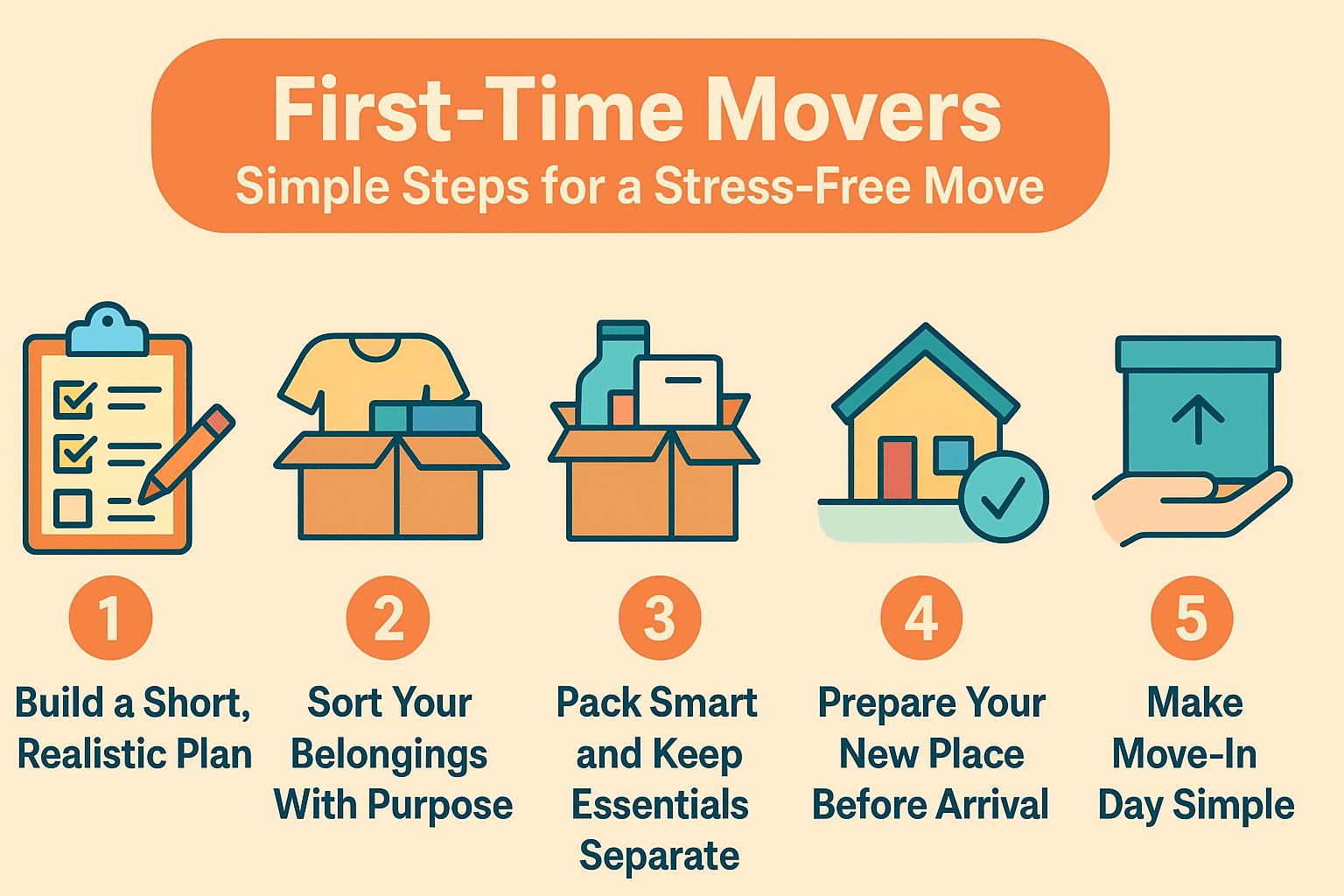
Step 5 — Make Move-In Day Simple
Move-in day shouldn’t feel chaotic (as much as that’s possible).
Keep pathways clear so boxes can go straight to the right rooms. Give movers short, direct instructions instead of long explanations.
That labeling and planning from earlier stages? This is when they’ll pay off.
Before anyone leaves, do a quick walk-through. Look for damage, confirm that all items arrived, and make sure no boxes ended up in storage areas by mistake.
A final pass-through helps you avoid small problems that usually show up days later when you’re already settling in.
Ready?
As much as it seems stressful, the first move doesn’t have to drain you. Just treat it as a series of clear choices rather than one giant task, and the pressure starts to fade.
You know what needs attention, what can wait, and what actually helps you settle in.
When you walk into your new place, you won’t feel buried under boxes or plans you never finished. You’ll feel ready to start shaping your space, one step at a time.
And if you ever move again, you’ll already have a practical system that makes the process far less chaotic than the stories you usually hear.