Planning a new patio, garage floor, or shed foundation? You need to know how much concrete to pour before you start. Concrete slab costs range from $4 to $12 per square foot.
The price depends on size, thickness, and location. Small projects, such as a 10×10 shed pad, might cost $600 to $1,200. Larger projects like a 30×30 garage floor can run $5,400 to $10,800.
This guide breaks down every cost factor. You will learn about material prices, labor rates, and ways to save money.
By the end, you will have clear numbers to plan your budget and choose the right contractor.
Average Cost to Pour a Concrete Slab
The national average cost to pour a concrete slab is $6 to $8 per square foot. This includes materials and basic labor. Most homeowners pay around $5,400 for a standard 30×30-foot project.
National Average Cost Breakdown:
| Cost Factor | Price Range |
|---|---|
| Cost per square foot | $4 – $12 |
| Cost per cubic yard | $110 – $180 |
| Average project cost | $5,400 |
| Small projects (100 sq ft) | $600 – $1,200 |
| Large projects (900 sq ft) | $5,400 – $10,800 |
| Labor cost per square foot | $2 – $3 |
Quick Calculator: Multiply your square footage by $6 to $8 for a basic estimate. For example, a 20×20 slab (400 square feet) costs $2,400 to $3,200. Always add 10% extra for waste and unexpected needs.
Concrete Slab Cost Breakdown by Slab Size
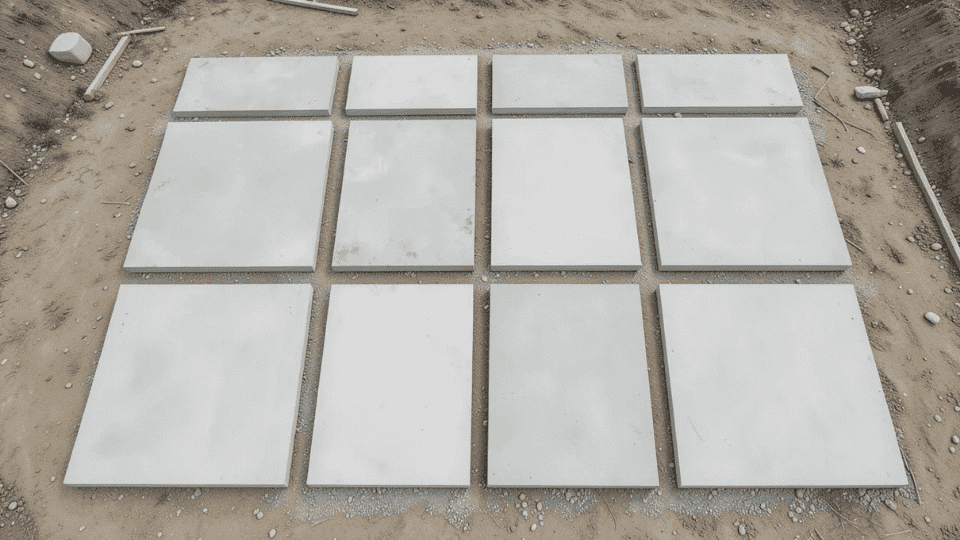
Knowing the cost by size helps you budget better. Here are prices for common concrete slab dimensions.
Small Slabs:
- 10×10 (100 sq ft): Costs $600 to $1,200 total, perfect for small sheds or storage areas.
- 12×12 (144 sq ft): Costs $864 to $1,728 total, ideal for garden sheds or small workshops.
Medium Slabs:
- 20×20 (400 sq ft): Costs $2,400 to $4,800 total, great for single-car garages or medium patios.
- 20×30 (600 sq ft): Costs $3,600 to $7,200 total, works well for standard two-car garages.
- 20×40 (800 sq ft): Costs $4,800 to $9,600 total, suitable for larger garages or extended patios.
Large Slabs:
- 30×30 (900 sq ft): Costs $5,400 to $10,800 total, common for spacious garages or large outdoor areas.
- 40×60 (2,400 sq ft): Costs $14,400 to $28,800 total, used for commercial spaces or large residential projects.
- 40×80 (3,200 sq ft): Costs $19,200 to $38,400 total, typically for commercial buildings or home foundations.
What Affects Concrete Slab Cost?
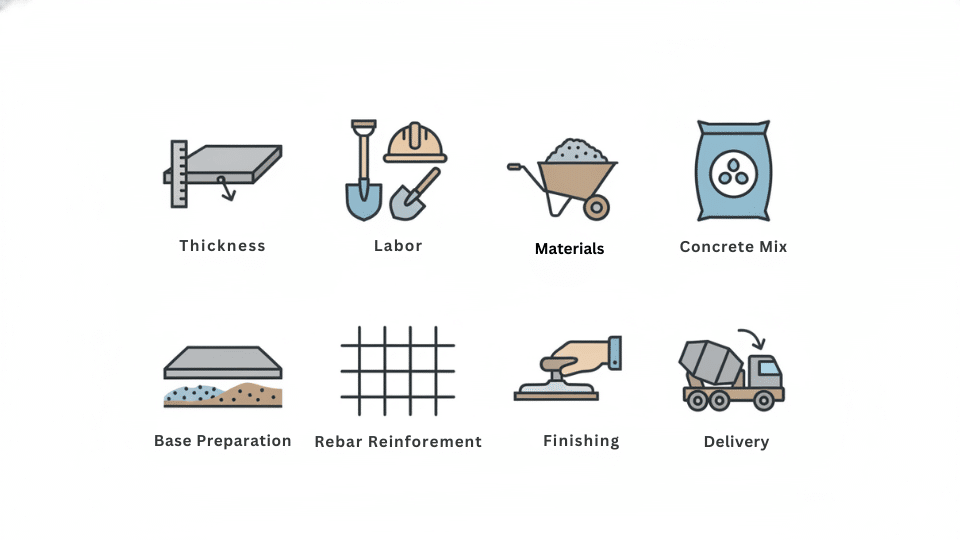
Multiple factors impact your final price. Understanding these helps you make smart choices and control your budget.
1. Slab Thickness
Thickness is one of the biggest cost drivers. Thicker slabs need more concrete and stronger support.
4-inch slabs cost around $5.35 per square foot. They work well for patios, walkways, and light-duty areas. This is the standard thickness for most residential projects.
5-inch slabs cost around $5.78 per square foot. They offer extra strength for areas with moderate traffic. Many homeowners choose this for garage floors.
6-inch slabs cost around $6.19 per square foot. They support heavy loads, such as vehicles and equipment. Driveways and commercial spaces often use this thickness.
8-inch slabs cost $10 to $15 per square foot. They handle heavy loads, such as heavy machinery or commercial trucks. Most residential projects do not need this thickness.
2. Labor Costs
Labor typically costs $2 to $3 per square foot. This covers site prep, framing, pouring, and finishing. Labor makes up 40% to 50% of your total project cost.
Regional rates vary widely. Urban areas like New York or California charge $3 to $5 per square foot. Rural areas often charge $2 to $3 per square foot. Your local cost of living affects these rates.
Labor includes excavation, leveling, building forms, mixing concrete, pouring, smoothing, and cleanup. Skilled workers prevent cracks and ensure proper drainage. Good labor saves you money on future repairs.
3. Materials and Concrete Mix
Concrete costs $110 to $180 per cubic yard. The national average is around $125 to $140 per cubic yard. One cubic yard covers 81 square feet at 4 inches thick.
Standard 3000 PSI concrete costs $130 to $150 per cubic yard. This mix works for most residential projects. Higher-strength 4000 PSI concrete costs $150 to $170 per cubic yard. It handles heavier loads and lasts longer.
Specialty mixes add to the cost. Fiber-reinforced concrete costs an extra $0.25 to $0.75 per square foot. Fast-setting concrete costs about $125 per cubic yard. High-strength commercial concrete can reach $170 to $210 per cubic yard.
4. Site Preparation
Proper site prep prevents future problems. This work costs an additional $1 to $3 per square foot. Grading and leveling ensure water drains away from the slab.
Excavation removes soil to reach the proper depth. Poor soil may need to be removed and replaced. This adds $500 to $2,000 to your project.
Subbase preparation includes adding gravel or crushed stone. A 4-inch gravel base costs $0.50 to $1 per square foot. This layer prevents cracking and settling. Compacting the subbase takes time but prevents costly repairs later.
5. Reinforcement Options
Reinforcement strengthens concrete and prevents cracks. Most slabs over 4 inches thick need some type of reinforcement.
Wire mesh costs $0.20 to $0.35 per square foot. It works well for driveways and patios. The mesh holds concrete together if cracks form.
Rebar costs $1.40 to $3 per square foot installed. It provides maximum strength for heavy loads. Foundations and commercial projects typically use rebar.
Fiber reinforcement costs $0.25 to $0.75 per square foot. Synthetic fibers are mixed into the concrete. They prevent small cracks and reduce shrinkage. Some contractors use fiber along with wire mesh or rebar.
6. Finishing Options
The finish choice affects both cost and the final look. Broom finish runs $2 to $4 per sq ft and is often included in the base price. Smooth finish costs $3 to $5 per sq ft.
Decorative options cost more: stamped concrete is $10 to $20 per sq ft, stained concrete is $3.50 to $7.50 per sq ft, and polished concrete ranges from $3 to $15 per sq ft, depending on the level of shine.
7. Location and Accessibility
Where you live significantly affects your costs. Coastal states like California charge $8 to $10 per square foot. Central states average $5 to $6 per square foot.
Urban areas have higher labor rates but more competition. Rural areas may have lower rates but limited contractor options. Delivery fees increase with distance from the concrete plant.
Hard-to-reach sites cost more. Steep slopes, narrow access, or obstacles increase labor time. Some sites need a concrete pump truck. Pump trucks cost $300 to $800 per day. Easy access sites with level ground keep costs down.
Concrete Slab Cost by Project Type
Different projects need different specifications. This affects your total cost for pouring a concrete slab.
- Shed Foundation: A shed foundation costs $600 to $4,800 in total, typically 4 inches thick, with a basic finish and minimal reinforcement.
- Patio Slab: A patio slab costs $1,000 to $6,000 total, typically 4 inches thick, with decorative finish options available.
- Garage Floor: A garage floor costs $2,400 to $6,900 total, generally 4 to 6 inches thick with wire mesh reinforcement.
- Driveway: A driveway costs $2,400 to $8,600 in total and requires a 4- to 6-inch thickness with reinforcement to support vehicle weight.
- Home Foundation: A foundation costs $12,000 to $28,000 in total and requires 6 to 8 inches of thickness, with rebar and vapor barriers.
- RV Pad: An RV pad costs $3,000 to $10,000 total, and must be 6 to 8 inches thick to support heavy recreational vehicles.
- Parking Pad: A parking pad costs $1,200 to $6,000 total, typically 4 to 6 inches thick, depending on vehicle type.
How to Calculate Concrete Needs?
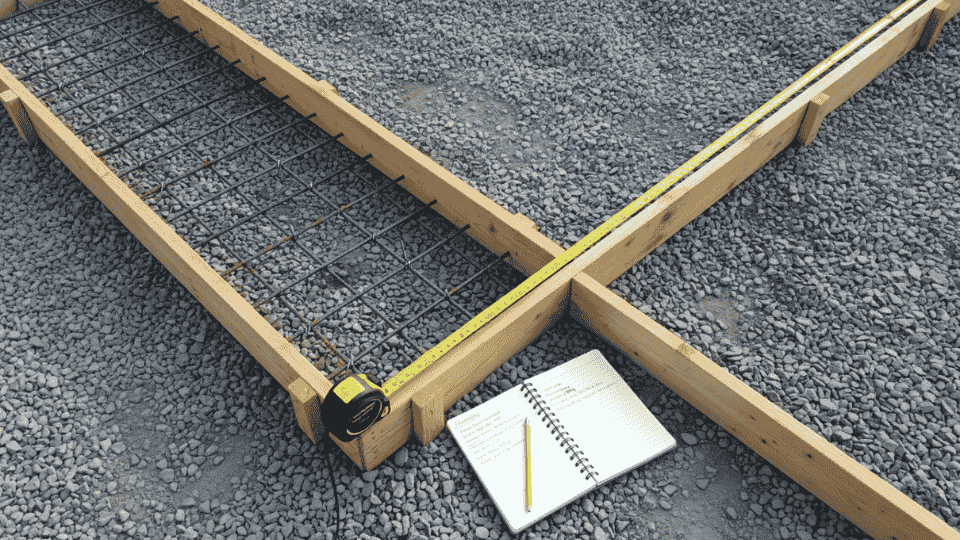
Accurate calculations prevent shortages and reduce waste. Follow these steps to determine how much concrete to pour for your project.
Step 1: Measuring Your Space
Start by measuring the length and width of your project area in feet. Use a quality tape measure for accuracy. Write down each measurement to avoid confusion later.
For rectangular or square areas, simply measure from one end to the other. Irregular shapes need a different approach.
Divide the total area into smaller rectangles or squares. Measure each section separately, then add all the square footage together to get your total area.
Step 2: Volume Calculation Formula
The basic formula is length × width × height, in feet. This gives you the total cubic feet of concrete needed. For example, a 20×20 slab at 4 inches thick requires conversion first. Four inches equals 0.33 feet (4 divided by 12). Multiply 20 x 20 x 0.33 to get 132 cubic feet.
Now divide the cubic feet by 27 to convert to cubic yards. Concrete suppliers sell by the cubic yard, not cubic feet. So 132 divided by 27 equals 4.9 cubic yards for this project.
Step 3: Cubic Yards Needed
Always round up to the nearest half yard when ordering. Most concrete plants deliver only in half-yard increments. For the 4.9-cubic-yard example above, order 5 cubic yards total. The extra 0.1 yards covers minor waste and uneven surfaces.
Full truckloads typically contain 10 to 12 cubic yards. Orders under 10 yards often include a short load fee. This fee adds $40 to $50 per cubic yard to your cost.
Step 4: Number of Bags Needed
Bagged concrete is suitable only for very small projects. One 80-pound bag covers approximately 0.6 square feet at 4 inches thick. An 80-square-foot slab requires about 133 80-pound bags of concrete. Each bag costs $4 to $6 at home improvement stores.
Bagged concrete makes sense for projects under 50 to 100 square feet. Anything larger should use ready-mix concrete instead. Ready mix saves time and often costs less for bigger jobs.
Step 5: Ordering Extra Material
Always order 5% to 10% more concrete than your calculation shows. This extra material accounts for spillage and waste during pouring. Uneven ground absorbs more concrete than flat surfaces do. Low spots need extra material to reach the proper thickness.
Running short during the pour creates weak joints and potential failure points. Most contractors recommend ordering 10% extra for first-time projects. The small additional cost prevents expensive problems and delays later.
DIY vs Professional Concrete Slab Installation
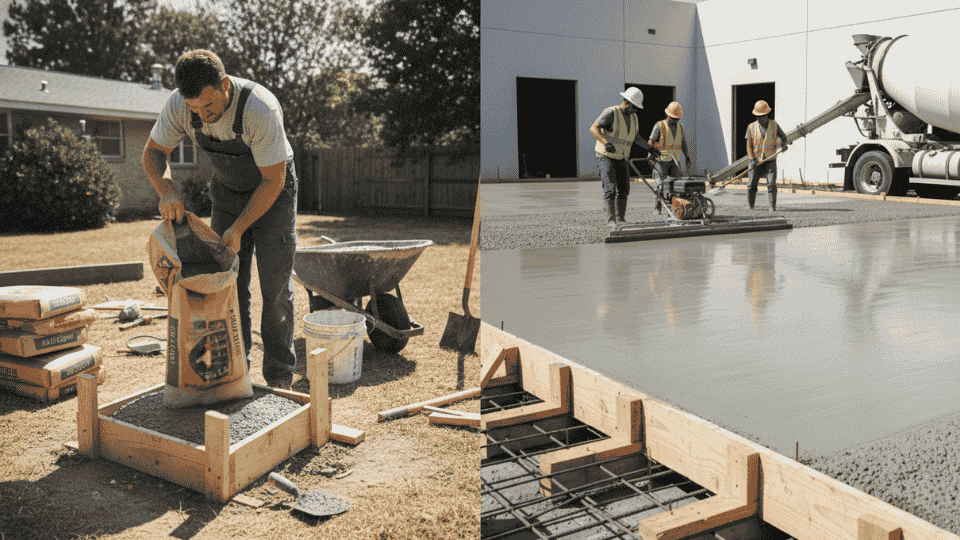
Deciding between DIY and professional installation affects your budget and results. Each option has clear advantages.
| Factor | DIY | Professional |
|---|---|---|
| Cost | $3 – $6 per sq ft (materials only) | $6 – $12 per sq ft (full service) |
| Tool rental | $500 – $1,000 extra | Included in price |
| Time required | 2 – 3 days minimum | 1 day typical |
| Skill level needed | High | Not required |
| Warranty | None | 1 – 5 years typical |
| Insurance coverage | Your risk | Contractor covered |
| Result quality | Varies | Professional grade |
| Best for | Projects under 100 sq ft | Projects over 100 sq ft |
|
Additional Costs to Consider: Extra costs can quickly add up. Permits run $25 to $300; removal costs $2 to $6 per square foot; and drainage may add $1,000 to $3,000. Vapor barriers, insulation, sealing, delivery, and pump trucks can also increase your total. Always confirm these extras in your quote. |
Ways to Save Money on Your Concrete Slab
Smart planning can reduce costs without sacrificing quality. These strategies help you save money on your project.
- Do Your Own Site Prep: Clear debris, remove vegetation, and rough-grade the area yourself to save $500 to $2,000 in labor costs.
- Choose Simple Designs: Stick to basic shapes and standard finishes to avoid paying an extra $5 to $15 per square foot for decorative work.
- Time Your Project Right: Schedule work during the off-season, such as fall or winter, when contractors offer lower rates and better availability.
- Get Multiple Quotes: Contact at least three contractors to compare prices and services, potentially saving 15% to 25% on your total cost.
- Buy Materials in Bulk: Order concrete in full truckloads of 10 cubic yards or more to avoid short-load fees of $40 to $50 per yard.
- Skip Decorative Finishes: Use a basic broom finish or a smooth finish instead of stamped or stained concrete to save $8 to $20 per square foot.
- Use Standard Thickness: Choose a 4-inch thickness for low-traffic areas instead of 6 inches to reduce material costs by up to 30%.
Avoid These Mistakes That Inflate Concrete Slab Cost
Avoiding these mistakes saves you money and prevents future repairs. Know what can go wrong before you start.
| Mistake | Cost Impact | How to Avoid |
|---|---|---|
| Poor site preparation | Adds $1,000 – $5,000 in repairs | Hire experienced contractors for grading |
| Wrong thickness choice | Wastes $500 – $2,000 or causes failure | Match thickness to project load requirements |
| Skipping reinforcement | Creates $1,500 – $5,000 in crack repairs | Use wire mesh or rebar for durability |
| Improper mixing | Reduces strength by 30% | Order from reputable ready mix suppliers |
| Weather issues | Delays cost $500 – $1,500 extra | Check the forecast and plan accordingly |
| Rushing the project | Causes weak spots and cracks | Allow proper curing time of 28 days |
How Long Does a Concrete Slab Last?
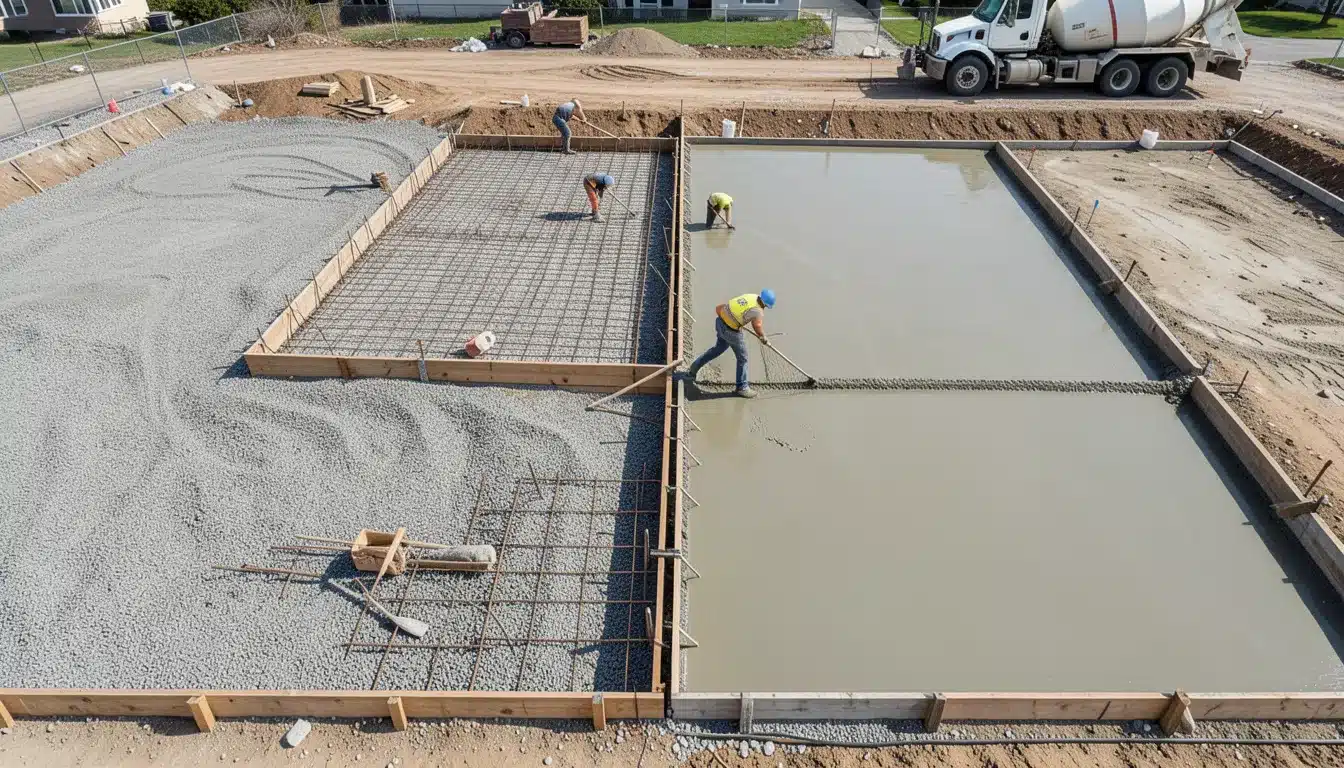
Properly installed concrete slabs last 30 to 50 years with basic maintenance. Some slabs can last over 100 years with proper sealing and care. Lifespan depends on climate, soil conditions, and traffic loads.
Cold climates with freeze-thaw cycles shorten lifespan to 30 years. Warm, stable climates extend lifespan beyond 50 years.
Regular maintenance includes cleaning, sealing every 2 to 3 years, and fixing small cracks immediately. Annual sealing costs $1 to $3 per square foot but prevents $3,000 to $10,000 in replacement costs.
Repair costs range from $500 for minor cracks to $5,000 for major damage. Replacement costs match original installation prices.
Investing in quality installation and regular maintenance maximizes your concrete slab’s lifespan.
The Bottom Line
Understanding how much to pour into a concrete slab makes budgeting easier and helps prevent last-minute surprises.
Costs usually range from $4 to $12 per square foot, depending on slab size, thickness, site conditions, and location. Small projects like shed foundations may start around $600, while larger jobs like driveways or foundations can reach $10,000 or more.
Labor, concrete mix quality, site prep, reinforcement, and finishing choices are the biggest cost drivers. Comparing multiple quotes and confirming what’s included helps you avoid hidden charges.
If you’re planning a project, start by measuring your space and calculating your concrete needs. Then request detailed quotes from trusted local contractors.
Taking these steps now can save you time, money, and costly mistakes later.