Pet Friendly Grasses: What “Non-Toxic” Won’t Tell You (aka: the label is not the boss of me)
If you’ve ever stood in the nursery aisle holding a plant tag that proudly says NON-TOXIC, and thought, “Cool, my dog can face-plant into this at full speed,” I need you to scoot over and make room for me on the bench.
Because here’s the annoying truth: “Non-toxic” doesn’t mean “can’t hurt your pet.” It just means the plant isn’t chemically poisonous. Your vet is still out there treating scratched corneas, pokey seed awns in ears, and mouth cuts from plants that technically passed the “won’t poison you” test.
So let’s talk about grasses the way your pets experience them: with their face, their paws, and their extremely questionable life choices.
The 60 second nursery test (before you bring home chaos)
Before you buy anything grassy and pretty, do these quick checks:
- Get the botanical name. Common names are a mess. “Foxtail” alone can mean multiple things, and none of them are the fun kind of tail.
- Check the ASPCA Toxic/Non-Toxic Plant database. It’s not perfect, but it’s the best starting point.
- Touch the plant. Yes, pet it like a weirdo.
- Soft + bendy = usually safer
- Stiff + wiry + sharp edges = future regret
- Look at the shape. In general, mounding grasses (little tidy clumps) behave better in pet yards than grasses that fling poky parts everywhere.
- Snap a photo of the label (and maybe note where you planted it). When your dog does something ridiculous later, you’ll be glad you did.
I know, it’s not as exciting as buying the plant and sprinting to the checkout. But it’s cheaper than an emergency vet visit, so.
Why “safe” grasses can still mess up your day
A grass can be non-toxic and still be a menace. The big issues aren’t poison they’re physics.
1) Seed awns (the tiny evil darts)
Some grasses make barbed seed heads (often called awns) that break off and act like little one way splinters. They can lodge in ears, nostrils, paws, and then work deeper. This is how you end up saying sentences like, “Yes, the vet removed a plant from my dog’s ear.”
2) Sharp blades (paper cuts, but make it veterinary)
Stiff grasses can slice gums, scratch eyes, and poke paws especially if your dog does the classic full speed yard launch after a ball. (I’ve seen dogs treat landscaping like an obstacle course. Landscaping does not consent.)
3) The “I ate half the yard” problem
Even safe grass can cause vomiting/diarrhea if your pet goes full salad bar. Often it passes within 6-12 hours, but it’s still… not a vibe.
The grasses I’d actually plant with pets in mind
I’m going to give you my short list stuff like coastal muhly grass that’s generally soft, flexible, and less likely to turn into a pokey nightmare. (Still: nothing is indestructible if you have a determined chewer. Ask me how I know.)
My softest picks (best for chewers, puppies, and the “why is this in your mouth?” crowd)
- Japanese Forest Grass (Hakonechloa macra ‘Aureola’)
This one is genuinely soft. Like, “I would let a toddler hug it” soft. It stays around 1-2 feet, loves shade, and brightens dark corners with that golden color. - Everillo Sedge (Carex oshimensis ‘Everillo’)
Another shade friendly option with a softer texture and without the scary seed head drama you get from awn-y grasses. - Blue Fescue (Festuca glauca)
Cute little blue tufts, usually 8-12 inches, great for edging. It’s not the plushest thing on earth, but it’s generally a lower risk texture if you’re not dealing with an obsessive plant chomper.
Taller “busy yard” grasses (fine, but placement matters)
These are commonly considered pet safe from a toxicity standpoint, but if you are wondering invasive or well behaved I still wouldn’t plant them right where your dog faceplants daily.
- Fountain Grass (Pennisetum cultivars) ASPCA lists as non-toxic.
‘Karley Rose’ is a popular one. Pretty, handles some traffic, not usually the stabby kind of seed head. - Maiden Grass (Miscanthus sinensis) and Switchgrass (Panicum virgatum)
Great for height/privacy (4-6 feet), and bonus: seed heads are often higher than your average pet’s eyeballs. - Pink Muhly (Muhlenbergia capillaris)
The cotton candy fall color is ridiculous in the best way, and it’s generally considered pet safe.
Pampas grass: toxic? no. pokey? sometimes.
Pampas Grass (Cortaderia selloana) is ASPCA listed as non-toxic, which surprises people because it looks like it belongs in a dramatic music video. Outdoors, its height can keep the plumes out of reach.
Indoors, though if you’re decorating with dried pampas treat it like you would a bowl of potpourri: put it up high and anchor it in a heavy vase. Dried bits eaten can cause GI blockage risk, and I don’t want that for you.
One that’s “fine” but not near the zoomies
- ‘Karl Foerster’ Feather Reed Grass (Calamagrostis × acutiflora)
Non-toxic, very popular, very pretty… and those tips can be pointy. I’d keep it away from tight play zones and anywhere your pet rubs their face.
Grasses I wouldn’t plant anywhere near pets (hard no)
These are the ones that tend to make those barbed seed awns that lodge and migrate (horrifying!):
- Foxtail Barley (Hordeum jubatum)
- Cheatgrass (Bromus tectorum)
- Mexican Needle Grass (Nassella tenuissima)
- Honestly: anything with “foxtail” or “needle” in the name deserves your suspicion
Quick visual test: if the seed head looks thin, bristly, barbed, or needle like instead of fluffy/soft… treat it like it’s plotting against you.
If you’re truly unsure, you can call ASPCA Animal Poison Control: (888) 426-4435. (They may charge a fee, but so does surgery, so.)
Design your yard around your dog (not your Pinterest board)
Your dog already has a preferred yard layout. You just haven’t admitted it yet.
Watch the “patrol route”
Most dogs do laps along fences and boundaries like tiny, furry security guards. Instead of fighting it, work with it:
- Observe for a week or two
- Leave a clear path about 36 inches wide
- Plant your grasses beside the route, not across it
Raised beds = instant plant protection
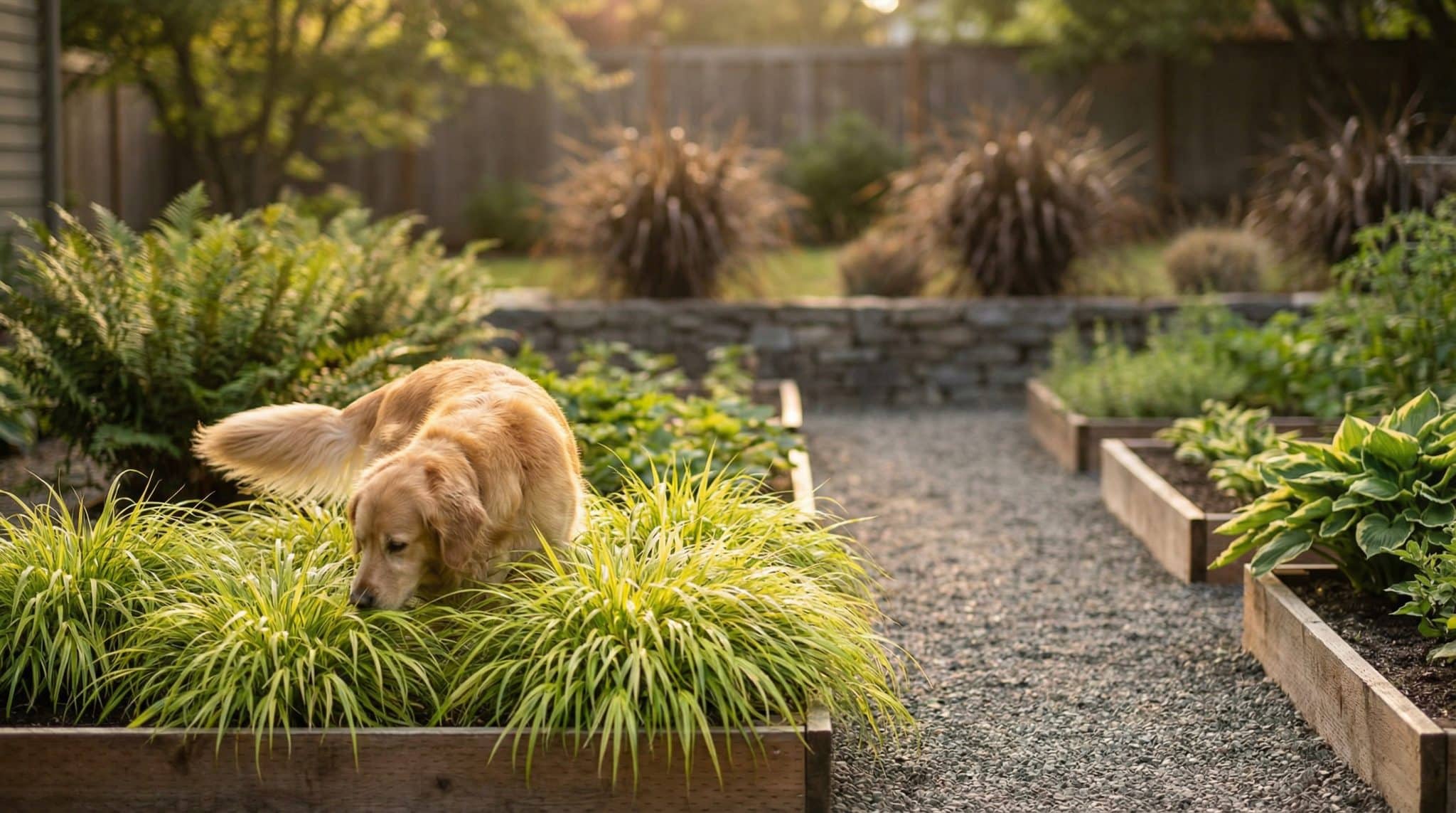
If you can swing it, 18-24 inch raised beds help keep plants above nose level and reduce trampling. Most dogs won’t hop up into them unless they’ve decided gardening is their new personality.
If you have a digger, give them a “yes zone”
Some dogs dig to cool off. A little sand pit with damp sand can save your beds (and your blood pressure). Wet it on hot days so it’s the VIP lounge compared to your flower border.
Mulch and groundcover: the part people accidentally mess up
First, the big one:
Do not use cocoa bean hull mulch.
It contains theobromine (same problem as chocolate) and can seriously poison dogs.
Safer options tend to be:
- Pea gravel
- Smooth river stone
- Splinter free bark mulch (pine, fir, cedar)
- Coconut based mulch
And here’s my favorite “mom” rule: put your hand on it in direct sun. If it’s too hot for your palm, it’s too hot for paws.
Quick note on clover lawns
I love clover for pet yards. It’s soft, holds up to play, and it doesn’t do that dramatic “dog pee = dead patch” thing as much as traditional grass. Microclover from seed is usually the most budget friendly route.
For pets who snack on greenery: give them their own salad bar
If your pet is determined to chew grass, I’d rather you give them a safe option than have them stress test your landscaping.
Grow wheat grass or oat grass in a container and rotate two pots:
- one available for grazing
- one recovering outside
It’s simple, and it keeps them away from whatever you fertilized last weekend.
The other danger: “companion plants” that are actually toxic
Ornamental grasses are often fine. The stuff planted next to them? That’s where people get blindsided.
Remove these ASAP (especially if you have cats)
- All lilies (even pollen or drinking vase water can cause kidney failure in cats within 12-36 hours)
- Sago palm (incredibly toxic one seed can cause severe illness)
Also common troublemakers:
- Azaleas
- Oleander
- Hydrangeas
- Morning glory
- Daffodils / hyacinth
- Hosta
- Begonias
- Iris
- Lily of the valley
- Holly
Generally safer companions include:
- Roses
- Petunias
- Snapdragons
- Marigolds
- Herbs like mint, rosemary, lavender, basil
(Still: check anything you plant if you’ve got a committed nibbler.)
When to watch at home vs. when to call the vet (not medical advice, just practical)
I’m not your vet. I’m just the person who wants you to avoid a midnight panic spiral.
Watch at home (and keep an eye on things)
- One episode of vomiting/diarrhea that resolves within 12 hours
- Pet is alert, drinking water, and can rest comfortably
Call your vet today
- Vomiting/diarrhea lasting more than 12 hours
- Limping more than 2 hours
- Lethargy more than 4 hours
- Repeated gagging, pawing at mouth, or constant head shaking
Go to the vet now
- You can see an awn in the ear canal (don’t pull it yourself)
- Trouble breathing / possible airway obstruction
- Blood in vomit or stool, swollen belly, or severe weakness
The 2 minute habit that saves you drama: the post walk check
Within about 30 minutes of outdoor time, do a quick scan:
- Run your fingers through the coat against the grain
- Check between paw pads (a fine tooth comb helps)
- Peek in the ear flaps
- Check the base of the tail (stuff loves to hitchhike there)
It’s boring. It’s also wildly effective.
If you do one thing this week…
Walk your yard like your dog does. Notice the routes, the nap spots, and the “I sprint here like I’m training for the Olympics” zones. Then plant the softer, safer grasses where they’ll actually survive and keep the pokier stuff (or the truly risky awn makers) out of your life entirely.
You can have a beautiful yard and pets that aren’t constantly trying to injure themselves on landscaping. It’s a balancing act… but honestly, so is owning pets in the first place.